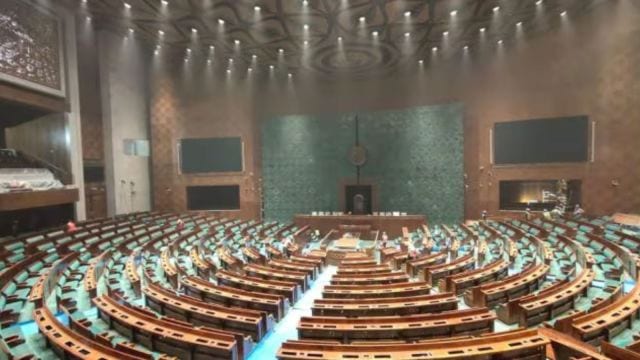

The very foundation of parliamentary democracy rests upon a delicate but dynamic balance of power between the legislature and the executive. The principle is simple: The executive, drawn from the legislature, must command its confidence to govern, but the legislature must hold the reins of oversight, scrutiny and accountability. This Westminster model, envisioned as a dance of democratic accountability, has in our contemporary Indian context been twisted into a monologue of executive dominance, a regression that bodes ill for the long-term health of our republic.
Evidence of this decline is not merely anecdotal; it is etched in the very calendar of our national discourse. Consider the profound symbolism in the number of sitting days: The first Lok Sabha, the House of a nascent republic, met for an average of 135 days annually between 1952 and 1957. In stark contrast, the 17th Lok Sabha, serving a vastly more complex and populous nation, sat for a mere 55 days on average. This precipitous drop is not a mere statistic of administrative efficiency; it is a chilling metric of a legislature in retreat, its chamber growing silent, its role as the grand inquest of the nation being systematically hollowed out.

This hollowing out has been facilitated by a legal instrument that has fundamentally altered the character of our legislatures, namely the anti-defection law. Conceived with the noble intention of curbing unprincipled floor-crossing, this law has morphed into a travesty that has effectively exorcised conscience, constituency, and common sense from parliamentary proceedings.
Members of Parliament today are less representatives of the people who elect them and more subjects of their party’s ubiquitous whip, their vote pre-ordained by a binding diktat with disobedience carrying the penalty of political annihilation.
This inversion strikes at the heart of Parliament’s most sacred functions. For instance, the power of the purse, the foundational principle that no tax can be levied, no expenditure incurred, without the grant of the House. Can this grant be truly considered a free and deliberative act when members are compelled by the threat of disqualification to approve financial demands? Similarly, when the House takes up the impeachment of a president or a judge, its members are expected to act as jurors, weighing evidence with impartiality. The very notion of a juror bound by a whip is a grotesque contradiction of justice.
A dismal phenomenon was on display when an honourable member was ignominiously expelled from the 17th Lok Sabha in its twilight hours. The law has created a paradox: It has ensured stability of governments at the cost of paralysing Parliament’s soul, transforming lawmakers into mere lobotomised numbers responding to a division bell. This legislative ennui is compounded by an executive that has shown a profound insensitivity to the concerns of the Opposition, thereby creating a vicious cycle of disruption and disengagement.
The fundamental tenet of a healthy democracy — that the government may have its way, but the Opposition must have its say — has been stood on its head. The treasury benches propagate a twisted narrative that the responsibility for the smooth functioning of the House lies equally with the government and the Opposition. This is an insidious assertion.
The government commands the legislative agenda. It is the principal actor. The Opposition’s role is to scrutinise, critique and offer alternatives. When almost every notice for discussion, every adjournment motion on matters of public urgency, is summarily dismissed, the only tool left in the Opposition’s arsenal is disruption.
Question Hour and Zero Hour, the vital instruments of daily accountability, are often the first casualties of the ensuing chaos.
The government, rather than engaging in debate, often chooses to pass monumental legislation in a matter of minutes, with minimal discussion and scant regard for legislative scrutiny. The institution of parliamentary committees, meant to be the workshops of democracy where legislation is refined through cross-party deliberation and expert testimony, also find themselves diluted and struggling.
Constitutional eminences are meant to be neutral arbiters and guardians of parliamentary privilege — a function discharged more in the breach. Prerogative and plenipotentiary power is more often than not used to discipline Opposition members.
The constitutional status of an office does not render it immune from public scrutiny and criticism. There cannot be and should not be holy cows in a democracy. A convention, once broken, ceases to be a convention at all.
To understand how far we have strayed, one must look to the origins of the Westminster model itself, to the Oxford Parliament of 1258, where the foundational principles were laid down. It was established then that the king must govern with the advice of an elected council, that his ministers would serve fixed terms, and that Parliament would meet at regular, stipulated intervals, liberating it from the whims of the monarch. This was a system designed to subordinate the executive to the legislature.
Over the centuries, in Britain and in other Commonwealth realms like Canada and Australia, this system has evolved to strengthen legislative oversight. The practice of Prime Minister’s Questions in the UK ensures that the head of government is held to account on a direct, weekly and public basis. The committee systems in the US Congress and the UK Parliament are robust where executive officials, up to the highest levels, are compelled to testify and their evidence shapes law and policy.
In India, we witness the very opposite. Parliament has regressed from a robust legislature possessing unfettered powers of oversight into a mere approval body. The fascination of our founding fathers with the Westminster model would cease today, could they see what it has been turned into. The decline is not irreversible, but its reversal requires a collective political will to reclaim the very spirit of the Constitution.
It demands a radical reconsideration of the anti-defection law to restore the independence of the legislator, a reaffirmation of the government’s primary responsibility in ensuring that the House functions, and a refurbishment of the neutrality of constitutional offices.
Without these corrective measures, the edifice of our parliamentary democracy, though it may stand, will continue to echo with a silence that speaks volumes about the diminishing accountability of the powerful to the people they serve.
The writer is a lawyer, third term MP, and a former Information & Broadcasting Minister


