

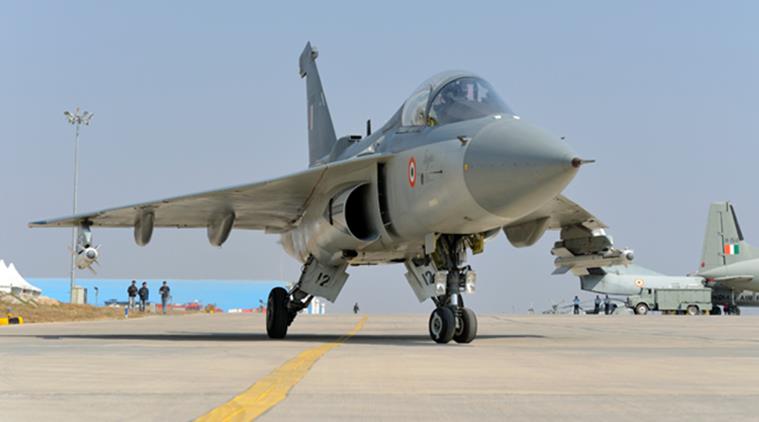
For an indigenous light combat aircraft (LCA) disparaged by the Indian Air Force brass as “overweight”, “underpowered”, “obsolete”, “a three-legged cheetah” and, in technical terms, as a plane that “cannot fly without telemetry, pull more than 6G or an angle-of-attack (AoA) greater than 20 degrees” and “with an air intake that starves the engine”, is supposedly afflicted with “53 identified shortfalls”, and fails to meet the “minimum air staff requirements (ASRs)”, the Tejas, entirely unreported by the Indian media, performed phenomenally well at the recent Bahrain International Air Show. It has silenced the naysayers. The minimum that this success ought to do is get the government to reconsider the deal with France, because the fact is Tejas’ future will be inversely affected by the Rafale deal. If one is up, the other is out.
The LCA’s composites-built airframe and small size enhance its stealth features, translating into a small radar signature and the greatest difficulty for enemy aircraft to detect it. Bahrain proved that fighting quality. There can be no complaints.


Tejas, a 4.5 generation aircraft like Rafale, has always been underfunded by government and undermined by the IAF with periodic rewriting of ASRs. Three years ago, for instance, a mid-air refuelling probe was included, necessitating aircraft redesign that cost time, money and delays in the certification and induction cycles.
Scarcity of money is the real problem and requires making hard choices. Should the Indian government commit Rs. 63,000 crore to the Tejas and Advanced Medium Combat Aircraft (AMCA) programmes rather than sustaining the French aviation industry, it will signal serious intent, bring the streamlined Defence Production Policy-2016 guidelines into play, permitting the DRDO to transfer source codes and flight control laws to Indian private-sector companies, incentivise small- and medium-scale technology innovation companies comprising an Indian mittelstand to take root, motivate foreign suppliers of components and assemblies that currently comprise 70 per cent of Tejas to manufacture these in India and, conjoined to a policy pushing its export, germinate a viable, comprehensively capable, aerospace sector-led Indian defence industrial growth. This infusion of funds will fast-track the synergistic development of follow-on versions of Tejas, its navalised variant, along with the AMCA, and the fifth generation fighter project in partnership with Russia. It will be the cutting-edge of a “Made in India” policy showcasing indigenous capability.
With Rafale facing production problems — only eight aircraft were outputted in 2014 — all the contracted Rafales won’t be in IAF service before 2030. It is not the answer to India’s immediate need. A more economical solution that will also satisfy the IAF’s apparent craving for French aircraft is to procure the 30-plus upgraded Mirage 2000-9s the United Arab Emirates want to be rid of, and a third Mirage squadron (with 80 per cent of its life intact) available from Qatar. Infrastructure already exists to service and operate the Mirages. It will not complicate the logistics nightmare created by the diversity of combat aircraft in the IAF’s inventory, which Rafale’s entry will do.


