

Journalism of Courage
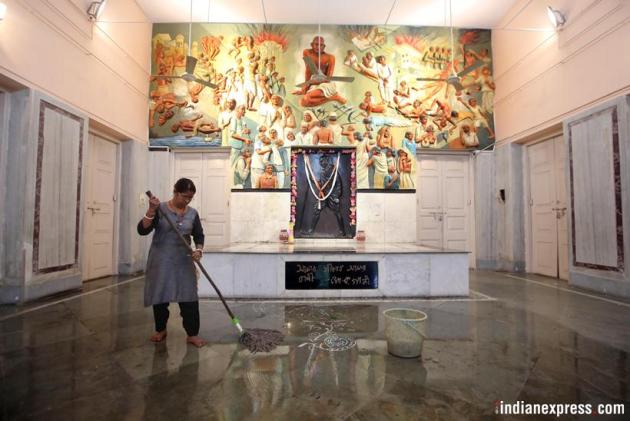
Rinku Das, 42, has been working as a cleaner for the past ten years at Hyderi Manzil in Kolkata’s Beliaghata, the place where Mahatma Gandhi stayed in the countdown to Independence. Rinku’s eight-hour work, which starts at 10 am, includes dusting the exhibit cases, sweeping and mopping the eight rooms and tending to the garden once a week. For this, she earns Rs 3,000 every month. (Express photo by Partha Paul)
READ | ‘I have been called a sweeper, it hurts… this is a temple, I am doing God’s work’


As the nation marks the Mahatma’s 150th birth anniversary on October 2, Rinku remains one of the countless footsoldiers on the ground of Swachh Bharat, the flagship initiative launched on Gandhi Jayanti four years ago. The initiative aims at turning Gandhi’s vision of cleanliness into reality.
(Express photo by Partha Paul)
READ | ‘I have been called a sweeper, it hurts… this is a temple, I am doing God’s work’

A mother of three — Sejal (11), Navya (3) and Maanvi (1) — Urmila, started working eight years ago at ‘Gandhi Smriti' in Delhi. She earns Rs 534 per day for 26 days of work, four weekly offs a month, and Rs 250 for overtime. (Express photo by Abhinav Saha)
READ | Mahatma Swachh Bharat: Where his journey ended, a new beginning for her — every day

Urmila was hired as a contract worker in 2010, three months after her husband, Surender Kumar, found work at Gandhi Smriti. Surender is from the Lohar community, and has never worked as a cleaner. Now, he cleans the neighbourhood he lives in, even trying to maintain a plot of government land that has turned into a garbage dump. (Express photo by Abhinav Saha)
READ | Mahatma Swachh Bharat: Where his journey ended, a new beginning for her — every day

Khilafat House is closed for Gandhi Jayanti but Vithoba Mahadeo Teli, 48, has to clean the 94-year-old ‘Ladies’ Mosque’, a prayer hall in the complex — unfailingly, the way he has for the last 14 years.(Express photo by Amit Chakravarty)
READ | Mahatma Swachh Bharat: ‘If surroundings are not clean, we can’t be at ease… Gandhiji taught us this’

Location : Mosque inside the premises of Khilafat House
Name : Vithoba Teli
Job : House Keeping at Khilafat House
Salary : Rs 11,000
Employeer : All India Khilafat Committee
(Express photo by Amit Chakravarty)
READ | Mahatma Swachh Bharat: ‘If surroundings are not clean, we can’t be at ease… Gandhiji taught us this’

Malti Devi, 65, is the only one responsible for cleaning the Chauri Chaura police station in eastern Uttar Pradesh’s Gorakhpur district with a monthly wage of Rs 600. (Express photo by Tashi Tobgyal)
READ | ‘I am just a safai karamchari here but this police station depends on me’
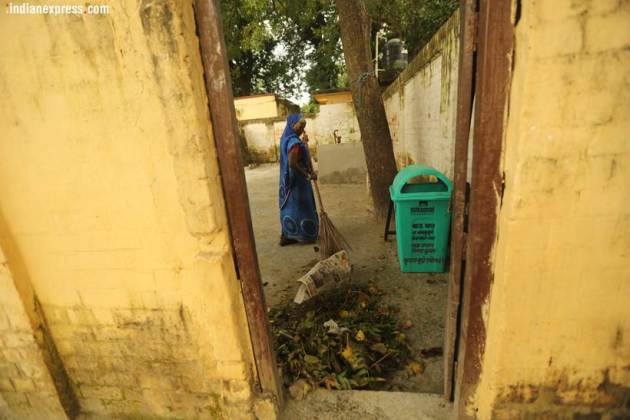
As of now, Malti's response to the meagre pay is simple — work harder. Chauri and Chaura are the names of two villages, but they are also two words that scarred a nationwide movement launched by the Mahatma 98 years ago. (Express photo by Tashi Tobgyal)
READ | ‘I am just a safai karamchari here but this police station depends on me’

Pushpamma Dasan, 52, temporary cleaner at the Vaikom Mahadeva temple in Kerala, joined the thin staff of cleaners, five years ago. Dasan works in two shifts every day which is 3.45-4.30 am and 7.30 am-4 pm with no off. Her monthly wage is Rs 9,000. (Express photo by Vignesh Krishnamoorthy)
READ | ‘I have work to do… I keep the temple clean, I keep my house clean’

Of Gandhi, she knows only that he was here and that he fought for freedom. But cleanliness remains a personal creed. (Express photo by Vignesh Krishnamoorthy)
READ | ‘I have work to do… I keep the temple clean, I keep my house clean’

Sandhya Nikhare, 42, works as as a chowkidar-cum-sweeper at the Jawahar Navodaya Vidyalaya in Maharashtra's Wardha. She earns Rs 25,000 per month and works 11 hours from Monday to Friday. Saturday is a half day while Sunday is a rest day for Sandhya. (Express photo by Nirmal Harindran)
READ | ‘What makes me happy is the fact that my struggles were not meaningless’

Sandhya starts her work by tidying the offices, gathering trash from bins, making sure the entrance and concourse are spotless. She then rings the 7 am prayer bell by striking a little hammer against a metal sheet hanging by the stairway. (Express photo by Nirmal Harindran)
READ | ‘What makes me happy is the fact that my struggles were not meaningless’

Budh Nath, a contractual worker with the local Municipal Council, has been cleaning Gandhi Dham, Jalandhar, since the past three years. He is paid Rs 7,600 a month and usually works eight hours a day. (Express photo by Gurmeet Singh)
READ | ‘Cleaning Gandhi Dham not just a job…. it’s like doing sewa’

Picking a heap of disposable plates, Ram wonders if ‘educated’ persons are really respecting Gandhi when they ignore a dustbin even if it is placed a few steps away. (Express photo by Gurmeet Singh)
READ | ‘Cleaning Gandhi Dham not just a job…. it’s like doing sewa’

Parashuram Gangaram Sungar, 70, has been cleaning the “Congress Well Park” in Karnataka's Belagavi since 2002, earlier known as Belgaum, which now includes a small, a museum centre showcasing photographs from the life of Gandhi and the event. His work which starts at 9:30 am and finishes by 6 in the evening earns him a monthly salary of Rs 10,000. (Express photo)
READ | ‘Born in year Gandhi died… cleaning all my life’
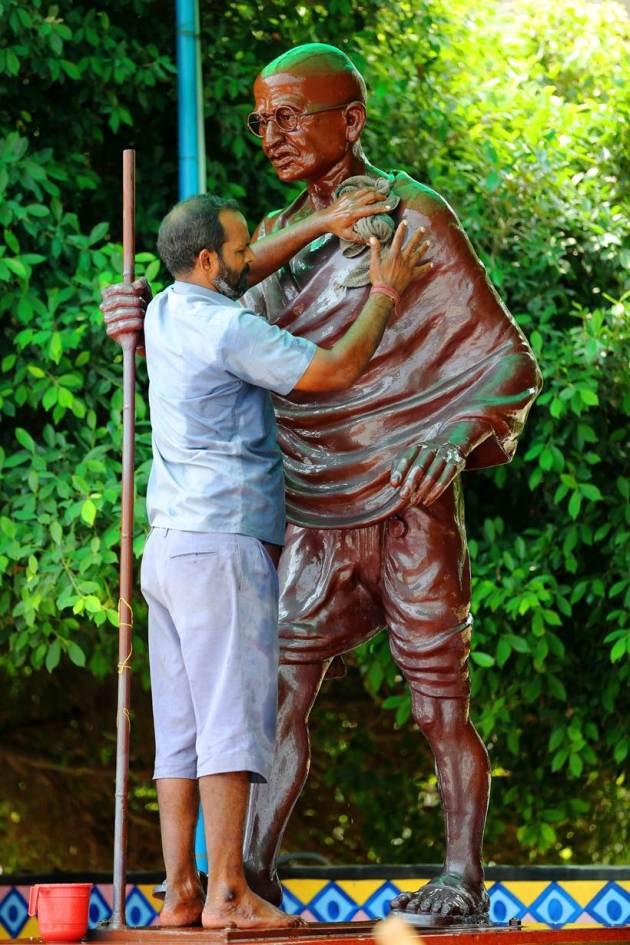
Forty-six-year-old Ram Nath Ram's day starts at 6 am every day and ends 12 hours later with an hour’s break around noon. He started out with a monthly salary of Rs 750 in 1996 and now, after several pay commission revisions, he earns Rs 32,000 a month. (Express Photo by Aksh Rahul)
READ | ‘Why do people think that someone else will be there to clean up after them?’

Ram’s work place is Motihari Railway Station in Bihar where, on April 15, 1917, Gandhi stepped off a train in Champaran to be met by thousands of aggrieved indigo farmers, setting off a series of events which would lead him to stay in the area for several months, be arrested, fight for their rights, and launch the Champaran Satyagraha. (Express Photo by Aksh Rahul)
READ | ‘Why do people think that someone else will be there to clean up after them?’

Inside the Gandhi haveli, renovated in 1950 and named Kirtimandir, the cleaning is handled by safai kamdars employed by a management committee. Outside, it’s Gitaben’s domain, with six green square boxes to segregate waste on her iron cart — plastic, paper, dust, cow dung, and more. “I have been sweeping this road for the last 20 years. My mother-in-law brought me here for the first time, when I was married for two years,” she says.
READ Meet Gitaben, she keeps Mahatma Gandhi’s birthplace Swachh for Bharat, daily

On Tuesday, she will start early as Chief Minister Vijay Rupani is arriving at Kirtimandir to attend the annual Gandhi Jayanti prayer meeting. Gitaben is excited and plans to wait opposite Kirtimandir until the event gets over. “This will be the No.1 road in Porbandar tomorrow, you wait and see,” she says.
READ Meet Gitaben, she keeps Mahatma Gandhi’s birthplace Swachh for Bharat, daily
Full coverage Read stories from Express' series Mahatma Swachh Bharat


