
Diagnosis and cure: All you need to know about Ebola virus outbreak
The practice of consuming bushmeat in many parts of Africa may be one of the main reasons for the infections.
 Ebola, formerly known as Ebola hemorrhagic fever, is a type of viral fever that affects humans and non-human primates.
Ebola, formerly known as Ebola hemorrhagic fever, is a type of viral fever that affects humans and non-human primates (apes, gorillas, chimpanzees etc). The Ebola Virus is a filovirus, a filamentous or a tube-shaped particle.
The natural reservoir or the host of this virus is yet to be identified, but scientific evidence suggests that bats are the most likely culprits.

 File – In the Oct. 3, 2014 file photo, hazardous material cleaners prepare to hang black plastic outside The Ivy Apartments in Dallas. A 15-member crew from the Cleaning Guys of Fort Worth labored for four days at the apartment where Thomas Eric Duncan stayed when he began showing Ebola-related symptoms such as vomiting and diarrhea. (Source: AP)
Originating in Africa, the virus has five species or strains – Zaire ebolavirus, Sudan ebolavirus, Bundibugyo ebolavirus, Reston ebolavirus and the Tai Forest ebolavirus. The Zaire and the Sudan species have caused maximum human casualties.
The practice of consuming bushmeat in many parts of Africa may be one of the main reason’s for human infections. Carcasses of animals like gorillas, chimpanzees and bonobos have shown traces of the virus and partially eaten fruits and seeds (that contain saliva) dropped by bats are presumed to be the source of their infection.
The current outbreak in West Africa is due to the Zaire ebolavirus. It has historically been the cause behind most deaths among all the known strains. The disease was first detected in Sudan and Zaire (now Democratic Republic of Congo) in 1976.
Signs and symptoms
The initial symptoms are like any other viral fever – chills, sudden bouts of fever, body ache and loss of appetite. Progressively, the patient starts developing a skin rash, spasms of abdominal pain and drastic weight-loss coupled with diarrhea and nausea.
The symptoms start to appear anywhere between 2-21 days after exposure to the ebolavirus. The infection affects the CNS (Central Nervous System) causing severe headaches, and even seizures. Certain patients have slipped into an induced coma.
Ebola causes the internal organs to fail and the patient experiences unstoppable internal and external bleeding or hemorrhage.
Diagnosis
The immediate diagnosis of Ebola is almost impossible as most of its symptoms are that of any common viral fever, but medical practitioners must not rule out the disease and must carry out the necessary tests.
The antigens in the patient’s blood are tested and the virus isolation is carried out to confirm its presence. IgM and IgG ELISA tests are conducted. (ELISA is Antigen-capture enzyme-linked immunosorbent assay.)
Treatment
With no known cure or vaccine for the disease, an Ebola patient can only undergo supportive therapy. The body fluids, oxygen levels and electrolytes should be maintained and monitored. The patient must be placed in isolation and the body fluids (masks, tissues etc) and clothing of the infected person must be disposed properly in order to ensure no further spread of the disease.
Visitors and observers including medical personnel should exercise caution and wear medical-rated disposable gloves, face masks goggles and medical gown at all times. The medical equipment and premises should be sterilized.
Prevention
The prevention of Ebola is still a very challenging task as it is still unknown how humans really contract the disease. Standard quarantine and isolation procedures should be strictly followed and contact with the blood or any body fluid of the patient should be avoided at all costs.
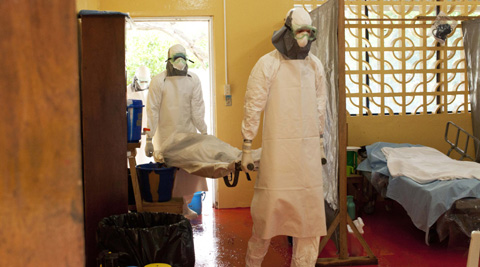 Dr. Kent Brantly (R) wears protective gear while treating a patient at the case management center on the campus of ELWA Hospital in Monrovia, Liberia. (Source: Reuters)
Medical personnel should employ barrier nursing techniques and in the case of the patient’s death his/her body must be disposed off carefully and contact to body fluids of even the deceased person must be avoided at all costs.
Ebola can affect dogs and pigs as well. Dogs are asymptomatic, but swine can contract the clinical disease. The main source of the virus spreading from infected persons and animals is via contact with the body fluids. Airborne particles of body fluids is a major contributor.
Current Crisis and Outbreak
The most recent outbreak of Ebola was recorded first in Guinea in February 2014. By April, the number of cases had increased to 242, including 142 deaths which meant the fatality rate was at 59 per cent.
The disease soon spread to the bordering countries of Liberia and Sierra Leone with each of them recording 300+ cases and 150+ deaths.The Liberian government banned public gatherings and also closed it land borders.
 (Source: CDC)
Sierra Leone installed check points along its road borders where people were checked for symptoms of the disease. The first case of the disease was reported in Nigeria.
The International Civil Aviation Organisation (ICAO) has held meetings with global health officials to discuss ways to curb further spread of the disease. The European Union (EU) has allocated an amount of €3.9 million to fight the outbreak.
West African airliner ASKY suspended all flights to Liberia and Sierra Leone, after a man arriving from Liberia died in Lagos after contracting Ebola in Nigeria on July 25th.
Most the the West African countries affected by the epidemic have relatively poor medical facilities and major portion of their population as little or no access to even basic healthcare. Organisations and NGOs like Doctors Without Borders and Samaritan’s Purse have taken special steps to set up clinics and medical centers to detect cases and treat the affected people.
They have also embarked on a journey to educate the people and train volunteers to spread awareness about Ebola.
Other West African countries like Togo, Ghana and Senegal conducted tests on a few suspected cases, but all have turned out to be negative so far.
 Share


