4 min read
Stay updated with the latest - Click here to follow us on Instagram

Journalism of Courage



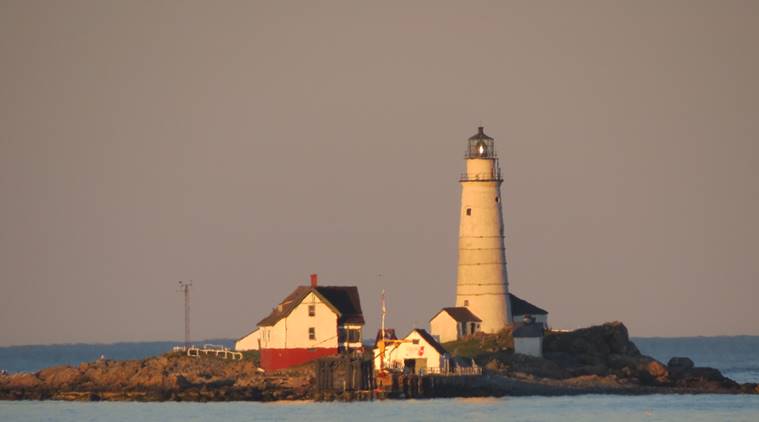 The Coast Guard had phased out resident keepers at all light stations save for Boston Light because Congress in 1989 mandated the Guard specifically staff and keep the light public in perpetuity. (Source: Wikipedia)
A singular lighthouse and its unique keeper are celebrating a milestone.
Boston Light, the nation’s first and oldest lighthouse station, turns 300 on Sept 14. Sally Snowman, the Coast Guard’s last resident keeper, is helping with celebrations.
Events are planned for downtown Boston’s waterfront and other parts of mainland Massachusetts. The lighthouse’s beam visible for 27 miles will even be ceremonially re-lighted at sunset.
“How many things established 300 years ago are still functioning as they were intended to be?” Snowman said to a reporter making a recent visit. “It was a major aid to navigation in 1716, and that’s exactly what it’s doing today. For me, that’s mind-boggling.”
The 65-year-old former college instructor has been keeper for 13 years and is the light’s first female keeper.
The Coast Guard has phased out resident keepers at all light stations save for Boston Light because Congress in 1989 mandated the Guard specifically staff and keep the light public in perpetuity.
Snowman, dressed in the Colonial dress and bonnet she wears on lighthouse tours, said she loves the solitude her job often affords.
“Island living is something that suits my personality,” she said. “I’m an introvert by nature, and I’ve always been able to entertain myself. It’s no problem to just leave me here. Just airdrop my food, and I can stay here forever.”
Snowman and her husband, James Thomson, a volunteer assistant keeper, live on Little Brewster Island from April to October with a rotating cast of volunteers, some of whom also spend nights on the island which is about nine miles from downtown Boston.
Boston Light has been a central part of Snowman’s life.
The Weymouth resident, who holds two doctorate degrees and taught at Curry College in Milton, Massachusetts, started volunteering there over 20 years ago and became a paid civilian employee in 2004.
She and Thomson married on the island in 1994 and have written three books about the lighthouse.
A spiritual person who drums, chants and meditates on the island, Snowman said she often senses spirits and other ghostlike presences. It’s not surprising, she said, since Boston Light’s first two keepers drowned and many more perished in nearby shipwrecks over the years.
Snowman also believes she was a keeper in a past life.
“The first time I went up there, I just felt like I had done it a thousand times before. There was just something intuitive about it,” she said of the lighthouse tower, which was built by the British, destroyed by them during the Revolutionary War and rebuilt by the new American nation in 1783.
Time on the island is roughly divided between busy tour days and quieter weekdays.
Friday through Sunday, guided tours swell the roughly 3-acre island’s population. More than 200 people visit or work there on a given summer weekend, Snowman said.
Monday to Thursday, Snowman and a pair of volunteers typically do routine cleaning and maintenance in the 89-foot lighthouse tower, as well as the keeper’s residence, fog signal building, cistern building and boathouse.
“We’re in a marine environment, so we need to keep on top of things,” Snowman said.
But even with the regular routine, she admitted, it’s easy to slip into island time.
“Everything is done just a little bit slower. If it’s really hot in the middle of the day, we take a siesta. We work earlier in the day or work later into the evening,” Snowman said. “We don’t have the hum of the mainland, the cars and the noise level of humanity. What we have is the wind and the sea and seagulls.”
Stay updated with the latest - Click here to follow us on Instagram