Journalism of Courage



 Share
Share


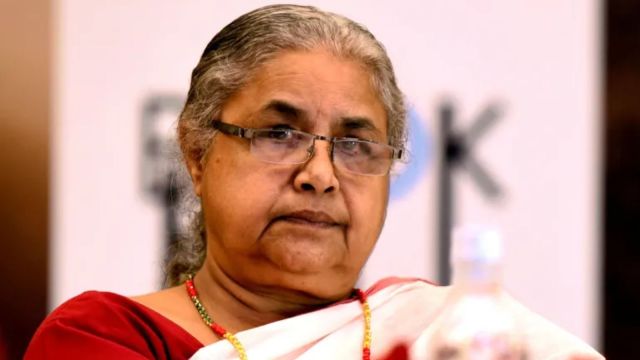 Who is Sushila Karki?: Nepal's former Chief Justice Sushila Karki looks on during the launch of her autobiography "Nyaya" at a ceremony in Kathmandu, Nepal, on September 22, 2018. [Stringer/REUTERS]
Kathmandu is bracing for a new chapter in its turbulent political history as former chief justice Sushila Karki was sworn in Friday as Nepal’s interim prime minister (PM). The swearing-in ceremony took place at the presidential residence in Shital Niwas.
The agreement to appoint Karki, 73, was reached after marathon negotiations between President Ramchandra Paudel, leaders of the Gen Z–led protest movement, and Nepal Army chief General Ashok Raj Sigdel. The deal came after days of unprecedented unrest that culminated in the resignation of Prime Minister KP Sharma Oli.
Karki is not a career politician but is remembered for her tenure as Nepal’s first woman chief justice from July 2016 to June 2017. Known for her zero-tolerance stance on corruption, she earned both respect and fierce opposition during her time on the bench. Her clean reputation propelled her into the political spotlight as protesters demanded she lead an interim administration.
Her elevation has already drawn comparisons to Nobel laureate Muhammad Yunus, who was invited to head Bangladesh’s interim government last year following a student-led uprising that toppled Sheikh Hasina.
Born in 1952 into a farming family in eastern Nepal, Karki earned a BA from Mahendra Morang Campus in 1972, a Master’s in political science from Banaras Hindu University in 1975, and a law degree from Tribhuvan University in 1978. After briefly teaching at Mahendra Multiple Campus in Dharan, she established her legal practice in Biratnagar.
During her years in the legal space, Karki rose steadily through the ranks. She led the Koshi Zonal Bar as president between 1988 and 1990, and later headed the Biratnagar Appellate Bar from 2002 to 2004. On December 19, 2004, she was recognised as a senior advocate. Five years later, in January 2009, she was appointed temporary justice of the Supreme Court. By November 2010, her position was made permanent.
In 2016, Karki rose to become chief justice. Her tenure was cut short in April 2017 when lawmakers from the Nepali Congress and Maoist Centre filed an impeachment motion against her, citing bias in a corruption-related ruling. She was suspended immediately, but after public protests and intervention by the Supreme Court, the motion was withdrawn. She returned briefly before retiring in June that year.
She presided over several high-profile cases, including the conviction of Information Minister Jaya Prakash Prasad Gupta in a corruption scandal.
While studying in Varanasi, Karki met Durga Prasad Subedi, a Nepali Congress youth leader who would become her husband. Subedi was among those involved in the 1973 hijacking of a Nepal Airlines flight carrying state bank funds. The cash was handed over to Girija Prasad Koirala to fund the party’s armed struggle against the monarchy.
Subedi and others were jailed in India before returning to Nepal ahead of the 1980 referendum. Karki would later call him her “most dependable friend and guide in crisis and all seasons.”
Karki’s selection comes after the deadliest protests Nepal has seen in years. At least 51 people were killed and more than 1,300 injured after police opened fire on demonstrators who defied curfews. The unrest was triggered by Oli’s nationwide ban on social media, widely viewed as an attempt to stifle dissent.
Police confirmed the casualties included 21 protesters, nine prisoners, three officers, and 18 others. Families are still retrieving the bodies of family members from Kathmandu hospitals.
Shops reopened in parts of the capital Friday, soldiers began withdrawing from the streets, and police carrying batons instead of rifles kept watch at key intersections.
(With inputs from The Kathmandu Post, Reuters)
 Share
Share