7 min read
Stay updated with the latest - Click here to follow us on Instagram

Journalism of Courage



 A view of Tromso, Norway, where citizens have inundated the police with calls about drone sightings or foreigners acting suspiciously on November 29, 2022. (Photo: The New York Times)
Written by Erika Solomon and Henrik Pryser Libell
In hindsight, some things just didn’t add up about Jose Giammaria.
For one, the visiting researcher at the University of Tromso, in Norway’s Arctic Circle, was ostensibly Brazilian. But he couldn’t speak Portuguese. Then there was the fact that he self-funded his visit, an oddity in academia, and even planned to extend it — yet he never talked about his research. But he was always helpful, even offering to redesign the homepage for the Center for Peace Studies, where he worked.
That was until Oct. 24, 2022, when Norway’s security police, the PST, arrived with a warrant to search his office. Days later, they announced his arrest as a Russian spy, named Mikhail Mikushin.
The revelation sent a chill through campus, said Marcela Douglas, who heads the Center for Peace Studies, which researches security and conflict. “I started to see spies everywhere.”
So is Norway, and much of the rest of Europe, too.
As the war in Ukraine bogs down and Moscow’s isolation increases, European nations have grown wary that a desperate Kremlin is exploiting their open societies to deepen attempts at spying, sabotage and infiltration — possibly to send a message, or to probe how far it could go if needed in a broader conflict with the West.
Mikushin is one of three Russians recently arrested in Europe on suspicion of being “illegals” — spies who embed in a local society for long-term espionage or recruitment. In June, an intern at the International Criminal Court, also with a Brazilian passport, was arrested in The Hague, Netherlands, and charged with spying for Russia. In late November, a Swedish raid caught a Russian couple accused of espionage.
Other suspicious incidents have popped up across Europe: In Germany, drones found flying over military sites where Ukrainians forces were being trained are strongly suspected by German officials of being Russian intelligence. Undersea cables cut in France, while not attributed to malignant intent, have raised suspicions among security analysts. And a hack of fuel distribution networks in Belgium and Germany days before Russia’s invasion also raised alarm.
Not all of the incidents can be traced to the Kremlin with certainty, and in many places, heightened vigilance and real concern have become hard to separate from widening paranoia. Russia has called a string of recent Norwegian arrests, mostly of Russian citizens for flying drones, a form of “hysteria.”
Norway, however, may have more reasons to worry than most.
Now that Western sanctions have all but cut off Russian fossil fuels to Europe, Norway is the biggest oil and gas supplier to the continent. Off its Arctic coast lie underwater cables that are critical for internet servicing for the financial hub of London, and for passing satellite imagery from the high north, where Norway borders Russia for 123 miles, across the Atlantic to the United States.
That vital role has felt all the more vulnerable since September, when explosions destroyed the Nord Stream pipelines between Russia and Germany, and for which Moscow and Washington have traded blame.
“It was a wake-up call. The war is not only in Ukraine. It can also affect us, even if it is hard to attribute,” said Tom Roseth, a professor at the Norwegian Defence University College.
A number of more conventional Russian spies have been rounded up and expelled in recent years, possibly making Russia more reliant on sleeper agents, especially as the war in Ukraine stumbles.
The recent surge in cases, Roseth said, reflected Russia’s need for its dormant spies to come through.
“At this point in time in Europe, with the pressure of the situation that Moscow is in, it wants its network to deliver,” he said. “Even though these activities have been there before, I think they take higher risks now.”
Norwegian citizens have dutifully responded to warnings to be alert, inundating police with calls over drone sightings, or foreigners allegedly acting suspicious.
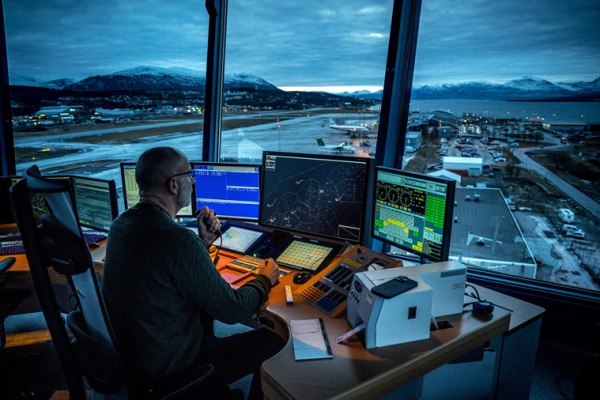 The control tower at the airport in Tromso, Norway, where air traffic has been disrupted by unauthorized drones, November 30, 2022. (Photo: The New York Times)
But now, some worry that hypervigilance has gone too far, especially in terrain as murky as suspected espionage.
On a recent afternoon, in the pitch black of Arctic winter, Tromso’s tiny regional courthouse was hearing two cases against Russian citizens accused of flying drones.
Neither was accused of spying, which is hard to prove. Instead, they were charged with violating European sanctions that ban Russians from flying aircraft, which Norway is now interpreting to include Russian individuals operating hobby drones.
Seven Russians were arrested in mid-October for flying drones, and four have been put on trial. Two have been convicted and ordered to serve prison sentences of 90 or 120 days.
Among those caught up in the arrests is Andrey Yakunin, the son of Vladimir Yakunin, a longtime ally of Russian President Vladimir Putin’s, in a trial closely followed across the country.
The younger Yakunin, a businessman who lives in the United Kingdom and holds British citizenship, has distanced himself from Russia’s invasion.
He was arrested after his yacht, the Firebird, was stopped by Norwegian authorities, who asked if he had a drone. He showed them a drone used to capture images of himself and his crew skiing and fishing among the glacial landscapes of Arctic Norway.
Prosecutors are pursuing a 120-day sentence.
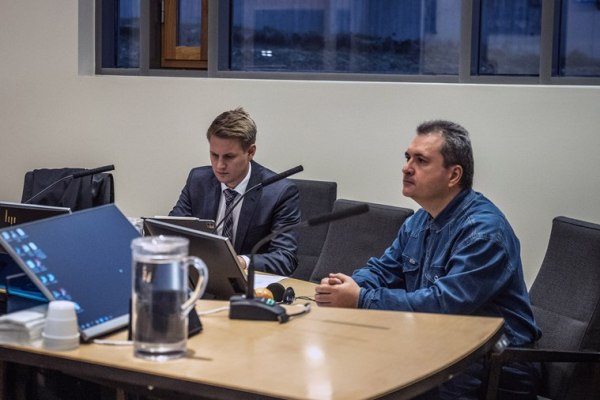 The Russian engineer Aleksey Reznichenko, right, who was accused of flying unauthorized drones in Norway, at a court hearing in Tromso, on November 29, 2022. (Photo: The New York Times)
“For sure I’m not a spy — though I do own a full collection of James Bond movies,” Yakunin joked in an interview after his trial began Dec. 3.
Across the hall, in a tiny courtroom away from the cameras, a graying man in denim, Aleksey Reznichenko, a Russian engineer, tearfully pleaded his own case in a much lower profile trial. He was arrested after taking pictures of fences and the parking lot outside the control tower at Tromso airport.
“It was a gut feeling,” said Ivar Helsing Schroen, the air control manager, who grew suspicious and called the police. “Something was very strange.”
The country itself seems to be conflicted as to how to handle the situation. The judges in both Yakunin’s and Reznichenko’s cases have now decided to acquit them. But prosecutors are appealing both cases. Yakunin will be back in Tromso’s court in January.
Those such as Schroen insist caution is always warranted. Checking the news from his tower, just a few miles from the courthouse, he felt no guilt over sending a man to trial.
Spies, he says, are definitely interested in the Arctic: “You’d have to be naive to think it was otherwise.”
This article originally appeared in The New York Times.
Stay updated with the latest - Click here to follow us on Instagram