3 min readNew DelhiUpdated: Sep 18, 2026 08:01 AM IST
The updated guidance in the USCIS Policy Manual expands the financial scrutiny for family and employment-based green card applicants. (Photo: AI-generated image)
Indian nationals applying for US permanent residency are set to face new rules related to public-charge assessment, as the updated guidance by US Citizenship and Immigration Services (USCIS) comes into effect on September 18.
The updated guidance in the USCIS Policy Manual expands the financial scrutiny for family and employment-based green card applicants. The manual also details how immigration officers will determine whether an applicant applying for adjustment of status to that of a lawful permanent resident is likely at any time to become a public charge.
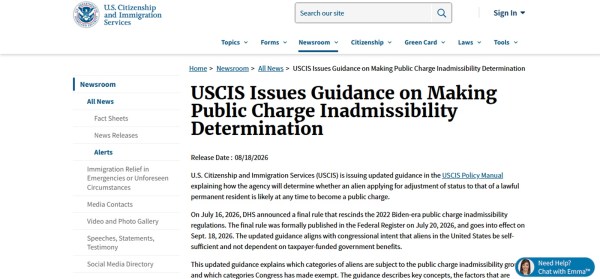
The change could affect Indian nationals applying for US permanent residency through categories subject to the public-charge rule. (Photo: USCIS website)
The updated USCIS policy was published on its website on August 18, following a Department of Homeland Security (DHS) final rule published in July 2026 that rescinds the 2022 Biden-era public charge inadmissibility regulations. The Trump administration stated that the updated guidance aligns with congressional intent that applicants in the United States be self-sufficient and not dependent on taxpayer-funded government benefits.
The USCIS officials will consider five statutory factors when making public charge inadmissibility determinations.
Family Status
Education and skills
Age
Health
Assets, resources, and financial status
Categories that are subject to public charge
Married sons and daughters of US citizens and their spouses and children
Brothers and sisters of US citizens
Unmarried sons and daughters of US citizens and their children
Spouses, children, and unmarried sons and daughters of LPRs
Spouses, children, and parents of US citizens
Widows or widowers of US citizens
Priority workers
Professionals with advanced degrees or aliens of exceptional ability
Skilled workers, professionals, and other workers
Investors
Religious workers
Certain employees or former employees of the US government abroad
Panama Canal Zone employees
Foreign medical school graduates
Retired employees of international organizations
Categories that are not subject to public charge
Asylees and refugees
Amerasian immigrants at admission
Afghan and Iraqi interpreters or Afghan and Iraqi nationals employed by or on behalf of the US government
Cuban and Haitian entrants at adjustment of status under section 202 of the Immigration Reform and Control Act of 1986
Applicants seeking adjustment under the Cuban Adjustment Act
Nicaraguans and other Central Americans who are adjusting status to lawful permanent resident
Haitians who are adjusting status to lawful permanent resident under the Haitian Refugee Immigration Fairness Act of 1998
Lautenberg parolees
Special immigrant juveniles
Applicants for registry
Applicants seeking Temporary Protected Status
Certain nonimmigrant ambassadors, ministers, diplomats, and other foreign government officials, and their families.
The USCIS guidance also details that immigration officials may consider Form I-864, Affidavit of Support Under Section 213A of the Immigration and Nationality Act (INA), which is executed by an individual who agrees to use their financial resources to support the applicant.
The Express Global Desk at indianexpress.com which delivers authoritative, verified, and context-driven coverage of key international developments shaping global politics, policy, and migration trends. The desk focuses on stories with direct relevance for Indian and global audiences, combining breaking news with in-depth explainers and analysis.
A major focus area of the desk is US immigration and visa policy, including developments related to student visas, work permits, permanent residency pathways, executive actions, and court rulings. The Global Desk also closely tracks Canada’s immigration, visa, and study policies, covering changes to study permits, post-study work options, permanent residence programmes, and regulatory updates affecting migrants and international students.
All reporting from the Global Desk adheres to The Indian Express’ editorial standards, relying on official data, government notifications, court documents, and on-record sources. The desk prioritises clarity, accuracy, and accountability, ensuring readers can navigate complex global systems with confidence.
Core Team
The Express Global Desk is led by a team of experienced journalists and editors with deep expertise in international affairs and migration policy:
Aniruddha Dhar – Senior Assistant Editor with extensive experience in global affairs, international politics, and editorial leadership.
Nischai Vats – Deputy Copy Editor specialising in US politics, US visa and immigration policy, and policy-driven international coverage.
Mashkoora Khan – Sub-editor focusing on global developments, with a strong emphasis on Canada visa, immigration, and study-related policy coverage. ... Read More




 The change could affect Indian nationals applying for US permanent residency through categories subject to the public-charge rule. (Photo: USCIS website)