Hormuz crisis: UAE builds new routes as India turns to US LPG
India’s trade with the UAE runs into hundreds of billions of dollars, while the disruption to the Strait has hit crude, LNG and LPG supplies, forcing New Delhi to seek alternative sources
Following months of blockade in the Strait of Hormuz, the United Arab Emirates has announced that it intends to bypass the water channel to carry on trading and exports. While the UAE would benefit from this, India, too, is expected to gain from the move.
The war and subsequent blockade of the Hormuz has thrown global trade and energy supply into a tizzy. India has also been hit significantly. On one hand, Iran claims it has full control over the strait; on the other, the US claims that no vessel can pass without authorisation by Washington. Effectively, it’s a vicious deadlock with Iran on one side of the channel and Oman, UAE, Kuwait, Qatar, and Bahrain on the other.
After the West Asia war disrupted LPG supplies from the Gulf, the US has developed as a much bigger supplier to India, accounting for more than 50% of the country’s LPG imports in the 6 months since the conflict began, up from less than 10% in the previous six months, according to an analysis of LPG shipping data over the past year.
The shift has laid bare India’s vulnerability to disruptions in the Strait of Hormuz, through which a large share of its energy imports traditionally flows. For Gulf economies, including the UAE, the disruption has also shown the need to reduce dependence on the strategic waterway. Speaking at the Hili Forum in Abu Dhabi, UAE Presidential adviser Anwar Gargash said that the UAE is now expanding port capacity along its eastern coast.
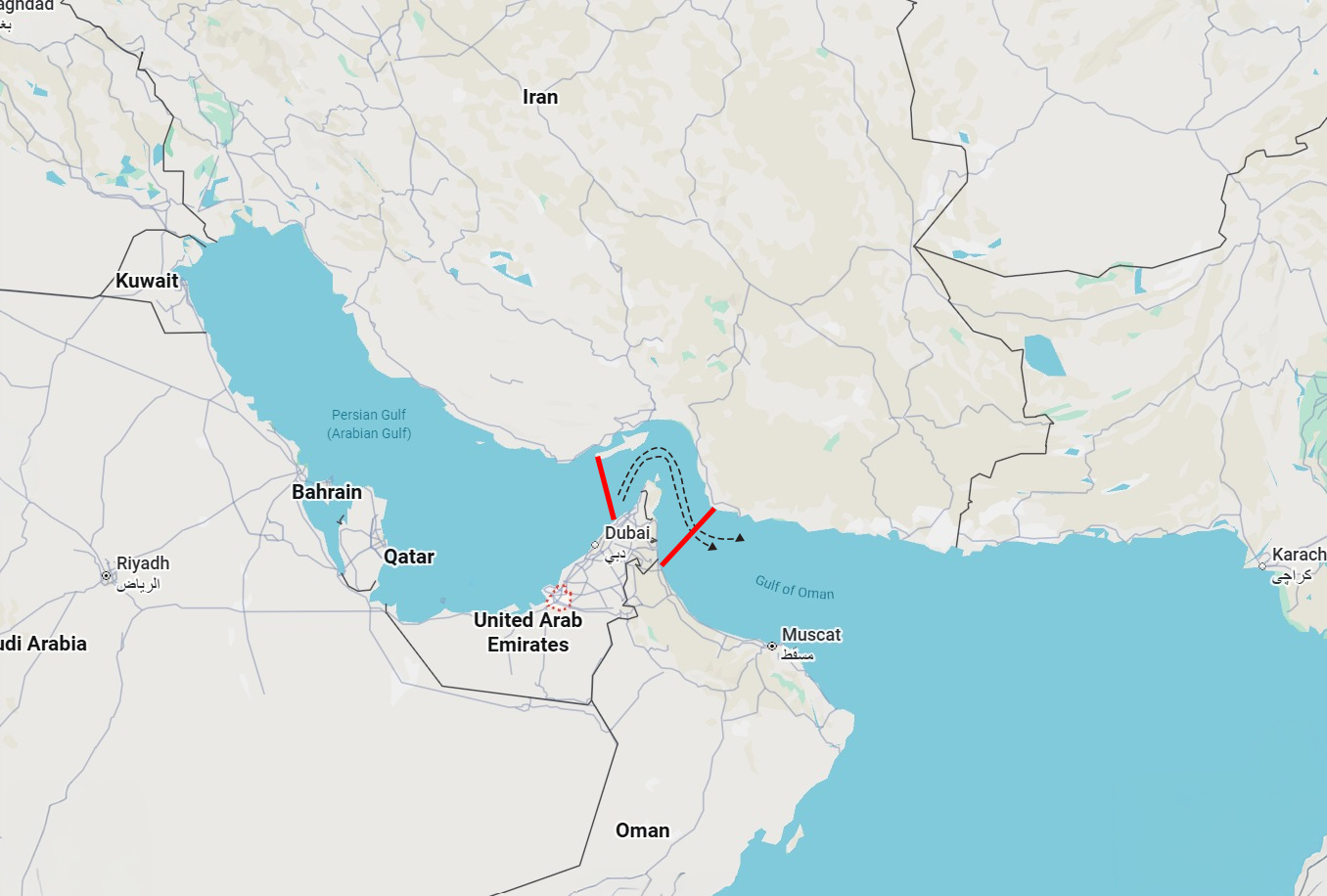
Map showing the Strait of Hormuz between Iran, the UAE and Oman, with the blockade area marked in red. (Source: Google Maps)
“Our energy exports will not be held hostage, nor will our trade and economic activity,” Gargash told the Hili Forum in Abu Dhabi.
The UAE has been expanding port capacity along its eastern coast, as well as developing pipelines, railways and trade routes for alternative corridors, he said.
The move assumes particular importance for India, one of the UAE’s largest trading partners. But the closure of shipping through the Strait of Hormuz has exposed another side of that relationship: India’s heavy dependence on the Gulf for its energy needs.
How the Hormuz closure has affected India
The Strait of Hormuz is critical to India’s energy security. Before the current disruption, around 40% of India’s crude oil imports, 60% of LNG imports and nearly 90% of LPG imports regularly came from West Asia through the waterway.
Story continues below this ad
India imports more than 88% of its crude oil requirement, around 60% of its LPG and about half of its natural gas needs. The scale of dependence means disruption in the Strait quickly feeds into India’s energy supply chain.
LPG has taken the biggest hit. India’s overall LPG imports fell by more than 40% sequentially between March and August, as supplies from traditional Gulf sources were disrupted. Imports from the US nearly quadrupled as Indian buyers turned to suppliers outside the conflict zone.
Following the drop in imports, India raised the price of LPG, petrol, diesel, CNG, and LNG.
US emerges as major energy supplier
The shift has effectively redrawn India’s LPG import map. The UAE, Qatar, Kuwait and Saudi Arabia have traditionally been among the suppliers, but the supply shock has pushed India to source more cargoes from much farther away.
Story continues below this ad
American LPG has emerged as one of the clearest beneficiaries of India’s scramble for alternative supplies. “Washington has been the biggest LPG exporter worldwide even before the crisis, and US propane was already cheaper than Asian supplies before the war,” Abu Dhabi-based energy analyst Natalia Katona said.
With cooking gas supplies a priority, India was prepared to pay the additional freight required to bring LPG from the US, she said.
Katona expects US supplies to remain strong until West Asian shipments normalise.
According to reports by news agency Reuters, the status of Hormuz remains a sticking point in negotiations between the US and Iran, with Qatar and Pakistan mediating efforts to ease tensions. Iran maintains that the strategic waterway is jointly under the jurisdiction of Iran and Oman, a claim rejected by Gulf Arab states.
Story continues below this ad
The UAE said freedom of navigation through the strait could not be used as a bargaining tool and any lasting settlement would need firm guarantees against further Iranian attacks on Gulf states.
The conflict, which began after US and Israeli strikes on Iran on February 28, remains deadlocked. A preliminary ceasefire reached in June has since broken down, with little progress reported in efforts to revive peace talks.
The Express Global Desk at indianexpress.com which delivers authoritative, verified, and context-driven coverage of key international developments shaping global politics, policy, and migration trends. The desk focuses on stories with direct relevance for Indian and global audiences, combining breaking news with in-depth explainers and analysis.
A major focus area of the desk is US immigration and visa policy, including developments related to student visas, work permits, permanent residency pathways, executive actions, and court rulings. The Global Desk also closely tracks Canada’s immigration, visa, and study policies, covering changes to study permits, post-study work options, permanent residence programmes, and regulatory updates affecting migrants and international students.
All reporting from the Global Desk adheres to The Indian Express’ editorial standards, relying on official data, government notifications, court documents, and on-record sources. The desk prioritises clarity, accuracy, and accountability, ensuring readers can navigate complex global systems with confidence.
Core Team
The Express Global Desk is led by a team of experienced journalists and editors with deep expertise in international affairs and migration policy:
Aniruddha Dhar – Senior Assistant Editor with extensive experience in global affairs, international politics, and editorial leadership.
Nischai Vats – Deputy Copy Editor specialising in US politics, US visa and immigration policy, and policy-driven international coverage.
Mashkoora Khan – Sub-editor focusing on global developments, with a strong emphasis on Canada visa, immigration, and study-related policy coverage. ... Read More




 Map showing the Strait of Hormuz between Iran, the UAE and Oman, with the blockade area marked in red. (Source: Google Maps)