


Stay updated with the latest - Click here to follow us on Instagram

Journalism of Courage
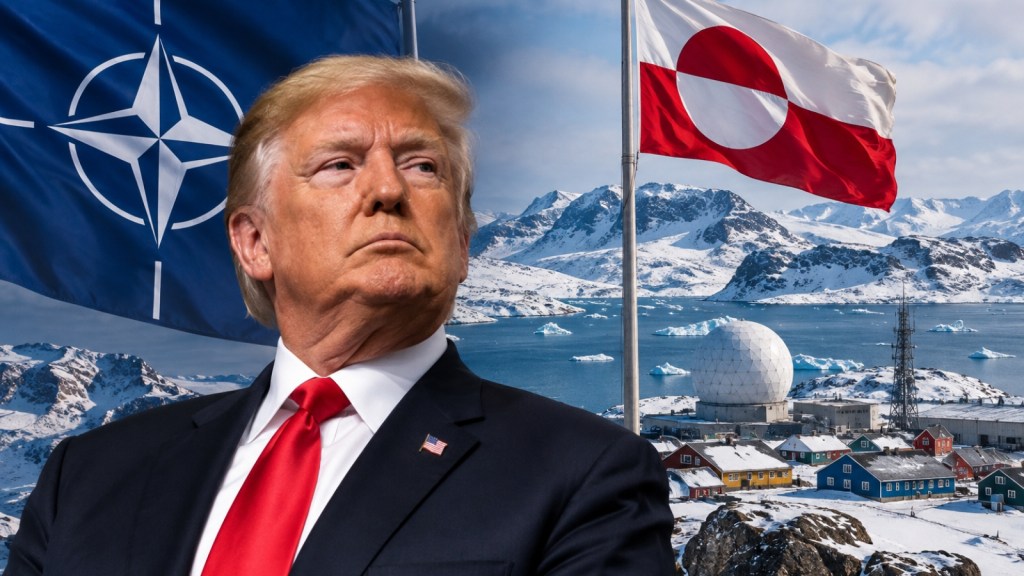 Trump signed a new security agreement with Denmark and Greenland that expands the US military presence on the Arctic island while explicitly tying its defence to NATO. (AI-generated image)
In April, President Donald Trump said he was considering pulling the United States out of NATO, calling the alliance a “paper tiger” and expressing frustration with European allies over their refusal to support US efforts to reopen the Strait of Hormuz.
Five months later, Trump signed a new security agreement with Denmark and Greenland that expands the US military presence on the Arctic island while explicitly tying its defence to NATO.
PRESIDENT TRUMP: As I announced just days ago, the U.S. has also reached an unprecedented agreement regarding the Northern Frontier of North America, the large and strategically vital piece of land known as Greenland.
This agreement, made with the Kingdom of Denmark and… pic.twitter.com/DLSb7G4TCf
— Breaking911 (@Breaking911) September 22, 2026
Trump, Danish Prime Minister Mette Frederiksen and Greenland Prime Minister Jens-Frederik Nielsen signed the pact at the UN General Assembly in New York on September 22. Reuters reported that it allows the US to establish two additional defence areas, at Narsarsuaq and Mestersvig, and expand its existing Pituffik Space Base.
The contrast is significant — Trump has questioned America’s commitment to NATO while agreeing to deepen the US military role in a territory whose defence the new pact places within the NATO framework.

On April 1, Trump told Reuters he was considering withdrawing the US from NATO and said he would discuss his “disgust with NATO” in an address to Americans.
Asked whether he was thinking about pulling out, Trump replied, “Oh, absolutely without question. Wouldn’t you do that if you were me?”
Trump on pulling out of NATO:
“I don’t need Congress for that decision. I can make it myself.”
In 2023 Marco Rubio co-authored a law specifically giving Congress — not the president — the power to withdraw from NATO.
Trump just said he doesn’t need it. pic.twitter.com/TGbsjhQed2
— Brian Allen (@allenanalysis) April 4, 2026
Reuters reported that Trump was angry because European NATO members had refused to send ships to help reopen the Strait of Hormuz. The comments came hours after then-US Defence Secretary Pete Hegseth declined to reaffirm the US commitment to NATO’s collective-defence principle.
The threat did not lead to an immediate US withdrawal. Washington has instead continued reviewing its military presence in Europe. Reuters reported that the US has about 80,000 troops in Europe and that one option under consideration was withdrawing as many as 25,000, although no decision had been made.
Trump’s dispute with Denmark over Greenland predates the NATO threat. The Associated Press reported that Trump first expressed interest in buying Greenland in 2019. In December 2024, he said, “The ownership and control of Greenland is an absolute necessity.”
Greenland’s then-prime minister Múte Bourup Egede responded, “We are not for sale and will never be for sale.”
Trump later refused to rule out military force to take control of the island, AP reported.
The new agreement does not transfer Greenland to the United States. Reuters reported that it instead provides for a larger US military role while maintaining Danish sovereignty and Greenland’s right to self-determination.
The agreement allows the US to establish defence areas at Narsarsuaq in southern Greenland and Mestersvig in the east. Reuters reported that Narsarsuaq is a former Cold War-era US base, while Mestersvig is used by Denmark’s Sirius Dog Sled Patrol.
Trump said, “We will immediately begin the process of developing a large military presence in the appropriate location. We will be building two very major military bases.”
The agreement does not specify troop numbers or a timetable. The US will also be able to expand activities at Pituffik Space Base. AP reported that the US military presence there has fallen from thousands of troops across 17 Cold War-era bases and installations to roughly 200 personnel today.
The pact also provides broader US military access across Greenland, including flyover, landing and undersea access.
 Denmark’s Prime Minister Mette Frederiksen, Greenland’s Premier Jens-Frederik Nielsen, and Greenland’s Minister for Foreign Affairs Mute B. Egede have a beer with delegations at a bar in Manhattan, after the agreement has been signed in New York, US, September 22, 2026. (Reuters)
Denmark’s government says the agreement is “deeply rooted in the NATO Alliance.” Frederiksen said the pact strengthens Arctic and North Atlantic security while respecting Danish sovereignty and Greenland’s right to self-determination.
Nielsen said, “The agreement recognizes that we are a people with the right to self-determination. At the same time, we are recognized as a part of our common security in the Arctic.”
He added, “We believe that it is vital to keep NATO strong, also in the Arctic, where the alliance has a key role to play.”
The pact also says that “no state that is not a member of NATO shall be allowed to establish its own manned or unmanned military installations in Greenland nor shall they be allowed a persistent presence of military forces in Greenland”.
There is no current decision to withdraw US troops from Greenland. The new pact is designed to expand the American presence. But if Washington later reduced its forces, the agreement would not automatically disappear. Reuters reported that it has no end date and can be amended only by mutual consent.
The immediate issue would be a capability gap. Pituffik’s location makes Greenland important for surveillance, missile warning, space-related activity and North Atlantic defence. Denmark and other NATO countries would then have to decide whether and how to compensate for lost US personnel, infrastructure and capabilities. NATO could not simply “take over” the US role because it is an alliance of national militaries.
If the US actually left NATO, there could be broader consequences. Under Article 13 of the North Atlantic Treaty, a member can withdraw one year after giving formal notice.
US law currently restricts the president from withdrawing the United States from NATO without either two-thirds Senate approval or an Act of Congress. The statute, 22 USC §1928f, says the president cannot withdraw the US from the North Atlantic Treaty except with the Senate’s advice and consent, with two-thirds of senators present concurring, or pursuant to an Act of Congress.
The NATO treaty itself also has a formal withdrawal procedure. Under Article 13, a member can leave one year after giving formal notice. NATO says the provision has never previously been used.
The Greenland pact does not resolve the question raised by Trump’s NATO threat. Rather, it highlights it. In April, Trump called NATO a “paper tiger”; in September, his administration signed an agreement that expands the US military role in Greenland while Denmark calls the pact “deeply rooted in the NATO Alliance”. Meanwhile, Washington is reviewing its wider military presence in Europe.
(With inputs from agencies)
Stay updated with the latest - Click here to follow us on Instagram