India does not want to say in advance how it will vote at the United Nations General Assembly on a likely draft resolution condemning Russia's proclaimed annexation of parts of Ukraine, Foreign Minister S. Jaishankar said on Monday. "As a matter of prudence and policy, we don't predict our votes in advance," Jaishankar said during a joint media briefing along with Australia's Foreign Minister Penny Wong in Canberra. The General Assembly is due to vote on the draft resolution on Tuesday or Wednesday, diplomats said.
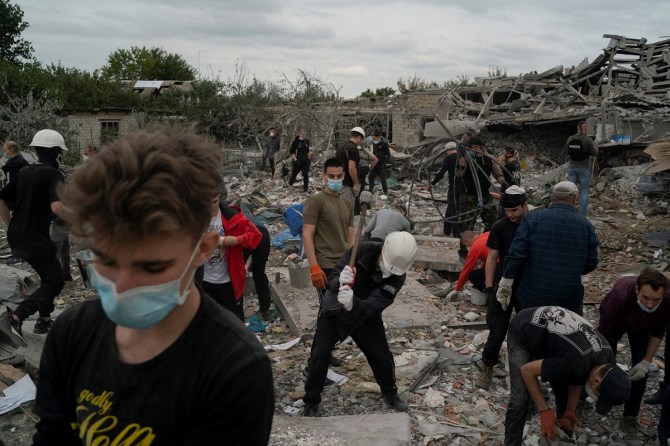 Volunteers work to clean the debris on a site where several houses were destroyed after a Russian attack at a residential area in Zaporizhzhia, Ukraine, October 9, 2022. (AP)
An external power line to Ukraine's Zaporizhzhia nuclear power plant — the biggest in Europe — was repaired on Sunday after shelling disconnected the facility from the grid and forced it to resort to emergency diesel generators, the U.N. nuclear watchdog said.The International Atomic Energy Agency said the 750-kilovolt line was reconnected to the plant on Sunday evening following repair work by Ukrainian engineers. That enabled the plant to start switching off the generators that had kicked in to provide it with power after the line — its last connection to the grid — was cut early Saturday.IAEA Director-General Rafael Grossi tweeted that the reconnection was “a temporary relief in a still-untenable situation.”
A Russian attack on Zaporizhzhia overnight struck apartment buildings and killed at least 17 people, a top official in the Ukrainian city said Sunday.City council Secretary Anatoliy Kurtev said the city was struck by rockets overnight, and that at least five private houses were destroyed and around 40 were damaged. The Ukrainian military also confirmed the attack, saying that there were dozens of casualties. The strike came after an explosion Saturday caused the partial collapse of a bridge linking the Crimean Peninsula with Russia, damaging an important supply artery for the Kremlin’s faltering war effort in southern Ukraine and hitting a towering symbol of Russian power in the region.
Ukraine’s Zaporizhzhia nuclear power plant, the biggest in Europe, has lost its last remaining external power source as a result of renewed shelling and is now relying on emergency diesel generators, the UN nuclear watchdog said on Saturday. The International Atomic Energy Agency said that the plant’s link to a 750-kilovolt line was cut at around 1 am on Saturday. It cited official information from Ukraine as well as reports from IAEA experts at the site, which is held by Russian forces.
With the Kremlin distracted by its flagging war more than 1,500 miles away in Ukraine, Russia’s dominium over its old Soviet empire shows signs of unraveling. Moscow has lost its aura and its grip, creating a disorderly vacuum that previously obedient former Soviet satraps, as well as China, are moving to fill.
On the mountain-flanked steppes of southwestern Kyrgyzstan, the result in just one remote village has been devastating: homes reduced to rubble, a burned-out school and a gut-wrenching stench emanating from the rotting carcasses of 24,000 dead chickens.
All fell victim last month to the worst violence to hit the area since the 1991 collapse of the Soviet Union — a brief but bloody border conflict between Kyrgyzstan and Tajikistan, both members of a Russia-led military alliance dedicated to preserving peace but which did nothing to halt the mayhem.
Russia’s latest wave of threats to use nuclear weapons and cut energy supplies even further so far haven’t scared off Ukraine’s allies in the US and Europe, only hardening their will to see Kyiv win. What they’re not so sure about is whether they want Vladimir Putin to lose. Joe Biden brought the tension into the open Thursday, warning that the Russian president’s nuclear threats may not be a bluff as his other options for salvaging his invasion of Ukraine narrow.


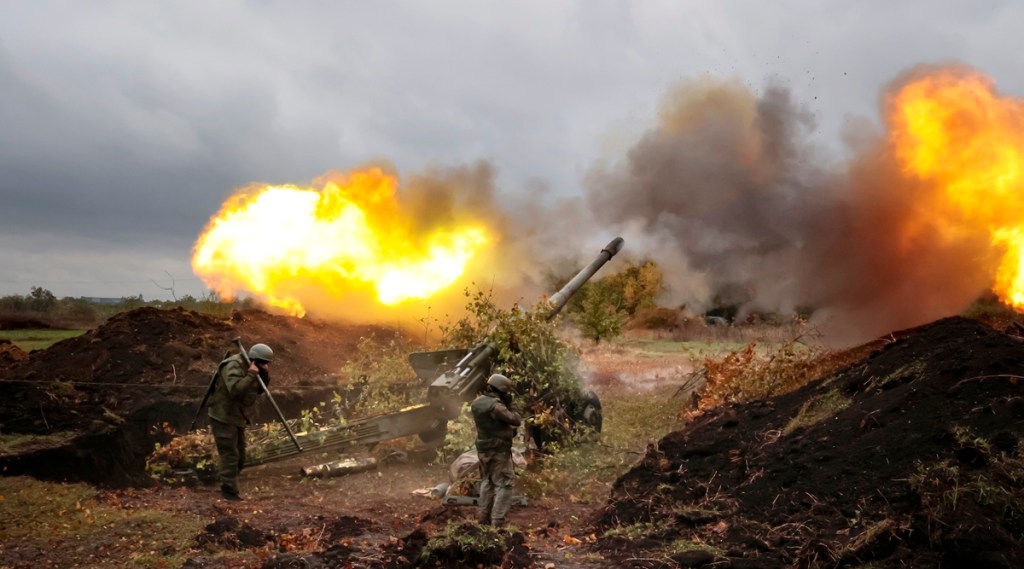 Servicemen fire from their 152-mm gun 2A36 'Giatsint-B' howitzer from their position at Ukrainian troops at an undisclosed location in Donetsk People's Republic, eastern Ukraine, Oct. 11, 2022. (AP)


This live blog is closed. Follow latest updates on the Russia-Ukraine war here.
Russia’s biggest air strikes against Ukraine since the start of the war killed at least 19 people, drove thousands of Ukrainians back into air raid shelters and knocked out electricity in hundreds of towns and villages. The strikes — denounced in the West for deliberately hitting civilian targets — have been hailed by hawks in Moscow as a turning point that demonstrates Russia’s resolve in what it calls its “special military operation” in Ukraine.
But Western military analysts say the strikes came at a staggering cost, depleted a dwindling supply of long-range missiles, hit no major military targets and are unlikely to change the course of a war going badly for Moscow. Read more
The Kremlin said on Wednesday that it still remained to be seen if President Vladimir Putin would attend November's G20 summit on the resort island of Bali. 'A large number of international forums are planned for November," Putin's foreign policy aide Yuri Ushakov told reporters.
"If you are asking about the G20, then there is still a lot of time before the G20, as well as before other forums - we'll wait and see," Ushakov said. US President Joe Biden, asked if he would meet Putin at the G20, said he didn't see a good reason for a sit-down with the Kremlin chief. "It would depend on specifically what he wanted to talk about," Biden told CNN, adding that if Putin wanted to discuss the jailed American basketball star Brittney Griner then he would be open to talking. (Reuters)
Russia has depleted a significant proportion of its precision-guided ammunition in its invasion of Ukraine and its industry cannot produce all kinds of ammunition and weapon systems due to Western sanctions, a senior NATO official said on Wednesday.
The official said he did not know how long it would take for Russia to mobilise the 300,000 troops Moscow is aiming for, and suggested it could take a few months. (Reuters)
As Russia rained shells and missiles in civilian areas in Ukraine and Western officials prepared to meet at NATO headquarters to discuss ways to sustain military assistance to the government in Kyiv, there was speculation over a possible link between the recent dramatic escalation in the war and the appointment of a new commander of the Russian forces.
The Kremlin on Saturday (October 8) announced the appointment of General Sergei Surovikin, a 55-year-old veteran of several intense and complex battles including as leader of the Russian forces in Syria, and a man with a reputation for ruthlessness and brutality. Read the full explainer here
Leaders often start wars in hubris, thinking that they would shape the course of the conflict. But it is the fog of war that, more often than not, ends up becoming the more significant determinant. Russian President Vladimir Putin is facing a similar predicament. Despite the reality on the ground, he continues to insist that the situation will soon be under control. Last week, he said he expected the situation to “stabilise” in Ukrainian regions annexed by the Kremlin despite his forces suffering military setbacks and losing several key towns to Kyiv. This was followed by heavy bombing in the southern Ukrainian city of Zaporizhzhia — the capital of one of the regions annexed by Russia – and then the raining of missiles across the vast Ukrainian territory from Kyiv and Lviv to Kharkiv and Odessa. Harish V Pant writes
The Netherlands will deliver 15 million euros worth of air defense missiles to Ukraine, the government said in a letter to parliament on Wednesday, in reaction to Russian air raids on Ukraine earlier this week.
"These attacks ... can only be met with unrelenting support for Ukraine and its people," wrote Defense Minister Kasja Ollongren. (Reuters)
A Ukrainian official dismissed as "nonsense" on Wednesday Russia's investigation into an explosion last weekend that badly damaged a bridge linking the Russian mainland to the Crimea peninsula that Moscow has annexed. Russian President Vladimir Putin has blamed Ukraine's security forces for the explosion and earlier on Wednesday Russia's Federal Security Service (FSB) said it had detained five Russians and three citizens of Ukraine and Armenia over the blast.
"The whole activity of the FSB and Investigative Committee is nonsense," Ukraine's public broadcaster Suspilne cited Andriy Yusov, a press officer for Ukrainian military intelligence, as saying when asked about Moscow's allegations on the Crimea Bridge blast. (Reuters)
President Vladimir Putin said on Wednesday that Russian gas could still be supplied to Europe through one remaining intact part of the Nord Stream 2 pipeline but the ball was now in the EU's court on whether it wanted that to happen. An international investigation is under way into explosions last month that ruptured the Russian-built Nord Stream 1 and Nord Stream 2 pipelines on the bed of the Baltic Sea.
Putin said it was possible to repair the pipelines but that Russia and Europe should decide their fate. Three of the Nord Stream pipelines are damaged. That leaves only one line of Nord Stream 2, which has an annual capacity of 27.5 billion cubic metres, functional. Read more
Russia is ready to resume gas supplies via one link of Germany-bound Nord Stream 2 pipeline that remains operational, President Valdmir Putin said Wednesday. (AP)
Ukraine President Volodymyr Zelenskiy is meeting G7 countries virtually on Tuesday to ask for more air defence weapons, among other demands. US President Joe Biden has said he is willing to supply more air defence systems to Ukraine after Russia bombed several of its key cities Monday (October 10), killing 19, injuring scores and inflicting devastating damage on critical infrastructure. The strikes continued in the southeastern town of Zaporizhzhia on Tuesday.
Meanwhile, the North Atlantic Treaty Organisation (NATO) is considering holding a virtual summit, a European diplomat told Reuters on Tuesday. No date has been fixed for the summit. While Ukraine has applied to join NATO, whose members are obliged to defend each other against invasions, it has not yet been granted membership. Read more
The Kremlin said on Wednesday there was no "new wave" of men being drafted into the army, despite some regional officials reporting they were stepping up mobilisation efforts this week. "There is no new wave," Kremlin spokesman Dmitry Peskov said, telling reporters to check with individual governors to see what they meant.
The defence ministry said more than 200,000 were drafted in the first weeks after President Vladimir Putin announced a partial mobilisation of reservists to fight in Ukraine. Defence Minister Sergei Shoigu earlier suggested 300,000 men with previous military experience would be called up to bolster Russia's war efforts in Ukraine, although Putin's decree did not disclose a number. (Reuters)
Russia’s latest wave of threats to use nuclear weapons and cut energy supplies even further so far haven’t scared off Ukraine’s allies in the US and Europe, only hardening their will to see Kyiv win. What they’re not so sure about is whether they want Vladimir Putin to lose. Joe Biden brought the tension into the open Thursday, warning that the Russian president’s nuclear threats may not be a bluff as his other options for salvaging his invasion of Ukraine narrow.
“We’re trying to figure out what is Putin’s off-ramp? Where does he get off? Where does he find a way out?” the US president said Thursday at a fundraiser in New York City. “Where does he find himself in a position that he does not, not only lose face but lose significant power in Russia?” For the moment, Putin has backed himself further into a corner, effectively ruling out talks with his annexation of occupied Ukrainian lands and redoubling his commitment to fight with the order to call up at least 300,000 reservists despite rising consternation at home. Read more
The Kremlin said on Wednesday it hoped the Group of Seven (G7) would hold "the Kyiv regime" accountable for the crimes it has committed.
The G7 nations pledged on Tuesday to continue providing financial, humanitarian, military, diplomatic and legal support to Ukraine, adding in a statement after a leaders' call that any use by Russia of nuclear weapons would be met with severe consequences. (Reuters)
A safety zone around the Zaporizhzhia nuclear plant in Russian-controlled Ukraine is not possible until the front moves forward by at least 100 km, the Russian-installed leader of the region said on Wednesday, RIA reported.
The International Atomic Energy Agency has been pushing for a demilitarised security zone around the plant, Europe's largest, which remains close to the frontline between Russian and Ukrainian forces. (Reuters)
For most of this month, the global attention on the war in Ukraine has remained nervously focused on Zaporizhzhia, an important town in the country’s southeast that houses the largest nuclear power plant in Europe. The Zaporizhzhia nuclear power station has been under Russian control since early March, but an escalation of the conflict in the town this month, including shelling and mortar attacks, some of which damaged parts of the nuclear station, has raised the spectre of nuclear disaster.
Russia and Ukraine have been accusing each other of attempting to damage the nuclear plant in ‘false flag’ operations. The plant continues to be operated by its Ukrainian staff, with Russian soldiers standing guard. On Tuesday, a team of officials from the International Atomic Energy Agency (IAEA) arrived in Ukraine to assess the condition of the plant, after Russia agreed to their visit. (Read more)
The head of the UN’s nuclear watchdog said Wednesday that a Ukrainian nuclear plant surrounded by Russian troops has lost all external power needed for vital safety systems for the second time in five days.
International Atomic Energy Agency Director-General Rafael Grossi said agency monitors at the Zaporizhzhia Nuclear Power Plant reported the interruption and said backup diesel generators are keeping nuclear safety and security equipment operational.
Prosecutors for International Mobile Justice teams are investigating as possible war crimes the ongoing Russian missile strikes in Kyiv and cities across Ukraine that have so far killed at least 26 people, an official told Reuters on Wednesday. (Reuters)
Russia's Gazprom said Wednesday it will ship 42.4 million cubic metres of natural gas to Europe via Ukraine on Wednesday, a volume in line with recent days. (Reuters)
Lyman, a rail hub in eastern Ukraine, was recaptured from Russian hands, following which forensic workers pulled several bodies from a mass grave Tuesday. This was a part of an arduous effort to piece together evidence of what happened under more than four months of Russian occupation.
Russia's Federal Security Service (FSB) said Wednesday that it had detained five Russians and three citizens of Ukraine and Armenia over the explosion that damaged the Crimea Bridge last Saturday, Interfax reported.
The FSB said the explosion was organised by the Main Intelligence Directorate of the Ukrainian Defence Ministry, and its director Kyrylo Budanov. (Reuters)
President Volodymyr Zelenskyy called for the G7 countries to help Kyiv establish an "air shield" following Russian strikes on a number of major Ukrainian cities.
Zelenskyy said that "millions of people would be grateful" for the shield. He added that Russia "still has room for further escalation" beyond Monday's missile strikes.
Ukraine's president said that Russia had fired an additional 28 missiles on Ukraine on Tuesday. He said that 15 drones, which were "mainly Iranian drones," were involved in the attacks, and that most of the drones had been shot down. (DW)
Ukrainian Defence Minister Oleksii Reznikov celebrated the arrival from the United States of what he said were four additional High Mobility Artillery Rocket Systems (HIMARS), whose accuracy and longer range have allowed Ukraine to reduce Russia's artillery advantage.
Ukraine on Tuesday received the first of four IRIS-T air defence systems Germany promised to supply, a German defence ministry source said. The United States said it was speeding up the shipment of NASAMS air defences to Ukraine. Washington has already provided more than $16.8 billion worth of security aid to Ukraine during the war. (Reuters)
Five blasts were heard in the city of Kherson early Wednesday, Russian media reported, adding that according to unofficial information air defence systems were launched.
Kherson, the administrative centre of the broader Kherson region, was one of the first cities to fall to Russian forces after they launched their invasion in Ukraine in February. (Reuters)
The head of the UN weather agency says the war in Ukraine “may be seen as a blessing” from a climate perspective because it is accelerating the development of and investment in green energies over the longer term — even though fossil fuels are being used at a time of high demand now.
The comments from Petteri Taalas, secretary-general of the World Meteorological Organisation, came as the world is facing a shortfall in energy needs — prompted in part by economic sanctions against key oil and natural gas producer Russia — and prices for fossil fuels have risen.
That has led some countries to turn quickly to alternatives like coal. But rising prices for carbon-spewing fuels like oil, gas and coal have also made higher-priced renewable energies like solar, wind and hydrothermal more competitive in the energy marketplace. (Read more)
The Russian strikes that hit civilian targets across Ukraine this week immediately brought new pledges by Ukraine’s allies to send in more weapons and ammunition. The United States promised more air defence missile systems, and Germany said it would send similar defences “in the next few days.” The NATO chief declared that support to Ukraine’s fight against Russia would continue “for as long as it takes.”
But for all of the assurances, there remains a problem. Ukraine also needs more of the Russian-style weapons that its military is trained to use, and the available global supply of them is running low. (Read more)
?? Russia's defence ministry said it had hit "all designated targets" in Ukraine on Monday in what it called an attack on military, communications and energy infrastructure. Putin earlier blamed Ukraine for an attack on a bridge linking Russia to annexed Crimea.
?? Ukrainian Foreign Minister Dmytro Kuleba accused Russia of committing war crimes by deliberately targeting energy facilities to create "unbearable conditions for civilians".
?? Ukraine urged civilians not to use domestic appliances like ovens and washing machines to save electricity as millions faced blackouts after the biggest Russian attack on its energy network since war broke out.
?? The governor of Russia's Belgorod region said on Tuesday more than 2,000 people had been left without power after Ukraine shelled an electricity substation in the town of Shebekino, on the border with Ukraine's Kharkiv region. (Reuters)
US President Joe Biden said in an interview for the CNN broadcaster that Russian counterpart Vladimir Putin made a mistake when assessing Moscow's ability to occupy Ukraine.
"I think he is a rational actor who has miscalculated significantly," Biden said during the interview.
"I think… he thought he was going to be welcomed with open arms, that this was the home of Mother Russia in Kyiv, and that where he was going to be welcomed, and I think he just totally miscalculated," he said.
Last week, Biden said the world risks "nuclear Armageddon" amid threats from Kremlin officials. (DW)
Turkish Defence Minister Hulusi Akar observed a "common understanding" regarding the need for a Russia-Ukraine ceasefire in a phone call with his Russian counterpart Sergei Shoigu on Tuesday, Akar's ministry said in a statement.
Akar emphasized the importance of an immediate ceasefire to stop loss of life and establish peace and stability in the region, according to a readout following the call between the two ministers.
"The importance of declaring a ceasefire urgently in order to prevent further loss of lives and to re-establish peace and stability in the region was emphasized, and it was gladly observed that there was a common understand?ng regarding the ceasefire," the Turkish defence ministry said.
The call came after Russian missiles hit Ukraine for a second day, although with less intensity than on Monday, when dozens of air raids killed 19 people, wounded more than 100 and knocked out power supplies across the country.
The two ministers also talked about a grain exports deal, humanitarian aid and northern Syria, the defence ministry said. (Reuters)
Ukraine urged civilians on Tuesday not to use domestic appliances like ovens and washing machines to save electricity as millions faced blackouts after the biggest Russian attack on its energy network since war broke out.
Authorities are trying to repair the damage after Russia fired missiles at energy facilities across Ukraine on Monday, causing widespread power outages and prompting Kyiv to announce it was halting electricity exports.
The Kyiv capital region began rolling power cuts to save energy, but repairs of the grid in the western city of Lviv were set back by a new Russian missile strike that left 30% of the population there without power.
The government said residents of 300 settlements in the Kyiv region and a similar number in the Lviv region had woken on Tuesday to find they had no electricity. A further 200 settlements in the northeastern Sumy region and over 100 in the Ternopil region of western Ukraine were also without power.
But Prime Minister Denys Shmyhal said Ukrainians had voluntarily cut their electricity consumption by an average of 10% on Monday after Russia's attacks, and urged them to limit use between 5 p.m. (1400 GMT) and 11 p.m. on Tuesday.
"We are united and will stand firm," he wrote on the Telegram messaging app.
"Please don't turn on energy-intensive appliances: electric stoves, electric kettles, power tools, heaters and air conditioners, ovens and irons, microwave ovens, coffee makers, washing machines and dishwashers."
'Primary targets'
Ukrainian officials say Russian attacks are now focused on damaging Ukrainian energy infrastructure and sowing fear among civilians.
At least 20 people were killed and 108 wounded in Monday's attacks.
"Primary targets of Russian strikes are energy facilities. They've hit many yesterday and they hit the same and new ones today," Foreign Minister Dmytro Kuleba said, suggesting the aim was to create "unbearable conditions for civilians".
Russia has denied deliberately targeting civilians since its forces invaded Ukraine in February.
Ukrainian authorities had already been preparing for a grim winter, with the Zaporizhzhia nuclear power plant- which usually provides about one-fifth of Ukraine's electricity - in "cold shutdown" after being occupied by Russian forces.
In Lviv, regional governor Maksym Kozytsky said four local electricity substations were now out of action, and would take months to rebuild. Two of them were hit by missiles on Tuesday as well as Monday, he said.
"This is complicated equipment, transformers that we do not have," he told reporters. (Reuters)
Bulgaria on Tuesday rejected reports that the truck linked to the powerful blast that damaged Russia's bridge to annexed Crimea had travelled via its territory.
Alexander Bastrykin, the head of Russia's Investigative Committee, said that the vehicle had passed through Bulgaria, Georgia, Armenia, South Ossetia and Russia's Krasnodar region before arriving on the bridge.
"It has been indisputably established that the truck blown up on the Crimea bridge was never in the territory of Bulgaria," the government said in a statement.
"The Bulgarian government will in no way allow the name of the country to be associated with any involvement in terrorist activity," it said.
Russia has escalated its attacks on Ukraine after the explosion. On Sunday, Russian President Vladimir Putin accused Ukraine of orchestrating the blast describing it as an "act of terrorism".
Mass bombardments of Ukrainian cities by Russia constitute war crimes under international law, the presidents of the Bucharest Nine group of countries, including Bulgaria, said on Tuesday. (Reuters)
Russia, the world's largest wheat exporter, is considering abolishing its grain export quota which it usually sets up in the second half of the July-June marketing season, the Interfax news agency reported, citing Russia's Deputy Prime Minister.
Russia, which supplies its wheat to Africa and the Middle East, usually sets up grain export quotas for the period from mid-February and until the end of June to secure enough supply for the domestic needs.
"The harvest is big, so, in principle, probably, yes, there are no prerequisites to impose any quantitative restrictions at the moment," Viktoria Abramchenko, who is in charge of the agriculture sector in the government, was quoted as saying on Tuesday.
Russia is on track to harvest a record grain crop of 150 million tonnes, including 100 million tonnes of wheat, in 2022, according to President Vladimir Putin's forecast.
Russia's Union of Grain Exporters said on social media that it would be better to keep the quota system in place but make sure the size of it is not of a restrictive nature.
The quota of 25 million tonnes of grains for exports from mid-February and until June 30 "could become a compromise option", the union said.
"The quota was introduced as a systematic measure to regulate grain exports, so there is probably no point in cancelling it because of the circumstances of a particular season," it added. (Reuters)
Russian President Vladimir Putin on Tuesday told International Atomic Energy Agency (IAEA) head Rafael Grossi that the situation around Ukraine's Russian-held Zaporizhzhia nuclear power plant is "of concern".
At a meeting in Moscow, shown on Russian state television, Putin told Grossi that Russia was open for dialogue and would discuss all issues concerning the facility's operations. (Reuters)
G7 leaders condemn Russian missile attacks in Ukraine in strongest possible terms, according to a joint statement issued Tuesday.
"We will continue to coordinate efforts to meet Ukraine's urgent requirements for military and defence equipment," they said. "We are committed to supporting Ukraine in its winter preparedness needs." (Reuters)
European arms manufacturers have urged the European Union to help coordinate weapons procurement as they scramble to boost production to meet soaring demand for the war in Ukraine.
Meeting ahead of a NATO defence ministers gathering in Brussels, defence company executives said their industry had been geared up for EU states spending less on defence rather than more, after decades of peace in Europe.
NATO Secretary General Jens Stoltenberg said the alliance has started dialogue with industry and allies on how to boost production and replenish weapons stocks.
He told a news conference that defence ministers would take decisions to increase stockpiles. Reducing stocks had been the right thing to do to support Ukraine, but production now needed to ramp up to ensure their allies' own capabilities and to continue support for Ukraine "for the long haul".
The NATO chief said he expected ministers to decide on more ambitious targets that would provide industry with the long-term demand they required to invest in new capacity and look at joint purchases.
Nicolas Chamussy, chief executive of French defence firm Nexter, said industry had to respond to a dramatic increase in EU demand for military equipment, while production capacities were designed for peace time.
He added there was a very important demand for artillery capabilities in Europe.
Nexter designs and manufactures military vehicles for French and international armed forces. It is now part of franco-german KNDS, which is 50% owned by the French state and 50% by the family-owned Wegmann-Gruppe.
The EU has been buying equipment and supplies for the Ukrainian military, including lethal weaponry, which it said should be used for defensive purposes.
Last Friday European Union leaders agreed to give more financial and military aid to Ukraine. The bloc's top diplomat, Josep Borrell, said specific proposals on that would be discussed this month.
Russia rained cruise missiles on busy Ukrainian cities on Monday in what the United States called "horrific strikes", killing civilians and knocking out power and heat with its most widespread air attacks since the start of the war in February.
Ukrainian President Volodymyr Zelenskiy will ask the leaders of the G7 group of nations to urgently supply Ukraine with air defence weapons.
"The immediate consequence for us (of Ukraine's invasion by Russia) is that we are asked to do more, to work faster, to deliver at a higher pace and we are asked to do all of this now," said Eric Beranger, head of pan-European missile manufacturer MBDA.
The company is owned by Airbus, BAE Systems and Leonardo.
Nexter's Chamussy called on EU leaders to avoid what he called "refragmentation at a national level" in a war-driven, hectic environment, with member states each pursuing their own agendas.
"On the contrary, this challenge must be met at European level," he added, calling for a boost to military capabilities with better, more efficient co-operation.
Executives said they urgently needed more staff. Chamussy called on the EU to help set up a "reservoir of people" and suggested calling back those who retired early and tapping other companies and dual-industry companies for experts. (Reuters)
As Russia launched missile attacks in several Ukraine cities, several people took shelter inside a subway station in capital Kyiv. See more photos here
Japanese Prime Minister Fumio Kishida said on Tuesday Russia's possible use of nuclear weapons is highly unpredictable and the situation must be closely watched.
Kishida's comment to reporters came after he attended a virtual meeting of G7 leaders on Russia's invasion of Ukraine.
"The situation does not at all allow any prediction. It requires serious, close attention," said Kishida, who comes from Hiroshima.
"For the past 77 years, the world has continued to put a stop to using nuclear weapons. This history of not using nuclear weapons must continue further." (Reuters)
President Vladimir Putin said on Tuesday that Russia was not working against anyone on energy markets and was seeking a balance between oil supply and demand, a week after Washington criticised a decision by OPEC+ to steeply cut oil production.
Speaking with President Sheikh Mohammed bin Zayed al-Nahyan of the United Arab Emirates, Putin said Russia aimed to create stability on energy markets and ensure that supply and consumption were balanced.
"We are also actively working within the framework of OPEC+. I know your position, our actions, our decisions are not directed against anyone, we are not going to and do not do it in such a way as to create problems for anyone," Putin said at the meeting in St. Petersburg.
"Our actions are aimed at creating stability in the global energy markets, so that both consumers of energy resources and those involved in production, suppliers to the global markets feel calm, stable and confident. So that the supply and demand would be balanced."
US President Joe Biden has called on his administration and Congress to explore ways to boost US energy production and reduce OPEC's control over energy prices after what Washington called the cartel's "shortsighted" production cuts.
The move drew a sharp response from Biden that underscores the growing rift between the United States and Saudi Arabia on energy policy.
Before the meeting, the UAE's foreign ministry said the visit aimed to help reach "effective political solutions" to the Ukrainian crisis.
The UAE sought to "achieve positive results for military de-escalation, reduce humanitarian repercussions, and reach a political settlement to achieve global peace and security," the ministry added.
Sheikh Mohammed said on Twitter about his meeting with Putin: "We discussed several issues of mutual concern, including the Ukraine crisis, and the importance of engaging in dialogue to reduce tensions and arrive at a diplomatic solution."
The Kremlin on Sunday praised OPEC+ for agreeing production cuts that it said had successfully countered the "mayhem" sown by the United States in global energy markets. (Reuters)
Ukrainian President Volodymyr Zelenskyy on Tuesday called on the leaders of the Group of Seven (G7) nations to give Ukraine enough air defence capabilities to stop Russia.
Speaking a day after missiles rained down on Ukrainian cities including the capital Kyiv, Zelenskiy called for tough new sanctions on Moscow and again ruled out talks with Russian President Vladimir Putin.
Zelenskyy, who joined the G7 leaders' virtual meeting, also asked the G7 to support an international mission on the Ukraine-Belarus border. (Reuters)
The governor of Russia's Belgorod region said on Tuesday that more than 2,000 people had been left without power after Ukraine shelled an electricity substation in the town of Shebekino, on the border with Ukraine's Kharkiv region.
In a post on Telegram, Governor Vyacheslav Gladkov said that emergency services were working to restore the power supply. (Reuters)
Russia has not yet heard a proposal from Turkey about hosting peace talks between Moscow and Western countries, the foreign ministry said on Tuesday, as tensions continue to rise after more than seven months of war in Ukraine.
President Vladimir Putin is set to meet Turkish President Tayyip Erdogan on Thursday, where the two have been tipped to discuss a Turkish proposal to host peace talks between Moscow and the West.
Foreign Ministry Spokeswoman Maria Zakharova said during a briefing that no such proposal had been received through diplomatic channels but added that the situation was changing "dynamically".
Turkey has been seen as a potential mediator between Russia and the West, and in July helped broker a deal to export Ukrainian grain blockaded in Black Sea ports.
Foreign Minister Sergei Lavrov said earlier that Moscow was open to talks with the West on the Ukraine war but had yet to receive any serious proposal to negotiate. (Reuters)
NATO will go ahead with its annual routine nuclear deterrent exercises as cancelling it now would send the wrong signal to Moscow, NATO head Jens Stoltenberg told a news conference on Tuesday.
Stoltenberg said NATO's military strength was the best way to prevent any escalation of tensions with Russia, which has made veiled threats of using nuclear weapons against Ukraine, which it invaded on Feb 24th. (Reuters)
NATO is in discussions with defence companies and members of the alliance on how to boost weapons production and replenish stocks that have been wound down by deliveries of material to support Ukraine in its war with Russia, the alliance's chief said.
Secretary-General Jens Stoltenberg said NATO defence ministers meeting in Brussels this week would take stock of efforts to ramp up weapons and ammunition production and would take further decisions to preserve allies' stock levels.
"But of course the longer the war in Ukraine continues this work with the industry becomes more and more important," he said, adding that NATO will need to give defence companies guidance on capability needs. (Reuters)
The head of the UN weather agency says the war in Ukraine “may be seen as a blessing” from a climate perspective because it is accelerating the development of and investment in green energies over the longer term — even though fossil fuels are being used at a time of high demand now.
The comments from Petteri Taalas, secretary-general of the World Meteorological Organisation, came as the world is facing a shortfall in energy needs — prompted in part by economic sanctions against key oil and natural gas producer Russia — and prices for fossil fuels have risen.
That has led some countries to turn quickly to alternatives like coal. But rising prices for carbon-spewing fuels like oil, gas and coal have also made higher-priced renewable energies like solar, wind and hydrothermal more competitive in the energy marketplace.
The energy crunch has also led many big consuming countries in Europe and beyond to initiate conservation measures, and talk of rationing has emerged in some places.
Taalas acknowledged that the war in Ukraine has been a “shock for the European energy sector,” and has prompted an upturn in the use of fossil energies.
“From the five- to 10-year timescale, it’s clear that the war in Ukraine will speed up our consumption of fossil energy." In the longer term, though, "it’s speeding up this green transition,” Taalas said.
“So we are going to invest much more in renewable energy, energy saving solutions,” and some small-scale nuclear reactors are likely to come online by 2030 as “part of the solution," he said. "So from climate perspective, the war in Ukraine may be seen as a blessing,” Taalas added.
He was speaking as WMO issued a new report that said the supply of electricity from cleaner sources of energy needs to double within the next eight years to curb an increase in global temperatures. The latest “State of Climate Services” annual report — based on contributions from 26 different organisations — focuses this year on energy.
Taalas said the energy sector currently is responsible for about three-quarters of emissions of heat-trapping greenhouse gases, and he called for a “complete transformation” of the global energy system. (AP)
Canada said on Tuesday it will send 40 more combat engineers to help support Polish efforts to train Ukrainian forces, as part of its commitment to increasing military aid for Ukraine.
The Canadian Armed Forces have trained more than 33,000 Ukrainian military and security personnel since 2015, but have paused aspects of the training effort since February.
"Today, I am announcing that in the coming weeks, Canada will deploy approximately 40 combat engineers to Poland to help Polish Forces train Ukrainian sappers on engineer reconnaissance, explosives, mining and de-mining," Canada's defence minister Anita Anand told a news conference in Warsaw.
Canadian forces have also helped the Polish military and government in supporting refugee reception centres and have helped support Britain-based training programmes.
Anand said the additional training "will complement Canadian training of new Ukrainian recruits in the United Kingdom, and Canadian training of Ukrainian personnel on the use of the M777 howitzers that we donated to Ukraine."
Russia rained cruise missiles on Ukrainian cities on Monday in what the United States called "horrific strikes", killing civilians and knocking out power supplies, in its most widespread air attacks since the start of the war in February.
"Canada wholeheartedly condemns those brutal strikes against civilian targets and infrastructure," Anand told journalists at a later meeting. "Those strikes constitute a war crime."
Russia calls its actions in Ukraine a "special operation" that it says is not designed to occupy territory but to destroy its southern neighbour's military capabilities and capture what it regards as dangerous nationalists. It has denied deliberately attacking civilians. (Reuters)
NATO Secretary-General Jens Stoltenberg said on Tuesday that "Ukraine has the momentum" in the war with Russia and the Western defence alliance would stand with Kyiv as long as it takes.
"While Russia is increasingly resorting to horrific and indiscriminate attacks on civilians and critical infrastructure, President Putin is failing in Ukraine," Stoltenberg told a news conference on the eve of a meeting of NATO defence ministers in Brussels.
He said NATO would hold its annual nuclear deterrence exercise next week and was closely monitoring Russia's nuclear forces.
"We have not seen any changes in Russia's posture but we remain vigilant," he added. (Reuters)
A deputy head of the Russian-occupied Zaporizhzhia nuclear power plant in Ukraine has been kidnapped by Russian forces and is being detained in an unknown location, Ukraine's state nuclear energy company Energoatom said on Tuesday.
In a post on the Telegram messaging app, Energoatom said the official, Valeriy Martynyuk, had been seized on Monday. The Russian defence ministry did not immediately respond to a request for comment.
Energoatom called on International Atomic Energy Agency chief Rafael Grossi to take "all possible measures" to help free Martynyuk.
The IAEA did not immediately respond to a request for comment. Grossi was due to meet Russian President Vladimir Putin on Tuesday, according to the Kremlin.
The incident follows the detention of the plant's then-chief, Ihor Murashov, on Oct. 1. Grossi announced his release on Oct. 3, after which the IAEA said Murashov would not return to his duties as the plant's head.
The facility, Europe's largest nuclear plant, was captured by Russia in the early days of the invasion of Ukraine, but is still operated by Ukrainian staff.
Russia announced plans last week for its personnel to take control of the plant, a move that was rejected by Energoatom chief Petro Kotin. Kotin appointed himself the plant's director, and said decisions on its operation would be taken in Kyiv. (Reuters)
Leaders of the Group of Seven (G7) countries will say following a meeting on Tuesday that they will support Ukraine for as long as it takes, Bloomberg News reported, citing a draft G7 statement.
"We will continue to provide financial, humanitarian, military, diplomatic and legal support and stand firmly with Ukraine for as long as it takes," Bloomberg cited the draft statement as saying. (Reuters)
Russia's financial monitoring agency, Rosfinmonitoring, has added US tech giant Meta Platforms Inc to its list of "terrorists and extremists", the Interfax news agency reported on Tuesday.
A Moscow court in June rejected an appeal by Meta after it was found guilty of "extremist activity" in Russia in March. In court, Meta's lawyer at the time said Meta was not carrying out extremist activity and was against Russophobia. (Reuters)
Russian President Vladimir Putin will meet Turkish President Tayyip Erdogan on Thursday to discuss Ukraine and bilateral relations, the Kremlin said on Tuesday.
The meeting will take place in Kazakhstan's capital Astana, Kremlin spokesman Dmitry Peskov said. Peskov has previously told reporters it was "possible" the two leaders would discuss a Turkish proposal to host talks between Russia and the West on peace in Ukraine. (Reuters)
Moscow's barrage of missile strikes on cities all across Ukraine has elicited celebratory comments from Russian officials and pro-Kremlin pundits, who in recent weeks have actively criticised the Russian military for a series of embarrassing setbacks on the battlefield.
Russian nationalist commentators and state media war correspondents lauded Monday's attack as an appropriate, and long-awaited, response to a successful Ukrainian counteroffensive and a weekend attack on the bridge between Russia and Crimea, the prized Black Sea peninsula Russia annexed in 2014. Many of them argued that Moscow should keep up the intensity of Monday's strikes to win the war now.
Some analysts suggested that Russian President Vladimir Putin was becoming a hostage of his allies' views on how the campaign in Ukraine should unfold. “Putin’s initiative is weakening, and he is becoming more dependent on circumstances and those who are forging the ‘victory’ (in Ukraine) for him,” Tatyana Stanovaya, founder of the independent R.Politik think tank, wrote in an online commentary Monday. “The fear of defeat is so strong, especially for those who are now fully immersed in this military venture, that Putin’s indecisiveness, with his logic of ‘We have not started anything yet’ and ‘Restrained tactics have paid off’ has become a problem,” the analyst said.
For weeks, Putin's supporters have called for drastic battlefield steps in Ukraine. The exhortations intensified over the weekend after an explosion on the Kerch Bridge linking Crimea to Russia; the bridge, Europe's longest, is a prominent symbol of Russian military might. Putin himself opened the span in 2018.
The response came Monday morning, when Russia simultaneously launched dozens of missiles at Ukrainian cities, killing and wounding scores and inflicting unprecedented damage on Ukraine's critical infrastructure. The strikes, which hit 15 Ukrainian cities, most of them regional capitals, knocked out power lines, damaged railway stations and roads, and left cities without water supplies. For the first time in months, Russian missiles exploded in the heart of Kyiv, Ukraine's capital, in dangerous proximity to government buildings.
Putin said Monday the strikes were in retaliation for what he called Kyiv’s “terrorist” actions targeting the Kerch Bridge, and vowed a “tough” and “proportionate” response should Ukraine carry out further attacks that threaten Russia’s security. “No one should have any doubts about it,” he said.
“Here comes the response,” RT's Simonyan tweeted on Monday after the attacks. “The Crimean bridge was that very red line from the very beginning.” Ramzan Kadyrov, the strongman leader of Chechnya, a Russian region in the North Caucasus, said he was now “100% happy" with the course of the Kremlin's “special military operation” in Ukraine. Kadyrov was among the most ardent proponents of “more drastic measures,” including the use of low-yield nuclear weapons.
The Moscow-installed governor of Crimea, Sergei Aksyonov, described Monday's strikes as “good news.” The cheering by Kremlin supporters came with demands for Putin and the Russian military to keep up the pace and intensity of the attacks and the damage inflicted on Ukraine's infrastructure. Aksyonov said that “had such actions to destroy the enemy's infrastructure been taken every day, then we would have finished everything in May and the Kyiv regime would have been defeated.” “I hope that now the pace of the operation will not slow down,” Aksyonov wrote. (AP)
Russian Foreign Minister Sergei Lavrov said on Tuesday that Moscow was open to talks with the West on the Ukraine war but had yet to receive any serious proposal to negotiate.
In an interview on state TV, Lavrov said officials including White House national security spokesman John Kirby had said the United States was open to talks but that Russia had refused.
"This is a lie," Lavrov said. "We have not received any serious offers to make contact."
He also said Russia would not turn down a meeting between President Vladimir Putin and US President Joe Biden at a forthcoming G20 meeting and would consider the proposal if it receives one.
"We have repeatedly said that we never refuse meetings. If there is a proposal, then we will consider it," Lavrov said.
Commenting on the possibility that Turkey could host talks between Russia and the West, Lavrov said Moscow would be willing to listen to any suggestions but could not say in advance whether this would lead to results.
He said Turkish President Tayyip Erdogan would have an opportunity to put proposals to Russian President Vladimir Putin when both visit Kazakhstan this week.
Lavrov was speaking in the eighth month of the war at a moment when Russia's invasion has stalled and it has been dealt a series of stinging defeats by Ukrainian forces since the start of September. (Reuters)
Canadian Foreign Minister Melanie Joly on Tuesday called Russia's latest attacks on Ukraine "abhorrent" and said she condemned them "in the strongest possible terms".
Joly made the comment at a joint news conference in Tokyo following a meeting with her Japanese counterpart Yoshimasa Hayashi.
Russia rained cruise missiles on busy Ukrainian cities on Monday in what the United States called "horrific strikes", killing civilians and knocking out power and heat with its most widespread air attacks since the start of the war. (Reuters)
Leaders of the Group of Seven (G7) nations are due to hold a virtual meeting on Tuesday with Ukrainian President Volodymyr Zelenskyy.
The urgent meeting comes a day after more than 80 Russian missiles rocked Ukrainian cities and struck the center of Kyiv for the first time in months.
The attacks left at least 19 dead and 105 injured, according to Ukrainian officials.
German Chancellor Olaf Scholz said Zelenskyy could count on the "solidarity of Germany and the other G7 states," and agreed on holding the emergency G7 meeting after the two leaders spoke Monday.
Germany currently holds the G7's rotating presidency.
French President Emmanuel Macron on Monday said the Russian strikes indicated "a profound change in the nature of this war."
The White House said US President Joe Biden had spoken with Zelenskyy and promised to send advanced air defense systems to Ukraine. Germany has also said it would deliver the first of four air defense systems. (DW)
External Affairs Minister S Jaishankar on Tuesday said that targeting infrastructure and causing civilian deaths is not acceptable in any part of the world, a day after Russia launched missile attacks on many parts of Ukraine.
External Affairs Minister S Jaishankar on Tuesday said that targeting infrastructure and causing civilian deaths is not acceptable in any part of the world, a day after Russia launched missile attacks on many parts of Ukraine.
Ukrainian Foreign Minister Dmytro Kuleba accused Russia on Tuesday of committing war crimes by deliberately targeting energy facilities to create "unbearable conditions for civilians".
"Primary targets of Russian strikes are energy facilities. They've hit many yesterday and they hit the same and new ones today. These are war crimes planned well in advance and aimed at creating unbearable conditions for civilians — Russia's deliberate strategy since months," he wrote on Twitter.
Russia has denied its forces have committed war crimes in Ukraine. (Reuters)
Russian Foreign Minister Sergei Lavrov said on Tuesday that the United States had long been involved in the war in Ukraine.
"It seems to me that the Americans have been participating de facto in this war for a long time," Lavrov told Russian state television. "This war is being controlled by the Anglo-Saxons."
Lavrov said that officials including White House national security spokesman John Kirby had said the United States was open to talks but that Russia had refused.
"This is a lie," Lavrov said. "We have not received any serious offers to make contact." (Reuters)
Russia's missile strikes on Ukraine are unacceptably "brutal attacks", Italian Prime Minister Mario Draghi told Ukrainian President Volodymyr Zelensky on Tuesday.
In a phone call, Draghi "condemned the unacceptability of these brutal attacks, which further aggravate Russian responsibilities", the prime minister's office said in a statement, adding Draghi reaffirmed Italy's closeness to Kyiv and the Ukrainian people. (Reuters)