4 min readDelhi/srinagarAug 15, 2026 05:03 AM IST
First published on: Aug 14, 2026 at 03:30 PM IST
Pakistan Prime Minister Shehbaz Sharif has again criticised India’s decision to keep the 1960 Indus Waters Treaty in abeyance, warning that Pakistan’s water is a “red line” and saying Islamabad would respond directly if its water supplies were threatened. His comments drew a sharp reaction from Jammu and Kashmir Chief Minister Omar Abdullah, who said the IWT should remain in abeyance since his state has the first right to its rivers.
Sharif said Pakistan wanted peace and stability in the region but warned that its preference for peace should not be mistaken for weakness. “India must come to the right path, otherwise it will be given a direct response,” he said.

India announced on April 23, 2025, that it was keeping the treaty in abeyance, a day after the April 22 Pahalgam terror attack in which 26 people were killed. India said the move was in response to the Pahalgam attack and Pakistan’s support for cross-border terrorism.
How Omar Abdullah reacted
In response to Sharif’s comments, Abdullah said, “It is our lifeblood that is being drained. These are our rivers and we have first right on them. Pakistan claims to sympathise with Kashmiris, but they lose this sympathy when it comes to water.”
“Where did this goodwill disappear to when the right to use our rivers was taken away from us?” Omar questioned.
Under the terms of the treaty, the waters of the Sutlej, Beas, and Ravi are utilised by India, while the western rivers — the Indus, Jhelum, and Chenab — are largely utilised by Pakistan.
Highlighting that the treaty had prevented J&K from fully utilising its water resources, the CM said that since the time the treaty was signed, “we are bearing the brunt of this arrangement.”
He pointed to restrictions on drawing drinking water from the Chenab, constructing a barrage at Tulbul, and building large dams to store and regulate water.
Responding to questions from the press on the sidelines of a government event on Friday, Omar also addressed concerns with regard to the delay in approval of the Transaction of Business Rules. “We have responded to all queries raised on this issue. There were some objections raised as well, and we have made changes accordingly. Now we are waiting for this to be implemented,” he said.
Omar added that he will be meeting Home Minister Amit Shah in New Delhi soon to sort this out. “We will also take up the concerns around the issue of reservation. We will not be responsible if Gen-Z protests start here. We have done our work. We have explained how we are justifying the changes that have been proposed in the reservation here. But it is not okay for them to suppress cabinet decisions in this manner,” he said.
About Indus Waters Treaty
The Indus Waters Treaty (IWT), signed by India and Pakistan in 1960 with the World Bank as a mediator, governs the sharing of the Indus River system’s waters. Under the treaty, the eastern rivers — Ravi, Beas and Sutlej — were allocated for India’s unrestricted use, while the western rivers—Indus, Jhelum and Chenab—were largely allocated to Pakistan.
India is permitted limited uses of the western rivers, including domestic use, agriculture and hydroelectric power generation, subject to treaty conditions. The agreement also establishes mechanisms for cooperation and resolving disputes over water between the two countries.

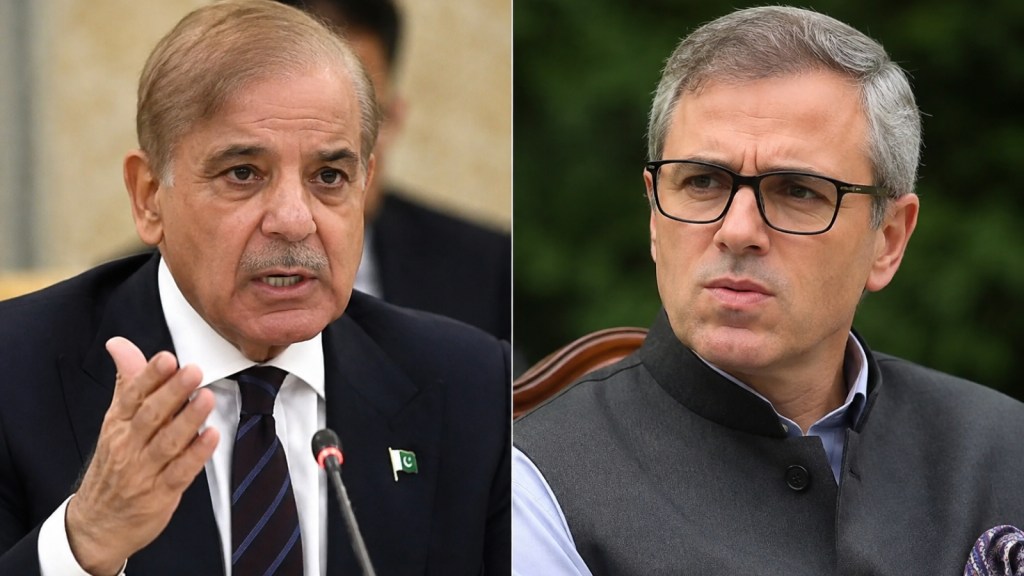 Pakistani Prime Minister Shehbaz Sharif and J&K CM Omar Abdullah. (AI-generated images)


 Share


