AI in schools: Why Mamdani wants NYC children to wait, while UAE says teach it
New York City is restricting student-facing generative AI through Grade 8, while the UAE is introducing an AI curriculum across public and private schools. Here’s why Mamdani is taking a more cautious approach, and what it could mean for the future of AI education.
New York City is putting the brakes on student-facing generative AI in schools, while the United Arab Emirates is making AI education part of the curriculum across public and private schools. The contrasting approaches highlight a growing global question — should children first learn without artificial intelligence, or learn how to use it from an early age?
The debate over AI in education is therefore shifting beyond whether students should use tools such as ChatGPT and Gemini.
New York City is restricting student-facing generative AI through eighth grade, while the UAE is introducing an AI curriculum across public and private schools. Both approaches are aimed at preparing students for an AI-driven future, but they take sharply different approaches to how that preparation should happen.
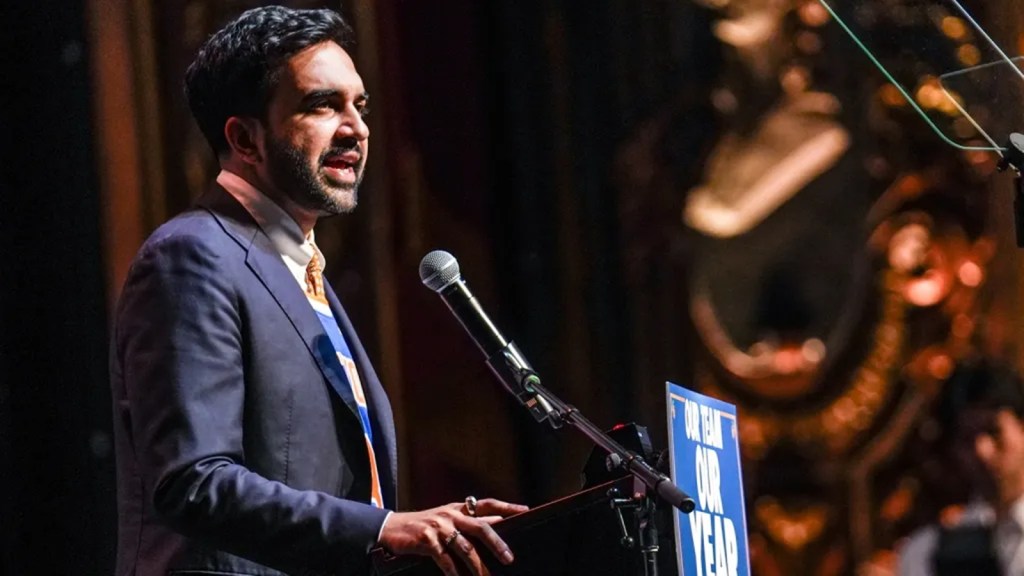
“Children need teachers and human connection in order to learn and grow”: New York City Mayor Zohran Mamdani announces 1-year AI ban for students till 8th grade pic.twitter.com/OG4V7TglW8
New York City Mayor Zohran Mamdani has imposed a one-year moratorium on student-facing generative AI for students from 2-K through eighth grade during the 2026-27 school year. Generative AI refers to systems that can create new text, images, audio or other content in response to a user’s instructions.
AI in schools: two sharply different bets on the future
New York City bans generative AI for students through eighth grade. The UAE makes it a mandatory subject from kindergarten. Same goal, opposite strategies.
New York City
Ban AI firstteach critical thinking
vs
United Arab Emirates
Teach AI fromkindergarten up
.
What NYC is doing
~600K
students affected (pre-K to Grade 8)
1 yr
moratorium (2026–27 school year)
37
US states with some AI guidance in schools
.
Mayor Zohran Mamdani announced a one-year ban on all student-facing generative AI software for 2-K through eighth grade, starting September 10.
.
The policy is described as the most expansive student-facing AI ban in the US, covering about two-thirds of NYC’s public-school enrolment.
.
Companion chatbots are banned across all grades, including high school.
.
High school students will receive twice-yearly AI literacy classes, and up to 50,000 high schoolers will join limited AI pilot programmes under educator supervision.
.
Teachers may still use AI for planning and operations, as long as tools meet NYC Public Schools’ safety standards.
.
Los Angeles Unified, the second-largest US district, has also restricted student generative AI use on district devices.
“Children need teachers and human connection in order to learn and grow. They need to develop skills alongside their peers, build relationships with educators and wrestle with tough problems on their own.”
— NYC Mayor Zohran Mamdani
.
What the UAE is doing
K–12
AI as a subject in all public and private schools
22,000
teachers and educators to be trained in AI
.
The UAE Cabinet, chaired by Sheikh Mohammed bin Rashid Al Maktoum, approved a nationwide AI curriculum for all public and private schools, from kindergarten to Grade 12.
.
Students will learn about AI data, algorithms, applications, risks and ethical use of technology.
.
22,000 teachers will be trained to use AI for teaching, assessment, curriculum analysis and lesson planning.
.
The Cabinet said a pilot programme in public schools had already produced “positive results” before the wider rollout.
.
The UAE approved a mechanism to make its AI curriculum available to education ministries internationally.
“To fulfil their new role, teachers will have to become lifelong learners — because if we teach our children today using the same methods of yesterday, we are depriving them of their future.”
— Sheikh Mohammed bin Rashid Al Maktoum
.
The question both approaches are really answering
Ban it
Let children learn without AI first
Teach it
Equip children to use AI from an early age
.
The debate has shifted beyond ChatGPT and Gemini — it is now about what kind of cognitive habits children should build first.
.
Experts have questioned how effective a one-year moratorium can be without a clear enforcement mechanism or a way to measure its impact on learning.
.
The US has no uniform national standard for AI literacy instruction, even as at least 37 states have some form of AI guidance.
.
NYC’s policy could become a test case for other school districts weighing whether to restrict AI or introduce it under tighter supervision.
“It is hard to know the effectiveness of the ban because they haven’t shared the enforcement mechanism.”
— Margaret Murray, Associate Professor, University of Michigan (to Al Jazeera)
Sources: Mayor’s Office, New York City · UAE Cabinet / Khaleej Times / The National · Associated Press · Al Jazeera. September 2–3, 2026.
Also, the official figure is nearly 600,000, representing about two-thirds of NYC’s public-school enrollment.
UAE introduces AI curriculum across schools
Meanwhile, the United Arab Emirates (UAE) has approved the implementation of an artificial intelligence curriculum across all public and private schools.
The curriculum, according to a Khaleej Times report, is expected to teach students about AI data, applications, algorithms, and risks alongside building an aptitude for awareness of the ethical use of technology.
UAE to train 22,000 teachers in AI
The UAE will also train 22,000 teachers and educators to use AI in teaching, assessment, curriculum analysis and lesson planning. The decision was announced after a Cabinet meeting chaired by Sheikh Mohammed bin Rashid Al Maktoum, Vice-President and Prime Minister of the UAE and Ruler of Dubai.
Story continues below this ad
NYC mayor cites human connection in education
Mamdani has framed the moratorium on student-facing generative AI around the importance of human connection, critical thinking and hands-on learning.
The NYC mayor added, “Each day when our children come to school, we teach them to ask questions… When it comes to AI in our schools, we hold an obligation to do the same.”
Other US school districts also restrict AI
New York is not alone in taking a cautious approach. Los Angeles Unified, the second-largest US school district, has also imposed restrictions on students’ use of generative AI on district-owned devices.
An Associated Press report said at least 37 states in the US already have some form of official AI guidelines. However, there are no uniform SOPs for AI literacy instruction.
Story continues below this ad
Academicians debate effectiveness of AI ban
New York City’s policy could become a test case for other school districts weighing whether to restrict generative AI or introduce it under tighter supervision. But experts have questioned how effective a one-year moratorium can be without a clear way to measure its impact on learning and student behaviour.
“NYC public schools banning AI in elementary and middle schools sends an important message because it is the largest school district in the US. However, it is hard to know the effectiveness of the ban because they haven’t shared the enforcement mechanism,” said Margaret Murray, associate professor of communication at the University of Michigan, Al Jazeera reported.
The Express Global Desk at indianexpress.com which delivers authoritative, verified, and context-driven coverage of key international developments shaping global politics, policy, and migration trends. The desk focuses on stories with direct relevance for Indian and global audiences, combining breaking news with in-depth explainers and analysis.
A major focus area of the desk is US immigration and visa policy, including developments related to student visas, work permits, permanent residency pathways, executive actions, and court rulings. The Global Desk also closely tracks Canada’s immigration, visa, and study policies, covering changes to study permits, post-study work options, permanent residence programmes, and regulatory updates affecting migrants and international students.
All reporting from the Global Desk adheres to The Indian Express’ editorial standards, relying on official data, government notifications, court documents, and on-record sources. The desk prioritises clarity, accuracy, and accountability, ensuring readers can navigate complex global systems with confidence.
Core Team
The Express Global Desk is led by a team of experienced journalists and editors with deep expertise in international affairs and migration policy:
Aniruddha Dhar – Senior Assistant Editor with extensive experience in global affairs, international politics, and editorial leadership.
Nischai Vats – Deputy Copy Editor specialising in US politics, US visa and immigration policy, and policy-driven international coverage.
Mashkoora Khan – Sub-editor focusing on global developments, with a strong emphasis on Canada visa, immigration, and study-related policy coverage. ... Read More