Hidekazu Yokoyama has spent three decades building a thriving logistics business on Japan’s snowy northern island of Hokkaido, an area that provides much of the country’s milk.
Last year, he decided to give it all away.
It was a radical solution for a problem that has become increasingly common in Japan, the world’s grayest society. As the country’s birthrate has plummeted and its population has grown older, the average age of business owners has risen to around 62. Nearly 60% of the country’s businesses report that they have no plan for what comes next.
While Yokoyama, 73, felt too old to carry on much longer, quitting wasn’t an option: Too many farmers had come to depend on his company. “I definitely couldn’t abandon the business,” he said. But his children weren’t interested in running it. Neither were his employees. And few potential owners wanted to move to the remote, frozen north.
So he placed a notice with a service that helps small-business owners in far-flung locales find someone to take over. The advertised sale price: zero yen.
Yokoyama’s struggle symbolizes one of the most potentially devastating economic impacts of Japan’s aging society. It is inevitable that many small- and medium-size companies will go out of business as the population shrinks, but policymakers fear that the country could be hit by a surge in closures as aging owners retire en masse.
In an apocalyptic 2019 presentation, Japan’s trade ministry projected that by 2025, around 630,000 profitable businesses could close up shop, costing the economy $165 billion and as many as 6.5 million jobs.
Economic growth is already anemic, and Japanese authorities have sprung into action in hopes of averting a catastrophe. Government offices have embarked on public relations campaigns to educate aging owners about options for continuing their businesses beyond their retirements and have set up service centers to help them find buyers. To sweeten the pot, the authorities have introduced large subsidies and tax breaks for new owners.
Still, the challenges remain formidable. One of the biggest obstacles to finding a successor has been tradition, said Tsuneo Watanabe, a director of Nihon M&A Center, a company that specializes in finding buyers for valuable small- and medium-size enterprises. The company, founded in 1991, has become enormously lucrative, recording $359 million in revenue in 2021.
But building that business has been a long process. In years past, small-business owners, particularly those who ran the country’s many decades- or even centuries-old companies, assumed that their children or a trusted employee would take over. They had no interest in selling their life’s work to a stranger, much less a competitor.
Mergers and acquisitions “weren’t well regarded,” Watanabe said. “A lot of people felt that it was better to shut the company down than sell it.” Perceptions of the industry have improved over the years, but there are “still many businesspeople who aren’t even aware that M&A is an option,” he added.
While the market has found buyers for the businesses most ripe for the picking, it can seem nearly impossible for many small but economically vital companies to find someone to take over.
In 2021, government help centers and the top five merger-and-acquisitions services found buyers for only 2,413 businesses, according to Japan’s trade ministry. Another 44,000 were abandoned. Over 55% of those were still profitable when they closed.
Many of those businesses were in small towns and cities, where the succession problem is a potentially existential threat. The collapse of a business, whether a major local employer or a village’s only grocery store, can make it even harder for those places to survive the constant attrition of aging populations and urban flight that is hollowing out the countryside.
After a government-run matching program failed to find someone to take over for Yokoyama, a bank suggested that he turn to Relay, a company based in Kyushu, Japan’s southernmost main island.
Relay has differentiated itself by appealing to potential buyers’ sense of community and purpose. Its listings, featuring beaming proprietors in front of sushi shops and bucolic fields, are engineered to appeal to harried urbanites dreaming of a different lifestyle.
The company’s task in Yokoyama’s case wasn’t easy. For most Japanese, the town where his business is situated, Monbetsu, which has around 20,000 people and is shrinking, might as well be the North Pole. The only industries are fishing and farming, and they largely go into hibernation as the days grow short and snow piles up to roof eaves. In deep winter, some tourists come to eat salmon roe and scallops and see the ice floes that lock in the city’s modest port.
A street full of 1980s-era cabarets and restaurants is a snapshot of a more prosperous time when young fishermen gathered to let off steam and spend big paychecks. Today, faded posters peel off abandoned storefronts. The town’s biggest building is a new hospital.
In 2001, Monbetsu constructed a new elementary school building just around the corner from Yokoyama’s company. It closed after just 10 years.
In times past, the classrooms would have been filled with the grandchildren of local dairy farmers. But their own children have now mostly moved to cities in search of higher-paying, less onerous work.
With no obvious successors, the farms have folded one after another. Decades-high inflation brought on by the pandemic and Russia’s war in Ukraine has pushed dozens of holdouts into early retirement.
As local farmers have aged and their profits thinned, more of them have come to depend on Yokoyama for tasks such as harvesting hay and clearing snow. His days start at 4 a.m. and end at 7 in the evening. He sleeps in a small room behind his office.
It would be “extremely difficult” if his business folded, said Isao Ikeno, the manager of a nearby dairy cooperative that has turned heavily to automation as workers have become harder to find.
On the cooperative’s farm, 17 employees tend to 3,000 head of cattle, and Yokoyama’s company fills in the gaps. No other area businesses can provide the services, Ikeno said.
Yokoyama began contemplating retirement about six years ago. But it wasn’t clear what would happen to the business.
While he had taken on a little over $500,000 in debt, years of generous economic stimulus policies have kept interest rates at rock bottom, easing the burden, and the company’s annual profit margin was around 30%.
The ad he placed on Relay acknowledged that the job was hard, but it said that no experience was needed. The best candidate would be “young and ready to work.”
Whoever was chosen would take over the debts, but also inherit all of the business’s equipment and nearly 150 acres of prime farmland and forest. Yokoyama’s children will get nothing.
“I told them that if you want to take it over, I’d leave it to you, but if you don’t want to do it, I’m giving it all to the next guy,” he said.
Thirty inquiries poured in. Among those who expressed interest were a couple and a representative of a company that planned to expand. Yokoyama settled on a dark horse, 26-year-old Kai Fujisawa.
A friend had shown Fujisawa the ad on Relay, and Fujisawa immediately jumped in a car and showed up on Yokoyama’s doorstep, impressing him with his youth and enthusiasm.
Still, the transition hasn’t been smooth. Yokoyama is not entirely convinced that Fujisawa is the right person for the job. The learning curve is steeper than either of them had imagined, and Yokoyama’s grizzled, chain-smoking employees are skeptical that Fujisawa will be able to live up to the boss’s reputation.
Most of the company’s 17 employees are in their 50s and 60s, and it’s not clear where Fujisawa will find people to replace them as they retire.
“There’s a lot of pressure,” Fujisawa said. But “when I came here, I was prepared to do this for the rest of my life.”

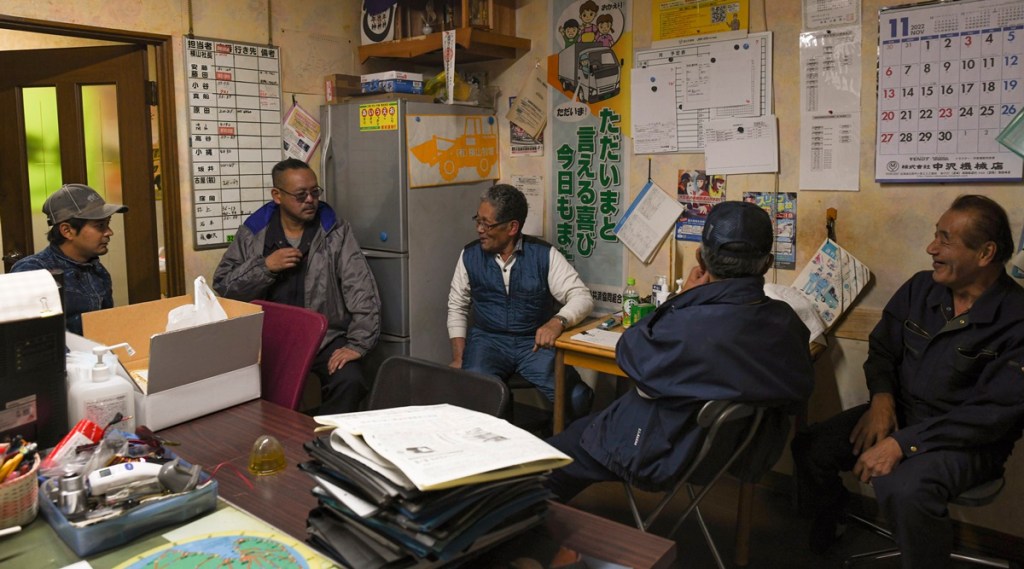 Workers employed by Hidekazu Yokoyama in Monbetsu, Japan, on Nov. 3, 2022. Many of Japan's aging business owners are struggling to find buyers, even for successful enterprises. Yokoyama, a dairy logistics entrepreneur, plans to just give away the business he spent decades building. (Noriko Hayashi/The New York Times)

 Share


