


Stay updated with the latest - Click here to follow us on Instagram

Journalism of Courage
 Airlines will be required to check all passengers from China have negative pre-departure tests, and passengers will not be allowed to board a flight without providing evidence of a negative test result. (China daily via Reuters)
Japan and South Korea defended public health restrictions on travellers from China on Wednesday, a day after China stopped issuing new visas in both countries in apparent retaliation.
Chinese embassies stopped issuing new visas for South Koreans and Japanese on Tuesday.
It wasn’t clear whether China would expand the visa suspensions to other countries that have imposed stricter virus testing on passengers from China following its COVID-19 surge.
South Korean Foreign Minister Park Jin said on Wednesday he finds it “significantly regrettable” that China stopped issuing short-term visas to South Koreans and called for China to align its pandemic steps with “scientific and objective facts”.
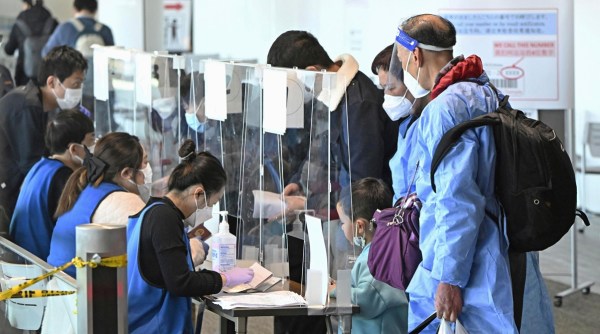 Passengers from Shanghai present proof of a negative Covid-19 test on their arrival at Narita airport near Tokyo on Jan. 8, 2023. (Kyodo News via AP)
According to South Korea’s Disease Control and Prevention Agency, about 17 per cent of the 2,550 short-term travellers from China from January 2 to Tuesday have tested positive.
South Korea has stopped issuing most short-term visas at its consulates in China through the end of January while also requiring all passengers from China, Hong Kong, and Macau to submit proofs of negative tests taken within 48 hours of their arrival in addition to COVID-19 tests at the airport.
Japanese Chief Cabinet Secretary Hirokazu Matsuno criticised China for “one-sidedly” restricting visa issuances to Japanese nationals “because of a reason that is not related to COVID-19 measures”.
Tokyo protested and demanded China scrap the measures and that Japan will “respond appropriately while closely watching China’s infection situation and how information disclosures are handled by the Chinese side”, Matsuno said.
Matsuno said Japan had to take temporary measures to avoid rapid inflow of infections into Japan because of China’s spreading infections and lack of transparency about the situation.
He said that Japanese border measures are purely aimed at preventing infections and have aimed to limit effects on international travel. “It is extremely regrettable that China has one-sidedly restricted visa issuances.” The Chinese embassies in Tokyo and Seoul announced the suspensions in brief online notices, without providing reasons or details such as when visa issuances will resume.
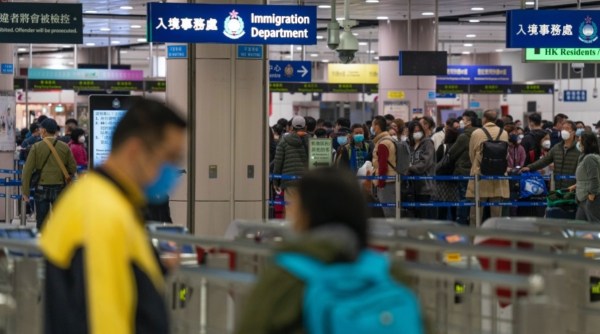 Travelers wearing face masks line up at the immigration counters of the departure hall at Lok Ma Chau station following the reopening of crossing border with mainland China, in Hong Kong.(AP Photo/Bertha Wang)
China’s Foreign Ministry threatened countermeasures last week against countries that had announced new virus testing requirements for travelers from China. At least 10 governments in Europe, North America, and Asia have done so recently.
Meanwhile, Thailand sent three ministers to Bangkok’s Suvarnabhumi Airport to welcome the country’s first planeload of Chinese tourists in years, in a bid to revive inbound tourism.
Japan reopened its borders for individual tourism in October. Most travellers can show proof of vaccination instead of testing at the airport, unless they show symptoms, but since December 30 travellers from China must show pre-departure negative tests and take an additional test upon arrival. Those who test positive must quarantine at designated facilities for up to seven days.
According to health ministry statistics, about 97 per cent of 497 people who tested positive upon arrivals from December 31 to January 9 were Chinese or had recently been in China.
 Despite the risk of new infections, the reopening, that will allow tens of thousands of people who have made prior online bookings to cross each day, is expected to provide a much-needed boost to Hong Kong’s tourism and retail sectors. (Reuters)
Some Japanese media recently showed Chinese tourists at pharmacies buying anti-fever medicine, noting shortages.
China’s worsening COVID-19 situation and lack of information mean that South Korea may need to extend restrictions, senior Disease Control and Prevention Agency official Lim Sook-young told a briefing. “Just because we haven’t seen the emergence of a new variant doesn’t necessarily mean we won’t see one later,” she said.
Park said he doesn’t believe that the friction over COVID-19 measures would seriously hurt bilateral relations, which he described as stable.
“The most important reason for our government’s measure is the lives and safety of our people,” he said. “We will monitor the COVID-19 situation in China before determining how long we will maintain our measures.” Withholding of visas from South Korean or Japanese businesspeople could delay commercial activity and potential new investment.
South Korea’s Ministry of Small and Medium-sized Enterprises and Startups on Wednesday opened telephone lines for small businesses to report any disruption caused by China’s decision to halt short-term visas.
While only a few calls had been received as of Wednesday afternoon, officials say that the Chinese steps could hurt some companies exporting to China by forcing their employees to cancel visits and business meetings.
“We are closely monitoring how much disruption,” the Chinese steps may cause, said ministry official Lee Gwon-jae.
Impact on Japan could be limited for now, as Japanese businesspeople are still largely watching the development. A major tour agency said none of its customers were currently seeking China visas.

A South Korean restaurant owner in Beijing said the announcement forced friends to postpone plans to visit China. He spoke on condition of anonymity out of concern his business might be affected. He added that he is preparing to renew his Chinese work visa and doesn’t know whether that will be affected.
China’s move appeared to be grounded in its strict view of reciprocity and demands that its citizens be treated the same as those of other countries.
“A handful of countries, in disregard of science, facts, and their actual epidemic situation, have insisted on taking discriminatory entry restriction measures targeting China,” Chinese Foreign Ministry spokesperson Wang Wenbin said on Wednesday.
“China made reciprocal responses in light of the actual discriminatory measures taken by these countries against China.” He did not respond directly when asked if new visas had been suspended for South Koreans and Japanese, saying only that he had “made it very clear”.
Once-cordial ties between South Korea and China, its biggest trading partner, soured in recent years after Beijing targeted businesses, sports teams, and even K-pop groups to protest the deployment of an advanced US anti-missile system in South Korea.
The World Health Organisation and several nations have accused China of withholding data on its outbreak.
China abruptly reversed its “zero-COVID” strategy of trying to contain the virus last month in response to what it says was the changing nature of the outbreak. That came after three years of lockdowns, quarantines, and mass testing that prompted rare politically tinged protests in major cities.
China is facing a surge in cases and hospitalizations in major cities and is bracing for a further spread into less developed areas with the start of the Lunar New Year travel rush, set to accelerate in the coming days. While international flights are still reduced, authorities say they expect domestic rail and air journeys will double over the same period last year.
Stay updated with the latest - Click here to follow us on Instagram