


Stay updated with the latest - Click here to follow us on Instagram
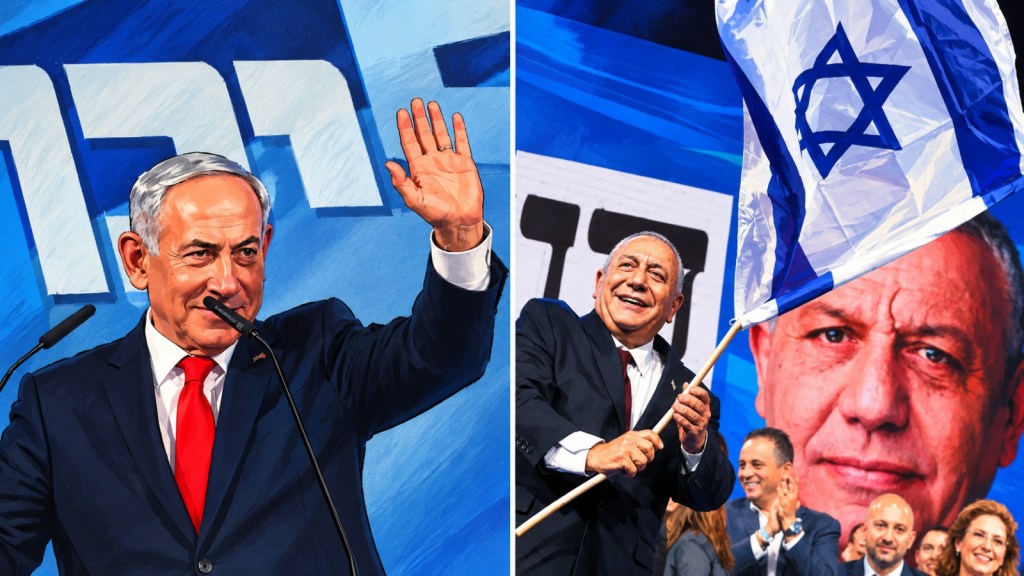 Israeli Prime Minister Benjamin Netanyahu waves following exit polls for Israels national election, at Likuds election headquarters in Jerusalem, October 28, 2026; former military chief Gadi Eisenkot, leader of the Yashar party, waves an Israeli flag following the exit polls. (Reuters)
Benjamin Netanyahu continues to be the caretaker prime minister of Israel after the 2026 general election results threw a hung parliament, with no bloc able to achieve a 61-seat majority in the 120-seat Knesset. Arab-led parties, including Ra’am and Joint List, sprang a surprise by securing 19 seats, which is now positioning them as kingmakers in the power corridors of Tel Aviv, as there seems to be no clear path to a new government.
Netanyahu’s main opposition, the Gadi Eisenkot-led bloc that includes Yashar, B’Yachad, The Democrats, and Yisrael Beytenu, also failed to win a majority in the Knesset, but the coalition of Jewish parties ensured that Netanyahu lost his coalition’s parliamentary majority following the elections held on October 27. Amid uncertainty over government formation, reports stated that weeks of political wrangling lie ahead as Israel’s political blocs weigh government arrangement possibilities.
Pro-Netanyahu coalition won 53 seats:
Eisenkot-led Jewish bloc won 48 seats:
Arab-led parties won 19 seats:
The result shows all blocs failing to secure a majority to form the next government in the Knesset. Some parties will have to realign or join other blocs to ensure a new government is formed.
After the counting of votes and declaration of results, the Israeli election outcome must be officially certified and presented to the country’s President Isaac Herzog by November 4. The new Knesset is scheduled to be sworn in on November 10, Al Jazeera reported.
After the swearing-in ceremony, President Herzog will give the responsibility to form a new government by November 11 to a member of Knesset. Herzog will reportedly make his decision after receiving input from Israeli party leaders, and will shortlist the candidate most favourable to form a majority coalition.
After the president selects a candidate, the shortlisted Knesset member will have 28 days to form a government; however, there will be a possibility of an extension for 14 days.
Yashar party chief Gadi Eisenkot has said Israeli voters overwhelmingly voted against PM Netanyahu.
“No matter how you look at the numbers, a majority of Israeli citizens, by a margin of more than half a million votes, voted against the government of October 7 and draft evasion, and in favour of change,” Eisenkot said.
The Yashar party leader added, “Do not let anyone mislead you: In the State of Israel, it is the Knesset that gives its confidence to the government, not the other way around,” Times of Israel reported.
Stay updated with the latest - Click here to follow us on Instagram