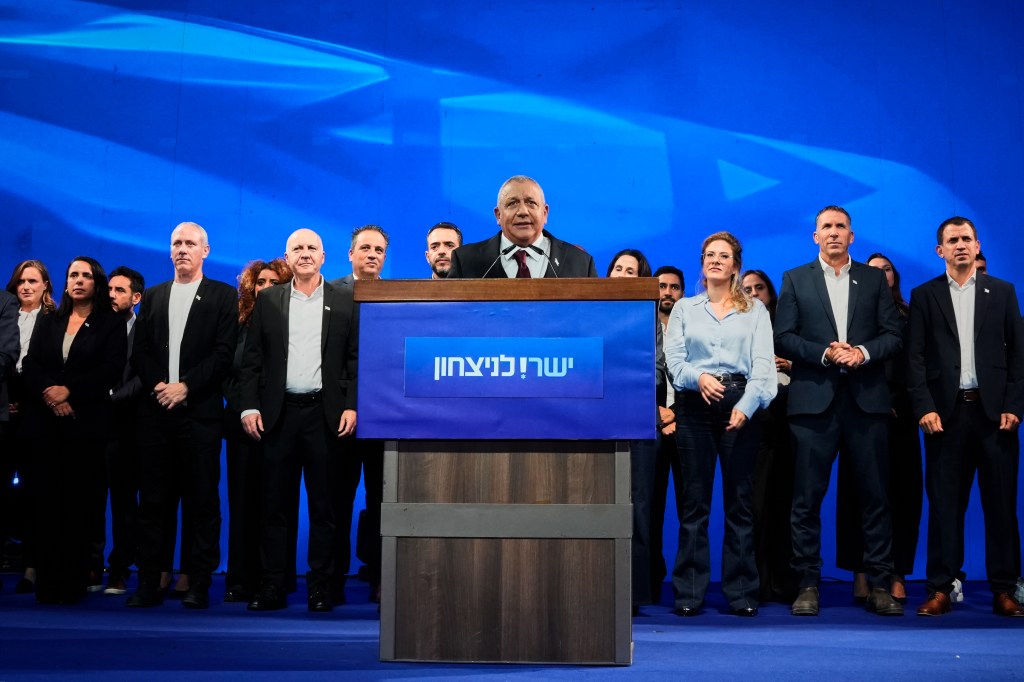
Israel Election Results 2026: Benjamin Netanyahu’s bloc wins 53 seats in Israel election, opposition secures 67
Israel’s election chief has dismissed allegations of widespread fraud following Benjamin Netanyahu’s claim that the vote was “stolen”, saying there is no evidence of systematic irregularities, as the counting of election results continues.
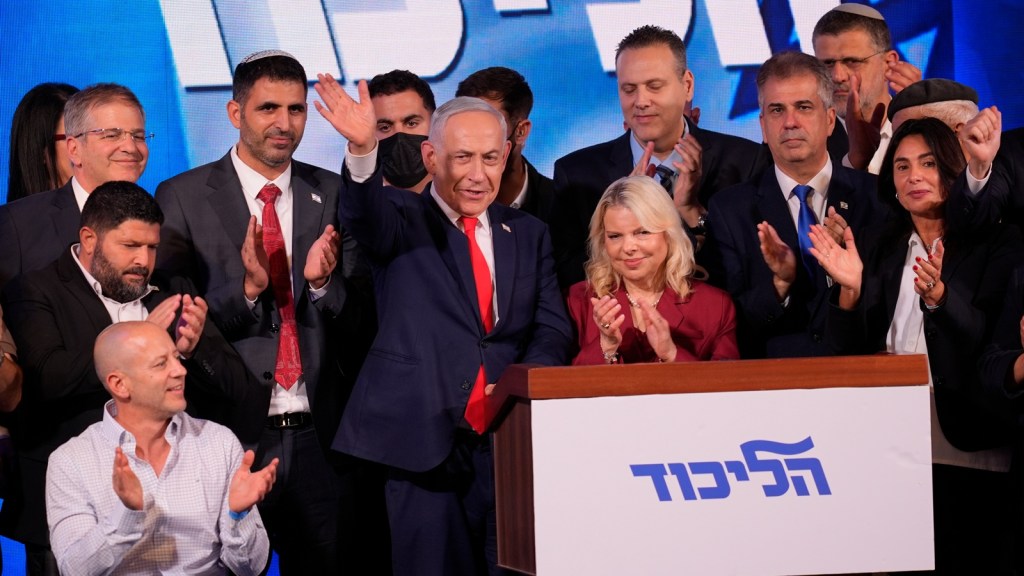
Israeli Prime Minister Benjamin Netanyahu waves to supporters as his wife, Sara, applauds at Likud party headquarters in Jerusalem following the release of the first exit poll results in Israel's general election. (AP Photo)
Vote counting in Israel’s 2026 election is now complete, with Prime Minister Benjamin Netanyahu’s bloc securing 53 seats in the 120-member Knesset. The opposition parties have secured 67 seats, leaving Netanyahu’s bloc short of a parliamentary majority.
This live blog has now been closed. For the latest updates on the 2026 Israeli election results, click here.
Story continues below this ad
Meanwhile, Iran has reportedly tried to interfere in the Israeli election held on Tuesday, and the Islamic Republic official has vowed that the country will try to disrupt the US midterm elections scheduled for next week.
“We have been looking into ways to recruit agents in both the American and Israeli regimes’ election processes,” an Iranian official said, adding that “powerful cyber groups have also been established to hack their election systems,” The Telegraph reported.
All ballots counted · Official certification pending
Israel election results: The count is complete
Build a coalition, test the Arab parties’ role, see who gained and lost, who is heading to the Knesset, where parties led and how the count unfolded. Pick a section.
Thirteen seats short of a majority without support from outside its bloc.
Arab-led parties
19
Joint List (11) and Ra’am (8) remain separate parties; their positions in negotiations may differ.
Likud 27
Yashar 21
B’Yachad 12
Joint List 11
The Democrats 8
Ra’am 8
Yisrael Beytenu 7
Otzma Yehudit 7
United Torah Judaism 7
Shas 6
Religious Zionism–Zehut 6
Neither major bloc has a majority on its own, so the Arab-led parties could be pivotal. Bloc groupings are editorial, not official Central Elections Committee categories. Forming a government is a separate process from the count, and no coalition scenario is certain.
Can you build a coalition that reaches 61 seats?
Tap a party to add its seats; tap it again to take it out, or use Clear all to start over. Seats are the reported completed-count figures, pending official certification.
Maths, not a prediction. A combination that adds up to 61 is not necessarily a politically viable coalition. Red lines, abstentions, outside support and confidence-vote strategy can all affect government formation.
of 120 seats
Tap a party again to remove it
61
61 seats or more
Mathematical majority: seats
Below majority
more seats needed
Netanyahu bloc
53 seats
Likud
Benjamin Netanyahu
27
Shas
Aryeh Deri
6
UTJ
United Torah Judaism
Yaakov Asher
7
Otzma Yehudit
Itamar Ben-Gvir
7
Religious Zionism–Zehut
Bezalel Smotrich
6
Opposition bloc
48 seats
Yashar
Gadi Eisenkot
21
B’Yachad
Naftali Bennett
12
Yisrael Beytenu
Avigdor Liberman
7
The Democrats
Yair Golan
8
Arab-led parties
19 seats
JL
Joint List
Yousef Jabareen
11
Ra’am
Mansour Abbas
8
Political reality check
Dated public positions relevant to your mix appear here: ruled out, reluctant, policy clash or open to talks. A position can change in negotiations.
Ruled out: Yisrael Beytenu + Arab-led parties
Avigdor Liberman has pledged not to form a government that relies on Arab parties (The Times of Israel, Oct 28).
Ruled out: B’Yachad + Arab-led parties
Naftali Bennett has pledged not to sit with Arab parties this time, although he led a government that included Ra’am in 2021 (The Times of Israel, Oct 28).
Ruled out: The Democrats + Likud or Haredi parties
Yair Golan says he will not sit with the Haredi parties, or with Likud while Netanyahu leads it (The Jewish Chronicle, Oct 28).
Ruled out: Likud + Arab-led parties
Netanyahu said it was unthinkable “to set up a government that relies upon anti-Zionist Arab parties” (The Times of Israel, Oct 28).
Ruled out: Yashar + Likud
Gadi Eisenkot has rejected serving under Netanyahu, including in a rotation (The Jerusalem Post, Oct 28). Netanyahu says partners are welcome “without a rotation” (Israel Hayom, Oct 28).
Policy clash: Yashar + Haredi parties
Eisenkot’s stated priority is a “Zionist government committed to military conscription” (Ynet, Oct 28). United Torah Judaism quit Netanyahu’s government over the draft law.
Reluctant: Yashar + Arab-led parties
Before the vote, Eisenkot ruled out a minority government relying on Arab-led parties (Al Jazeera, Oct 29). Since then he has not set out any framework for working with them (Ynet, Oct 28).
Open to talks: Ra’am
Mansour Abbas told Channel 12 that “everyone is speaking with us”, and said he is willing to join an Eisenkot-led coalition if it proves viable (The Times of Israel, Oct 28).
Open to talks: The Democrats + Arab-led parties
Golan has urged partners to form “a government of change in partnership with Israel’s Arab citizens” (The Times of Israel, Oct 28).
Open to talks: Joint List
Ahmad Tibi said the Joint List would not seek ministries or formal coalition membership, but would consider backing a government from outside in return for commitments on crime in Arab communities and an end to Bedouin home demolitions (Ynet, Oct 28).
61 is not the only route. To take office, a government needs more votes for it than against in a Knesset confidence vote. A party can join the cabinet, back the government from outside without taking ministries, or abstain. The Bennett-Lapid government was sworn in by 60 votes to 59 in 2021, with one abstention. A coalition below 61, though, needs outside help to pass laws and survive. Forming a government is a separate process from counting the votes: after the official results, the president consults the parties and asks a Knesset member to try to form one.
Can Arab parties decide Netanyahu’s future?
Joint List (11) and Ra’am (8) together hold a record 19 seats, but they are separate parties with different leaders and positions. Pick a starting bloc, then decide what each Arab-led party does in the confidence vote.
Step 1 · Start with a bloc
Step 2 · What do the Arab-led parties do?
Ra’am
Led by Mansour Abbas
8
JL
Joint List
Led by Yousef Jabareen
11
For
Against
Abstain
Takes office
More votes for than against
Fails
Not enough votes for the government
Working majority
Coalition holds seats, 61 or more
Minority
Coalition holds of 120 seats
Political reality check
Reluctant: Eisenkot
Before the vote, Eisenkot ruled out a minority government relying on Arab-led parties (Al Jazeera, Oct 29). Since then he has not set out any framework for working with them (Ynet, Oct 28).
Ruled out: Bennett
Naftali Bennett has pledged not to sit with Arab parties this time, although he led a government that included Ra’am in 2021 (The Times of Israel, Oct 28). This mix needs his support.
Ruled out: Liberman
Avigdor Liberman has pledged not to form a government that relies on Arab parties (The Times of Israel, Oct 28). This mix needs his support.
Arithmetic: without Bennett and Liberman
Yashar and the Democrats hold 29 seats between them.
Open to talks: Golan
Golan has urged partners to form “a government of change in partnership with Israel’s Arab citizens” (The Times of Israel, Oct 28).
Ruled out: Netanyahu
Netanyahu said it was unthinkable “to set up a government that relies upon anti-Zionist Arab parties” (The Times of Israel, Oct 28). Abbas says Likud has also approached him (The Times of Israel, Oct 28).
Open to talks: Abbas
Mansour Abbas told Channel 12 that “everyone is speaking with us”, and said he is willing to join an Eisenkot-led coalition if it proves viable (The Times of Israel, Oct 28). In 2021 Ra’am became the first Arab-majority party to join an Israeli government.
Open to talks: Joint List
Ahmad Tibi said the Joint List would not seek ministries or formal coalition membership, but would consider backing a government from outside in return for commitments on crime in Arab communities and an end to Bedouin home demolitions (Ynet, Oct 28).
Three ways to back a government
Join
Inside the coalition. Ministers and a share of power. Ra’am did this in the Bennett-Lapid government of 2021.
Back
Support from outside. Votes for the government without taking ministries. Yitzhak Rabin’s government relied on outside Arab support after 1993.
Abstain
Stay out of the vote. A government needs more votes for than against, not 61. Bennett-Lapid was sworn in 60–59, with one abstention.
The calculator assumes every party you have not added votes against. It is arithmetic, not a forecast: the Joint List and Ra’am are separate parties with different leaders and positions.
Sources: Seats: completed Central Elections Committee count as reported by Globes (Oct 29, 2026, 6:15pm Israel time), pending official certification. Positions: The Times of Israel, Ynet, Al Jazeera, The Jerusalem Post (Oct 28–29, 2026). 2021 vote: Axios. 1993 precedent: The Times of Israel.
Which parties gained seats and which lost ground?
Seats on the completed count, pending certification, compared with what each list won in the 2022 election, the last consistent baseline. Many lists merged or split, and some members switched parties during the outgoing Knesset, so read the notes before comparing names.
Netanyahu bloc
64
53
−11
Eisenkot bloc
46
48
+2
Arab-led parties
10
19
+9
Grey bar: seats won in the 2022 election. Coloured bar: seats on the completed count, pending certification. The 2022 bloc totals above are a retrospective grouping of the 2022 lists into today’s blocs.
YA
Yashar
First election
New
2022
0
2026
21
New party. Eisenkot was elected in 2022 on Benny Gantz’s National Unity list.
JL
Joint List
In 2022: Hadash–Ta’al
+6
2022
5
2026
11
Balad, which missed the threshold running alone in 2022, rejoined.
TH
The Democrats
In 2022: Labor
+4
2022
4
2026
8
Labor merged with Meretz, which won no seats in 2022.
RA
Ra’am
+3
2022
5
2026
8
YI
Yisrael Beytenu
+1
2022
6
2026
7
UTJ
United Torah Judaism
±0
2022
7
2026
7
New leader: Yaakov Asher replaced Moshe Gafni.
OT
Otzma Yehudit + Religious Zionism–Zehut
In 2022: Religious Zionism alliance
−1
2022
14
2026
13
The 2022 joint list, which also included Noam, split. Otzma 7, Religious Zionism–Zehut 6.
SH
Shas
−5
2022
11
2026
6
LI
Likud
−5
2022
32
2026
27
Now includes Gideon Sa’ar’s New Hope, which ran on the National Unity list in 2022.
B&
B’Yachad
In 2022: Yesh Atid
−12
2022
24
2026
12
Yesh Atid now runs inside Naftali Bennett’s list; Yair Lapid is No. 2.
NU
National Unity
Did not run in 2026
Did not run
2022
12
2026
0
Broke up in 2025. Gantz’s Blue and White withdrew on Oct 19, 2026.
Lists that merged, split or are new since 2022. 2022 seats in grey. Shas, United Torah Judaism, Yisrael Beytenu and Ra’am run under the same names as in 2022.
Yesh Atid 24
Bennett 2026 new
→
B’Yachad12 seats
Formed April 2026 and headed by Naftali Bennett.
National Unity 12
→
Yashar21 seats
Eisenkot left National Unity in 2025 and founded Yashar. The alliance ended in July 2025; Gantz’s Blue and White withdrew from the race on Oct 19, 2026.
Likud 32
New Hope ran in National Unity
→
Likud27 seats
Gideon Sa’ar’s New Hope agreed in 2025 to merge back into Likud.
Religious Zionism alliance 14
→
Otzma Yehudit7 seats
The joint list split in November 2022. Each party now runs on its own.
Religious Zionism alliance 14
Zehut no seats
Jewish Home no seats
→
Religious Zionism–Zehut6 seats
Jewish Home merged into Religious Zionism in 2023. Moshe Feiglin of Zehut is No. 2.
Labor 4
Meretz 0
→
The Democrats8 seats
Labor and Meretz merged in July 2024 under Yair Golan.
Hadash–Ta’al 5
Balad 0
→
Joint List11 seats
Hadash, Ta’al and Balad agreed on Aug 19, 2026, to run together again.
Sources: 2022 results: Central Elections Committee. 2026 seats: completed Central Elections Committee count as reported by Globes (Oct 29, 2026, 6:15pm Israel time), pending official certification. List changes: PoliWave, Israel Policy Forum. The 2022 baseline is the election result, not the outgoing Knesset’s final faction sizes.
Who is heading to the Knesset?
Israel votes for party lists, not local candidates. Seats go to names in ballot order, so a party’s seat count on the completed count shows who is set to enter, pending certification. Tap a party.
Likud
Led by Benjamin Netanyahu
27seats
The top 27 names are set to enter the Knesset on the completed count, pending certification. The next two are first in line if a member resigns.
Benjamin NetanyahuPrime minister
Eli CohenEnergy minister
Amir OhanaKnesset speaker
Yariv LevinJustice minister
Miri RegevTransportation minister
Israel KatzDefence minister
Gideon Sa’arForeign minister
Ofir KatzCoalition chairman
Tali Gu’iliNew Hope candidate on the Likud list
Yoav KischEducation minister
Yaakov BardugoBroadcaster
Miki ZoharCulture and sport minister
Almog CohenDeputy minister, PM’s Office
Amichai ChikliDiaspora affairs minister
Elisha MadanReserve combat soldier
David PeterLitigator
Moshe SaadaMK, former police investigator
Haim KatzTourism and housing minister
David AmsalemRegional cooperation minister
Etty AtiaMK
Boaz BismuthMK, foreign affairs and defence committee chair
David BitanMK, economics committee chair
Shlomo KarhiCommunications minister
Nir BarkatEconomy minister
Gila GamlielScience and technology minister
Eli GoldschmidtFormer MK
Erez TadmorPublicist and broadcaster
Cut-off on the completed count
Shlomo LernerLawyer
Yitzhak BunzelFamily-law attorney
Yashar
Led by Gadi Eisenkot
21seats
The top 21 names are set to enter the Knesset on the completed count, pending certification. The next two are first in line if a member resigns.
Gadi EisenkotFormer IDF chief of staff
Yoram CohenFormer Shin Bet director
Orit Farkash-HacohenFormer science minister
Adi AltshulerSocial entrepreneur
Matan KahanaFormer religious services minister
Chili TropperFormer culture minister; Yesodot Israel
Shaul MeridorFormer Treasury budgets chief
Tair IfarganFormer Labour Ministry director-general
Oshrat Gani GonenRegional council head
Shira ShapiraCivic activist
Inbar Harush GitiFormer Defence Ministry official
Elazar SternFormer intelligence minister
Kamil Abu RukunFormer COGAT head
Dvora BakarEducational entrepreneur
Alex RifActivist
Inbar YehezkeliAttorney
Roy FolkmanFormer MK
Israel ZariDeputy mayor of Ramat Gan
Tal OhanaFormer Yeruham council head
Elyasaf PeretzIDF reservist
Yafa TabajaInnovation centre founder
Cut-off on the completed count
Nir HajbiColonel (res.)
Ron BarkaiPolicy programme director
B’Yachad
Led by Naftali Bennett
12seats
The top 12 names are set to enter the Knesset on the completed count, pending certification. The next two are first in line if a member resigns.
The top 11 names are set to enter the Knesset on the completed count, pending certification. The next two are first in line if a member resigns.
Yousef JabareenHadash chairman
Ahmad TibiTa’al chairman
Faten GhattasHadash
Bakr AwawdehBalad
Ofer CassifHadash MK
Youssef AtaunaFormer MK, Hadash
Maha Karkabi-SabahSociologist, Balad
Ahmad DarawsheTa’al
Nihaya WishahyLecturer, Hadash
Hassan NasasraEducator, Balad
Haitham ZahalkaLawyer, Ta’al
Cut-off on the completed count
Iyas NatourProducer, Hadash
Ghassan AbdallahTa’al
The Democrats
Led by Yair Golan
8seats
The top 8 names are set to enter the Knesset on the completed count, pending certification. The next two are first in line if a member resigns.
Yair GolanMaj. Gen. (res.)
Naama LazimiMK
Gilad KarivMK, Reform rabbi
Efrat RaytenMK
Yair FinkSocial activist
Gaby LaskyFormer MK
Omri RonenProtest activist
Michal RozinFormer MK
Cut-off on the completed count
Moshe RadmanProtest leader
Sumaya BashirArts therapist
Shas
Led by Aryeh Deri
6seats
The top 6 names are set to enter the Knesset on the completed count, pending certification. The next two are first in line if a member resigns.
Aryeh DeriParty chairman
Yinon AzoulayMK
Michael MalkieliMK, former minister
Yoav Ben-TzurMK, former minister
Haim BitonMK, former minister
Dror AmosHaifa religious council head
Cut-off on the completed count
Moshe AbutbulMK
Uriel BusoMK, former health minister
United Torah Judaism
Led by Yaakov Asher
7seats
The top 7 names are set to enter the Knesset on the completed count, pending certification. The next two are first in line if a member resigns.
Yaakov AsherParty chairman, Degel HaTorah
Yitzhak GoldknopfAgudat Yisrael chairman
Yitzhak PindrusMK, Degel HaTorah
Meir PorushJerusalem affairs minister
Moshe Azriel RosenthalBnei Brak education official
Eli StarkPolitical operative
Yehuda Leib WeissfishYeshiva network director
Cut-off on the completed count
Yoel Yaakov TesslerMK, Agudat Yisrael
David ZaltzActing mayor of Beitar Illit
Otzma Yehudit
Led by Itamar Ben-Gvir
7seats
The top 7 names are set to enter the Knesset on the completed count, pending certification. The next two are first in line if a member resigns.
Itamar Ben-GvirNational security minister
Tally GotlivMK, ex-Likud
Yitzhak WasserlaufNegev and Galilee minister
Amichai EliyahuHeritage minister
Limor Son Har-MelechMK
Yitzhak KroizerMK
Chanamel DorfmanFormer chief of staff to Ben-Gvir
Cut-off on the completed count
Tzachi EliyahuParty activist
Yosef GoldbergerPolitical adviser
Yisrael Beytenu
Led by Avigdor Liberman
7seats
The top 7 names are set to enter the Knesset on the completed count, pending certification. The next two are first in line if a member resigns.
Avigdor LibermanParty chairman
Rafi Ben ShitritFormer Beit She’an mayor
Talia LankriCol. (res.)
Oded ForerMK, former agriculture minister
Yulia MalinovskyMK
Sharon SharabiHostage-return campaigner
Hamad AmarMK
Cut-off on the completed count
Evgeny SovaMK
Elvira KulichmanFormer deputy mayor of Lod
Ra’am
Led by Mansour Abbas
8seats
The top 8 names are set to enter the Knesset on the completed count, pending certification. The next two are first in line if a member resigns.
Mansour AbbasParty chairman
Yoav SegalovitzFormer deputy public security minister
Waleed TahaMK
Waleed AlhwashlaMK
Iman Khatib-YassinMK
Yasir HujeiratMK
Ibrahim al-TuriRahat
Abd al-Karim MasriKafr Qara
Cut-off on the completed count
Abd al-Karim AzzamNazareth
Ibrahim Abu LabanRamla
Religious Zionism–Zehut
Led by Bezalel Smotrich
6seats
The top 6 names are set to enter the Knesset on the completed count, pending certification. The next two are first in line if a member resigns.
Bezalel SmotrichFinance minister
Moshe FeiglinZehut chairman
Orit StrookSettlements minister
Simcha RothmanConstitution committee chair
Tzvika MorTikva Forum chairman
Itamar EitamLt. Col. (res.)
Cut-off on the completed count
Zvi SukkotMK
Yitzhak ZagaLawyer, Zehut
Not yet certified. Seats are confirmed only when the official results are published, expected on Nov 4, 2026. Names further down a list can still enter if members resign, including ministers who give up their seats under the so-called Norwegian law. List order verified against the Central Elections Committee’s published candidate lists. Short role descriptions are from The Petek and The Times of Israel and have not all been independently verified.
Sources: Candidate lists: Central Elections Committee approved lists for the 26th Knesset (via the Israel Democracy Institute), cross-checked with The Times of Israel, The Jerusalem Post and The Petek. Seats: completed Central Elections Committee count as reported by Globes (Oct 29, 2026, 6:15pm Israel time), pending official certification.
Where Netanyahu, the opposition and Arab parties led
A map of the leading party in 29 of Israel’s statistical regions, plus the localities where first and second place are separated by less than two points.
Regions and towns do not elect members. All 120 seats are shared out nationally by proportional representation; these figures show where each list drew its votes.
Each dot is a statistical region, coloured by the party with the most votes. Tap a dot to see the result.
Haifa Region
355,850 votes counted
Largest list: Likud1.9 pts ahead of the next list
Eisenkot-bloc lists together polled more here, but Likud was the largest single list.
Netanyahu37.8%
Eisenkot51.0%
Arab-led6.3%
Judean Mountains
339,700 votes counted
Largest list: UTJ3.9 pts ahead of the next list
Netanyahu65.2%
Eisenkot23.3%
Arab-led5.8%
Be’er Sheva Region
266,345 votes counted
Largest list: Ra’am24.1 pts ahead of the next list
Netanyahu29.4%
Eisenkot19.5%
Arab-led47.7%
Judea and Samaria
229,831 votes counted
Largest list: Religious Zionism3.5 pts ahead of the next list
Netanyahu79.4%
Eisenkot13.8%
Arab-led0.1%
Holon Region
183,052 votes counted
Largest list: Likud13.4 pts ahead of the next list
Netanyahu50.3%
Eisenkot43.4%
Arab-led0.3%
Hadera Region
153,702 votes counted
Largest list: Likud6.2 pts ahead of the next list
Eisenkot-bloc lists together polled more here, but Likud was the largest single list.
Netanyahu34.8%
Eisenkot39.7%
Arab-led20.3%
Ashqelon Region
128,904 votes counted
Largest list: Likud25.7 pts ahead of the next list
Netanyahu61.5%
Eisenkot31.8%
Arab-led0.2%
Ashdod Region
126,277 votes counted
Largest list: Likud17.7 pts ahead of the next list
Netanyahu63.1%
Eisenkot31.7%
Arab-led0.1%
Alexander Mountain
95,573 votes counted
Largest list: Joint List50.1 pts ahead of the next list
Netanyahu12.2%
Eisenkot8.9%
Arab-led76.8%
Judean Foothills
78,034 votes counted
Largest list: UTJ17.8 pts ahead of the next list
Netanyahu80.8%
Eisenkot12.4%
Arab-led0.4%
Karmi’el Region
72,021 votes counted
Largest list: Joint List17.0 pts ahead of the next list
Netanyahu16.9%
Eisenkot26.3%
Arab-led52.7%
Eastern Sharon
64,797 votes counted
Largest list: Joint List51.0 pts ahead of the next list
Netanyahu2.9%
Eisenkot10.3%
Arab-led84.9%
Lakhish Region
47,539 votes counted
Largest list: Likud25.5 pts ahead of the next list
Netanyahu71.2%
Eisenkot23.2%
Arab-led0.1%
Akko Region
43,091 votes counted
Largest list: Joint List17.6 pts ahead of the next list
Netanyahu30.3%
Eisenkot18.8%
Arab-led48.3%
Gerar Region
37,115 votes counted
Largest list: Likud8.1 pts ahead of the next list
Netanyahu81.0%
Eisenkot14.3%
Arab-led0.1%
Kinnerot
35,988 votes counted
Largest list: Likud19.6 pts ahead of the next list
Netanyahu62.8%
Eisenkot29.5%
Arab-led3.1%
Besor Region
32,288 votes counted
Largest list: Likud16.7 pts ahead of the next list
Netanyahu68.8%
Eisenkot25.2%
Arab-led0.3%
Arava Region
29,744 votes counted
Largest list: Likud13.4 pts ahead of the next list
Netanyahu50.2%
Eisenkot42.8%
Arab-led1.6%
Eastern Lower Galilee
27,641 votes counted
Largest list: Yashar6.2 pts ahead of the next list
Netanyahu23.1%
Eisenkot45.0%
Arab-led27.2%
Eastern Upper Galilee
26,559 votes counted
Largest list: Likud13.8 pts ahead of the next list
Netanyahu67.8%
Eisenkot21.0%
Arab-led7.5%
Hula Basin
24,030 votes counted
Largest list: Likud7.1 pts ahead of the next list
Eisenkot-bloc lists together polled more here, but Likud was the largest single list.
Netanyahu43.6%
Eisenkot50.0%
Arab-led0.7%
Hof HaKarmel
20,228 votes counted
Largest list: Joint List5.4 pts ahead of the next list
Eisenkot-bloc lists together polled more here, but Joint List was the largest single list.
Netanyahu17.3%
Eisenkot41.5%
Arab-led37.1%
Bet She’an Basin
19,666 votes counted
Largest list: Likud26.3 pts ahead of the next list
Netanyahu66.6%
Eisenkot26.6%
Arab-led0.3%
Hazor Region
14,983 votes counted
Largest list: Likud5.5 pts ahead of the next list
Netanyahu44.8%
Eisenkot27.1%
Arab-led24.4%
Elon Region
12,492 votes counted
Largest list: Yashar3.0 pts ahead of the next list
Netanyahu24.4%
Eisenkot53.0%
Arab-led16.0%
Kokhav Plateau
8,852 votes counted
Largest list: Joint List22.0 pts ahead of the next list
Netanyahu3.1%
Eisenkot27.2%
Arab-led67.6%
Harod Valley
7,356 votes counted
Largest list: Yashar15.5 pts ahead of the next list
Netanyahu20.0%
Eisenkot61.4%
Arab-led14.0%
Hermon Region
1,871 votes counted
Largest list: Yisrael Beytenu5.1 pts ahead of the next list
Netanyahu10.0%
Eisenkot78.5%
Arab-led2.6%
Arava Region (incl. Eilat) lies further south; its dot sits at the bottom edge
Likud 14
Joint List 6
Yashar 3
UTJ 2
Ra’am 1
Yisrael Beytenu 1
Religious Zionism 1
Dots are placed on each region’s main town, not its boundaries; Besor and Judea and Samaria are placed at approximate centres, and Hazor and Eastern Upper Galilee are nudged apart so both can be tapped. Central Lower Galilee (1,126 votes) is not plotted. PoliWave lists all 53 regions; only the 29 we could retrieve and check row by row are shown, so areas including Tel Aviv are missing.
Localities where the top two lists are within two points, with the exact vote gap in the count so far. Shares are rounded to one decimal place. These could still flip as the last ballots are counted.
Rekhasim
Tied on 2,983 votes each
Shas
43.7%
2,983 votes
UTJ
43.7%
2,983 votes
Giv’at Ze’ev
20 votes apart
Shas
22.7%
2,603 votes
UTJ
22.6%
2,583 votes
Majdal Shams
5 votes apart
Yisrael Beytenu
35.6%
529 votes
Yashar
35.3%
524 votes
Meshhed
38 votes apart
Ra’am
49.2%
2,570 votes
Joint List
48.5%
2,532 votes
Zur Hadassa
41 votes apart
Likud
21.4%
1,151 votes
Yashar
20.6%
1,110 votes
Atlit
53 votes apart
Yashar
27.0%
1,674 votes
Likud
26.1%
1,621 votes
Pardes Hanna-Karkur
277 votes apart
Yashar
24.5%
6,693 votes
Likud
23.5%
6,416 votes
Netivot
328 votes apart
Shas
28.7%
7,254 votes
Likud
27.4%
6,926 votes
Alfe Menashe
75 votes apart
Likud
25.7%
1,256 votes
Yashar
24.2%
1,181 votes
El’ad
366 votes apart
Shas
39.2%
8,750 votes
UTJ
37.6%
8,384 votes
Hurfeish
55 votes apart
Yisrael Beytenu
31.4%
989 votes
Yashar
29.7%
934 votes
Giv’at Shmuel
334 votes apart
Likud
19.8%
3,552 votes
Religious Zionism
17.9%
3,218 votes
Yirka
143 votes apart
Likud
31.9%
2,439 votes
Yashar
30.0%
2,296 votes
Beit Jann
100 votes apart
Yisrael Beytenu
30.4%
1,611 votes
Yashar
28.5%
1,511 votes
Nizzan
27 votes apart
Religious Zionism
32.8%
457 votes
Likud
30.8%
430 votes
Sources: PoliWave live results from the Central Elections Committee count (98% of polling stations, Oct 29, 2026, 2:01am Israel time). Bloc groupings are PoliWave’s. Only the 29 of 53 regions we could retrieve and check are shown. Comparable 2022 figures by region were not available, so change since 2022 is not shown. Percentages are rounded; vote gaps in close races are exact counts.
How the result changed as votes came in
Every published update from the exit polls to the completed count, in order: the share of the vote for each bloc, and seat figures where they were reported. All ballots are now counted; official certification is pending.
Netanyahu bloc
50.0% → 42.0%
Opposition bloc
39.9% → 37.7%
Arab-led parties
4.2% → 15.3%
Others
5.9% → 5.1%
Netanyahu bloc
Opposition bloc
Arab-led parties
Others
10:00pm
Tue, Oct 27
Exit polls
Polls close. Both main exit polls put neither bloc near 61.
Channel 12 exit poll
50
52
18
Channel 13 exit poll
50
53
17
2:11am
Wed, Oct 28
1.9% counted
First results. Netanyahu bloc on half the counted vote.
Share of the counted vote
Netanyahu 50.0%
Opposition 39.9%
Arab-led 4.2%
3:47am
Wed, Oct 28
18.8% counted
Share of the counted vote
Netanyahu 48.4%
Opposition 37.4%
Arab-led 8.6%
4:05am
Wed, Oct 28
25.2%* counted
Netanyahu bloc projected at 63. Ra’am was below the 3.25% threshold (3.2%), so its votes earned no seats.
Seat projection (The Times of Israel)
63
49
8
4:51am
Wed, Oct 28
32.5%* counted
Netanyahu bloc down to 59. The report did not break down the remaining 15 seats.
Seat projection (The Times of Israel)
59
46
15†
5:13am
Wed, Oct 28
34.5% counted
Share of the counted vote
Netanyahu 46.3%
Opposition 36.0%
Arab-led 12.3%
6:02am
Wed, Oct 28
41.1%* counted
With about two-fifths of votes counted, the Netanyahu bloc was projected at 57 seats.
Seat projection (Ynet)
57
47
16
7:42am
Wed, Oct 28
54.9% counted
Share of the counted vote
Netanyahu 43.8%
Opposition 39.0%
Arab-led 11.9%
10:02am
Wed, Oct 28
72.1% counted
Share of the counted vote
Netanyahu 43.3%
Opposition 37.5%
Arab-led 14.0%
2:33pm
Wed, Oct 28
92.8% counted
Netanyahu bloc down to 53 projected seats; Arab-led parties at a record 19.
Share of the counted vote
Netanyahu 42.2%
Opposition 37.7%
Arab-led 15.0%
Seat projection (Times of Israel, 2:32pm)
53
48
19
11:35pm
Wed, Oct 28
97.4% counted
Share of the counted vote
Netanyahu 42.1%
Opposition 37.7%
Arab-led 15.2%
2:01am
Thu, Oct 29
98.0% counted
Last PoliWave snapshot before the double-envelope count.
Share of the counted vote
Netanyahu 42.0%
Opposition 37.7%
Arab-led 15.3%
Seat projection (PoliWave)
53
48
19
6:14am
Thu, Oct 29
~91%* counted
Double-envelope count under way. Ra’am up to 8 seats and the Joint List down to 11; the bloc totals did not change.
Seat projection (N12)
53
48
19
3:23pm
Thu, Oct 29
Counting
With 295,607 double-envelope ballots counted, Likud gains a seat at the expense of its ally Shas. No change in the blocs (The Times of Israel).
6:15pm
Thu, Oct 29
Count complete
All ballots counted. Likud 27, Shas 6, Joint List 11, Ra’am 8. Subject to final verification; not yet certified.
Completed count (Globes)
53
48
19
Expected
Wed, Nov 4
Next step
The Central Elections Committee is expected to publish the official, certified results.
Seat bars are out of 120; the dashed line marks the 61-seat majority.
Shares move as different areas report, so early figures are not a sample of the whole country. Seat figures also jump when a list crosses or falls below the 3.25% threshold, and because of surplus-vote agreements, so a seat change does not by itself mean voters changed their minds. Exit polls are surveys, not counts. †Not broken down in the report; calculated as the remainder of 120. *Starred figures are shares of votes counted as reported by The Times of Israel, Ynet and N12; unstarred figures are PoliWave’s share of polling stations reported. The two measures are not directly comparable.
Sources: Vote shares and 2:01am seats: PoliWave, from Central Elections Committee data. Exit polls and 6:02am projection: Ynet. 4:05am, 4:51am and 2:32pm projections: The Times of Israel. Thursday 6:14am: N12. Thursday 3:23pm: The Times of Israel. Completed count: Globes (Oct 29, 2026, 6:15pm). All times Israel time.
All ballots counted · Official certification pending. The Central Elections Committee has finished counting the regular and double-envelope ballots. Seats shown are the reported completed-count figures (Globes, Oct 29, 2026, 6:15pm Israel time), still subject to final verification. Official results are expected on Nov 4, 2026. Bloc groupings are editorial, not Central Elections Committee categories. The map section is a historical vote-share snapshot (PoliWave, Oct 29, 2026, 2:01am Israel time, 98% of polling stations), taken before the double-envelope count.
The report, quoting another Iranian official, stated, “War does not just mean missiles and guns when we are under their blockade. It also means we are prepared to disrupt their elections, their banking, their travel and all their ordinary systems. We are not in favour of any candidate anywhere, but we would like to see a divided America and a divided Israel.”
Qatar on Thursday denied interfering in the Israeli elections and rejected the allegations “made by certain Israeli politicians and their contacts in the media” that the country had interfered in the Israeli elections.
Shin Bet security agency launches probe
Earlier, Israel’s Shin Bet security agency has opened an investigation into suspected foreign funding of groups urging Arab citizens to vote, Channel 12 reports. Elections Committee head Justice Noam Solberg ordered the probe after receiving intelligence. Prime Minister Benjamin Netanyahu’s Likud party believes Qatar and Turkey are behind the alleged funding, the Times of Israel reported.
Meanwhile, Arab party Ra’am has risen to eight seats from seven, while the Joint List has slipped to 11 from 12. The two parties retain a combined 19 seats, leaving the other blocs unchanged. The figures are based on 91% of votes counted.
A contested seat would still go to the Joint List under the parties’ surplus-vote agreement, according to the latest figures from the Central Elections Committee. Ra’am is about 1,200 votes short of claiming the seat.
Officials have begun counting double-envelope ballots, cast mainly by soldiers, as well as by prisoners, medical personnel, voters with medical conditions and Israelis posted abroad. Regular results have been processed from 11,712 of the 12,018 polling stations, covering 5,126,759 voters. The remaining ballots are still being verified.
As of the latest reported results, Netanyahu’s bloc is leading with around 53-54 seats, ahead of the opposition led by Gadi Eisenkot, while neither side has secured the 61 seats needed for a majority.
Earlier counts showed Prime Minister Benjamin Netanyahu’s bloc and the opposition led by former military chief Gadi Eisenkot both falling short of the numbers needed to form a government.
However, differences over working with Arab parties among some of Eisenkot’s allies could complicate government formation. Israel’s president has urged political parties to remain open to different arrangements to avoid another election.
Top updates
Eisenkot claims the mood for change: He told supporters “the public wants change”. He also warned Netanyahu not to use his powers as caretaker prime minister, or Israel’s security, to shape the talks on a new government, the Times said.
Netanyahu says Likud is the largest party: He called for a “national right-wing government”. Likud did win more votes than any other single party, but exit polls show his bloc short of 61 seats.
Arab parties could decide the outcome: They are projected to have their strongest result ever. Netanyahu has effectively ruled out working with them, and Eisenkot and his partners have also hesitated.
Other routes are being discussed: Analysts are weighing a unity government between Netanyahu and Eisenkot, but the two would have to agree who becomes prime minister. Eisenkot has also floated a minority government.
Arab politicians accuse Netanyahu of stoking hatred: Leaders of Arab-led lists said he incited hatred against Palestinian citizens of Israel to help his chances.
Follow the latest updates on the Israel election here. This live blog tracks the key developments as voting day unfolds. The headline, introduction and Top Developments section will be refreshed through the day to reflect the most important news from the vote.
Live Updates
Oct 30, 2026 01:04 AM IST
Benjamin Netanyahu’s bloc wins 53 seats in Israel election, opposition secures 67
Vote counting in Israel’s 2026 election has officially concluded, with Prime Minister Benjamin Netanyahu’s bloc falling short of a majority in the 120-seat Knesset. The opposition parties have secured 67 seats, leaving Netanyahu’s bloc short of a parliamentary majority.
Oct 29, 2026 10:23 PM IST
Was the vote a referendum on Benjamin Netanyahu?
Certainly, many saw this as a referendum on Netanyahu, Israel’s longest-serving prime minister.
For his supporters, Netanyahu is the only person to be trusted with Israel’s security, especially given the threat from Iran. They credit him for weakening – albeit not defeating – the two non-state actors that most threaten Israeli security, Hezbollah and Hamas, and they praise him for ensuring President Donald Trump’s support for Israel.
But for those who voted against Netanyahu, the fact that he has refused to take any personal responsibility for the Oct. 7 security failure – amid reports that he had warning of a major planned Hamas attack – factored into his poor election showing, as did his government’s refusal to establish a state commission of inquiry to investigate the Oct. 7 security failings.
Many also blame Netanyahu for not prioritizing the release of the Israeli hostages held in Gaza and prolonging the war there. He is also held responsible by many for the precipitous decline in Israel’s international standing and for jeopardizing Israel’s crucial alliance with the United States.
But it was domestic issues, rather than external ones, that motivated many of those who voted for anti-Netanyahu parties. Many fear that democracy in Israel is under attack, and they particularly oppose the effort by Netanyahu’s government to weaken the power and independence of the Israeli judiciary, which sparked massive street protests in 2023.
They also strongly resent that Netanyahu’s government has allowed ultra-Orthodox men to avoid military service, despite the Israeli military’s growing manpower shortage. And on a personal level, Netanyahu is widely perceived as self-serving and dishonest – he is still on trial for corruption.
- AP
Oct 29, 2026 10:20 PM IST
What drove the Arab parties’ surprise showing in Israel election?
The performance of the Arab majority parties, the more secular and left-wing Joint List and the more religious and conservative United Arab List, is very important.
Combined, they currently look to have increased their representation by nine seats, bringing their total to 19, a historic high for them.
The reason for that is the massive turnout of Arab voters – much higher than the last election. But also, a less noticed trend is the increase in Jewish votes that those parties received. It is important to note that these are Arab-majority parties, not simply Arab parties.
Aside from Netanyahu, it was also a disappointing result for the main opposition party, Yashar; its leader, Gadi Eisenkot; and the anti-Netanyahu Change Bloc it was part of. The pre-election polls suggested that the Zionist opposition bloc would do slightly better than the ruling coalition bloc.
But Yashar ended up with over 200,000 fewer votes than Likud, winning a projected 21 seats compared to Likud’s 26, and the “Change Bloc” is heading to 48 seats, far short of a parliamentary majority.
Ultimately, what is clear is that the Israeli public remains deeply divided. And the fact that there is still a good chance that Netanyahu will emerge as prime minister is remarkable given that many observers had already written his political obituary after the Oct. 7 attack. (AP)
Oct 29, 2026 10:19 PM IST
Israel has voted, but what comes next? Dissecting a messy ballot and coalition-building process
The Israeli election of October 27 was among the most highly anticipated votes in the country’s history. It was consequential, if not yet conclusive.
With nearly all the votes counted, it is still unclear who will lead the country following the first national ballot since the Oct. 7, 2023, Hamas-led attack, and the devastating wars in Gaza, Lebanon, and Iran that Israel has launched since.
The Conversation turned to Dov Waxman, an expert on Israeli politics at the University of California, Los Angeles, to walk us through the main takeaways and the process and difficulties facing anyone trying to form a coalition government following a divided vote.
What can we take away from the election results?
The first thing to note is simply the massive turnout – with a 77.7% turnout of those eligible voting, the highest turnout in more than two decades. That in itself is significant. It underscores how much importance Israelis attached to this vote.
Before the election, many observers were saying that it was one of the most consequential – if not the most consequential – votes, and clearly many Israelis felt the same way.
What drove this high turnout was different types of fears. Israelis of all persuasions were worried about how the outcome would affect what kind of country Israel becomes.
The second big takeaway is that the ruling coalition, formed by Prime Minister Benjamin Netanyahu after the 2022 election, was resoundingly rejected by the majority of Israeli voters – well over 50% cast their vote for parties opposed to the current government.
The five parties that make up Netanyahu’s right-wing and religious coalition went into the election with 68 seats in the 120-seat parliament. That same bloc will now have 53 – and that is a significant loss, no matter how Netanyahu tries to spin this as a victory.
- AP
Oct 29, 2026 09:40 PM IST
Iran reportedly tried to meddle with polls as Netanyahu claims interference
Iran has reportedly tried to interfere in the Israeli election held on Tuesday, and the Islamic Republic official has vowed that the country will try to disrupt the US midterm elections scheduled for next week.
"We have been looking into ways to recruit agents in both the American and Israeli regimes’ election processes," an Iranian official said, adding that “powerful cyber groups have also been established to hack their election systems,” The Telegraph reported.
The report, quoting another Iranian official, stated, "War does not just mean missiles and guns when we are under their blockade. It also means we are prepared to disrupt their elections, their banking, their travel and all their ordinary systems. We are not in favour of any candidate anywhere, but we would like to see a divided America and a divided Israel."
Oct 29, 2026 08:52 PM IST
October 7 attack's enduring impact reflected in Israel election results: Report
The 2026 Israel general election was held against the backdrop of the trauma of the Hamas-led attack on October 7, 2023, when militants killed 1,200 people, mostly civilians, and abducted 251 others, and the ensuing wars in Gaza and beyond.
The deadliest day in Israel’s history featured prominently in the campaigns. Israelis focused on the security failures surrounding October 7 rather than on the humanitarian situation in war-devastated Gaza.
Netanyahu has rejected an investigation into October 7. His supporters say he led the country back from that difficult day and scored important achievements in wars in Gaza, Lebanon and Iran.
Some of Netanyahu’s opponents have said creating a commission of inquiry would be among their first acts in power. (AP)
Oct 29, 2026 08:47 PM IST
Final Israel election results will kick off weeks of negotiations
The election was widely seen as a referendum on Netanyahu. His party, Likud, received the most votes but lost support compared with the previous election in 2022. Voter turnout was 77%, the highest since 1999.
Support for far-right parties in Netanyahu’s coalition dropped significantly, putting his bloc below the 61 seats needed to form a government.
Local media projections show Netanyahu's main rival, Gadi Eisenkot, would also need support from other parties to secure a majority in parliament, the 120-seat Knesset.
Israel's president will soon task someone with forming a government. If multiple attempts to do that fail, the country could face new elections early next year. (AP)
Oct 29, 2026 08:22 PM IST
Netanyahu alleges election fraud by Arab parties; they accuse him of incitement
Ahmad Tibi, one of the leaders of the Arab Joint List party, said Netanyahu was on an orchestrated, toxic campaign meant to undermine the election results.
"This entire campaign is directed against Eisenkot, to prevent him, intimidate and scare him off forming a government that relies on external support from the Joint List or Ra'am," Tibi told Reuters.
During and after Tuesday's election, Netanyahu and his allies warned against rising Arab turnout, and his right-wing Likud party issued statements accusing the Arab parties of "stealing the vote."
It demanded that police and the Shin Bet domestic intelligence service investigate incidents of suspected election bribery and intimidation at ballot stations in Arab towns. It said it possessed evidence of such activity but has not presented it to the public.
The police say they have arrested at least seven people since Tuesday in Israel's south, where many Arabs live, on suspicion of voter fraud. Israel's public broadcaster Kan said they were suspected of attempting to bribe voters to cast ballots for the Arab-dominated party Ra'am, which has Islamist roots.
On Thursday, the head of Israel's Central Election Committee, Supreme Court jurist Noam Sohlberg, said he had asked the Shin Bet to investigate suspicions that unidentified foreign players had tried to intervene in the election.
Likud seized on Sohlberg's request, alleging an attack on Israel's democracy, "an Islamisation of Israel and the toppling of the right-wing in order to bring about IDF withdrawal and defeat on all fronts, foremost Iran."
Likud said Qatar was behind the alleged election intervention, which Qatar later denied.
Ra'am head Mansour Abbas said on Thursday his party was not involved in the reported suspicious conduct and urged a full investigation. He said that Netanyahu was on an incitement campaign against Israel's Arab citizens.
"We have one message in response to the campaign of incitement and delegitimization he is waging against Arab citizens: Nothing will come of it, because there is nothing there," Abbas said in a statement.
In a letter sent to a parliamentarian and published by the Central Election Committee, the committee said that there was "no base for claims that there was systematic harm to the election's integrity."
- Reuters
Oct 29, 2026 08:14 PM IST
Netanyahu, at risk of losing power, steps up attacks on Israel's Arab parties
Israeli Prime Minister Benjamin Netanyahu alleged on Thursday, without providing evidence, that Arab parties' record gains in an election this week were driven in part by voter fraud, a charge rejected by Arab leaders who accused the premier of incitement.
The allegation represents an escalation of anti-Arab rhetoric by Netanyahu and his far-right partners after high Arab turnout in a national ballot on Tuesday effectively blocked a smooth path to power for either him or his main Jewish rivals.
Israeli election officials said on Thursday that there was a probe into fraud allegations, though the election's integrity was not "systematically compromised."
Election officials were expected to finish tallying votes later on Thursday, in a tightly fought election that has produced no clear winner and is likely to be followed by weeks of protracted negotiations over a new government.
Oct 29, 2026 08:11 PM IST
Netanyahu bloc holds 53 seats; 97% of vote counting over. Who will form the government?
The Central Election Committee of Israel has reportedly counted 97 per cent of the votes for Tuesday's general election, and the balance between the blocs remains unchanged.
Prime Minister Benjamin Netanyahu’s coalition remains at 53 seats and Eisenkot’s bloc at 48. Parties representing Palestinian citizens of Israel hold 19 seats.
Oct 29, 2026 07:45 PM IST
Democrats chief Golan meets Lapid as part of effort to 'save Israel' after election results
יוצא מפגישה טובה עם חברי, יאיר לפיד.
אני נחוש לעשות כל מאמץ, להפוך כל אבן ולפעול עם כל שותפינו כדי להציל את ישראל.
נמשיך לעבוד בתיאום. לא נוותר על ההזדמנות לשינוי.
נעשה ונצליח 🇮🇱 https://t.co/jQLZgv69Iz
The Democrats' chief, Yair Golan, met Israel's Leader of the Opposition, Yair Lapid, on Thursday in an effort to "save Israel" and oust Prime Minister Benjamin Netanyahu following the election results.
"I am determined to make every effort to turn over every stone and act with our partners in order to save Israel. We will continue to work in tandem. We won’t give up on the opportunity for change," Golan wrote in a post on X.
Oct 29, 2026 07:04 PM IST
Jewish-Arab coalition in Israel? Netanyahu’s rivals face a crucial choice
Israeli Prime Minister Benjamin Netanyahu has ruled out cooperation with Arab-led parties and intensified allegations of election fraud against them, even as their gains in the October 27 parliamentary election have placed them in a potentially decisive position in negotiations to form the next government.
The question now remains whether the opposition bloc led by former military chief Gadi Eisenkot will be willing to work with the Arab-led Ra’am and Joint List parties to end Netanyahu’s tenure, or whether political differences will prevent an alternative government from taking shape.
The Times of Israel reported, citing the latest partial count, that Netanyahu’s bloc has 53 seats in the 120-member Knesset, compared with 48 for Eisenkot’s bloc. The two Arab-led parties are projected to win a combined 19 seats, taking the potential opposition grouping to 67, more than the 61 required for a parliamentary majority. The figures remain provisional as counting continues.
However, the seat arithmetic does not guarantee a coalition. Netanyahu has rejected cooperation with the Arab parties, while Eisenkot and several of his prospective allies have been reluctant to commit to relying on their support.
Netanyahu alleges election fraud, rules out Arab-party cooperation
On Thursday, Netanyahu intensified his allegations of election fraud by Arab-led parties, describing suspected foreign interference as an “earthquake” and demanding an immediate investigation by the police and Shin Bet, Israel’s internal security agency.
In a social media post, Netanyahu cited Central Elections Committee chief Justice Noam Sohlberg’s decision to ask Shin Bet chief David Zini to investigate suspicions of foreign funding and improper influence in Tuesday’s election.
Qatar denies interfering in Israeli election, calls claims disinformation
تنفي دولة قطر نفياً قاطعاً المزاعم بشأن تدخلها في الانتخابات الإسرائيلية أو تمويل أي أنشطة تستهدف التأثير في نتائجها، وترفض الاتهامات التي يروج لها بعض السياسيين الإسرائيليين وأطراف إعلامية مرتبطة بهم، في إطار حملة تضليل جديدة تستهدف الزج باسمها في التجاذبات السياسية الداخلية في إسرائيل، على خلفية الانتخابات التي جرت هذا الأسبوع. ونشير إلى تناقض هذه الاتهامات، التي تتراوح بين الزعم بشراء ولاء بنيامين نتنياهو، وتمويل اليسار الإسرائيلي، وصولاً إلى التأثير في أصوات الناخبين العرب، وكأننا، وفقاً لهذه المزاعم، نتحكم في المشهد السياسي الإسرائيلي بأكمله.
ونؤكد أن هذه الاتهامات الباطلة تجمع بين العبثية والخطورة، وأن الإصرار على الزج باسمنا في الخطاب الانتخابي بهذه الطريقة يعكس هوساً مفرطاً بقطر لدى بعض الأوساط السياسية والإعلامية الإسرائيلية يتجاوز المنطق. ونشدد على أننا لسنا كبش فداء للإخفاقات السياسية لبعض السياسيين الإسرائيليين، وأن الأجدى بهم، بدلاً من محاولة صرف الأنظار نحونا، هو الاستجابة لتطلعات ناخبيهم، ومعالجة تداعيات سياساتهم الكارثية على المنطقة.
ونجدد التأكيد على أن أننا غير معنيين بالتنافس السياسي والانتخابي في إسرائيل فهو شأن داخلي لا نتدخل فيه، ولن نقبل الزج بنا في خلافاته. ونؤكد أن أي حكومة تفرزها الانتخابات مطالبة بالالتزام بالقانون الدولي وقرارات الشرعية الدولية، والتعامل بجدية وصدق مع القضية الفلسطينية، واحترام حقوق الشعب الفلسطيني الشقيق غير القابلة للتصرف، وفي مقدمتها حقه في تقرير المصير وإقامة دولته المستقلة على حدود عام 1967 وعاصمتها القدس الشرقية.
ونشدد على أن هذه الحملات لن تثنينا عن مواصلة دورنا في الوساطة، وجهودنا الدبلوماسية والإنسانية، ودعم الشعب الفلسطيني الشقيق، والتزامنا بالعمل لتحقيق سلام عادل وشامل يعزز الأمن والاستقرار في المنطقة. ونؤكد مواصلة العمل الوثيق مع شركائنا الإقليميين والدوليين لتسوية النزاعات بالوسائل الدبلوماسية، وأن الصمت لن يكون استراتيجيتنا إزاء توظيف اسمنا لخدمة أجندات انتخابية أو مكاسب سياسية ضيقة.
— د. ماجد محمد الأنصاري Dr. Majed Al Ansari (@majedalansari) October 29, 2026
Qatar on Thursday denied interfering in the Israeli elections and rejected the allegations “made by certain Israeli politicians and their contacts in the media” that the country had interfered in the Israeli elections.
"We categorically deny allegations that Qatar has interfered in Israeli elections or funded any activities intended to influence their outcome," Qatar's foreign ministry spokesperson Majed Al Ansari said.
"They accuse Qatar of buying off Benjamin Netanyahu, the Israeli political left and now, in this latest campaign, the Arab vote... These accusations are ridiculous and dangerous in equal measure," the Qatari spokesperson added.
Oct 29, 2026 05:54 PM IST
What Israel's Arab party chief said about the election fraud allegations?
The head of one of Israel's Arab parties, the United Arab List, also known as Ra'am, has rejected the reported allegations of electoral fraud in the 2026 general elections and welcomed an investigation into the matter, saying the Ra'am party had “no connection” with the issue.
"Ra’am has no connection whatsoever to the affair in question or to any other affairs, and we declare that we will fully cooperate with all law enforcement authorities to uncover the truth," Ra'am party chief Mansour Abbas said, according to a spokesperson for his party, The Guardian reported.
Oct 29, 2026 05:32 PM IST
What comes next as Israeli parties face tough post-election coalition talks?
The developments in the recently concluded Israeli general election amplified the difficult decisions for the weeks ahead. Those include whether some Jewish and Arab parties would team up in a historic alliance, or whether some parties that campaigned on ousting Netanyahu would toss that aside and join forces with the deeply divisive prime minister.
While the race for a 61-seat majority needed to control the 120-seat Knesset plays out, Netanyahu remains in charge.
Final results could come as early as Thursday evening after about a half-million absentee ballots are counted from military personnel, diplomats, people in prisons and hospitals, and others. They are not expected to sway the results dramatically.
Local media projected 53 parliament seats for Netanyahu's bloc, 48 seats for opposition parties and 19 for Arab-led ones, which also want Netanyahu out.
Oct 29, 2026 05:27 PM IST
What Eisenkot said about Netanyahu, Qatargate and Israel’s election results
Yashar party leader Gadi Eisenkot has accused Israeli Prime Minister Benjamin Netanyahu of attempting to "delegitimise" the recently concluded elections and highlighted the alleged Qatari influence in the polls.
"I commend Netanyahu for finally condemning Qatari involvement in the State of Israel. Foreign involvement in Israel is an unacceptable and gravely serious matter, especially when it involves a country that funds and supports the Hamas organization. This is grave when it happens in the Prime Minister’s Office and grave if it occurs in the election system," Netanyahu's main rival, Eisenkot, said.
Eisenkot said that Netanyahu has "grown accustomed to dealing with reality through lies, information engineering, and sowing chaos" and is running “an illegitimate influence operation on the Israeli public aimed at delaying the publication of election results on time and creating fictitious delegitimization for the activities of the 26th Knesset,” the Times of Israel reported.
Oct 29, 2026 05:04 PM IST
Shin Bet chief discusses alleged election interference with Netanyahu, Eisenkot
Following allegations of election interference in the recently concluded polls, Shin Bet chief David Zini met with Israeli Prime Minister Benjamin Netanyahu on Wednesday to discuss the investigation into the reports of foreign interference in the election.
Zini, on Thursday morning, met with Netanyahu's main rival, Yashar party chief Gadi Eisenkot, the party said in a statement.
"During the meeting, he was updated on the suspicions regarding foreign interference in the election in Israel. Eisenkot offered his support for the Shin Bet and law enforcement officials for a swift and transparent investigation," the statement added.
Oct 29, 2026 04:54 PM IST
Israel President Isaac Herzog urges thorough investigation into alleged election interference claims
Israeli President Isaac Herzog has said that he spoke with Central Elections Committee chief Noam Sohlberg and Shin Bet head David Zini regarding the former's allegations of foreign interference in the voting earlier this week, saying the issue must be “thoroughly investigated” and urging against “tarnishing” the Arab community as a whole.
"I am closely following developments in the investigation into the suspicions reported this morning. The integrity of elections is a paramount value in a democracy. The evidence and suspicions must be thoroughly investigated, and the offenders must be investigated and punished to the fullest extent of the law," Herzog was quoted as saying at his residence by the Times of Israel.
"But even at a moment like this, we must avoid tarnishing an entire community that sought to exercise its right to vote and take an active part in democracy," the Israeli President added.
Oct 29, 2026 04:21 PM IST
How could Israel break the election deadlock?
Israel's 2026 general election this week was indecisive, and there is no clear winner poised to form a government. Benjamin Netanyahu remains in office as caretaker prime minister, but faces a parliament stacked with an opposition majority vying to oust him.
Here are some scenarios that could break Israel's election deadlock:
Another general election
Netanyahu's Likud party-led unity government
Netanyahu's main rival, Gadi Eisenkot, forms a minority government
Netanyahu finds a majority for a right-wing government
Oct 29, 2026 04:14 PM IST
Israel's Golan accuses Netanyahu of targeting Arab voters in ‘ugly’ campaign
The leader of Israel's Democratic Party, Yair Golan, has accused Prime Minister Benjamin Netanyahu of attempting to "undermine the election results through an ugly delegitimisation campaign" by targeting Arab voters.
The development comes as the Netanyahu-led Likud party has claimed, without any evidence, that parties representing Palestinian citizens of Israel have “stolen” the 2026 general election and demanded that Shin Bet, the country's internal security agency, probe the allegations.
"Netanyahu suffered a crushing democratic defeat. The public fired him, and he refuses to accept the verdict of the voters. Now he is trying to undermine the election results through an ugly delegitimisation campaign against the will of the public, and against the Arab public in particular. Any genuine suspicion of damage to the integrity of the elections must be investigated to the end," Golan said in an X post.
Oct 29, 2026 03:52 PM IST
Netanyahu rival Eisenkot warns against using foreign interference probe to stall Knesset
Yashar party leader and Israel Prime Minister Benjamin Netanyahu's main opposition, Gadi Eisenkot, has warned political opponents against exploiting allegations of foreign interference in Israel’s election, which could delay the swearing-in of the 26th Knesset.
"Israel must safeguard the integrity of the elections against any attempt at interference, spin and manipulation, and examine every complaint thoroughly. On the other hand, political actors must not be allowed to exploit the situation and affect the swearing-in date of the 26th Knesset," Eisenkot was quoted as saying by Ynet.
Oct 29, 2026 03:36 PM IST
Netanyahu steps up election fraud claims, rules out cooperation with Arab parties
הודעת הליכוד:
פרשת רע״מגייט היא רעידת אדמה. גנבו את הבחירות בישראל!
הדברים של השופט סולברג על מעורבות של גורמים זרים שהתערבו ושיחדו מצביעים לטובת המפלגות הערביות הם טלטלה חסרת תקדים.
מדובר בפיגוע בדמוקרטיה שמטרתו להוביל להשתלטות זרה על הכנסת, לאיסלאמיזציה של ישראל, ולהפלת שלטון הימין כדי להוביל לנסיגה ותבוסת צה״ל בכל הזירות - ובראשן איראן.
אחרי שהתברר שגורמים זרים ניסו להשתלט על הכנסת ברור שאסור לאף מפלגה ציונית לשתף פעולה עם רע״מ והמשותפת, להחליף את יו״ר הכנסת באמצעות קולות שנקנו במזומן, ולהקים ממשלה מסוכנת לישראל.
אנו דורשים לפעול מייד ובכל האמצעים הקיימים בידי השב״כ והמשטרה כדי לחקור את הפשעים הללו.
— Benjamin Netanyahu - בנימין נתניהו (@netanyahu) October 29, 2026
Israeli Prime Minister Benjamin Netanyahu on Thursday intensified allegations of election fraud by Arab-led parties, describing suspected foreign interference as an "earthquake" and demanding an immediate investigation by the police and the country's top internal security agency.
In a social media post, Netanyahu cited Central Elections Committee (CEC) chief Justice Noam Sohlberg's decision to ask Shin Bet chief David Zini to investigate suspicions of foreign funding and improper influence in Tuesday's election.
Oct 29, 2026 03:33 PM IST
Avigdor Liberman, former deputy PM of Israel, vows he won't join government with Netanyahu
Yisrael Beytenu party chair Avigdor Liberman, formerly Israel's deputy prime minister, has clarified that he won't join a government led by Prime Minister Benjamin Netanyahu or by the Joint List’s Ahmad Tibi.
"What we said before the elections is even more true after the elections. We will not sit with Bibi or with Tibi. There are too many developments and events. We will wait for the dust to settle and consider the steps forward," Liberman said on Thursday, the Times of Israel reported.
Oct 29, 2026 03:15 PM IST
‘Islamization of Israel’: Netanyahu-led Likud’s warning against an Arab party alliance
Likud party, led by Israeli Prime Minister Benjamin Netanyahu, has alleged an attempted "Islamization of Israel" if the Arab-led parties come to power in the country after the recently concluded general elections.
"After it was revealed that foreign entities tried to take over the Knesset, it is clear that no Zionist party should cooperate with Ra’am and the Joint List, replace the Knesset speaker through votes bought for cash, and form a government that is dangerous to Israel," the Likud party said in a statement.
Oct 29, 2026 03:00 PM IST
Israelis await final election results as claim of foreign interference emerges
Israelis on Thursday waited for final election results to confirm what they see taking shape: No majority of parliament seats for Prime Minister Benjamin Netanyahu and his allies, or for the array of parties seeking to unseat him.
Adding to the uncertainty, the head of the Central Elections Committee asked the Shin Bet intelligence service to investigate alleged foreign interference.
The letter dated Wednesday noted alleged funding by “foreign entities against the Israeli interest,” without specifics, and could not speak to the validity of the claims. It was not clear who made them. (AP)
Oct 29, 2026 02:57 PM IST
Arab party wins 8 seats, could spoil Netanyahu's dream
Arab party Ra’am has risen to eight seats from seven, while the Joint List has slipped to 11 from 12. The two parties retain a combined 19 seats, leaving the other blocs unchanged. The figures are based on 91% of votes counted.
A contested seat would still go to the Joint List under the parties’ surplus-vote agreement, according to the latest figures from the Central Elections Committee. Ra’am is about 1,200 votes short of claiming the seat, The Times of Israel reported.
Oct 29, 2026 02:51 PM IST
4 Ra'am activists arrested in alleged bribery scheme, say police
Four men were arrested on Thursday morning over the suspicion of involvement in an alleged scheme to bribe voters, police was quoted as saying by Times of Israel. Ra'am party has identified the arrested men as party activists and denied the allegations. As per the allegations, there were attempts to bribe people to vote for Ra'am.
Oct 29, 2026 01:47 PM IST
Shin Bet opens election funding probe as Likud points to Qatar, Turkey
Israel’s Shin Bet security agency has opened an investigation into suspected foreign funding of groups working to get Arab citizens to vote. Elections Committee head Justice Noam Solberg ordered the probe after receiving intelligence, Channel 12 reports. The money is said to have moved through channels similar to those once used to fund terrorism.
Prime Minister Benjamin Netanyahu’s Likud party believes Qatar and Turkey are the source, according to Hebrew media.
Likud had reportedly prepared in advance to challenge results from Arab areas and call the election “stolen” if it lost, but police said there was no evidence to support such claims.
Earlier today, Shin Bet chief David Zini dismissed the allegation and said voting was going well, with high turnout and proper monitoring. (Times of Israel)
Oct 29, 2026 01:15 PM IST
Israel election body asks Shin Bet to probe foreign interference allegations
Justice Noam Sohlberg, who chairs Israel’s Central Elections Committee, has asked Shin Bet chief David Zini to investigate claims that foreign groups tried to influence election through funding. Sohlberg said he cannot confirm the claims are true, but argued that anything involving foreign entities must be looked into properly. "While I cannot attest to the substance of these suspicions, it is my view that — given they involve foreign entities — there is an obligation to investigate them thoroughly," he wrote.
He did not say which countries or organisations are suspected. He wants the Shin Bet to use its powers to find evidence that either backs up or disproves the suspicions, and to report back within a week, saying this is needed to protect public trust in the vote.
Oct 29, 2026 01:04 PM IST
What we know so far
Israel’s election has left no one with a clear majority. Neither Netanyahu’s bloc nor the opposition parties have enough seats to govern alone.
Local media project 53 seats for Netanyahu’s bloc, 48 for opposition parties and 19 for Arab-led parties, which also want Netanyahu out. A majority needs 61 of the Knesset’s 120 seats.
About half a million absentee ballots (military personnel, diplomats, prisoners, hospital patients) are still being counted. Final results could come this evening and they aren’t expected to change the picture much.
Netanyahu’s Likud party won the most votes but has accused Arab-led parties of “stealing” the election. It gave no specific evidence and the election committee has rejected the allegations, reporting that irregularities were low.
Former military chief Gadi Eisenkot, Netanyahu’s main rival, called for a government that serves all Israelis. He hasn’t mentioned working with Arab parties, though he has said he is open to it.
The Joint List, an Arab-led party, hailed an “unprecedented show of strength” and said it is open to cooperation. Small rallies in Tel Aviv and Jerusalem backed a coalition that includes Arab parties.
A Jewish-Arab alliance would be historic. Until 2021, no Arab party had ever joined a coalition government and that one was brief.
Next week, President Isaac Herzog will pick someone to try to form a government. It is usually the leader of the biggest party, but that isn’t required. If repeated attempts fail, Israel faces another election early next year, which Herzog and Eisenkot both want to avoid.
Some opposition parties that campaigned to oust Netanyahu may now have to decide whether to join him. Netanyahu stays in charge while talks play out.
According to an Associated Press report, possible new US-backed strikes on Iran after the 3rd November US midterms could add pressure. Experts say Netanyahu might use renewed war to push for a unity government under him, which could delay a public inquiry into the 7 October 2023 attack.
Oct 29, 2026 12:54 PM IST
Army airlifts ballot boxes to Knesset after Eilat floods
Heavy rain and flooding in southern Israel disrupted the country’s election on Tuesday, cutting off the main road into the city of Eilat. With roads closed across the Eilat and Arava region, the military said dozens of ballot boxes kept at army bases in the south could not travel by land.
Instead, an Israeli Air Force helicopter flew them to the Knesset in Jerusalem overnight. The military said the airlift was meant to make sure the votes reached the Central Elections Committee in time to be counted. (Times of Israel)
Oct 29, 2026 11:58 AM IST
What are the possible scenarios in this Israel election
The election in Israel has ended in a political deadlock with Benjamin Netanyahu‘s ruling coalition and Gadi Eisenkot-led opposition alliance failing to cross the halfway mark. The ruling coalition has 53 seats, and Eisenkot’s alliance 48. Arab parties, which include the Joint List and Ra’am, currently hold 19 seats in the 120-member Knesset, according to the latest figures from The Times of Israel. The magic number required to form government is 61.
The counting has concluded for most polling stations, with only absentee ballots remaining, largely from IDF soldiers and Israeli representatives on missions abroad.
With no clear winner, Israel could likely see an alliance, a phenomenon not uncommon in the country’s politics. The election trends also seem concerning for Netanyahu, who has served as the Prime Minister for over 19 years... Read Here
Oct 29, 2026 11:47 AM IST
Police say no evidence backs Likud’s 'stolen election' claim
Israel Police have rejected claims by Prime Minister Benjamin Netanyahu’s Likud party that Arab parties “stole” this week’s election. A police source said election day had very few irregularities, even compared with past votes and that there is no evidence or intelligence to support the fraud claims.
An official from the Central Elections Committee had also dismissed the allegations a day earlier.
Arab parties won 19 seats, with the count still ongoing, after record turnout in their communities. Hebrew media had reported before the vote that Likud was preparing fraud complaints in advance, to use if Netanyahu lost. (Times of Israel)
Oct 29, 2026 10:55 AM IST
Ra’am gains a seat from Joint List with 91% of votes counted
Several Israeli media outlets report that the Arab party Ra’am has picked up an extra seat in the election, taking its total to 8 from 7. The Joint List slipped to 11 from 12, so the two parties still hold 19 seats between them, and the other blocs are unchanged. The reports are based on 91% of votes counted. The latest official figures from the Central Elections Committee, as of now show that the contested 19th seat would still go to the Joint List under the surplus-vote agreement the two parties signed. Ra’am is about 1,200 votes short of claiming it, according to a Times of Israel report.
Oct 29, 2026 10:46 AM IST
Who can vote through the double-envelope system?
The double-envelope system allows several categories of eligible voters to cast their ballots away from their regular polling stations. These include soldiers and reservists, police personnel, prisoners, hospital patients, certain medical and election workers, people with limited mobility, evacuees voting at designated polling stations, and eligible Israeli representatives serving abroad. According to the Israel Democracy Institute, the system ensures that voters who cannot reach their designated polling stations can still participate in elections.
Oct 29, 2026 10:35 AM IST
Netanyahu alleges election fraud by Arab parties
Israeli Prime Minister Benjamin Netanyahu alleged that Arab parties had stolen votes in Israel’s elections through bribery, threats, violence and other irregularities. In a post on X, he said his Likud party would submit hundreds of testimonies and pieces of evidence to the police, the Shin Bet and the Central Elections Committee. The alleged irregularities include cash and Ra’am party slips found in ballot envelopes, multiple voting, forged identities and the use of prohibited software to mobilise voters. Netanyahu called for an immediate investigation and prosecution of those responsible, claiming the offences had undermined Israeli democracy and voters’ rights.
הליכוד:
הבחירות במדינת ישראל נגנבו על ידי מפלגות ערביות שתומכות בטרור ובחיסול המדינה היהודית באמצעות עבירות פליליות חמורות של שוחד, איומים, אלימות, זיופים ושימוש בתוכנות אסורות להמרצת מצביעים.
מפלגת הליכוד מעבירה למשטרה, לשב״כ ולוועדת הבחירות מאות עדויות וראיות על גניבת בחירות בקלפיות ערביות רבות- אלפי מעטפות עם כסף מזומן ופתקי רע״ם, איומים ואלימות כלפי חברי הקלפי, ריבוי מצביעים מאחורי הפרגוד, הצבעות בזהות כפולה, פערים בין מספר המעטפות למספר המצביעים, שימוש בתוכנות המרצה אסורות ועוד.
אנו דורשים מהמשטרה ומהשב״כ חקירה יסודית בגין גניבת הבחירות על ידי המפלגות הערביות ומיצוי הדין עם העבריינים.
אנו דורשים מוועדת הבחירות התייחסות מיידית לחקירת העבירות הפליליות הללו שפגעו באופן קיצוני בטוהר הבחירות בישראל ובתוצאות הבחירות.
זו פגיעה חמורה בדמוקרטיה הישראלית ובזכות הבחירה של אזרחי ישראל. גופי האכיפה מוכרחים לפעול ביד קשה ובאופן מיידי.
— Benjamin Netanyahu - בנימין נתניהו (@netanyahu) October 28, 2026
Israel begins counting absentee ballots; Netanyahu leading
Israel’s Central Elections Commission has begun counting double-envelope votes, largely cast by IDF soldiers, along with ballots from prisoners, medical personnel, voters with medical conditions and Israeli representatives posted abroad. The counting comes as verification of regular votes continues, with results processed from 11,712 of the 12,018 polling stations, covering 5,126,759 voters. The remaining stations are undergoing standard verification procedures.
As of the latest reported results, Netanyahu’s bloc is leading with around 53-54 seats, ahead of the opposition led by Gadi Eisenkot, while neither side has secured the 61 seats needed for a majority.
Oct 29, 2026 07:36 AM IST
Israel election ends in deadlock as neither bloc reaches majority
Israel’s election, with most votes counted, has produced no clear path to a governing majority.
Netanyahu’s bloc is projected at 53 seats, down from the 68-seat coalition he led in the outgoing Knesset.
Opposition bloc led by ex-military chief Gadi Eisenkot is projected at 48 seats.
Arab parties are set for a record 19 seats, which could give the opposition and Arab parties a combined majority.
Some of Eisenkot’s allies are divided over working with Arab parties, which could complicate government formation.
Israel’s president has urged parties to stay open to different arrangements to avoid another election.
Israel's currency, stocks and bonds dipped on Wednesday as initial election results showed Prime Minister Benjamin Netanyahu's bloc, though performing better-than-expected, falling short of a majority to form a government, news agency Reuters reported.
With around 86% of votes counted, Israeli media projected Netanyahu's right-wing bloc to win 53 seats, surpassing the 48 forecast for rival Gadi Eisenkot's opposition bloc, but short of the 61 needed for a majority in the 120-seat parliament.
Oct 29, 2026 06:07 AM IST
No clear winner in Israel election with nearly 90 percent of votes counted
After counting nearly 90 per cent votes, no clear winner has emerged in Israel election as of now. Both major political blocs are falling short of the 61 seats needed to form a government.
Oct 28, 2026 10:24 PM IST
Did Arab parties steal Israel’s election? Netanyahu alleges fraud
הליכוד:
הבחירות במדינת ישראל נגנבו על ידי מפלגות ערביות שתומכות בטרור ובחיסול המדינה היהודית באמצעות עבירות פליליות חמורות של שוחד, איומים, אלימות, זיופים ושימוש בתוכנות אסורות להמרצת מצביעים.
מפלגת הליכוד מעבירה למשטרה, לשב״כ ולוועדת הבחירות מאות עדויות וראיות על גניבת בחירות בקלפיות ערביות רבות- אלפי מעטפות עם כסף מזומן ופתקי רע״ם, איומים ואלימות כלפי חברי הקלפי, ריבוי מצביעים מאחורי הפרגוד, הצבעות בזהות כפולה, פערים בין מספר המעטפות למספר המצביעים, שימוש בתוכנות המרצה אסורות ועוד.
אנו דורשים מהמשטרה ומהשב״כ חקירה יסודית בגין גניבת הבחירות על ידי המפלגות הערביות ומיצוי הדין עם העבריינים.
אנו דורשים מוועדת הבחירות התייחסות מיידית לחקירת העבירות הפליליות הללו שפגעו באופן קיצוני בטוהר הבחירות בישראל ובתוצאות הבחירות.
זו פגיעה חמורה בדמוקרטיה הישראלית ובזכות הבחירה של אזרחי ישראל. גופי האכיפה מוכרחים לפעול ביד קשה ובאופן מיידי.
— Benjamin Netanyahu - בנימין נתניהו (@netanyahu) October 28, 2026
Israeli Prime Minister Benjamin Netanyahu, in a post on X, has said that the 2026 general election has been "stolen" by the Arab-led parties.
"The elections in the State of Israel were stolen by Arab parties that support terrorism and the elimination of the Jewish state through serious criminal offenses of bribery, threats, violence, forgeries, and the use of prohibited software to mobilize voters."
"The Likud party is transferring to the police, the Shin Bet, and the Central Elections Committee hundreds of testimonies and pieces of evidence regarding election theft in many Arab polling stations—thousands of envelopes with cash and Ra'am slips, threats and violence against polling station members, multiple voting behind the curtain, voting with double identities, discrepancies between the number of envelopes and the number of voters, the use of prohibited mobilization software, and more."
Oct 28, 2026 10:17 PM IST
'I will examine the issue': Trump open to intervening to establish unity government in Israel
US President Donald Trump, when asked by Tel Aviv-based Channel 12, whether he will intervene to establish a unity government in Israel, responded saying, "I will examine the issue."
Oct 28, 2026 10:04 PM IST
Netanyahu-led Likud party claims election stolen by Arab parties, demands probe into alleged election fraud
Prime Minister Benjamin Netanyahu-led Likud party has claimed that the election was "stolen" by the Arab-led parties, which include the Joint List and Ra’am, that are ahead by 19 seats until now. The Likud party has called for an investigation by Israeli police and the Shin Bet into allegations of widespread voter fraud.
"The elections in Israel were stolen by Arab parties that support terror and the elimination of the Jewish state through serious criminal offenses of bribery, threats, violence, forgeries and the use of illegal software to mobilize voters," the Likud party said in a statement.
Oct 28, 2026 09:40 PM IST
Can the double-envelope count alone determine who becomes prime minister?
No, the double-envelope count alone can't determine who becomes Israel's next prime minister. The count determines the final distribution of seats, but it does not directly elect the prime minister.
After the official results are published, President Isaac Herzog will consult representatives of the elected parties and assign a lawmaker he believes has the best chance of forming a government. That candidate must secure the support needed for a parliamentary majority.
Oct 28, 2026 09:38 PM IST
When will Israel announce the final election results?
The official Israeli election results are scheduled to be announced by November 4. Until the special ballots are verified and counted, the published seat distribution remains provisional. Even after the final tally, forming a government could take weeks because a candidate must secure sufficient parliamentary support.
Oct 28, 2026 09:35 PM IST
Up to 480,000 absentee ballots yet to be counted, Israel's election committee says
Israel’s Central Elections Committee has said that absentee ballots between 430,000 and 480,000 have been cast in the 2026 general elections. It added that the figure is lower than the previously estimated 600,000 that had been previously estimated, but is subject to change as officials continue to process the ballots.
The absentee ballots, which are yet to be counted, could play a significant role in deciding the overall election results, as each seat in the Israeli parliament is believed to be worth around 40,000 votes.
Oct 28, 2026 09:16 PM IST
Why are the Arab-led parties important in Israel election?
The Arab-led parties, the Joint List and Ra’am, are projected to hold 19 seats in the reported count, a historically high total, according to The Times of Israel.
Their representation could change as the remaining votes are counted. Their potential role in coalition negotiations is significant because neither main bloc has secured a majority, although Netanyahu has opposed relying on Arab-led parties to form a government.
Oct 28, 2026 09:08 PM IST
How many seats does Benjamin Netanyahu need to form a government?
A majority in the 120-member Knesset requires 61 seats. With his bloc at 53 seats in the reported count, Likud-led Benjamin Netanyahu remained eight seats short of a majority. He would need support from additional parties to form a government.
Oct 28, 2026 09:07 PM IST
When will the double-envelope votes be counted?
Israel's Central Elections Committee has said the counting would begin after the regular ballots were processed.
The Times of Israel reported that the special ballots might not be fully counted until Friday, while Ynet reported that the process could extend into Friday morning. The schedule depends on the verification process and the final volume of ballots.
Oct 28, 2026 09:04 PM IST
Who can vote through the double-envelope system?
The double-envelope system covers several categories of eligible voters, including soldiers and reservists, police personnel, prisoners, hospital patients, certain medical and election workers, voters with limited mobility, evacuees using designated polling stations, and eligible Israeli representatives serving abroad.
The Israel Democracy Institute explains that the arrangement enables voters who cannot reach their regular polling stations to participate in the election.
Oct 28, 2026 08:54 PM IST
Israel's caretaker government led by Netanyahu can go to war with Iran despite legal hurdles: Report
Benjamin Netanyahu is expected to face more constraints as Israel's caretaker prime minister after Tuesday's election, but experts say his government could still retain significant powers including when it comes to waging war on Iran.
Neither Netanyahu's right-wing coalition nor an opposition bloc led by former military chief Gadi Eisenkot is projected by Israeli media to win a majority in the country's 120-seat legislature. Eisenkot has acknowledged the prime minister was still in office as a caretaker but issued a warning that Netanyahu might use security for political ends.
A caretaker government faces limitations when it comes to issues such as appointments, but has leeway to act in matters where there is a public interest, analysts say.
“In general, security issues are the clearest exception to this duty of restraint,” said Or Asher, a researcher at the Tel Aviv-based Tachlith Institute, noting that Israel's supreme court has previously held that a caretaker government must avoid far-reaching decisions unless they are justified by a pressing necessity.
“The Supreme Court has historically avoided intervening in decisions to go to war, and parliamentary oversight is at its thinnest in the weeks after the new Knesset convenes and before its committees are formed,” Asher said, adding that “a caretaker prime minister can legally take Israel to war, including against Iran”. (Reuters)
Oct 28, 2026 08:32 PM IST
What are double-envelope votes in Israel election, and can they change Netanyahu’s chances?
Israeli media has reported that most of the ballots are expected to be counted today, but the double-envelope votes may not be fully counted until Friday.
The Central Elections Committee has reportedly highlighted that there are around 650,000 double-envelope votes, which is significantly higher than in the 2022 general election, and that they would be worth 15 seats.
The double-envelope votes mostly comprise young people, soldiers, reservists, prisoners, medical personnel, those with medical conditions, and students. It also includes those who voted at Israeli missions across the world and those who voted at accessible polling stations.
During the Israeli election, voters use two envelopes, wherein the first is anonymous and contains their ballot. That envelope is then placed inside a second envelope, which has the marking of the voter's identifying details that enables officials to ensure that an individual doesn't vote in multiple locations, without linking their ballot to their identity.
Quoting Acting Central Elections Committee director Dean Livne, the Times of Israel reported that because of the overall high turnout, there could be more absentee ballots than initially anticipated, leading to delays in completing the counting.
What's next in Israel after election results? Here's the full political schedule ahead of the government formation
The completion of counting of duplicate votes is scheduled to be completed by October 30.
Thereafter, consultations will take place within and between the parties and blocs on future options.
Publication of the official electoral results by the Israeli Central Elections Committee on November 4.
On the morning of November 4, the bloc leading in the final electoral results would recommend to President Isaac Herzog whom to task with in order to form the next government in the country.
Swearing-in of the 26th Knesset (Israeli parliament) on November 10.
The president, within two weeks, then assigns one of the candidates to form the government.
Oct 28, 2026 07:33 PM IST
Gaza residents watch Israel election, hoping to unseat Netanyahu as airstrikes continue
In the southern Gaza Strip, where Israeli airstrikes are still a regular occurrence despite a ceasefire, residents of the city of Khan Younis were following the results of Israel's election closely, hoping that anyone but Prime Minister Benjamin Netanyahu will form the next government.
"All of their policies towards Gaza are tough, but we choose the lesser of two evils," resident Ayman Ahmed said.
Ahmed said that he hoped Netanyahu's main challenger, Gadi Eisenkot, would prevail, noting that he supports US President Donald Trump's road map for Gaza. (AP)
Oct 28, 2026 07:06 PM IST
Israel President Herzog urges political parties to avoid another election, calls for 'open mind' in coalition talks
Israel President Isaac Herzog has urged political parties to avoid another election as the partial results of the 2026 general election show a hung parliament with no bloc achieving a majority.
During a gathering at the President's residence in Jerusalem on Wednesday, Herzog said, "We must do everything we can, certainly after yesterday, to avoid another round of elections. So I expect everyone who comes here to come with an open mind."
Oct 28, 2026 06:55 PM IST
85.6% of the vote count complete, Netanyahu-bloc leads with 53 seats
The data from the Israeli Central Elections Committee on Wednesday showed that 85.6 per cent of the ballots had been counted, and Prime Minister Benjamin Netanyahu-led bloc has 53 seats, and for the bloc led by Yashar leader Gadi Eisenkot, 48 seats. The Arab parties have a historic 19 seats.
Oct 28, 2026 06:36 PM IST
Lawmaker urges Israel opposition to unite with Arab parties against Netanyahu
The Democratic leader and member of the Israeli parliament, Knesset, Gilad Kariv, has called on the opposition bloc to work with Arab parties and form the government as Tel Aviv is in a “different political reality” after the 2026 general election.
In a post on X, Kariv said, "The fully right-wing coalition has lost quite a few seats. It will most likely be unable to form a government in a similar setup."
Kariv added, "The opposition has grown stronger – both in its representation of the liberal Jewish public and in its representation of the Arab public. A very large majority, by a margin of hundreds of thousands, voted against Benjamin Netanyahu."
The Democrat lawmaker wrote, "A huge part of the Israeli public – who serve, work, contribute and create – expects us to make significant and fateful decisions for Israel’s future and to continue acting together, with full recognition that it is forbidden to let Netanyahu and his partners continue to lead our country in the destructive direction they have taken in the last four years."
Oct 28, 2026 06:23 PM IST
Israel First party lawmaker calls for new government 'without Arabs'
Leader of the Israel First party, Sharren Haskel, has accused the country's far-right leaders of mobilising voters among Israel’s Palestinian minority, and also called to form a government that would exclude Arab-led party leaders.
In an X post, Haskel accused Israel's National Security Minister Ben Gvir and Smotrich of turning out Israel’s Palestinian citizens “in droves to anti-Zionist parties”.
Oct 28, 2026 06:12 PM IST
Eisenkot bloc seeks to replace Netanyahu ally Ohana as Knesset speaker
Amid the political uncertainty over the 2026 Israel general election results, Tel Aviv-based Channel 12 reported that opposition leader Yashar Gadi Eisenkot-led bloc is planning to oust the Likud party's Knesset Speaker Amir Ohana, who is an ally of Prime Minister Benjamin Netanyahu, with the help of the Arab parties, the Joint List and Ra’am.
The report added that the Eisenkot-led bloc is yet to finalise a name for the Knesset speaker, but it named Yisrael Beytenu MK Oded Forer and Elazar Stern of Yashar as options being discussed.
Oct 28, 2026 05:56 PM IST
Israelis await final election results as Netanyahu remains far from defeated
Anxious Israelis watched election results take shape Wednesday after the highest voter turnout in over a quarter-century, as no clear winner emerged and weeks of negotiating could lie ahead for Prime Minister Benjamin Netanyahu and an array of opposition parties trying to unseat him.
Arab-led parties made a historic showing, but it's not clear if other opponents of Netanyahu's far-right government would form a coalition with them for a majority of seats in the next parliament. Issues around the Palestinians and their descendants remain incredibly sensitive in Israel.
Netanyahu seeks to remain the country's longest-serving prime minister. In defiant comments after the vote, he dismissed the idea of partnering with Arab parties - whose constituents make up 20 per cent of Israel's population - as treasonous.
"We must establish a strong, right-wing, nationalist government," Netanyahu said. "We must not endanger Israel and establish a government that relies on anti-Zionist Arab parties." His top challenger, centrist former military chief Gadi Eisenkot, has left the door open to partnering with Arab parties under certain conditions, including their recognition of Israel as a Jewish state and of Hamas as an extremist group.
- AP
Oct 28, 2026 05:53 PM IST
Israel stock exchange plunges amid political uncertainty after general election
Israel's Tel Aviv Stock Exchange and the country's currency, the shekel, plunged on Wednesday as initial election results and the exit poll pointed towards a political deadlock with no bloc, including the Prime Minister Benjamin Netanyahu, securing a clear majority.
The Tel Aviv Stock Exchange’s TA-125 benchmark index slipped 1.7 percent, while the shekel weakened 1 percent against the dollar, Times of Israel reported.
Oct 28, 2026 05:25 PM IST
What has Arab-led Joint List party chief Yousef Jabareen said on Netanyahu's government?
The Arab-led Joint List party, along with Ra’am, has secured 17 seats so far in the ballot counting. Its chief, Yousef Jabareen, has said that any party seeking to replace Prime Minister Benjamin Netanyahu’s government will have to engage with his faction.
In an interview to Channel 15, Jabareen said, "Anyone who wants to offer a substantive and genuine alternative to Netanyahu’s government of bloodshed will have to talk to us to pave the way for the change that the Israeli public longs for."
"It is either continued racism, continued exclusion and continued supremacy, or genuine Jewish-Arab partnership,” Jabareen asserted.
Oct 28, 2026 04:42 PM IST
What is the current status of ballots counting as Netanyahu's seat hangs in balance?
After 84.5 per cent of the ballot boxes had been counted by 12:34 pm (local time), the 2026 Israel general election partial results, as displayed by the country's Central Elections Committee, gave 54 seats to the bloc led by Prime Minister Benjamin Netanyahu and 49 seats to the bloc led by Yashar’s Gadi Eisenkot.
In a setback to the Arab-led parties, the Joint List and Ra’am, their combined seats have plunged to 17. Here is a list of parties that are below the 3.25 per cent mark: Reservists (2.7 per cent), People of Israel (1.6 per cent), and Charedi Public (0.2 per cent).
Oct 28, 2026 04:23 PM IST
Israel polls: Golan urges Eisenkot's bloc to form government with Arab parties to oust Netanyahu
Yair Golan, leader of Israel's Democratic Party, on Wednesday urged the opposition bloc led by former military chief Gadi Eisenkot to form a government in partnership with Arab-led parties to replace Prime Minister Benjamin Netanyahu, highlighting divisions within the opposition over such cooperation.
Several allies in the opposition's "change bloc" have rejected the proposal to include Arab parties in a governing coalition, while some have also ruled out relying on their support from outside.
Oct 28, 2026 03:46 PM IST
Joint List leader Jabareen pledges to help remove Netanyahu
Yousef Jabareen says his party is prepared to take responsibility for bringing Prime Minister Netanyahu’s far-right coalition down.
“The government has made the lives of every Arab citizen miserable,” Jabareen was quoted by the national Yedioth Ahronoth newspaper as saying.
His movement “will know how to leverage” its political strength to advance its values, he added.
Oct 28, 2026 03:29 PM IST
Israel confirms attack near embassy in Belgrade
Israel's foreign ministry confirmed reports of an attempted terrorist attack near the Israeli Embassy in Belgrade. "The attacker was neutralized by local police. No embassy personnel were injured, and the mission was closed at the time of the incident, which occurred late at night," the statement posted on X read.
Attempted Terrorist Attack Near the Israeli Embassy in Belgrade
We confirm reports of an attempted terrorist attack near the Israeli Embassy in Belgrade.
The attacker was neutralized by local police. No embassy personnel were injured, and the mission was closed at the time of the incident, which occurred late at night.
The incident is currently under investigation by the relevant authorities.
Policeman kills attacker outside Israeli embassy in Serbia
An attacker with two knives wounded a policeman guarding the Israeli embassy in Belgrade overnight, before the officer shot the assailant dead, Reuters reported quoting Serbia's outgoing interior minister.
“One minor, of so far undetermined identity, who is reasonably suspected to be from (the western city of) Šabac, rushed at an officer of the Gendarmerie shouting ‘Allahu Akbar’ and attacked him with two knives,” Ivica Dacic said in an emailed statement.
Oct 28, 2026 03:14 PM IST
Eisenkot warns Netanyahu against using ‘security for political needs’
Main challenger Gadi Eisenkot issued a veiled warning to Netanyahu, who some observers suggest could use a new attack on Iran to prolong his premiership, reported Al Jazeera.
“Netanyahu, don’t you dare use Israel’s security for your political needs,” Eisenkot said, calling him “a caretaker prime minister without a mandate or the people’s trust”.
Oct 28, 2026 02:10 PM IST
Netanyahu Bloc leading with 54 seats
With 72.4% of ballot boxes counted as of 10.03 am, partial results from the Central Elections Committee show the pro-Netanyahu bloc leading with 54 seats against 48 for the bloc led by Gadi Eisenkot. Arab parties hold 18 seats, helped by a two-seat gain for Ra’am. Three parties are currently below the 3.25% electoral threshold: Reservists (2.7%), People of Israel (1.7%) and Charedi Public (0.2%).
Oct 28, 2026 01:21 PM IST
Netanyahu’s bloc leads opposition in Israel polls as counting continues
Israel Prime Minister Benjamin Netanyahu’s ruling bloc was leading the opposition camp led by former military chief Gadi Eisenkot, with partial results showing 55 seats against 49 as 57.3% of ballot boxes were counted by Wednesday morning.
Arab-led parties were projected to win 16 seats. The provisional results differed from most exit polls, which had indicated a narrow opposition lead, with neither bloc close to the 61 seats needed for a majority in the 120-member Knesset.
US President Donald Trump credited his endorsement of Netanyahu for the shift in the prime minister’s fortunes, though there was no independent evidence to establish that it had influenced voting.
The final outcome will depend on the remaining count and negotiations with smaller parties, with the Arab-led parties potentially playing a key role in government formation.
Oct 28, 2026 12:15 PM IST
‘Likud largest party, Iran weaker than ever’: Netanyahu in first speech after Israel election
Israel Prime Minister Benjamin Netanyahu told cheering supporters in Jerusalem early on Wednesday, October 28, that his Likud party is the largest in Israel and that the right-wing bloc has won a “decisive majority”.
The Israeli leader was speaking at Likud’s election night event just after 3am local time in his first public appearance since counting began. His claims go further than the exit polls, which show no clear winner and his bloc short of the 61 seats needed to form a government. Netanyahu called for a “national right-wing government”, said Israel must not rely on Arab parties, and attacked TV channels and the opposition. He also spent much of the speech on Iran, saying Israel and US President Donald Trump have a chance to end the threat “once and for all”. He said final results should come within one or two days. Read more
Oct 28, 2026 12:12 PM IST
The long fight to put Indian-origin jews into Knesset
Ballot boxes are set up at a polling station ahead of the voting in the Israel Election 2026. As Israelis voted on Tuesday to elect the 26th Knesset in the Israel Election 2026, Yaniv Ashtamker, a community leader from Kiryat Gat, is contesting on the Tzomet Beit Yisrael ticket, seeking to take the concerns of Indian-origin Jews into Parliament.
Yaniv Ashtamker is placed third on the party’s list. His candidature comes four decades after an earlier attempt by the community to win representation by contesting the July 1984 election.
Ben-Gvir's Otzma Yehudit fails to grow as exit polls show party stuck on six seats
Far-right national security minister Itamar Ben-Gvir was one of the apparent losers of Israel's election on Tuesday, October 27, The Guardian said. His party, Otzma Yehudit (Jewish Power), won six seats in 2022, and he was expected to do better this time. Instead, most TV exit polls suggest the party will stay at six seats. There was stunned silence at the party's watch party in central Israel as the results appeared on screen.
Oct 28, 2026 11:51 AM IST
Coalition talks loom as Israel exit polls suggest Netanyahu and Eisenkot blocs tied
Israel could face weeks of political bargaining after exit polls and partial official results showed that neither Prime Minister Benjamin Netanyahu's coalition nor the opposition bloc led by former general Gadi Eisenkot has enough seats to form a government. Polls from Israel's main TV networks put both blocs level on 51 seats each, short of the 61 needed for a majority in the 120-seat Knesset. Netanyahu, Israel's longest-serving prime minister, spoke at 3 am local time and said he would try to build a coalition.
Key points
A tie, with no majority: Both the governing bloc and the opposition bloc are projected at 51 seats. Neither can govern alone, so the talks that follow could take weeks.
Netanyahu's plan: He said he would form a coalition through deals between Likud, far-right factions and Jewish religious parties. "We must put in place a strong government of the right," he told cheering supporters, adding that the "Jewish and Zionist majority must unite".
Oct 28, 2026 11:43 AM IST
Trump claims his endorsement reversed Netanyahu’s defeat
US President Donald Trump has claimed his endorsement turned Netanyahu’s “decisive defeat” into a possible impasse or win for the Israeli prime minister.
“It all took place AFTER the Endorsement by President Trump, who only wants what is good for the Middle East, Israel, and the United States of America!” Trump wrote on his social media platform Truth Social.
Oct 28, 2026 11:40 AM IST
Netanyahu, Eisenkot stake rival claims to lead Israel after deadlocked vote
Prime Minister Benjamin Netanyahu and rival Gadi Eisenkot offered competing claims to lead Israel after Tuesday's election, with Netanyahu calling for a right-wing government and Eisenkot saying voters had rejected the longtime Israeli leader, even as exit polls left their blocs deadlocked.
While the projected results would represent a setback for Netanyahu and his nationalist-religious coalition, the deadlock could work in his favour, leaving the 77-year-old in office as a caretaker prime minister during what are likely to be prolonged coalition negotiations or even until another election can be held.
With vote counts trickling in, Kan 11 and Channel 13 exit polls had the blocs tied at 51 seats each, while Channel 12 gave Netanyahu's Likud-led bloc a narrow 52-49 edge. That left both sides short of the 61 seats needed for a majority in the 120-seat Knesset, and neither Netanyahu nor Eisenkot claimed victory.
Oct 28, 2026 11:39 AM IST
More than 2.7 million votes now counted
More than 2.7 million ballots have been counted in Israel's election, according to data from the Central Elections Committee. The Times of Israel said this is 55.4% of the total vote. Benjamin Netanyahu's Likud party is still in front, but its share of valid votes has fallen a little as counting goes on. Gadi Eisenkot's Yashar party is second, and Naftali Bennett's Together alliance has moved into third place. The results are preliminary and may change.
Key points
Likud still leads, but slips: Its share of valid votes fell from 21.7% to 20.8%.
Yashar stays second: Eisenkot's party has 17.06% of valid votes.
Bennett moves up: His Together alliance has passed the Arab-led Joint List into third place, with 9.2%.
Oct 28, 2026 11:28 AM IST
We have started a new live blog on the Israel election exit poll results. Stay with us for all the latest updates.