


Journalism of Courage
 Share


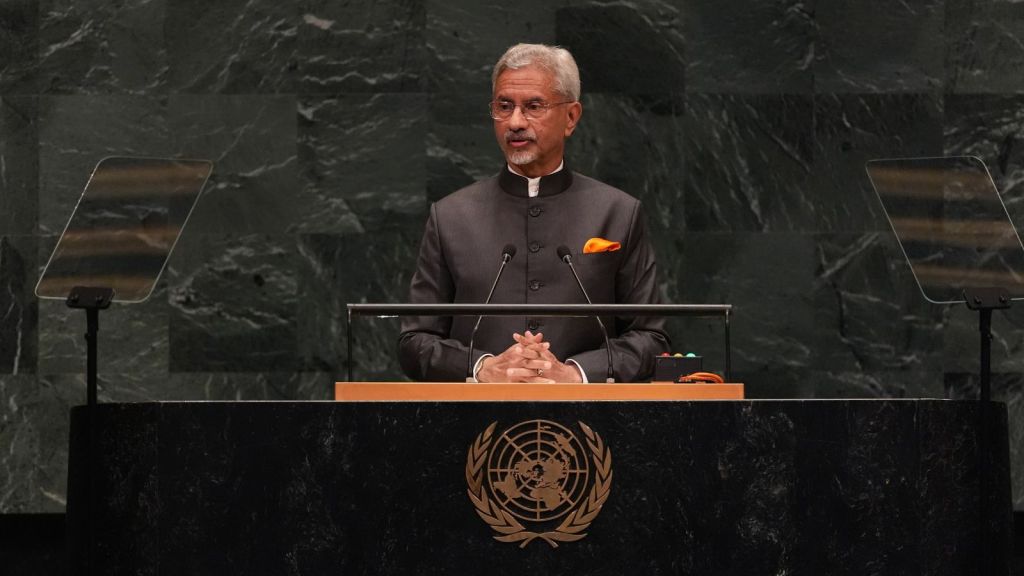 Foreign Minister Subrahmanyam Jaishankar speaks during the 81st session of the United Nations General Assembly at United Nations headquarters. (Photo: AP)
The war in the Gulf has spread beyond land and air, pulling in shipping lanes used by countries that have no stake in the fighting. Against this backdrop, External Affairs Minister S Jaishankar addressed the General Debate at the 81st session of the UN General Assembly in New York on Friday, setting out India’s position on the conflict and its impact on global trade routes.
In his speech, Jaishankar said countries with no role in ongoing conflicts are being made to pay the price for them, and renewed India’s warning over attacks on ships and sailors in the Gulf, according to PTI.
Jaishankar said nations that have no part in a conflict often end up bearing its cost the most.
“Countries far from conflicts are being penalised for no fault of theirs. Those most impacted often have the least say. This assembly must face up to the true state of affairs,” Jaishankar said.
He linked this directly to the war in the Gulf. “This year, we are witnessing a conflict in the Gulf, one that is exacerbating an already difficult situation. We remain deeply concerned over continuing hostilities,” he said.
Jaishankar said ships and crew passing through international waters have become targets, and called this unacceptable.
Jaishankar pointed to two recent incidents involving Indian crew members.
India said the targeting of commercial shipping and seafarers passing through international waters is “simply unacceptable,” and noted that such attacks have taken place “in the Gulf, and from the Red Sea to the Black Sea.”
#WATCH | New York: Addressing the 81st session of the United Nations General Assembly, EAM Dr. S. Jaishankar says, "Countries far from conflicts are being penalized for no fault of theirs. Those most impacted often have the least say. This assembly must face up to the true state… pic.twitter.com/S3hoYiFXQw
— ANI (@ANI) September 26, 2026
Large numbers of Indian seafarers work on Indian-flagged as well as foreign-flagged vessels. Many of these ships pass through high-risk waters, including the Strait of Hormuz, Gulf of Oman, Red Sea, Gulf of Aden, Bab-el-Mandeb, Black Sea and waters off Somalia.
This puts Indian crew members at direct risk whenever conflict spills over into shipping lanes.
On Friday, India and Liberia formally set up the Group of Friends on Safety and Security of Shipping and Seafarers. India said it has joined Liberia and 23 other partners in this effort to build global support against such attacks on ships and crew.
“We must ensure that the safety and security of shipping and seafarers is never compromised. Scrupulously observing international law is an integral element of that endeavour,” Jaishankar said.
He also called on all sides in the ongoing conflicts to show restraint, reduce tensions, protect civilians, and keep the flow of energy and trade uninterrupted.
India’s position at the UN was direct: attacks on ships and sailors must stop, and countries must work together to keep sea routes safe.
 Share
