Germany’s far-right Alternative for Germany (AfD) has secured a decisive victory in the eastern state of Saxony-Anhalt, rising as the largest party in the regional election, but fell short of the majority it had sought to govern on its own.
The AfD was predicted to win around 44% of the vote, more than double its 2021 tally of 23.7% and well ahead of Chancellor Friedrich Merz’s Christian Democratic Union, which was trailing at around 18%, Reuters reported.
With 39 seats in the 83-member state parliament, the AfD remained three seats short of the 42 required for an outright majority, as per reports. Its ability to form a government remains uncertain because the party has ruled out a coalition, while mainstream parties have maintained a political firewall against cooperating with it.
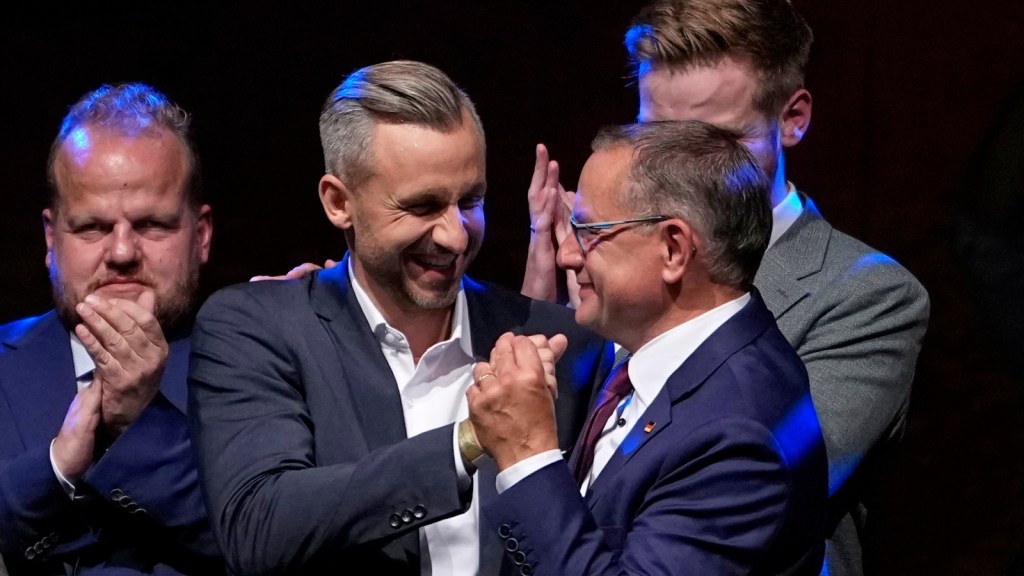
The 35-year-old AfD lead candidate Ulrich Siegmund praised the results as historic and said the voters had sent a clear message that “things cannot carry on like this”.
“We have made history in this state,” Siegmund told supporters as projections came in. AfD co-leader Alice Weidel said that the result as a “clear government mandate”, while Siegmund said the party was prepared to reach out to political forces seeking change.
Siegmund, who switched to AfD from center-right CDU, has been dubbed as “Germany’s most dangerous man” by the influential magazine Der Spiegel. “A very good campaigner for us in this election campaign was Friedrich Merz,” Siegmund said.
However, the party has so far resisted the prospect of leading a minority government. Siegmund said that if necessary, another election could be held, predicting that the AfD could then win 50% or 55% of the vote, BBC reported.
Story continues below this ad
The far-right party has been in the news over the past years for its controversial statements: on immigration, European Union, Holocaust and headscarf girls.
Controversial AfD policies
Immigration and domestic security were among the central issues in the AfD campaign. The party supports a controversial policy of “remigration”, a term critics associate with mass deportations, while the AfD says it refers to deporting criminals and people living in Germany illegally, as per the BBC.
In Saxony-Anhalt, it has criticised the Bauhaus school in Dessau, calling it a “dead-end of modernism”. Critics have accused the party of echoing language associated with the Nazi era.
The AfD’s leader in the German state of Thuringia, Björn Höcke has faced criticism over the remarks about the country’s Nazi past. In 2017 after calling Berlin’s Holocaust memorial a “monument of shame” and calling for Germany to move away from what he termed its culture of atoning for its Nazi history. In July 2023, Höcke was criticized after saying that “this EU must die so that the true Europe may live.” A German court had ruled in 2019 that calling Höcke a “fascist” was not defamatory, Deutsche Welle reported.
Story continues below this ad
CDU’s setback
The result was a dramatic reversal for the CDU, which has governed Saxony-Anhalt since 2002. Its vote share fell by more than half compared with the previous election.
CDU state leader Sven Schulze accepted defeat, saying the campaign was extremely tough and intensive. The party nevertheless reiterated that it would not cooperate with the AfD.
The CDU’s general secretary Franziska Hoppermann called the result a defeat overall for the party and said it was also a setbakc for those who had governed the state since the end of the communist era.
The election result could also put fresh pressure on Merz, whose popularity has been weak in the state. Only 9% of voters in one recent poll said they were satisfied with his politics. Siegmund credited Merz with helping the AfD during the campaign.
Story continues below this ad
The AfD’s path to power remains complicated by the refusal of Germany’s mainstream parties to enter into a coalition with it. The political strategy, known as the Brandmauer, or firewall, is intended to keep the far right out of government.
The AfD’s state organisation in Saxony-Anhalt has been grouped as “right-wing extremist” by Germany’s domestic intelligence agency, which was a designation rejected by Siegmund.
The left-wing Die Linke was projected to finish third with about 9.3%, followed by the Greens at 8.7% and the Social Democrats at 8.4%. The Sahra Wagenknecht-led BSW also appeared to cross the 5% threshold required to enter the state parliament.
The BSW’s entry is important because its presence reduces the AfD’s chances of securing a parliamentary majority. The party has showed that it could cooperate with the AfD on selected issues, including energy-price reform.
Story continues below this ad
An election closely watched
The election was being closely watched beyond Saxony-Anhalt because no far-right party has controlled a German state since World War II. A state government would give the AfD influence over areas including policing, education and culture.
Voter turnout was unusually high, at roughly 76.5%-76.7%, with about 1.7 million people eligible to vote in the state, which has a population of around 2.1 million, according to BBC reports.
The AfD’s strongest support continues to come from eastern Germany. The party also won the 2024 state election in neighbouring Thuringia but was unable to secure enough seats to form a government there. Nationally, it has been leading opinion polls ahead of Merz’s conservatives and the Social Democrats.
How parties reacted to AfD’s rise
United states president Donald Trump shared a screenshot of German election projections on Truth Social, while Russian presidential envoy Kirill Dmitriev praised this historic win for AfD.
Story continues below this ad
 Graph shared by US president Donald Trump on Truth Social.
Polish Prime Minister Donald Tusk reacted to the results saying that, “in Poland only idiots and traitors can rejoice at the triumph of the AfD”.
The party’s rise has also alarmed its opponents and Jewish community leaders. Charlotte Knobloch, a Holocaust survivor and veteran head of the Jewish community in Munich and Bavaria, said the result frightened her. “On days like this I find it hard to recognise my homeland any more,” the 93-year-old Holocaust survivor said, appealing for mainstream parties not to stand by and allow “this decline”.




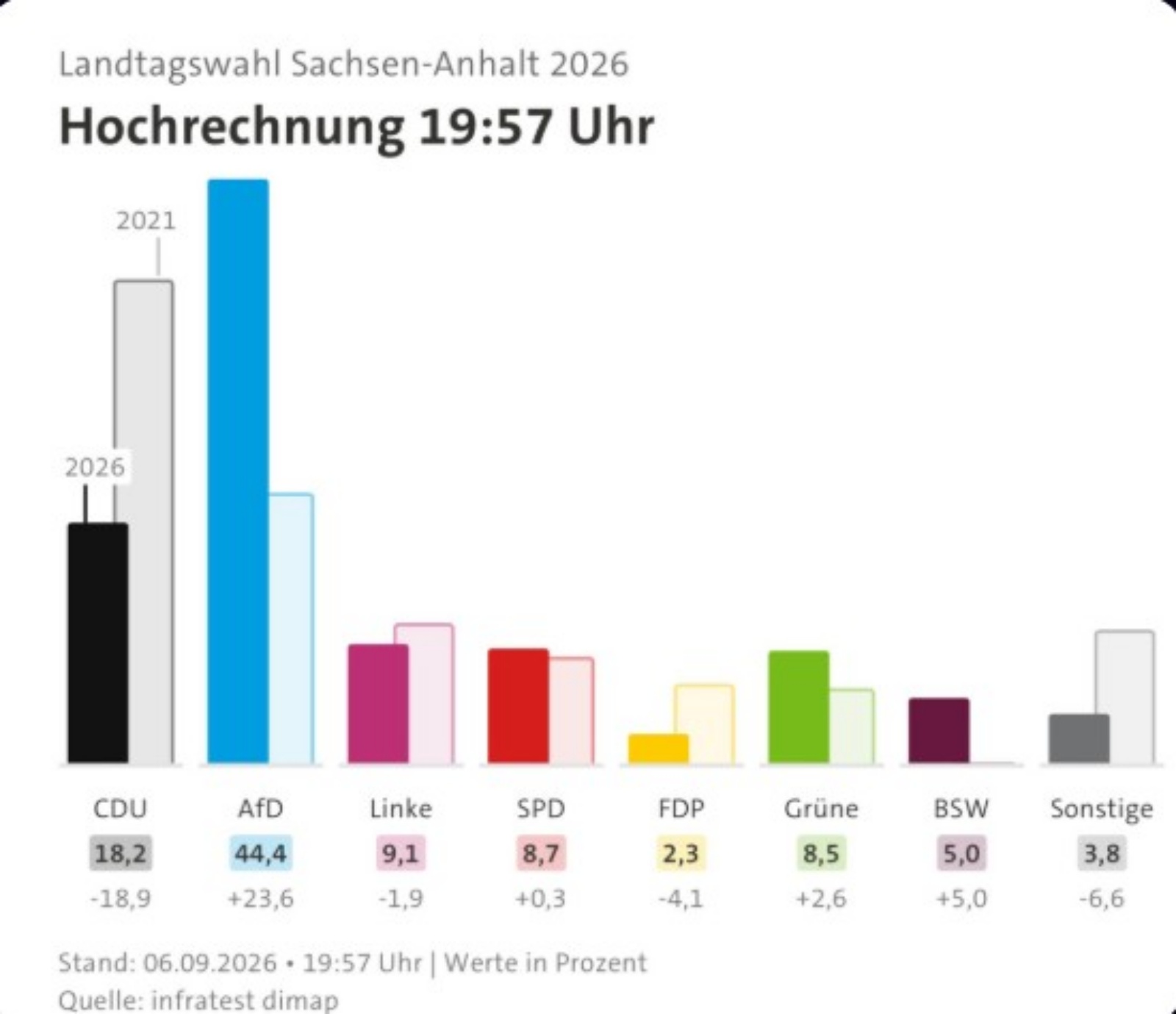 Graph shared by US president Donald Trump on Truth Social.