

Journalism of Courage


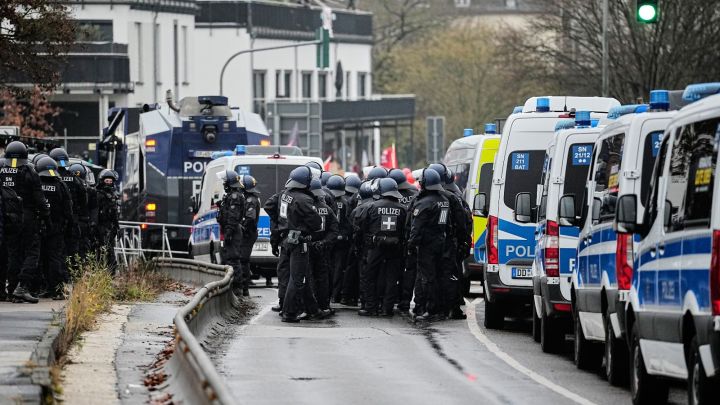
The far-right Alternative for Germany (AfD) set up its new youth wing on Saturday while thousands of people demonstrated outside the party’s meeting, according to the Associated Press (AP). Police said some protesters clashed with officers as they tried to block roads leading to the convention centre.
AfD’s convention started more than two hours late after groups of protesters blocked or tried to block key roads, delaying delegates. Police told AP they used pepper spray after stones were thrown at officers and deployed water cannons twice to clear blockades.


Police estimated that between 25,000 and 30,000 people took part in the demonstrations, the regional interior minister Roman Poseck told AP. He condemned the violence.
Up to 5,000 officers were deployed, and 10 to 15 officers were slightly injured. Many protesters demonstrated peacefully, officials said.
AfD leaders criticised the protests as the meeting opened. “What is being done out there dear left-wingers, dear extremists you need to look at yourselves is something that is deeply undemocratic,” party co-leader Alice Weidel said, according to AP.
She added that one AfD lawmaker had been attacked. Police confirmed a lawmaker had been injured near Giessen but gave no details.
The new youth group, Generation Germany, replaces the former Young Alternative. The old group was dissolved in March after AfD cut formal ties with it. The new organisation will be open to party members under 36 and will be under tighter party control.

AfD finished second in Germany’s national election in February with more than 20% of the vote, AP said. It is now the largest opposition party.
Germany’s domestic intelligence agency had labelled the Young Alternative a right-wing extremist group. AfD itself was also classified the same way, but that designation is suspended while the party challenges it in court.
AfD co-leader Tino Chrupalla said the party must avoid past mistakes. “We should have taken more care of the young new hopes in our party; it will be different in the future,” he told delegates. He said young activists must “put themselves at the party’s service”.
Jean-Pascal Hohm, a 28-year-old regional lawmaker from Brandenburg, was elected unopposed as the leader of Generation Germany. He told delegates he had been a “proud chairman” of the Young Alternative in his state.
Hohm is classified as a right-wing extremist by regional intelligence officials, a designation he denies and says is politically motivated, AP reported.
Kevin Dorow, a delegate from northern Germany, said the new youth group would continue the work of the old one training young members and bringing them into party politics. He said he did not see a “drift in a radical direction” in the Young Alternative.
AfD presents itself as an anti-establishment party at a time of declining trust in government. It gained national seats in 2017 after the arrival of large numbers of migrants. Migration remains its main theme, but the party has benefited from wider discontent too.
Five German states will hold elections next year, including two in the east where the AfD is strongest.
“We will get the majority of mandates; we will provide our first governor,” Weidel said, according to AP.
The story was corrected to show that the interior minister put the number of demonstrators at 25,000–30,000, not 25,000–35,000.


