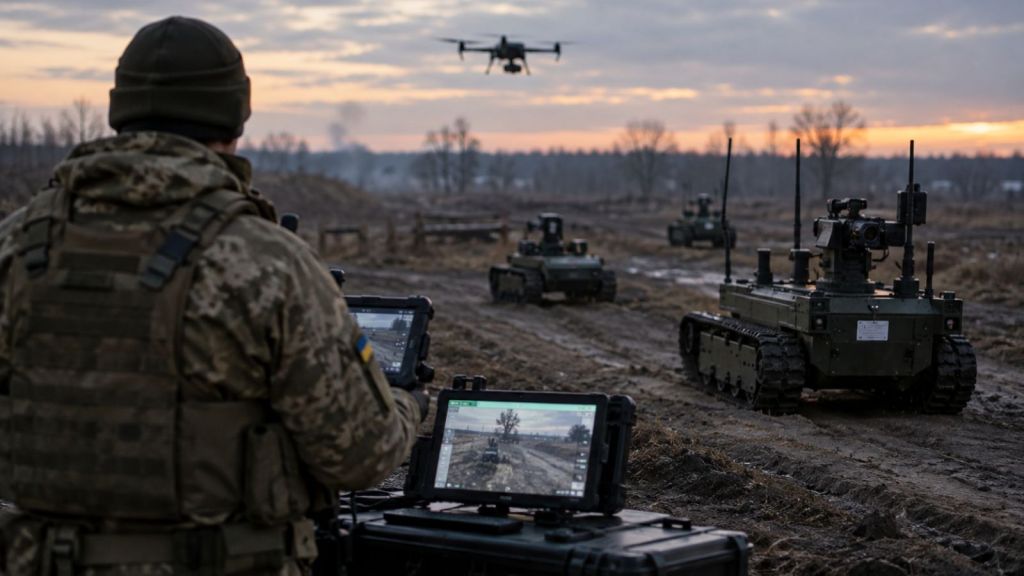
Former Ukrainian Defence Minister Mykhailo Fedorov has announced a new defence technology initiative, the “Army of Robots”, aimed at developing systems that could eventually reduce the need for human soldiers on the battlefield, Kyiv Independent reported.
Fedorov unveiled the initiative on social media and during a presentation at the IT Arena conference in Lviv on September 26, marking his latest move into defence technology after President Volodymyr Zelenskyy dismissed him as Defence Minister in July, according to the report.
The project is modelled on Fedorov’s “Army of Drones” programme, which he launched in 2022 while serving as digital transformation minister. However, he said the new initiative would not operate as a single company but as an “ecosystem”.
“We will invest in defence tech companies, launch our own technology projects, create R&D capabilities, test solutions together with the military, and scale up as quickly as possible the things that actually work on the battlefield,” Fedorov said.
Fedorov’s dismissal initially left questions over his next move. His departure was followed by weeks of protests by thousands of Ukrainians calling for the return of the technology-focused reformer, the report noted.
He later challenged Ukraine’s wartime political order by calling for elections in mid-August, before shifting his focus towards defence technology.
During a high-profile visit to the United States in late August, Fedorov met supporters, donors and technology leaders and announced a fund intended to promote innovation and increase production to address Ukraine’s defence requirements.
Story continues below this ad
Days later, he said he would establish his own defence technology company, with Alex Karp, the CEO of Palantir, among its first investors. Palantir’s products are used in Ukraine’s war effort.
Fedorov did not identify the organisation behind the “Army of Robots” initiative. His press team also did not respond to questions from The Kyiv Independent seeking clarification.
“Even outside government, now from the private sector, we are continuing to work on our vision of technological warfare — Air. Land. Economy. — and on our main mission: to create technologies that help Ukraine win and save the lives of our service members,” Fedorov said.
He also called on experienced robotics engineers to join the initiative, the report said.
Story continues below this ad
Humanoid robots in battlefield
A key element of Fedorov’s vision is the development of humanoid robots that could eventually take the place of infantry soldiers in trenches.
Fedorov said the initiative aims to see a humanoid robot kill an enemy soldier for the first time within six months and conduct the first successful assault on an enemy position without infantry within 12 months.
However, even in highly publicised assaults involving only unmanned ground vehicles (UGVs), human soldiers are still required to physically occupy and secure the ground.
The announcement was accompanied by an AI-generated video showing futuristic robots of various designs fighting in trenches and open fields. The footage depicted soldiers wearing Ukrainian uniforms and patches, although its English-language narration did not explicitly mention Ukraine.
Story continues below this ad
“Robots intercept the enemy, defend against attacks, destroy targets, move on to enemy positions first,” the voiceover said. “People control the systems from a safe distance and enter the cleared position only when it is safe.”
“Yeah, it sounds like the war of the future, but we are already there.”
Ukraine’s growing use of ground robots
Unmanned ground vehicles, referred to in Ukraine as “ground robotic complexes”, have become increasingly important to both sides of the conflict, particularly for logistics.
The widespread use of first-person-view drones has made vehicle-based supply runs and casualty evacuations near the front line extremely dangerous, increasing reliance on unmanned systems for such tasks.
Story continues below this ad
Despite their description as robots, these machines are generally not autonomous. Most are operated directly by human controllers, often through Starlink internet connections.
Some advanced units have also used UGVs to attack enemy positions or directly engage opposing forces. However, battlefield experience with “robots fighting instead of people” remains at an early stage and faces several practical limitations.
Ground drones have limited supplies of energy and ammunition and require humans to service, recharge and reload them in the field.
They can also be vulnerable to enemy drones when operating near the front line, despite being smaller and less conspicuous than conventional crewed military vehicles.
Story continues below this ad
Many of the designs shown in Fedorov’s video, including humanoid, spherical, dog-like and spider-like robots, are not currently deployed in combat in Ukraine.