


Stay updated with the latest - Click here to follow us on Instagram

Journalism of Courage
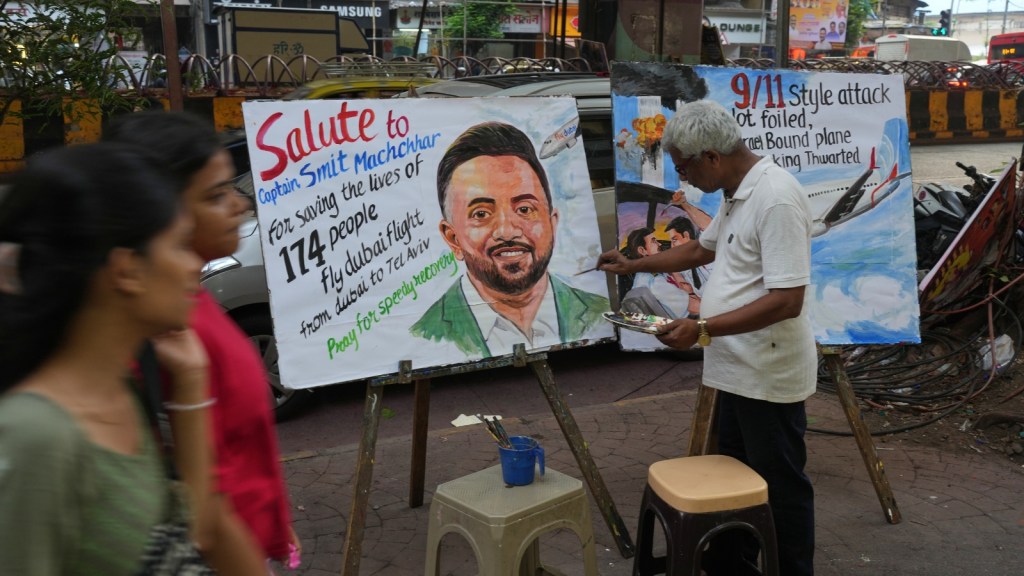 A teacher from Gurukul School of Art paints a portrait honouring Smit Machchhar,, an Indian pilot with FlyDubai, in Mumbai, India, Thursday, Oct. 1, 2026.(AP Photo)
Israel’s aviation-security system is facing scrutiny after Omani co-pilot Hamam al-Hammami allegedly attacked Indian captain Smit Machchhar aboard flydubai flight FZ1073 bound for Tel Aviv, sending the aircraft into a steep dive and prompting passengers and other crew members to rush into the cockpit.
Al-Hammami, an Omani national, has been identified as the co-pilot accused of attacking Machchhar. News agency Associated Press reported Saturday that he had previously been barred from flying in Oman over concerns about extremist views, raising questions about how he was later hired by flydubai and cleared to operate flights. The circumstances and motive for the attack remain under investigation.
CNN had earlier reported that al-Hammami had been working for flydubai for about eight months. The airline has suspended flights to and from Israel following the incident.
Express InfoGenIE · Aviation security
FlyDubai FZ1073: Where aviation security faces new questions
Follow the aircraft through the security chain — and see where the alleged cockpit attack has raised questions.
 ?
Pilot vetting
Airport screening
?
Cockpit security
?
Distress response
Emergency landing
The aviation security chain · ? marks where questions have emerged
How to read this
Tap a numbered point on the aircraft, or use the tabs
The safeguards around flight FZ1073 did not prevent the alleged cockpit attack. Investigators have not yet established whether that was a gap in the system or a failure to follow existing rules.
Expert analysisAviation-security expert Menachem Bachrach suggested it may reflect a compliance lapse rather than flawed procedures, and cautioned against rushing to tighten security.
Source: AP
01 · Before take-off
Who screens the crew?
Pilot licensingRegulatorMedical checksRegulatorBackground and security vettingAirlineAirport security screeningVaries by countryBody screeningAirportLuggage checksAirportThe traditional focus of aviation securityAPAre crew held to the same level of scrutiny as passengers?
ConfirmedAviation security has traditionally focused far more on passengers and luggage, AP reports.
Expert analysisDave Komendat, a former Boeing chief security officer, says crew screening should “mirror very closely what a passenger goes through” — but procedures vary around the world.
Source: AP
02 · In the cockpit
What happens when the threat is inside?
CABINExpert analysisThe door “has also created a fortress into which the good guys cannot gain access to a rogue individual,” says Philip Baum of Coventry University.
OfficialIsrael’s former national security adviser Eyal Hulata: “Until this event, the possibility of a threat originating from a pilot or crew member was not considered a likely scenario.”
Source: AP
03 · During the emergency
How did the system respond?
TRANSPONDER
Altitude plunge7700General emergency7500Unlawful interference / hijackingDistress callDiversion to TabukEmergency landingTurn over JordanConfirmedFlight-tracking data show squawk 7700, then 7500, and a 180-degree turn over Jordan before the landing in Tabuk.
OfficialInvestigators are expected to examine how Saudi and Jordanian authorities handled the distress calls, and why the aircraft took that route.
Source: AP, Flightradar24
04 · After FZ1073
What could change?
Crew vetting
More scrutiny of pilots flying into Israel
OfficialIdentity checks
Israel says it will know the identities of pilots operating flights into the country
OfficialCockpit security
Re-examine how to respond when the threat comes from inside the flight deck
Expert analysisEmergency response
Review how distress calls and diversion requests are handled
Expert analysisOfficialIsraeli Prime Minister Benjamin Netanyahu announced pilot vetting and identity checks for all flights entering Israel.
What investigators still need to establish
AllegationThe co-pilot is accused of attacking the captain. His motive has not been established, and investigations in Israel, the UAE and Saudi Arabia are continuing.
Source: AP, Reuters
Sources: AP, Reuters, Flightradar24, official statements and aviation-security experts as quoted. Aircraft illustration is stylised.
The attack was thwarted after Machchhar, despite being seriously injured, managed to open the cockpit door. Passengers then rushed inside and helped subdue the co-pilot, while other pilots who were travelling aboard the aircraft took over and helped land the plane safely in Tabuk, Saudi Arabia. CNN claimed to have obtained footage showing passengers rushing into the cockpit, with one crew member calling for a doctor and another shouting that they needed a pilot.
The aircraft plunged about 17,000 feet before passengers intervened, CNN reported.
Oman does not have diplomatic relations with Israel. Israeli Prime Minister Benjamin Netanyahu has said Israel has arrangements with foreign airlines concerning pilots from countries without diplomatic relations with Israel flying into the country.
Channel 12 reported that Israel had nevertheless allowed dozens of Omani pilots to fly into the country in recent years and that enforcement of the reported restriction had effectively been left to foreign airlines.
A report in The Jerusalem Post on Friday, however, cited sources familiar with the investigation as saying the bilateral aviation agreement between Israel and the UAE did not stipulate that pilots operating flights between the two countries had to be nationals of countries maintaining diplomatic relations with Israel.
According to Channel 12, the Shin Bet security service did not independently examine the origins of Flydubai’s pilots beyond asking the airline not to use pilots from states that lacked ties with Israel.
The report quoted an anonymous airline industry official as saying, “The Shin Bet has all the means to know, within five minutes, who all of the pilots on the Dubai airline are, and they simply chose to turn a blind eye.”
“In Israel, they expected the airline to be reliable enough, so they didn’t conduct reviews in recent years,” the official was quoted as saying.
Israel’s Transportation Ministry, meanwhile, said in a statement to Channel 12 that the Shin Bet had never issued a specific warning regarding threats from Flydubai, beyond asking for increased baggage checks.
The Channel 12 report also cited a 2024 recommendation from Israel’s State Comptroller’s Office calling on the government to review air-travel security protocols.
The Transportation Ministry is expected to come under scrutiny as part of the investigation, including the work of the Center for Aviation Security Operations, Channel 12 reported.
Israel has announced that security checks on pilots flying into the country will be tightened. A spokesperson for Netanyahu said authorities would know the identities of pilots flying into Israel and carry out security checks on them, Reuters reported.
Netanyahu has acknowledged the issue, saying, Obviously, there was a loophole here. And we’re taking care of that.
The attack aboard flight FZ1073 was thwarted after Machchhar managed to open the cockpit door while he was being attacked.
CNN’s footage shows passengers rushing into the cockpit, restraining the co-pilot and providing medical assistance to Machchhar. One crew member can be heard calling for a doctor, while another person shouts that they need a pilot.
Other flydubai pilots who were travelling as passengers then helped take control of the aircraft and land it safely in Saudi Arabia.
The aircraft plunged about 17,000 feet during the incident, CNN reported.
The exact weapon used in the attack has not been publicly established. Netanyahu told CNN that the co-pilot used an axe, while earlier reports had referred to a knife or axe. Investigators have yet to establish how the weapon came into the cockpit.
In a video call with Prime Minister Narendra Modi on Friday, Machchhar described how he managed to open the cockpit door while he was injured.
“I knew that the aircraft was falling down, and I knew, in that moment, one last push, Smit. Just do it. The door is right there. And even at that time, he was beating me up. And then I just opened it, sir, and then everybody came,” he said.
Machchhar stressed that the intervention was not his alone. “I was doing this for my life, but at the same time, I knew that I cannot let everybody else die,” he told Modi.
The Indian captain, who suffered serious injuries and underwent surgery, is recovering in the UAE after being transferred from Saudi Arabia.
The incident has raised a broader question for aviation authorities – how do you protect a cockpit from a threat that originates inside it?
“Until this event, the possibility of a threat originating from a pilot or crew member was not considered a likely scenario. Security efforts have traditionally focused much more heavily on passengers and their luggage,” Eyal Hulata, Israel’s former national security adviser, told AP.
Aviation-security experts told AP that crew screening should generally closely mirror passenger screening, although procedures vary between countries and airlines. International Civil Aviation Organization standards establish baseline pilot-vetting and licensing requirements, while national regulators and airlines can impose additional measures.
Aviation-security expert Menachem Bachrach cautioned against assuming that the entire system was flawed.
“Before we’re jumping to tighten security, I would just say it’s likely that somebody didn’t follow the protocols,” Bachrach said.
The Flydubai incident has also renewed scrutiny of one of aviation’s most important post-9/11 security measures – reinforced, locked cockpit doors.
The doors were strengthened and locked worldwide after the September 11, 2001 attacks to prevent passengers or other intruders from entering the flight deck. But the flydubai incident highlights a different vulnerability: when the threat comes from someone already inside the cockpit.
Aviation-security expert Philip Baum told AP that the cockpit door can become a “fortress” that prevents passengers or crew from reaching a rogue person inside the flight deck.
Matthew Borie, chief intelligence officer at Osprey Flight Solutions, said airline personnel can be familiar with security vulnerabilities and may know how to exploit them if they become an insider threat.
The investigation will now focus not only on what happened aboard flight FZ1073 but also on how al-Hammami was hired and cleared to fly.
AP reported that investigators are examining whether al-Hammami acted alone or had connections to extremist groups. The UAE is leading the investigation, with other countries involved.
Investigators are also expected to examine cockpit recordings, flight-data records and passenger and crew accounts to reconstruct the incident. CNN reported that these records will be important in determining what happened inside the cockpit and how the aircraft was brought under control.
CNN reported that accounts apparently belonging to al-Hammami contained material that investigators may examine as part of his background.
One LinkedIn account bearing his name contained posts published after the incident, including footage filmed from the cockpit of a Boeing 737 Max and images involving Israeli airlines. CNN reported that the video ended with images of former Al Qaeda leader Ayman al-Zawahiri and another man linked to a 2009 suicide bombing.
A second post featured an AI-generated image of Islam’s three holiest sites alongside a poem about rejecting humiliation and not fearing death, CNN reported.
However, CNN said it was unclear who published the posts or whether they had been scheduled in advance. The social-media accounts have since been deleted.
As the investigation continues, there are also signs of tension between Israel and the UAE over how the incident should be characterised.
The Channel 12 report said the UAE was unhappy with Israel’s early assessment that the attack was motivated by nationalism and was insisting on conducting its own investigation.
Israeli officials have also described the incident as a terror attack. Netanyahu said the accused pilot had undergone “Islamist radical indoctrination”, but investigators have not publicly established a motive. CNN reported that Israel had characterised the incident as an act of terror while the investigation into the motive continued.
The UAE’s attorney general has ordered a specialist investigation into whether the incident involved “any terrorist activity or purpose” or prior planning or direction.
Anwar Gargash, an adviser to UAE President Mohammed bin Zayed, on Friday described the attempted crash as an “act of terrorism” and praised Machchhar, saying the Indian captain “showed the meaning of courage when he confronted a dangerous and potentially catastrophic act of terrorism”.
Gargash also warned against “simplistic interpretations” and conspiracy theories surrounding the incident.
(With inputs from agencies)
Stay updated with the latest - Click here to follow us on Instagram