


Journalism of Courage
 Share


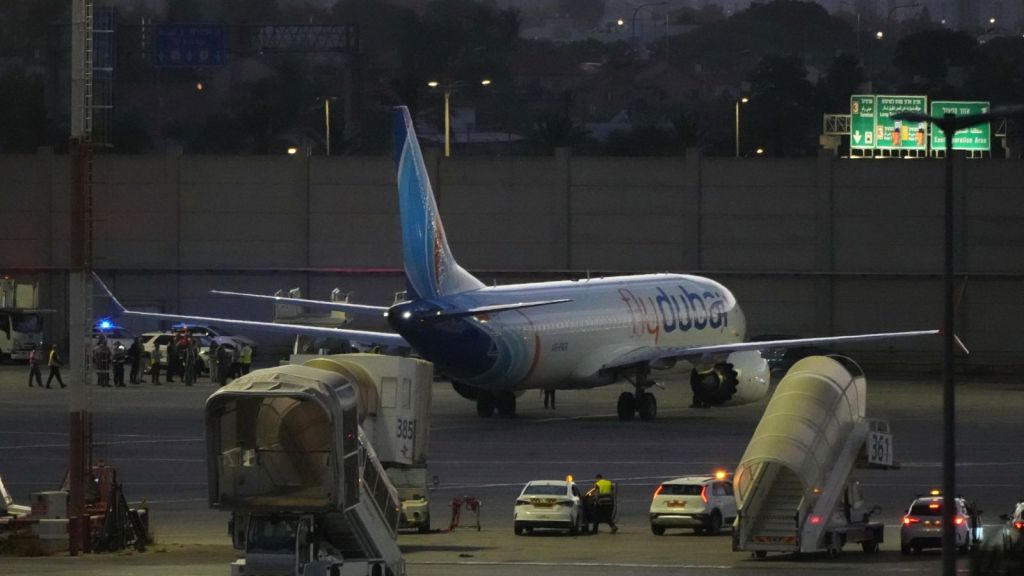 A FlyDubai aircraft carrying Israelis who experienced an emergency landing in Saudi Arabia parked at Ben Gurion International Airport, near Tel Aviv, Israel. (Photo/AP)
When Smit Machchhar lay on the floor of his cockpit on September 30, hurt, unable to see well and with the plane dropping, he had one task left: get to the door. In a video call with Israeli Prime Minister Benjamin Netanyahu on Saturday, the Indian captain of Flydubai flight FZ1073 said he thought he was going to die and used what strength he had to open it.
The Boeing 737 Max was flying from Dubai to Tel Aviv with 174 people on board, most of them Israelis. Machchhar, who has flown for 17 years, says he opened the door twice. The first time, the co-pilot, Hamam al-Hammami, shut it and he fell to the floor. The second time, people were waiting outside. They came in, overpowered al-Hammami and helped bring the cockpit back under control. The plane landed in Tabuk, in north-west Saudi Arabia.
VIDEO | Jerusalem: Israel PM Benjamin Netanyahu invites PM Modi and Indian pilot Smit Machchhar to light celebratory flame on Israel’s next independence day. (Source: Israel PMO X account) (Full video available on PTI Videos – https://t.co/d8jp61yd2p) https://t.co/nG6m5y1Stx
— Press Trust of India (@PTI_News) October 4, 2026
Machchhar said the plane was flying normally when the co-pilot stood up to pray. He did not think it unusual and, out of respect, chose not to look behind him. After about four to five minutes, he felt a hard blow to the back of his head.
It was so sudden that he thought the aircraft itself had been hit. When a second blow came, he understood the attack was from the person behind him. “The co-pilot’s initial blows had completely blurred my vision,” he told Netanyahu. He could feel the plane going sharply down.
Machchhar said he reached the door and opened it once. Al-Hammami closed it, and he fell to the floor. He knew then that he had one more chance.
“I thought I’m going to die, and that’s when I pushed against everything,” he said. When the door opened again, he saw people waiting outside. They rushed in, and the fight ended.
VIDEO | Jerusalem: Israel PM Benjamin Netanyahu calls Indian FlyDubai pilot Smit Machchhar a "hero of the entire world". (Source: Israel PMO X account) (Full video available on PTI Videos – https://t.co/d8jp61yd2p) https://t.co/LVJdyNq6ci
— Press Trust of India (@PTI_News) October 4, 2026
In an earlier call, on 2 October, he told Prime Minister Narendra Modi that he was fighting for his own life, but “was not going to let others die”. He also said he recited the Hanuman Chalisa during the attack.
Netanyahu asked about “pulling the pin” on the door. Machchhar said there is no pin. Inside the cockpit, the door opens with a twist of a knob. People outside need a code.
His colleagues were trying the code, but al-Hammami was keeping the door shut. The hard part was reaching the knob. Once his hand was on it, one short, quick twist was enough.
Netanyahu used those words for Machchhar and invited him and PM Modi to Israel for the country’s Independence Day. He also said the co-pilot had gone through “Islamist radical indoctrination”.
Machchhar has been moved from Saudi Arabia to the UAE, where he is recovering. Authorities in the UAE, Saudi Arabia and Israel are looking into the facts, the motive and whether the attack was planned or linked to terrorism.
 Share
