


Stay updated with the latest - Click here to follow us on Instagram
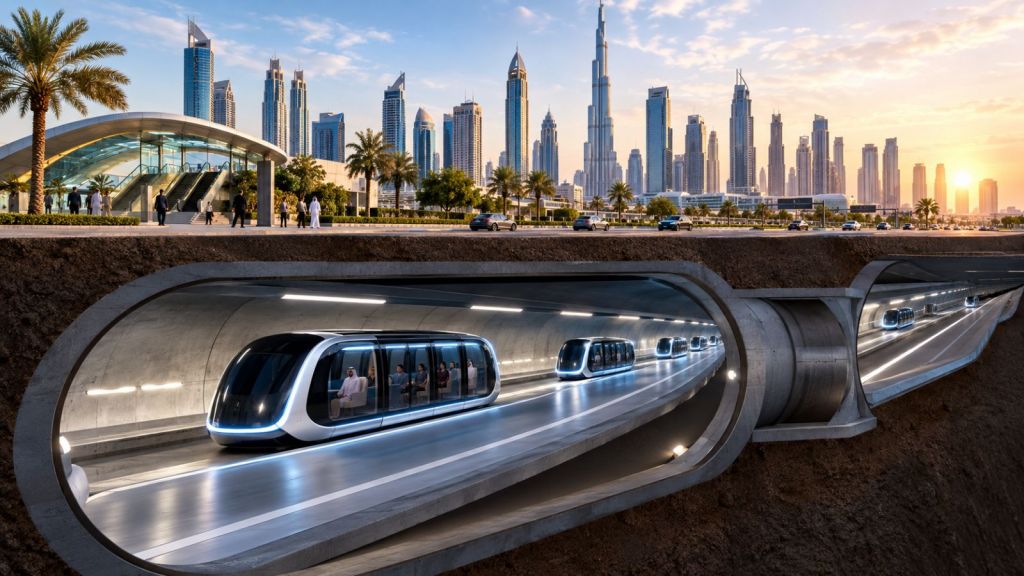 Dubai Loop Tunnel Project will create an underground road network designed to transform urban mobility (Image generated using AI)
Dubai Loop project: The Dubai Loop Tunnel project is set to improve urban transport in the Middle East by providing first-and-last-mile connectivity through an advanced underground transport system. Earlier this week, Sheikh Mohammed bin Rashid Al Maktoum, Dubai Crown Prince and UAE Deputy Prime Minister reviewed the Dubai Loop project with Steve Davis, President of The Boring Company.
The meeting focused on discussions about the latest progress of the tunnel project, estimated to cost around AED 2 billion (approximately Rs 5,000 crore), in the emirate.
Earlier this year, on the sidelines of the World Governments Summit (WGS) 2026, Dubai’s Roads and Transport Authority (RTA) signed a strategic partnership agreement with US-based The Boring Company, owned by Elon Musk. Under the agreement, both sides will finalise the project design and begin mobilisation work.
Express InfoGenIE · Dubai
Why is Dubai building the Dubai Loop?
Six reasons behind the underground electric-vehicle tunnel project, in motion.

To improve movement in high-density areas
6.4 km 4 STATIONS
DIFCDubai MallPhase 1 links the Dubai International Financial Centre and Dubai Mall underground.
To move some trips underground
BUSY ROADDEDICATED TUNNEL
Electric passenger vehicles run in dedicated underground tunnels instead of adding to busy roads.
Faster links between key destinations
~22 km 19 STATIONS
Trade CentreBusiness BayPILOTThe full network would link the Trade Centre and financial districts with Business Bay.
First- and last-mile connections
Home or office→Dubai Loop→Metro & transitNot a replacement for the Metro: it is meant to plug into the wider mobility system.
Less disruption on the surface
✓ Roads stay open
The RTA highlights minimal impact on existing roads and utility services.
ELECTRIC VEHICLES
Electric vehicles, thousands of trips
Diagrams are schematic and not to scale; station positions are illustrative.
The six reasons at a glance
The first phase will connect DIFC and Dubai Mall through a 6.4-km underground route with four stations.
Dedicated tunnels for electric passenger vehicles; the RTA says they can be built with less impact on roads and utilities than conventional systems.
The full network is planned at about 22 km with 19 stations, linking the Trade Centre and financial districts with Business Bay.
It is not positioned as a replacement for the Metro, but as a link into the wider mobility system.
Underground construction limits the need for major road closures and surface works.
About 13,000 passengers a day in the pilot phase; capacity of about 30,000 a day on the full route.
Sources: Roads and Transport Authority (RTA), Dubai; WAM; Zawya
Express InfoGenIECreated by Aniruddha Dhar
The Dubai Loop project is an underground passenger transport network that will use electric vehicles to connect different parts of the emirate. It will use advanced technologies to improve transport efficiency and traffic flow in densely populated urban areas.
According to The Boring Company, the ‘Loop’ is an express public transportation system that resembles an underground highway more than a subway system. The project aims to provide flexible urban mobility, connect key destinations and important areas, and support Dubai’s focus on innovative and sustainable transport solutions.
The RTA said several studies have highlighted the Dubai Loop project’s potential in terms of capacity and operating costs. The pilot phase is expected to carry nearly 13,000 passengers a day, while the full route is projected to handle around 30,000 passengers daily.
According to the latest update, preliminary work and project delivery have continued to progress since the agreement was signed in February. Several technical and engineering activities are currently moving forward at the same time. These include the assembly of the tunnel boring machine (TBM) and the casting of concrete segments that will be used to line the tunnels.
According to RTA, the implementation of the first phase of Dubai Loop project will commence with the construction of a 6.4km pilot route, comprising four stations and linking the Dubai International Financial Centre and Dubai Mall. This phase will pave the way for the full alignment, which will stretch up to 22.2 km with 19 stations, connecting Dubai World Trade Centre and the financial district with Business Bay.
As per The Boring Company, the project involves the construction of tunnels with a diameter of 12 feet (3.6m), dedicated to vehicle transport. The tunnels will be developed using advanced tunnelling technologies that enable faster delivery, lower construction costs, and reduced impact on existing roads and utilities compared with conventional transport systems, it said.
Stay updated with the latest - Click here to follow us on Instagram