


Journalism of Courage
 Share


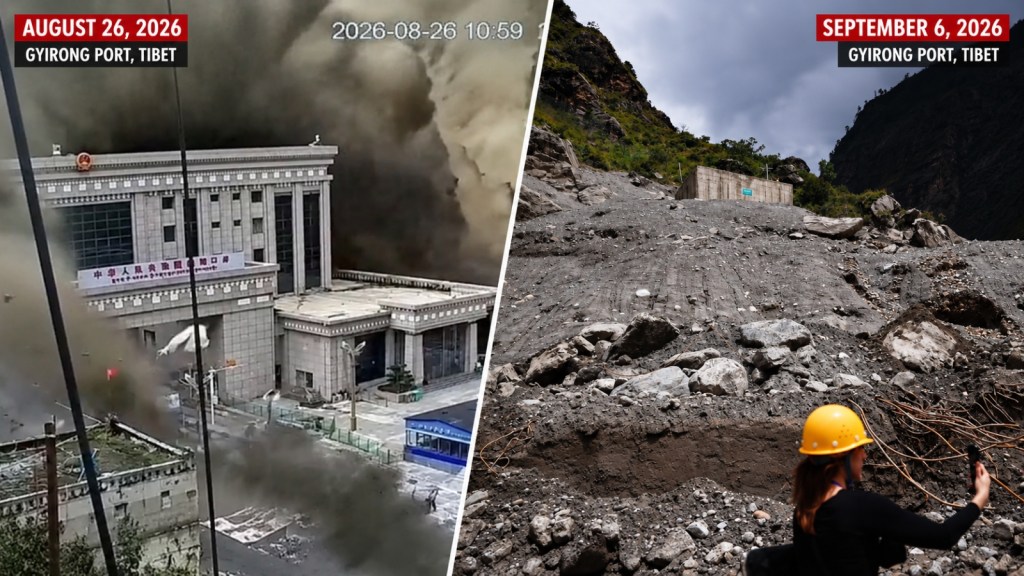 (Left) A torrent of water tearing through Gyirong Port, one of the main border crossings between Nepal and Tibet on August 26, 2026; and a journalist walks past a water tower installation which is the only structure visible, at the core disaster-hit area at Gyirong Port amid rescue efforts following the mudslide, on September 6, 2026 (Screengrab and AP photo)
A terrifying CCTV camera video shows a huge wall of water, mud and rock racing towards a border crossing between Nepal and Tibet. Within seconds, the torrent overwhelms buildings at Gyirong Port, one of the main crossing points between China and Nepal.
The video, recorded on August 26, captured the moment a glacier collapse on the Nepal side triggered a devastating flash flood and mudslide that swept through the Himalayan border region.
Nearly two weeks later, international journalists were allowed to see the destruction on the Chinese side of the Nepal-Tibet border. What they found was a landscape almost impossible to recognise, news agency Reuters reported.
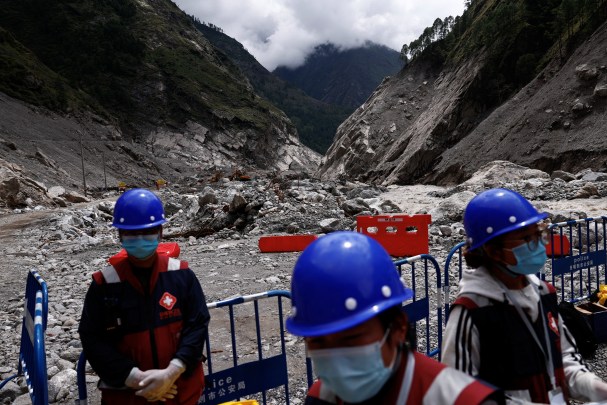
The five-storey Chinese customs building at Gyirong Port was gone. The nearly 20-metre-high border gate had disappeared. Grey and black mud covered the area, while rescue workers continued searching for people and human remains.
The visit, organised by China’s foreign ministry on September 6, provided international media with one of the clearest looks yet at the scale of destruction at the China-Nepal border crossing. Reuters reporters who visited the site described rescue teams using excavators, shovels and ground-penetrating radar to search the debris.
But behind the destroyed buildings is an even more sobering number: hundreds of people are still missing.
The August 26 Nepal floods have become one of the region’s deadliest disasters.
By September 7, at least 1,380 people had died and more than 5,500 remained missing across Nepal and Tibet, according to Reuters. Nepal was observing a national day of mourning as search operations continued.
On the Chinese side, authorities reported 43 deaths and 519 people missing. Of those missing, 261 were foreign nationals from 23 countries, Reuters reported. That includes 49 Indian citizens.
The figure is particularly significant because Gyirong is not simply a border crossing. It is an important route for people travelling between Nepal and Tibet, including pilgrims heading towards Mount Kailash, one of Hinduism’s most sacred sites.
The contrast between the video and the images taken nearly two weeks later tells the story better than the numbers.
In the August 26 footage, floodwater and debris surge towards the border infrastructure with extraordinary speed.
In the later images, there is almost nothing left.
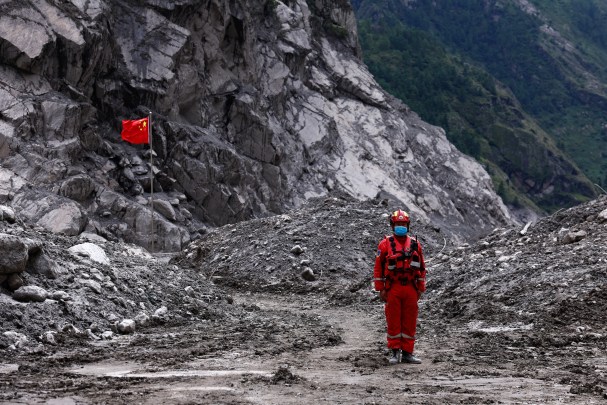
The Chinese customs building has disappeared. Rescue workers move through thick layers of mud. A Chinese flag marks the area where the border gate once stood.
Warning signs tell people to move quickly through what remains of the disaster zone.
PTI, which was among the foreign media allowed into the area, reported that even officials involved in the rescue operation struggled to identify exactly where some buildings had stood. Iron rods protruding from the ground were used to indicate the approximate location of the former immigration building.
A small memorial with yellow flowers had also been placed near what was believed to be the former gate.
Why were so many Indians at Gyirong Port?
Gyirong Port is a key gateway for Indians travelling to Kailash Mansarovar through Nepal. Pilgrims travel from Kathmandu through Rasuwa to Rasuwagadhi, cross into Tibet at Gyirong, then continue to Darchen. The overland journey takes about 10–14 days.
The route has grown sharply in popularity: 13,523 pilgrims and religious tourists crossed Rasuwagadhi in 2025-26, up 18.75% from the previous year. Private Nepal operators also offer routes without the MEA’s roughly 1,000-pilgrim annual cap, making them an important alternative for Indian travellers.
The operation at Gyirong Port is now as much about identifying the dead as finding survivors.
Chinese officials told visiting journalists that recovery teams were recording fingerprints and physical features such as tattoos from bodies recovered from the mud.
They had also collected 993 personal belongings from the disaster site, Reuters reported.
Those belongings could be important for families trying to establish what happened to relatives who disappeared in the Nepal-Tibet floods.
The identification process is particularly complicated because so many foreign nationals were in the area when the disaster struck.
For Indian families, the destruction at Gyirong has a direct human dimension.
Chinese authorities have reported 49 Indians among the 261 foreign nationals still missing on the Chinese side, according to Reuters. Many of the foreign nationals were believed to be pilgrims travelling towards Mount Kailash.
The number should be distinguished from the broader figure of Indians reported missing across the entire disaster area.
India’s Ministry of External Affairs subsequently said 275 Indian nationals remained missing and 166 had been rescued in connection with the Nepal floods. It also said 1,907 Indians had safely crossed into Nepal from China.
The difference reflects the fact that the two figures cover different groups and locations.
For families of those still missing, however, the problem is the same — uncertainty.
The international media visit also brought renewed attention to questions about information-sharing.
Families and diplomats representing countries with missing citizens have privately expressed frustration to Reuters over what they describe as limited information from Chinese authorities.
Among the unresolved questions is how DNA testing will be used to identify victims.
Diplomats from four countries told Reuters they had not received details about China’s DNA identification process. They also raised questions about whether video recorded at the border crossing — including possible facial-recognition footage — could be shared with families or used to help identify missing people.
China has rejected suggestions that it has failed to provide adequate information. Its foreign ministry has said its reporting of the disaster has been transparent and timely and that Beijing is willing to cooperate with other countries and agencies.
The destruction of Gyirong is important beyond the immediate rescue operation.
After the 2015 Nepal earthquake damaged another major crossing farther east, Gyirong became the principal route for trade and travel between Nepal and Tibet.
The crossing handled Chinese exports, including electric vehicles, and became a route for pilgrims travelling through Nepal towards Mount Kailash in Tibet.
That makes the disaster particularly relevant to India.
The Kailash Mansarovar Yatra attracts Indian pilgrims, many of whom travel through Nepal before entering Tibet. Several groups were near the China-Nepal border when the August 26 flash flood struck.
The Guardian previously reported that many of the missing foreign nationals had been travelling towards the Kailash region, while families waited in Nepal for information about their relatives.
The disaster began high in the Himalayas but its consequences travelled rapidly downstream. Chinese officials have said the August 26 event originated on the Nepalese side of the border.
Norbu Tsering, deputy head of China’s emergency rescue headquarters, said greater international cooperation was needed to improve monitoring and early-warning systems.
Chinese scientists say more than 3,000 glacial lakes have been identified on the Tibetan Plateau, including 187 classified as high-risk and monitored using remote sensors or ground checks.
Research cited by PTI from the Institute of Tibetan Plateau Research, Chinese Academy of Sciences, found that the mudslide travelled about 22 km down the valley and reached Gyirong Port in roughly seven minutes.
The initial collapse of ice and rock gathered additional material as it moved, scouring the riverbed and pulling debris from the valley into the flow.
(With inputs from agencies)
 Share
