
 People demonstrate at a “Black Lives Matter” rally to mark the death of George Floyd in Zurich, Switzerland. (Alexandra Wey/Keystone via AP)
Black Lives Matter protests refuse to die down as the US remains wrapped up in discussions of structural racism, white supremacy and police abolition. Most importantly, conversations have been sparked even in families without necessarily any progressive or activistic leanings. It isn’t only on Instagram and it isn’t just commentators like Hasan Minhaj talking — South Asian diaspora communities in the US are ringing with multitudes of online and offline conversations to reckon with how to respond and how to address apathy, anti-black racism and casteism within.
It is no secret that South Asians grapple with various measures of anti-blackness that manifest in banal preferences for lighter complexions, prevailing negative associations in pop culture, and languages with all things black. Sometimes it is unleashed as verbal and physical attacks against Africans. Once in the US, immigrant families often continued to mingle within their own caste and regional associations and strongly discouraged children from dating or marrying African- Americans. Even when many of them gained economic and cultural capital, old patterns and prejudices lingered. According to the Pew Research, Indian-Americans have a higher household income than any other ethnic subgroup in the United States.

“For decades, South Asians have been very afraid to rock the boat,” said Shoba Sharad Rajgopal, a media studies professor at Westfield State University in Massachusetts. As outsiders, many felt “their status was so marginal in the first place that they barely got a toehold in the American society.” But awareness, frustrations and activism within the community have simultaneously come together to interrupt decades of bystander syndrome. Crucially, the young generation that is unafraid to introspect within and initiate difficult conversations is increasingly putting its weight behind the cause.
In response to Black Lives Matter, Tarina Ahuja, a college-bound Indian American teen, along with her cousin and two friends in Ashburn, Virginia, is organising an open-to-all, virtual townhall for South Asians for different generations to talk about inherent bias and colourism, the history of institutional oppression against Black Americans, and how to build solidarity with them. According to Ahuja, who joined several demonstrations and protests in recent weeks, their initiative is representative of what she’s seeing in friend circles, in Bhangra teams and across South Asian student associations and organisations in high schools and colleges.
“What I am noticing now is young people saying that it is uncomfortable but we don’t have the luxury anymore to ignore it,” said racial justice educator-activist and author Simran Jeet Singh, who was born and raised in San Antonio, Texas. Lately, he has received a number of grassroots requests from high school and college students to speak on webinars they have been organising for their parents’ communities. “Kids today understand the term [‘structural racism’] in a way that I didn’t when I was growing up,” he said.
View this post on Instagram
A post shared by South Asians 4 Black Lives (@southasians4blacklives) on Jun 15, 2020 at 1:59pm PDT
Digital publications such as Brown Girl Magazine, The Juggernaut, Medium and Kaur Life have been replete with guides and personal essays by young South Asians that inform and call attention to the pressing need for the community to stand up for Black lives and of examining self-complicity in perpetuating anti-blackness. Letters for Black Lives, a crowdsourced, multilingual project designed for those who want to have honest and respectful conversations with their parents, has been translated by volunteers into several Indian languages.
View this post on Instagram
A post shared by South Asians 4 Black Lives (@southasians4blacklives) on Jun 4, 2020 at 7:00pm PDT
“We are over one per cent of America now because of Black activism,” said Anirvan Chatterjee, a US-born techie who curates the Berkeley South Asian Radical History Walking Tour and mentors activists. Between 1946 and 1965, the US quota of immigrants from India was capped at hundred persons a year. Substantial immigration only began after the US Congress passed the Immigration and Nationality Act of 1965, which was largely made possible by the Civil Rights Act that African-Americans had pushed through in 1964. The latter helped dismantle a whole host of policies that discriminated on the grounds of race and nationality.
Indians comprise more than 80 per cent of the 5.4 million South Asians living in the US, according to a demographic fact sheet released by the civil rights-based non-profit South Asians Americans Leading Together (SAALT) in 2019. They include citizens, legal permanent residents, students, H-1B and H-4 visa holders, DACA recipients, and undocumented immigrants.
Another facet of the Immigration and Nationality Act of 1965, which eliminated country-of-origin quotas, was that it favoured highly educated people with specialised skills such as doctors, engineers, scientists and business people.
The term “model minority” was coined in the 1960s to stereotype economically successful South Asian and East Asian immigrants — to denominate them above economically struggling African-Americans. It omitted the fact that only highly educated, middle-class people (who were overwhelmingly upper caste) — “the absolute creme de la creme of Indian, Pakistani etc. societies, unlike the average working class people” that Lady Liberty was supposed to embrace — were allowed. This myth, masking as a compliment, drove a wedge between Asians and other minorities, as many Asian-Americans came to believe that they were exceptional and could align themselves with whiteness. America’s hierarchy of white supremacy conveyed that the best an immigrant could be was ‘not black’.
It was also an act of self-preservation against racism and xenophobia they themselves encountered as brown people in White America. Reflecting on his immigrant family’s experience in the eighties and nineties, Singh said, “We told ourselves that if we could get people to see us like them as a part of the American Dream — then we would be safe. They wouldn’t attack us, they wouldn’t kill us, they would give us jobs. As I matured, I came to see the damage and the flip side of that.”
The generous solidarity extended to protesters by Ruheil Islam, the Bangladeshi owner of Minneapolis’s riot-struck Gandhi Mahal restaurant and Indian-American Rahul Dubey’s opening of his home to provide shelter to at least 70 protesters in Washington D.C, captured attention. A group of Indian-American tech employees knelt in solidarity with George Floyd in Palo Alto, California. Several small and large cultural, religious, professional associations of brown people have for the first time released strong statements supporting Black Lives Matter and condemning racial violence.
“The progress we are seeing is not in a vacuum. South Asians have been thinking about their complicity with anti blackness for some time, mainly because a lot of organisations and activists and writers have been talking about this,” said Deepa Iyer, a racial justice activist, lawyer and author. A number of factors, she said, have contributed towards awareness. The post 9/11 generation grew to be acutely aware and vocal against Islamophobia, hate attacks, surveillance and racial profiling. The first Black Lives Matter protests in 2015 got many South Asians thinking about their positions on race. The Trump administration soon supplied an immigrant-vilifying context in which racism was overt and glaring. Conversations about internal issues such as caste and support for Hindutva within the South Asian diaspora have also grown louder in recent years.
The need for a selfish solidarity with Black Lives Matter also came to the fore when Sureshbhai Patel, an Indian man visiting his son in Madison, Alabama, was mistaken for “a skinny Black man” by a neighbour who called the cops on him. When the cops could not communicate with Patel who struggled with English, one officer brutally slammed him to the ground, which left him partially paralysed.
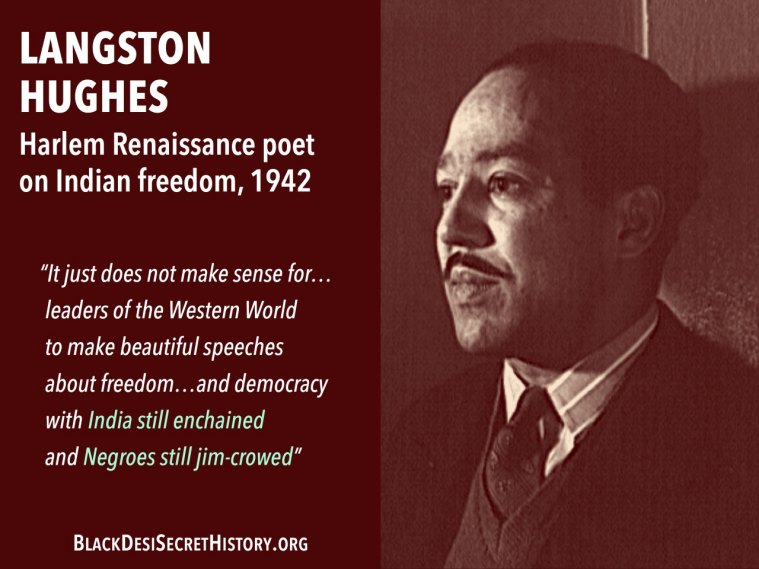
After the first Black Lives Matter protests, Chatterjee started the webpage BlackDesiSecretHistory to bring the century-long entangled history of South Asians and African-Americans solidarity — mainly known only to academics — into the public eye. The page curates rich interrelationships, such as Black-Bengali marriages at the turn of the last century (documented in Vivek Bald’s Bengali Harlem), social reformer Kamaladevi Chattopadhyay’s strong links as a “coloured woman” with African-American activists, freedom fighter Ram Manohar Lohia’s intentional violation of racist Jim Crow laws and Dalit activists’ drawing inspiration from Black power.

One of his favourite stories is that of Bayard Rustin, a quiet eminent Black American activist who architected Martin Luther King’s landmark protest march in Washington in 1963. But two decades before that, a younger Rustin in the 1940s had been actively following the Indian independence struggle as the director of the Free India Committee and repeatedly courted arrest for the Indian cause by leading sit-in protests in front of the British Embassy in Washington D.C.
“A black, gay activist in the east coast in the 1940s — that’s not what I thought of as an Indian freedom fighter,” said Chatterjee, “It really expanded my sense of … to whom we owe debts of solidarity and who stood with us.” Knowing this shared history, he recently wrote, leaves us a choice about whether to ignore it and give into our worst instincts. Or to celebrate it and build on our best traditions.
In the last few years, activist collectives realised that the need for slow, sustained conversations within the community as a conduit to change. Community education curriculums were developed such as the one called “It Starts at home: Confronting Anti-Blackness in South Asian Communities” by Queer South Asian National Network, which provide guidance, roadmaps and role plays on how to talk about it.
In December 2019, six young South Asian women in Bay Area, California came together to develop another curriculum that took millennial and Gen Z participants through a series of discussions on the history of South Asians, its connections with anti-blackness, ways to be powerful allies and channeling the internal trauma of brown immigration stories. When the killings of Ahmaud Arbery, Breonna Taylor and George Floyd shook the national conscience — the programme Solidarity in Struggle: South Asians for Black Lives saw its educator’s role expand quickly. Collaboration requests came pouring in as its social media pages, which feature artwork centering BLM demands, breaking down concepts such as police abolition and a trove of resources such as tips to discuss anti-blackness with family and friends, took off.
View this post on Instagram
A post shared by South Asians 4 Black Lives (@southasians4blacklives) on Jun 12, 2020 at 12:38pm PDT
“We’ve been coddled by that model minority myth … which encourages us to be apathetic and to not work towards movements for Black lives. I think what we need is a model minority mutiny,” said one of the women behind the initiative, “We need all of us to continue to work together towards the liberation of people of colour, and particularly Black and indigenous communities of colour. And I think that what we’re seeing with our South Asian for Black Lives page is that there are so many young folks who are wanting to do that work and are just looking for the right way that they can plug into it.”
“The increased interest in confronting anti-Blackness among South Asian community members shows some progress. We have gotten more requests than ever before for tools, resources, and discussions on how individuals and organisations can effectively talk about this issue and understand systemic racism,” wrote Sophia Qureshi, who manages communications for South Asian Americans Leading Together (SAALT), in an email. However, she emphasises that solidarity statements are far from enough and the need for South Asians to interrogate their reliance on the police and an inherently racist criminal justice system. Solidarity against racism, she said, also goes hand in hand with confronting other injustices such as oppression and violence against Dalits, Islamophobia and rising Hindu nationalism.
“We have become really good as a society about saying the right things,” said Singh. “I think there is some value in that but there is also frustration when your words aren’t followed up with actions because that doesn’t help anybody.” Activists across the board have encouraged South Asians to attend protests, contribute money, pro bono services, and time and attention to petitions, demands and voting.
Thenmozhi Soundarajan, a Dalit American activist and executive director of Equality Labs, a progressive, Ambedkarite South Asian organisation, said many well-to-do South Asians are guilty of strategically exploiting the ‘Person Of Color’ label to further their own personal careers and positions, without acknowledging their privileged status above other minorities. She cautioned desis against a superficial, performance-only solidarity and called for difficult introspective questions that Black Lives Matter should raise.
“Anti-Dalitness and casteism … informs and feeds South Asian anti-Blackness,” she said in an email, pointing out how the two intersect each other: “From the marginalistion of Afro-Indian groups like the Siddi, to police violence against caste-oppressed people in India and against Black and Indigenous people in the US to the ways South Asians carry casteist practices to their communities in other countries.”
View this post on Instagram
A post shared by Equality Labs (@equalitylabs) on Jun 17, 2020 at 9:59am PDT
In a recent panel conversation called South Asians in Defence of Black Lives, she called for empathy and outrage for injustice across the board. “Educate yourselves,” she said to the panel audience, “Learn about Ambedkar and learn about caste abolitionist practices.”
She did not mince words while speaking about silences on recent atrocities against Dalits, attacks on Indian Muslims and imprisonment of individuals like Anand Teltumbde and Safoora Zargar. “You only have to look at Kashmir and the north-east to remind yourself of people who are oppressed and wrongfully in prison today,” she said.
Rathi is a former journalist with indianexpress.com
 Share


