


Journalism of Courage
 Share


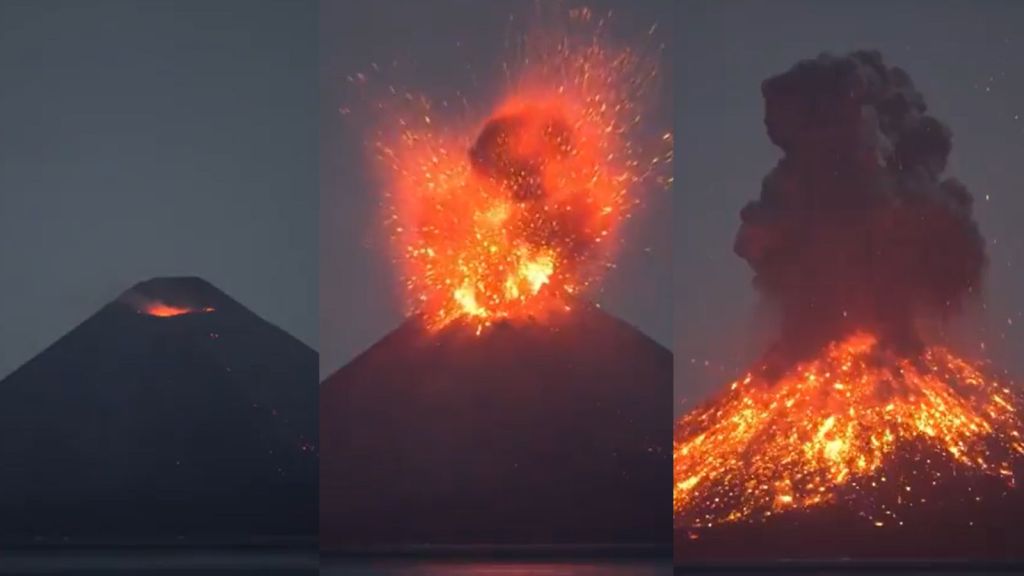 ndonesia’s Anak Krakatau volcano blew again this morning and blasted ash up to 50,000 feet. (Screengrab/X/@nanana365media)
A volcano in Indonesia has erupted more than once since Friday, sending ash as high as 50,000 feet into the sky and forcing the closure of eight airports across the country, including both of Jakarta’s main airports. By Monday morning, the shutdown had affected around 170,000 passengers and led to the cancellation of more than 1,550 flights, according to Reuters.
The volcano, Anak Krakatau, sits in the Sunda Strait between Java and Sumatra. It had shown signs of activity from Friday, then erupted for 30 seconds at 3:53am on Sunday, followed by a second, shorter eruption about three hours later, Indonesia’s Geological Agency said.
🔴INDONESIA 🇮🇩| 🌋 Mount Anak Krakatau erupted on Sunday, September 6, sending around volcanic ash plumes up to 50,000 feet. This eruption led to the temporary suspension of flight operations at Jakarta's Soekarno-Hatta International Airport. More than 200 flights were diverted. pic.twitter.com/kk9fx5Yb9X
— Nanana365 (@nanana365media) September 6, 2026
A further eruption was recorded on Sunday night at 8:23pm, according to the volcano monitoring agency’s website. No deaths or injuries have been reported, and no evacuation order has been issued, though people have been told to stay at least 3 kilometres from the crater.
Airspace was shut around Jakarta’s Soekarno-Hatta and Halim Perdanakusuma airports, along with six others, including Radin Inten II Airport in Lampung. All eight were ordered closed until 8:59am on Monday, though Jakarta’s main airport operator later said on Instagram that Soekarno-Hatta would stay shut until 6pm local time. Services at Bali’s main airport and at Medan were also disrupted.
Breaking : Fresh footage of Mount Anak Krakatau shared by a local resident shows its current volcanic condition in Indonesia pic.twitter.com/GD96dFydd2
— World Updates (@Updatesofwworld) September 6, 2026
Indonesia’s transport minister, Dudy Purwagandhi, said the situation was still changing. “We cannot ascertain when this will end due to the dynamic weather,” he said, Reuters reports.
Two ash clouds have been tracked by satellite. One reached about 20,000 feet and drifted over Jakarta, Banten and West Java. A second, larger cloud reached around 50,000 feet and spread over Banten, Lampung and Bengkulu provinces, the southern Sunda Strait, and part of the Indian Ocean west of Sumatra, weather agency BMKG said.
Lana Saria, head of Indonesia’s Geological Agency, said activity at the volcano has picked up since July, with Sunday’s eruption the strongest in that period. She said the pattern points to a steady supply of magma and gas below the volcano, though officials cannot say whether a bigger eruption will follow. The monitoring agency has also warned that further eruptions remain likely in the coming period.
One stranded traveller, Spanish tourist Diego Urdiales, had been due to fly home to Madrid and said he was still waiting to hear from his airline about rebooking. Another passenger, Michele Gouw, said the disruption was simply something people had to accept. “It’s a natural disaster, it’s a force majeure,” she said, according to AP.
Schools in affected parts of Jakarta and Lampung have moved to online learning to keep children away from the ash, state news agency Antara reported. The disaster agency has also advised people to wear masks outdoors.
Singapore Airlines said on social media that it had cancelled ten flights between Singapore and Jakarta on 6 and 7 September because of the eruption, warning that other flights on the route could also be affected as the situation remained fluid. The airline said passengers who booked directly with it could use its online form to rebook or ask for a refund, while those who booked through a travel agent or another airline should contact them directly. “SIA apologises to all affected customers for the inconvenience caused,” the airline said in its post.
 People look at an information board as flights are disrupted due to the eruption of Mount Anak Krakatau, at Soekarno-Hatta International Airport in Tangerang, Indonesia. (Photo: AP)
| Flight | Route | Date | Time |
|---|---|---|---|
| SQ968 | Singapore to Jakarta | 6 Sep | 2155 |
| SQ951 | Jakarta to Singapore | 7 Sep | 0525 |
| SQ950 | Singapore to Jakarta | 7 Sep | 0620 |
| SQ952 | Singapore to Jakarta | 7 Sep | 0740 |
| SQ956 | Singapore to Jakarta | 7 Sep | 0905 |
| SQ953 | Jakarta to Singapore | 7 Sep | 0805 |
| SQ955 | Jakarta to Singapore | 7 Sep | 0925 |
| SQ957 | Jakarta to Singapore | 7 Sep | 1100 |
| SQ958 | Singapore to Jakarta | 7 Sep | 1235 |
| SQ959 | Jakarta to Singapore | 7 Sep | 1420 |
Meanwhile social media accounts reported that more than 200 flights had been diverted from Soekarno-Hatta airport after the eruption, and that the World Meteorological Organization had released footage showing smoke from Indonesian forest fires drifting into Malaysia, Singapore and the Philippines.
BREAKING : The World Meteorological Organization Released a footage of smoke from Indonesian forest fires has crossed into Malaysia, Singapore and the Philippines pic.twitter.com/fWNeRbfH8v
— World Updates (@Updatesofwworld) September 6, 2026
Anak Krakatau means “child of Krakatau” and formed from the site of the much larger Krakatau volcano, whose 1883 eruption killed more than 36,000 people in a series of tsunamis and cooled the global climate for years afterwards.
In 2018, an eruption of Anak Krakatau triggered an underwater landslide that caused part of its slope to collapse, setting off a tsunami that killed at least 430 people in Sumatra and Java. Scientists said the island was left about a quarter of its original size after that event.
Indonesia sits on the Pacific “Ring of Fire”, a zone known for frequent earthquakes and volcanic eruptions.
 Share
