
UPSC Key: US-China Summit, Iran’s 7-day Peace Proposal and New Highway Design Rules
Why is knowing about the recent Trump-Xi Summit relevant to the UPSC exam? What significance do topics such as Taiwan issue, new highway design rules, ECI's functioning and Yuan internationalisation hold for both the preliminary and main examinations? You can learn more by reading the Indian Express UPSC Key for September 26, 2026.
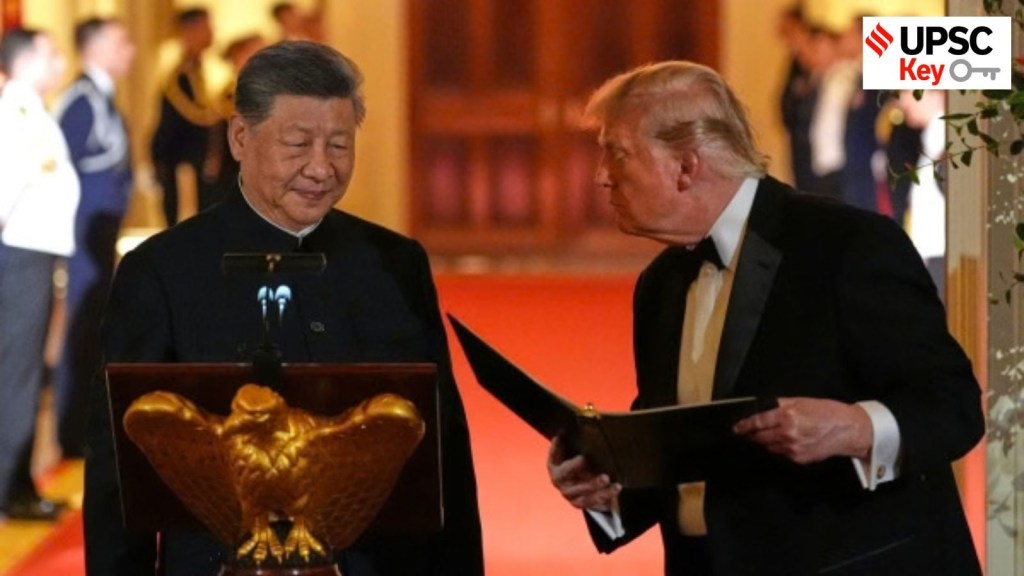 US President Donald Trump and China’s President Xi Jinping during a State Dinner at the White House on September 24. (Source: AP)
Important topics and their relevance in UPSC CSE exam for September 26, 2026. If you missed the September 25, 2026 UPSC CSE exam key from the Indian Express, read it here
WORLD
Trump, Xi wrap up summit with tea minus any big breakthrough
Syllabus:
Preliminary Examination: Current events of national and international importance.

Mains Examination: General Studies II: Effect of Policies and Politics of Developed and Developing Countries on India’s interests
What’s the ongoing story: President Donald Trump and Chinese President Xi Jinping drank tea at the White House and visited the National Archives on Friday, ending a three-day summit that showcased personal diplomacy rather than big public breakthroughs in economic relations.
Key Points to Ponder:
— Why are US-China economic relations important for the global economy?
— What are the major areas of competition and collaboration between the US and China?
— How did the US-China trade conflict develop, particularly after 2018?
— Why has artificial intelligence emerged as an important area of both competition and cooperation between the two countries?
— Read about China+1 strategy.
— How can US-China tensions affect India’s exports, imports and investment?
— Why does the Indo-Pacific matter in the US-China strategic relationship?
— What is the Taiwan issue?
— What is APEC? How is it different from the G20?
Key Takeaways:
— The two leaders praised each other in remarks while they had tea in the White House Red Room. Trump said the summit between the world’s two largest economies had produced great strides and that “I think our farmers are going to be happy”, but did not provide details.
— “America is very happy about this visit, and I’m sure China is very happy also,” he said. Xi said the US-China relationship had developed into a constructive one of “strategic stability on the basis of respect, fairness and reciprocity.”
— Xi also said he and Trump would have two more opportunities to meet this year, the APEC summit in China and a G20 summit in Miami.
— “I do welcome you, Mr. President and the First Lady to visit China,” he said. The lavish state summit, with flyovers, colours and a glittering state dinner, has been heavy on symbolism but light on substance.
— Still, Trump highlighted progress under a bilateral trade mechanism, citing what he described as increased market access for US farmers and ranchers, while both leaders identified artificial intelligence as an area for cooperation.
— Details of the limited agreements the two sides struck regarding their tense trade relationship would be released on Monday, US Trade Representative Jamieson Greer told CNBC on Friday.
— “We’re in a managed trade situation. … We’ve had progress, and we will release on Monday, I think, a lot more details about what we’ve accomplished over the past few weeks in negotiating with the Chinese,” he said.
Do You Know:
— During Chinese President Xi Jinping’s visit to the United States, issues ranging from tariffs to artificial intelligence (AI) regulation were on the agenda, with global ramifications. But for China, perhaps the most significant concern may be the US government’s policy on Taiwan.
— China has long made historical claims to Taiwan, even as Taiwanese political leaders have increasingly referred to themselves as functioning independently anyway. Concurrently, the Chinese claims are being made with greater intensity, alongside tactics like aircraft flybys near Taiwan.
— Before 1979, the US officially recognised Taiwan as representing China internationally. Then we had the three Joint Communiqués signed by the governments of the US and mainland China through 1982 that led to them recognising each other diplomatically, conditional on the US revoking recognition of Taiwan.
— The third document also stated that the US would gradually decrease its arms sales to Taiwan. At the same time, the US put forth the Six Assurances — a classified memo to Taiwan — stating it had not agreed to an end date on arms sales and would not negotiate with China over them. That balanced Taiwan’s feeling of being left behind.
— Since then, the Taiwan Relations Act of 1979 has formed the basis of unofficial relations between the US and Taiwan, with the US being its primary arms seller. We have a deep commitment to aid Taiwan’s defensive needs so they can credibly deter China from contemplating a military contingency.
Other Important Articles Covering the same topic:
📍The takeaways from Trump-Xi summit: Plenty of show, little of substance — and worries for India
📍An expert explains | Amid Trump-Xi bonhomie, why an island 15,000 km away looms large
Previous year UPSC Mains Question Covering similar theme:
“The West is fostering India as an alternative to reduce dependence on China’s supply chain and as a strategic ally to counter China’s political and economic dominance.” Explain this statement with examples. (UPSC CSE, 2024)
EXPLAINED
How Taiwan looms large in US-China ties
Syllabus:
Mains Examination: General Studies II: Effect of Policies and Politics of Developed and Developing Countries on India’s interests.
What’s the ongoing story: During Chinese President Xi Jinping’s visit to the United States, issues ranging from tariffs to artificial intelligence (AI) regulation were on the agenda, with global ramifications. But for China, perhaps the most significant concern may be the US government’s policy on Taiwan.
Key Points to Ponder:
— Locate Taiwan, the Taiwan Strait, Spratly Islands, Paracel Islands, Senkaku Islands and the South China Sea on the map.
— What is the Taiwan Strait and why is its location strategically important?
— Read about the history of Taiwan and its relationship with mainland China.
— What is the One-China principle? How is it understood by China?
— What is meant by the US policy of “strategic ambiguity” towards Taiwan?
— What is the significance of the Taiwan Strait for global trade and maritime security?
— Why is Taiwan important in the global semiconductor industry?
— Read about the first and second island chains in the Western Pacific.
— How does the Taiwan issue affect US-China strategic competition?
— Why does Taiwan matter to India’s broader Indo-Pacific strategy?
Key Takeaways:
— The Chinese government has earlier described the island of Taiwan as a “red line” that cannot be challenged. Xi recently said in Washington, DC, that “China hopes the US side will adhere to the correct position of opposing ‘Taiwan independence,’ and handle the Taiwan question with caution, so as to lay a solid foundation for China-US strategic cooperation…”
— China has long made historical claims to Taiwan, even as Taiwanese political leaders have increasingly referred to themselves as functioning independently anyway. Concurrently, the Chinese claims are being made with greater intensity, alongside tactics like aircraft flybys near Taiwan.
— In Donald Trump’s first term, beginning in 2017, his policies centered on strategic competition and correcting unfair trade with China. This view has evolved, largely due to his belief that his personal charm and business approach can persuade autocratic leaders — a playbook he used with Vladimir Putin and Kim Jong Un. It hasn’t worked well with Putin, since there has been no agreement on Ukraine.
— With China, it’s unclear. I give Trump credit for understanding the importance of respect in Chinese culture and going above and beyond to show that. But what comes next, and what concessions can the US extract? During the last trade war, when China restricted rare earths, the US lost its leverage.
Do You Know:
— The US-Taiwan ties have been driven by Cold War machinations, Taiwan’s material significance to the US, and its strategic interests.
— The modern-day states of China and Taiwan were established in 1949, after the end of a civil war between the Communists and the Nationalist Party. The Communists won in mainland China, while the Nationalists fled to Taiwan to establish a separate government, even as both governments laid historical claims to both territories.
— Today, Taiwan identifies itself as a sovereign state, while China views it as a breakaway province, fated to reunite with the “motherland”. The United States’ view is rather complex.
Other Important Articles Covering the same topic:
📍As Trump notes prospect of China attacking Taiwan, understanding why the island matters to the US
Previous year UPSC Prelims Question Covering similar theme:
(1) Which one of the following statements best reflects the issue with Senkaku Islands, sometimes mentioned in the news? (UPSC CSE, 2022)
(a) It is generally believed that they are artificial islands made by a country around the South China Sea.
(b) China and Japan engage in maritime disputes over these islands in East China Sea.
(c) A permanent American military base has been set up there to help Taiwan to increase its defence capabilities.
(d) Though the International Courts of Justice declared them as no man’s land, some South-East Asian countries claim them.
Conflict and Consensus in the ECI’s functioning
Syllabus:
Mains Examination: General Studies II: Appointment to various Constitutional Posts, Powers, Functions and Responsibilities of various Constitutional Bodies.
What’s the ongoing story: The functioning of the three-member Election Commission of India is under scrutiny this week, after an investigation by The Indian Express published on September 23 revealed that two Election Commissioners had placed their objections on record at least 14 times in 10 months. The Election Commission has responded by saying that the decisions taken by the Commission have been unanimous, saying that “observations” were a part of the deliberative process.
Key Points to Ponder:
— What is the Election Commission of India (ECI)? Why is it important for the electoral process?
— Read Article 324 of the Constitution. What powers and responsibilities does it give to the ECI?
— What is meant by the ECI’s “superintendence, direction and control” over elections?
— How is the ECI constituted? What does the Constitution say about the number of Election Commissioners?
— What is the role of the Chief Election Commissioner (CEC) in the Commission?
— How has the composition of the ECI changed since 1950?
— Why was the ECI made a multi-member body?
— How are decisions taken in a multi-member Election Commission?
— Read about the Chief Election Commissioner and Other Election Commissioners (Appointment, Conditions of Service and Term of Office) Act, 2023.
— What are the constitutional and statutory safeguards for the independence of the ECI?
— How are the CEC and other Election Commissioners appointed?
Key Takeaways:
— The Election Commission derives its powers from Article 324 of the Constitution, which provides for a Commission for the “superintendence, direction and control of the preparation of the electoral rolls for, and the conduct of, all elections to Parliament and to the Legislature of every State and of elections to the offices of President and Vice-President…”
— It further says that the commission will consist of the Chief Election Commissioner (CEC) and “such number of other Election Commissioners” that the President may appoint, subject to provisions of law. The CEC “shall act as the Chairman of the Election Commission”.
—How the Election Commission is supposed to arrive at decisions is laid out in the Chief Election Commissioner and Other Election Commissioners (Appointment, Conditions of Service and Term of Office) Act, 2023.
— Section 17 of the Act says that the “business of the Election Commission shall be transacted in accordance with the provisions of this Act.”
— Deliberation, debate, and internal dissent form the lifeblood of any functional constitutional democracy. Yet, an elementary principle of constitutional jurisprudence governs all collegiate bodies: While deliberation and dissent represent the intellectual process, it is the final outcome that constitutes the binding decision.
— To challenge the legitimacy of an institution simply because its internal deliberations reflect divergent viewpoints, or because a ruling does not produce absolute unanimity, is legally unlettered and a calculated assault on institutional integrity.
— A multi-member body is crafted to assemble diverse viewpoints. When the Constitution provided for an Election Commission (ECI) under Article 324, and Parliament subsequently framed statutory frameworks to govern its functioning, the law explicitly structured the mechanics of collegiate decision-making.
Do You Know:
— Article 324 of the Constitution vests the “superintendence, direction and control of elections” in an Election Commission consisting “of the Chief Election Commissioner and such number of other Election Commissioners, if any, as the President may from time to time fix”.
— From the commencement of the Constitution on January 26, 1950 until 1989, the ECI was a single-member body, with only a Chief Election Commissioner (CEC). The ECI was expanded just ahead of the elections to the ninth Lok Sabha.
— However, the three-member arrangement only lasted for 70 days. For the next two years, the ECI continued to function as a single-member body.
— Unhappy with Seshan asserting the Commission’s independence, the Congress government headed by P V Narasimha Rao decided to expand the ECI again on October 1, 1993. M S Gill and G V G Krishnamurthy were appointed ECs.
— Simultaneously, The Chief Election Commissioner and Election Commissioners (Conditions of Service) Act, 1991 was amended by an Ordinance. The name of the law was changed to The Election Commission (Conditions of Service of Election Commissioners and Transaction of Business) Act, 1991.
— The government made the CEC and the ECs equal by giving all three the status of a Supreme Court judge, retiring at the age of 65 years. In other words, all three Commissioners now had equal decision-making powers.
Other Important Articles Covering the same topic:
📍14 times in 10 months, two Election Commissioners objected on record to poll panel steps
📍Dissent is not dysfunction, institutions need it
Previous year UPSC Prelims Question Covering similar theme:
(2) Consider the following statements: (UPSC CSE, 2017)
1. The Election Commission of India is a five-member body.
2. Union Ministry of Home Affairs decides the election schedule for the conduct of both general elections and bye-elections.
3. Election Commission resolves the disputes relating to splits/mergers of recognised political parties.
Which of the statements given above is/are correct?
(a) 1 and 2 only
(b) 2 only
(c) 2 and 3 only
(d) 3 only
Displacing the dollar: Why Yuan is falling short
Syllabus:
Preliminary Examination: Current events of national and international importance.
Mains Examination: General Studies II: Effect of Policies and Politics of Developed and Developing Countries on India’s interests
What’s the ongoing story: Chinese President Xi Jinping’s visit to the US and his meeting with US President Donald Trump comes at a time when the global economy is buffeted by uncertainty.
Key Points to Ponder:
— What is a reserve currency?
— What is dollarisation? Distinguish between official, semi-official and de facto dollarisation.
— What factors determine the internationalisation of a currency?
— Why has the US dollar remained the dominant global currency for decades?
— What economic strengths make the yuan a potential international currency?
— What are the major limitations to the yuan’s internationalisation compared with the US dollar?
— How can BRICS and other emerging-economy groupings contribute to reducing dependence on the dollar?
— What are local-currency trade settlements?
— What are currency swap arrangements?
— What role do payment systems play in international trade?
— Why are deep financial markets important for an international currency?
Key Takeaways:
— Apart from the wars in Ukraine and Iran, global trade has also been disrupted by the tensions between the world’s two biggest economies, especially as Trump continues to levy punitive tariffs on all and sundry.
— The ensuing disruption, be it in the form of higher prices or reduced foreign investments, often hurts smaller and poorer economies such as India the most.
— China is still some distance away from overtaking the US — its GDP (or gross domestic product, the measure of the size of an economy) is around $21 trillion while the US’s is at around $32 trillion.
— But China has easily become the second biggest economic power on the planet since it already dwarfs the Euro area (at less than $20 trillion) in total economic size.
— China’s rise over the past 20 years has not only been spectacular but has also been in sharp contrast to the economic stagnation in European economies.
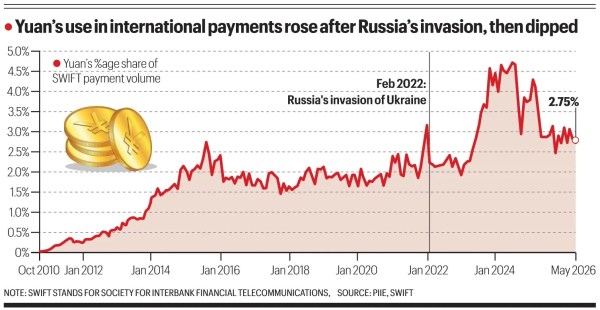 The yuan’s performance.
Do You Know:
— A key reason India is not supporting de-dollarization is the rise of the Chinese yuan as a potential competitor to the US dollar. India has refrained from using the yuan for imports of Russian oil, despite the increasing acceptance of this currency in Russia.
— Dollarisation is the process by which a country decides to recognize the U.S. dollar (stronger currency) as a medium of exchange alongside or in place of its domestic currency. It is a form of currency substitution where governments may choose to partially or fully adopt a foreign currency.
— For the past 80 years, the US dollar has been the dominant global reserve currency. Central banks, corporations, and travelers rely on the dollar to facilitate international trade and financial transactions. Today, the dollar is the most widely held reserve currency, playing a role in an estimated $6.6 trillion in daily transactions.
— Notably, the history of the beginning of ‘Dollarisation‘ goes back to the Bretton Woods Conference of 1944, which redefined the global monetary order with participation from 44 Allied countries, including the US, Canada, and much of Western Europe.
— In response to Europe’s need for financial stability post- second world war, the US established the dollar as the central reserve currency, pegging global currencies to it and making it convertible to gold at a fixed rate.
— This framework fostered stability in international trade and solidified the dollar’s dominance in the global economy. Under the Bretton Woods system, the dollar’s centrality was reinforced by its role in international transactions and trade.
Other Important Articles Covering the same topic:
📍Will the BRICS push for de-dollarisation inadvertently benefit China?
📍Why does RBI want a hedge against dollar reliance, but not push for de-dollarisation?
📍Knowledge nugget of the day: Dollarisation and De-dollarisation
Previous year UPSC Prelims Question Covering similar theme:
(3) Consider the following statements: (UPSC CSE, 2021)
The effect of devaluation of a currency is that it necessarily
1. improves the competitiveness of the domestic exports in the foreign markets
2. increases the foreign value of domestic currency
3. improves the trade balance
Which of the above statements is/are correct?
(a) 1 only
(b) 1 and 2
(c) 3 only
(d) 2 and 3
EDITORIAL
Syed Akbaruddin writes: A declining United Nations is not a good news for a rising India
Syllabus:
Mains Examination: General Studies II: Important International Institutions, agencies and fora – their Structure, Mandate.
What’s the ongoing story: India is rising as the United Nations (UN) loses authority. Rivalry among major powers may create room for manoeuvre but it also makes agreements harder to trust. For an aspirational power, that is a poor bargain. Indian diplomacy must win more influence over UN decisions while helping make those decisions matter.
Key Points to Ponder:
— Why was the United Nations established?
— What are its principal objectives under the UN Charter?
— Know the composition, mandate and voting structure of the UN Security Council
— What is the significance of the P5 and the veto power in the functioning of the UNSC?
— What is the role of the UN General Assembly?
— What has been India’s historical contribution to the United Nations and its peacekeeping operations?
— Examine the major arguments advanced by India for the permanent membership of the UNSC.
— What are the major proposals for reforming the UN Security Council?
— What are the principal areas of disagreement over UNSC reform?
— What is the G4 grouping?
— Why has reform of the UNSC remained unresolved despite decades of negotiations?
Key Takeaways:
— This year’s General Assembly is unlikely to resolve that tension. Governments whose consent the UN needs are often pursuing objectives it was established to restrain. A week of diplomacy in New York will do little to change the calculations that lead powerful states to bypass the organisation or block its work.
— India needs agreements that hold when relations sour. New Delhi has long defended sovereignty and resisted intrusive international rule-making. Yet constraints imposed by powerful countries can leave it with even less say.
— The question is who writes the rules and how much influence India has over them. Multilateral arrangements give India a voice in those negotiations and room to cooperate with countries it disagrees with elsewhere.
— Ukraine, Gaza and the war involving Iran and the Gulf expose the Security Council’s inability to restrain its strongest members and their clients. Sudan demonstrates the consequences of neglect.
— The Council was designed to work when the major powers could agree. Its veto gives each permanent member the means to block action when they cannot. Appeals to the Charter have little effect when those expected to uphold it can prevent its enforcement.
Do You Know:
— The United Nations is divided into five regional groups representing Asia, Africa, Latin America, Eastern Europe, and Western Europe & Others (WEOG). The latter comprises the United States, Canada, Australia, New Zealand and Israel.
— The Eastern Europe group is reminiscent of the Cold War era, with the UNSC’s permanent membership (P5) of the United States, United Kingdom, France and Russia also representing the victorious Allied powers, plus China.
— The UNSC also has 10 non-permanent members elected by the UN General Assembly for two-year terms. These include three from Africa, one from Eastern Europe, and two each from Asia, Latin America and WEOG.
— Five elected members retire every year, making way for a rotation among the non-permanent members. Pakistan is presently a member of the UNSC from Asia, having joined in 2025-26, while Bahrain’s tenure expires in 2027. Kyrgyzstan will replace Pakistan in 2027 and serve through 2028.
Other Important Articles Covering the same topic:
📍India’s rise demands a seat at the UNSC
📍Expert Explains: India’s campaign for a UN Security Council seat in 2028-29
Previous year UPSC Prelims Question Covering similar theme:
(4) With reference to the United Nations General Assembly, consider the following statements: (UPSC CSE, 2022)
1. The UN General Assembly can grant observer status to the non-member States.
2. Inter-governmental organisations can seek observer status in the UN General Assembly.
3. Permanent Observers in the UN General Assembly can maintain missions at the UN headquarters.
Which of the statements given above are correct?
(a) 1 and 2 only
(b) 2 and 3 only
(c) 1 and 3 only
(d) 1, 2 and 3
Previous year UPSC Mains Question Covering similar theme:
“The reform process in the United Nations remains unresolved, because of the delicate imbalance of East and West and entanglement of the USA vs. Russo-Chinese alliance.” Examine and critically evaluate the East-West policy confrontations in this regard. (UPSC CSE 2025)
ECONOMY
India’s 50,000-km high-speed road plan: What new highway design rules say
Syllabus:
Mains Examination: General Studies III: Infrastructure (Roads)
What’s the ongoing story: In a move to ensure uniformity and consistency in the construction of high-speed corridors, also known as access-controlled national highways or expressways, the National Highways Authority of India (NHAI) has issued detailed guidelines covering the design, standards and specifications for such projects.
Key Points to Ponder:
— Why is road infrastructure important for economic growth and regional development?
— Why is a high-speed, access-controlled road network important?
— Know the mandate and institutional role of the National Highways Authority of India (NHAI).
— Identify the major National Highways and their routes: NH-44, NH-27, NH-48, NH-16 and NH-19.
— Locate the Golden Quadrilateral, North–South Corridor and East–West Corridor on the map.
— What share of India’s freight movement is carried by roads, and why has road transport emerged as the dominant freight mode?
— What are high-speed corridors, and how do they differ from conventional national highways?
— Why has NHAI introduced uniform design standards for high-speed corridors?
— What is Right of Way (ROW), and why is corridor protection important for national highways?
— What is Multi-Lane Free Flow (MLFF) tolling, and how can barrier-less tolling improve highway efficiency?
Key Takeaways:
— Until now, consultants have been preparing detailed project reports (DPRs) for these corridors based on varying standards and specifications. The move assumes significance as India targets 50,000 km of high-speed corridors by 2036-37 under Vision 2047.
— These corridors are special sections of national highways which provide uninterrupted, end-to-end travel. The total length of high-speed corridors by December 2025 stood at 3,052 km.
— The highway authority has mandated that traffic assessment of these projects should include existing, generated, induced, as well as diverted traffic based on proper traffic modelling.
— “Freight growth rate shall be duly analysed considering economic development. The traffic shall be validated from other secondary sources such as toll transactions. For freight traffic and determination of VDF (vehicle damage factor), data from GST portals, mining departments and other sources should be validated,” it said.
— It said that when the present traffic is up to 15,000 PCU (passenger car unit), the corridor should be developed as a four-lane highway with a four-lane structure. If the traffic is between 15,000 to 25,000 PCU, the corridor should be of four-lane highway and six-lane structures, and if the traffic is 25,000-40,000 PCU, then it should be a six-lane highway with six-lane structures.
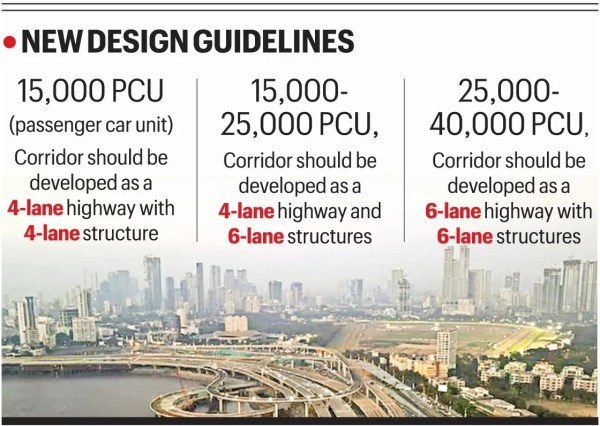 New design guidelines.
Do You Know:
— As India rapidly scales its highway infrastructure to achieve its goal of becoming a developed nation by 2047, the definition of infrastructure modernisation has also evolved beyond basic expansion of roads and highways.
— Modernisation is no longer seen as constructing multi-lane roads or improved connectivity, but it also includes ensuring the safety and sustainability of the road network so that it protects both human life and the environment.
— India accounts for 11 per cent of global road accident fatalities, despite having only about 1 per cent of the world’s vehicles, according to a report by the World Bank. The high mortality rate is driven by a combination of structural design flaws and human behavioural factors.
— To address the limits of physical enforcement and driver reaction times (time a driver takes to spot a hazard and act), the National Highways Authority of India (NHAI) under the Ministry of Road Transport and Highways (MoRTH) is introducing major technological upgrades through the integration of Intelligent Transport Systems (ITS).
— As part of this initiative, Advanced Traffic Management Systems (ATMS) are being deployed across major expressways to cut down response times and improve safety. These systems use AI-driven CCTV cameras, vehicle speed detection systems, dynamic Variable Message Signs (VMS), and automated incident detection technologies.
Other Important Articles Covering the same topic:
📍Cars in India will soon ‘talk’ to each other. Will it reduce road deaths?
📍‘Real-time location, AI and quick ambulances in accident’: NHAI plans to upgrade its 1033 helpline
📍How technological innovations help India build safe, sustainable road network
Previous year UPSC Prelims Question Covering similar theme:
(5) With reference to India’s projects on connectivity, consider the following statements: (UPSC CSE, 2023)
1. East-West Corridor under Golden Quadrilateral Project connects Dibrugarh and Surat.
2. Trilateral Highway connects Moreh in Manipur and Chiang Mai in Thailand via Myanmar.
3. Bangladesh- China- India- Myanmar Economic Corridor connects Varanasi in Uttar Pradesh with Kunming in China.
How many of the above statements are correct?
(a) Only one
(b) Only two
(c) All three
(d) None
FRONT
Iran proposes 7-day plan to end war, re-open Strait of Hormuz, revive N-talks
Syllabus:
Mains Examination: General Studies II: Effect of Policies and Politics of Developed and Developing Countries on India’s Interests, Indian Diaspora.
What’s the ongoing story: Iranian Foreign Minister Abbas Araghchi said on Thursday (September 24) that Iran had proposed a seven-day plan to the US to end the ongoing war, reopen the Strait of Hormuz, and initiate comprehensive talks about Tehran’s nuclear programme.
Key Points to Ponder:
— What is the history of US–Iran relations since the 1979 Iranian Revolution?
— Why have the US and Iran had a prolonged strategic and diplomatic confrontation?
What was the Joint Comprehensive Plan of Action (JCPOA), and why did the US withdraw from it in 2018?
— What are the major issues in the US–Iran nuclear negotiations?
— How have economic sanctions shaped Iran’s economy and its relations with the US?
— What is the significance of the recent US sanctions regime against Iran?
— What is Lindsey O. Graham Sanctioning Russia and Iran Act of 2026? Examine its possible implications for India.
— Locate the Strait of Hormuz on the map and identify the countries bordering it.
— Examine the significance of the Strait of Hormuz in the context of the current US–Iran conflict and global trade.
— Distinguish between a strait, an isthmus and a canal, with suitable geographical examples.
Key Takeaways:
— “We have introduced a plan to the United States through the intermediators that if certain conditions are met, the Strait of Hormuz would be open on the end of the seventh day and talks would restart,” Araghchi told reporters at a press briefing at the United Nations General Assembly (UNGA) in New York.
— Araghchi said that the latest proposal builds on the commitments that both Iran and the US agreed to in a Memorandum of Understanding (MoU) in June. Iranian officials said that the new proposal, while similar to the MoU, was designed to move at a much faster pace. On paper, the June agreement had granted a 60-day extension to a ceasefire that was announced in April.
— The hope was that during this period, even as the two countries negotiated the terms of a final agreement, the US would issue waivers for Iranian oil exports while shipping through the Strait of Hormuz — the narrow waterway between Iran and Oman that accounted for a fifth of global oil flows before the West Asia war began — would gradually return to prewar levels.
— The agreement also said that Iran and Oman would “determine” how to administer maritime traffic through the Strait. The MoU, which was criticised by both Republicans and Democrats, also entailed Israel halting its military operations in Lebanon. The deal, however, unravelled in early July after alleged violations on both sides.
— Although the Donald Trump-led US administration has said that it will not return to the June agreement, Iranian officials in New York have engaged in diplomatic talks with the US on the sidelines of the UNGA.
Do You Know:
— Articles 37 to 44 of the UNCLOS that govern “Straits used for International Navigation” hold that all ships and aircraft have a “right of transit passage”: the freedom of continuous, swift navigation and overflight through and over international straits.
— They “shall not be impeded”, and “there shall be no suspension of transit passage” through a strait. The reasoning behind this framing is that when a considerable portion of global trade depends on a narrow corridor, bordering states are not allowed to use that corridor as leverage.
— The Strait of Hormuz is generally considered as one such “international strait”, a narrow waterway connecting to the rest of the world.
— The Strait of Hormuz is critical to India’s energy security. Before the current disruption, around 40% of India’s crude oil imports, 60% of LNG imports and nearly 90% of LPG imports regularly came from West Asia through the waterway.
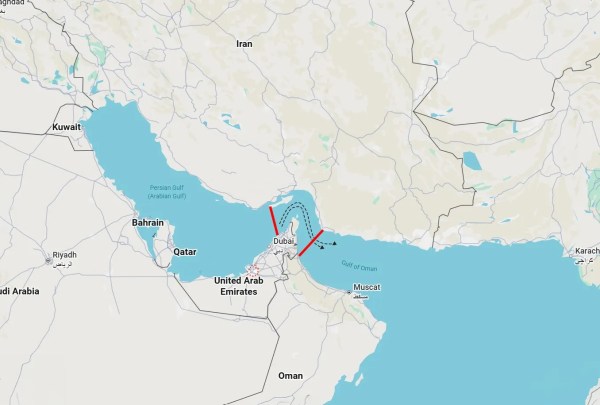 Map showing the Strait of Hormuz between Iran, the UAE and Oman, with the blockade area marked in red. (Source: Google Maps)
Other Important Articles Covering the same topic:
📍Can Iran charge navigation fees for transit through the Strait of Hormuz? An Expert Explains
📍Trump’s Iran sanctions hit India next? Rice, pharma trade explained
📍Trump rejects Iran’s 7-day peace proposal, war likely to resume after US polls
(6) Ships from which of the following countries have to cross the Strait of Hormuz to reach out to the Indian Ocean? (UPSC CSE, 2026)
1. Bahrain
2. Syria
3. Qatar
4. Egypt
Select the answer using the code given below:
(a) 1 and 2
(b) 1 and 3
(c) 2 and 3
(d) 3 and 4
Previous year UPSC Mains Question Covering similar theme:
Mention the significance of straits and isthmus in international trade. (UPSC CSE, 2022)
ALSO IN NEWS
Key trade pacts in mind, Delhi looks at multi-nation visit by PM in December
— Keeping the focus on sealing key trade agreements, Delhi is looking to schedule a multi-nation visit of Prime Minister Narendra Modi in December, The Indian Express has learnt. Destinations may include the US, Canada and at least two European countries, according to diplomatic sources.
— While the India-Canada Comprehensive Economic Partnership Agreement (CEPA) is likely to be finalised and signed in December, it is learnt that the India-EU Free Trade Agreement will also be signed in Brussels the same month. Delhi and Washington, meanwhile, remain engaged on the Bilateral Trade Agreement, and hope to finalise it by December.
— Although there is no official announcement yet from the Ministry of External Affairs on the Prime Minister’s likely visit to North America and Europe, it is expected that he will travel to Miami for the summit of the G20 leaders on December 14-15.
Manga, helpline and AI, India pilots BRICS mental health support network
— A big challenge is facing countries across the BRICS grouping: how to make mental healthcare more accessible, acceptable and closer to where people live.
— This is where a newly-established BRICS Network of Centres of Excellence (CoEs) in mental health, which will be piloted by India, hopes to play a role bringing together approaches developed across member countries and adapting them to local health systems.
— “The hope is that this network will mitigate the existing treatment gaps across BRICS countries by scaling task-sharing models and digital tele-health platforms. It will also aim to integrate mental healthcare into primary health centres, bringing services to hard-to-reach and rural populations,” says Dr Naveen Kumar C, professor of psychiatry at NIMHANS and one of those working on setting up the network.
IIT Delhi researchers build home grown graphics chip for low-cost devices
— Researchers at IIT-Delhi claimed to have developed a programmable micro-graphics processing unit (GPU) designed in India, a step they say could eventually enable locally designed graphics hardware for low-cost embedded devices.
— The processor is designed for graphics and display applications rather than high-end AI computing, with potential uses ranging from industrial control displays and e-rickshaw navigation systems to educational devices and navigation terminals for small boats. Currently, all GPUs are imported.
Jaishankar: Attacks on seafarers are indefensible
— External Affairs Minister S Jaishankar Friday sharply responded to a Pakistani journalist who questioned him about terrorism at the United Nations headquarters in New York.
— The exchange took place after Jaishankar and Liberian Foreign Minister Sara Beysolow Nyanti addressed reporters on the launch of a new Group of Friends focused on the safety and security of shipping and seafarers.
— After the ministers’ remarks, the Pakistani journalist asked Jaishankar, “When will your government stop sponsoring terrorism in Pakistan?” Jaishankar responded, “A terrorist country is asking me that question. Come on.”
Union Minister to join Naga peace negotiations; encouraging: NSCN (IM)
— In a significant step forward in the Naga peace process, the Centre has agreed to include “a Union Minister or a group of Union-level Ministers” in the talks, meeting a longstanding demand of the NSCN-IM for political representation in the negotiations.
— This development comes seven months after former Joint Intelligence Committee chief Ajit Lal was appointed as the Centre’s pointsman for the talks.
— In a statement Thursday, the NSCN-IM welcomed the move: “We particularly welcome the GoI’s decision to include a Union Minister, or a group of Union-level Ministers, in the negotiation framework. We expect this will ‘expedite the political process’ and create the necessary momentum for reaching an honourable and enduring political settlement.”
PRELIMS ANSWER KEY
1.(b) 2.(d) 3.(a) 4.(d) 5.(d) 6.(b)
🚨As we mark the 3rd anniversary of the UPSC Essentials Magazine, we thank our readers for being part of this journey. Your trust, feedback and continued support have shaped the magazine and encouraged us to keep improving with every edition. Click here to read the UPSC Essentials magazine for September 2026. Share your views and suggestions in the comment box or write to us at manas.srivastava@indianexpress.com.🚨
Subscribe to our UPSC newsletter. Stay updated with the latest UPSC articles by joining our Telegram channel – IndianExpress UPSC Hub, and follow us on Instagram and X.


Raveena Baneta is a consultant with the UPSC section of The Indian Express where she writes on Ethic... Read More
 Share


