
UPSC Key: Tulu Language, Drought and Formation of New States
Why Domestic Tourism Expenditure Survey is relevant to the UPSC exam? What is the significance of topics such as World Health Organization, Anoop Baranwal ruling and official language of State on both the preliminary and main exams? You can learn more by reading the Indian Express UPSC Key for September 24, 2026.
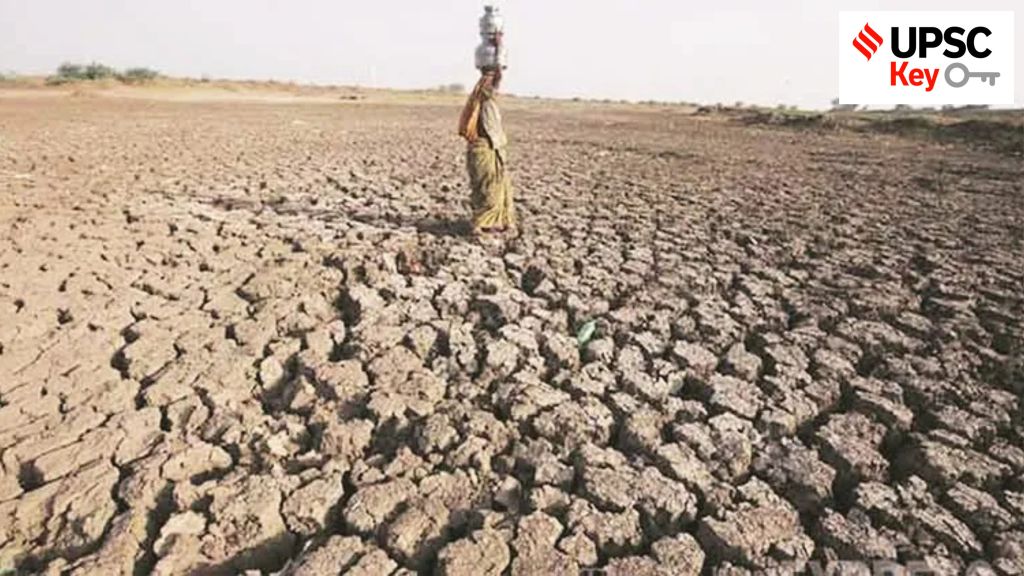 UPSC Key August 2026: Here's what you should be reading from the September 24, 2026 edition of The Indian Express.
Important topics and their relevance in UPSC CSE exam for September 24, 2026. If you missed the September 23, 2026 UPSC CSE exam key from the Indian Express, read it here
The World

WHO chief: Matter of time before US returns to world health agency
Syllabus:
Preliminary Examination: Current events of national and international importance.
Main Examination: General Studies II: Important International institutions, agencies and fora- their structure, mandate.
What’s the ongoing story: World Health Organization (WHO) chief Tedros Adhanom Ghebreyesus said he hopes the United States will rejoin the global health agency and disclosed that he has been in talks with US Health and Human Services Secretary Robert F. Kennedy Jr.
Key Points to Ponder:
• What is the role of World Health Organization?
• How many countries are members of World Health Organization (WHO)?
• What is the mission and vision of the World Health Organization (WHO)?
• What are the three stages of health defined by World Health Organization (WHO)?
• What are the contributions of the World Health Organization (WHO)?
• What are the issues and challenges with the World Health Organization (WHO)?
• What was one of the main criticisms cited by United States for its withdrawal from the WHO?
• What are the implications of United states’ withdrawal from the World Health Organization?
• Know the potential consequences of a country’s withdrawal from international health organizations like the WHO on its domestic health policies and outcomes.
Key Takeaways:
• “The US leadership is very important and I want to assure you that we have continued to communicate from our side. It is a matter of time until the US joins the WHO,” Dr Ghebreyesus told reporters at a Health Coverage Fellowship programme conducted by the Centre for Health Communication at the Harvard T H Chan School of Public Health in Boston.
• The US formally notified the WHO of its withdrawal in January 2026, citing concerns over the agency’s handling of the COVID-19 pandemic. Ghebreyesus, whose second term as WHO director-general ends next year, has rejected several claims made by the US administration.
• The financial stakes are significant. The US has historically been WHO’s largest donor, providing both assessed contributions and voluntary funding. During the 2022-23 biennium, the US contributed $1.284 billion, according to WHO.
• US funding has supported programmes ranging from emergency response and polio eradication to HIV, tuberculosis, immunisation, maternal and child health and other public health initiatives. WHO has said the loss of US support has created major funding gaps, forcing the agency to reprioritise programmes and contain costs.
• The importance of the US, however, extends beyond money. Dr Ghebreyesus pointed to the expertise and global reach of institutions such as the Centers for Disease Control and Prevention and the National Institutes of Health. “No other organisation can replace what WHO does,” its chief said, pointing to its role in coordinating responses to major health crises such as Ebola. “We prefer to play a positive role because US leadership is important,” he said.
Do You Know:
• Founded in 1948, the World Health Organization (WHO) is the United Nations agency dedicated to global health and safety. The Organization connects nations, partners and communities to promote health and serve the vulnerable. WHO works with its Member States to achieve the highest level of health for all people by pursuing universal health coverage.
• WHO headquarters are located in Geneva, Switzerland. WHO is governed by 194 Member States grouped into 6 regions.
• WHO receives funding through membership dues paid by Member States and voluntary contributions from Member States and other partners. Calculated as a percentage of each country’s gross domestic product, membership dues are assessed every 2 years at the World Health Assembly. Less than 20% of WHO’s total budget comes from membership dues, while the remainder comes from voluntary contributions, largely from Member States as well as from other United Nations organizations, intergovernmental organizations, philanthropic foundations, the private sector and other sources.
• The United States is by far the largest contributor to the WHO, providing around $950 million (£760 million) in 2024, making up nearly 15% of the total budget.
• The US pullout raises tough financial questions for the global health body, particularly in light of the growing health crises worldwide.
Other Important Articles Covering the same topic:
📍Under Trump, US withdraws from WHO: Impact, what this means for India
Previous year UPSC Mains Question Covering similar theme:
📍Critically examine the role of WHO in providing global health security during the Covid-19 pandemic. (UPSC, GS2, 2020)
Explained
EC appointment: Why SC placed matter before CJI
Syllabus:
Preliminary Examination: Indian Polity and Governance
Mains Examination: General Studies II: Appointment to various Constitutional posts, powers, functions and responsibilities of various Constitutional Bodies; Salient features of the Representation of People’s Act.
What’s the ongoing story: A two-judge bench of the Supreme Court on Wednesday referred petitions challenging the 2023 law on the appointment of the Chief Election Commissioner (CEC) and other Election Commissioners (ECs) — which excludes the Chief Justice of India (CJI) from the process — to the CJI to consider forming a Constitution Bench (which has a minimum of five judges).
Key Points to Ponder:
• How are Election Commissioners appointed?
• What was the Supreme Court’s 2023 Anoop Baranwal ruling?
• What the 2023 law on EC appointments said?
• Why Chief Election Commissioner and Other Election Commissioners (Appointment, Conditions of Service and Term of Office) Bill, 2023 is in news these days?
• What did Supreme Court say now?
• The Supreme Court described Parliament’s decades-long delay in enacting a law for appointments to the Election Commission, until it was directed to do so in 2023, as “tyranny of the elected”-what have you understood by the given statement?
• Who appoints Chief Election Commissioner of India?
• How Chief Election Commissioner of India and other Election Commissioners are appointed?
• Election Commission of India and Article 324 of the Constitution-Know in detail
• The independent and impartial functioning of the Election Commission-How it is ensured?
• Election Commission of India- Powers and Functions
• Chief Election Commissioner and the two other Election Commissioners have equal powers-True or False?
• In case of difference of opinion amongst the Chief election commissioner and/or two other election commissioners, the matter is decided by the Supreme Court of India-Right or Wrong?
• In March 2023, the Supreme Court stepped in to check what it called the “pernicious effects of the exclusive power being vested with the Executive to make appointment to the Election Commission” and ordered something-can you recall that?
Key Takeaways:
• While Justices Dipankar Datta and Satish Chandra Sharma were split on referring the matter to a larger bench, they agreed that it should be placed before the CJI. They said sending the issue first to a three-judge bench would be of “little worth” and would only delay a final decision on the important Constitutional questions raised by the case.
• The judges flagged the long delays in deciding Constitutional references. They noted that the Anoop Baranwal case (2023) took eight years to reach a final judgment and cited other references that remained pending for years. Calling such delays “a source of institutional embarrassment”, they urged the CJI to consider setting up a permanent five-judge bench for Constitutional cases.
• Justice Datta took the view that the petitions could be decided by the present bench itself. According to him, the top court had already settled the governing Constitutional principle in Anoop Baranwal, which held that appointments to the EC cannot remain under “exclusive executive control”. The question now, he said, was whether the 2023 law complies with that principle. That exercise was “no more than the application of the settled principles of law to the facts of the case” and did not require a Constitution Bench, he said. Justice Datta, therefore, held that “neither any Constitutional bar nor a precedent precludes hearing of these petitions by the present Bench”.
Do You Know:
• The challenge to the Chief Election Commissioner and Other Election Commissioners (Appointment, Conditions of Service and Term of Office) Act, 2023 traces its origins to the Supreme Court’s judgment in Anoop Baranwal v. Union of India in March 2023. In that ruling, a Constitution Bench had noted that Parliament had not enacted a law governing appointments to the Election Commission despite Article 324 of the Constitution contemplating one.
• It laid down an interim mechanism under which appointments would be made by a committee comprising the Prime Minister, the Leader of Opposition in Lok Sabha and the Chief Justice of India — until Parliament enacts a law. The bench had underlined the importance of an independent Election Commission and observed that those entrusted with conducting elections must be insulated from executive influence. Parliament subsequently enacted the Chief Election Commissioner and Other Election Commissioners (Appointment, Conditions of Service and Term of Office) Act, 2023. But the law replaced the CJI on the selection committee with a Union Cabinet minister nominated by the Prime Minister. The government, therefore, got two representatives on the three-member panel, alongside the Leader of Opposition.
• As per Article 145(3), a Constitution Bench of five or more judges decides a “substantial question of law” involving the interpretation of the Constitution. A case does not go to a larger bench merely because it involves the Constitution. The question must be “unsettled” — that is, one the court has never authoritatively answered before. Constitution Bench rulings also carry greater weight than ordinary judgments.
Other Important Articles Covering the same topic:
📍CEC must go, SC should act: Opp chorus after EC divide out in open
📍Independent ECI not enough, it must also appear to be so: SC
📍I voted for three decades. Why is my SIR incomplete? Commission has no answer
📍Chief election Commissioner is not the election Commission of India
Previous year UPSC Prelims Question Covering similar theme:
1) Right to vote and to be elected in India is a (UPSC, CSE, 2017)
(a) Fundamental Right
(b) Natural Right
(c) Constitutional Right
(d) Legal Right
2) Consider the following statements: (UPSC, CSE, 2017)
1. The Election Commission of India is a five-member body.
2. Union Ministry of Home Affairs decides the election schedule for the conduct of both general elections and bye-elections.
3. Election Commission resolves the disputes relating to splits/mergers of recognised political parties.
Which of the statements given above is/are correct?
(a) 1 and 2 only
(b) 2 only
(c) 2 and 3 only
(d) 3 only
Previous year UPSC Mains Question Covering similar theme:
📍Is the right to vote a fundamental right? Discuss the position of the Election Commission of India while undertaking the revision of electoral rolls. Can it also examine the question of citizenship of voters? (UPSC, GS2, 2026)
📍In the light of recent controversy regarding the use of Electronic Voting Machine (EVM), what are the challenges before the Election Commission of India to ensure the trustworthiness of elections in India? (UPSC, GS2, 2018)
Tulu’s ‘official’ tag in Karnataka: What this means
Syllabus:
Preliminary Examination: Indian Polity and Governance
Mains Examination:
• General Studies I: Diversity of India.
• General Studies II: Indian Constitution—historical underpinnings, evolution, features, amendments, significant provisions and basic structure.
What’s the ongoing story: During the first Cabinet meeting at Mangaluru on Friday (September 18), the D K Shivakumar-led Congress government decided to accord Tulu the second additional administrative language status. The move is largely being seen as an attempt by the Congress to counter the communally charged politics of coastal Karnataka with
a slew of measures, which included the special status for Tulu.
Key Points to Ponder:
• What is Tulu?
• What has the Karnataka government decided?
• Why was this demand raised?
• What does official language status mean in practice?
• What are the challenges of implementation?
• What is the cultural significance of the decision?
• What is the official language of a State?
• What are the constitutional provisions governing official languages in states in India?
• What exactly Article 345 says with respect to the official languages?
• Compare and contrast—State official language, a language in the Eighth Schedule and a national language of India .
• Know relationship between Articles 343 and Article 345 to Article 351 of the Constitution.
Key Takeaways:
• The state Cabinet has accorded Tulu the status of second additional official language in Dakshina Kannada and Udupi districts. This means government offices in these districts can now use Tulu for official communication, alongside Kannada.
• The Cabinet also decided to grant Rs 82 lakh every year for translation, training, and activities related to language use so that the decision could be implemented.
• The primary challenge in implementing the decision is that not many know the Tulu script. For years, even writers in Tulu and other languages of the coast have used the Kannada script for writing. Although the Tulu script has been revived in recent years, the language is not taught in schools and colleges, which has made it harder for the general populace to read it.
Do You Know:
• Tulu is classified among the five Dravidian languages, the others being Tamil, Telugu, Kannada, and Malayalam. It is spoken mainly in the coastal districts of Dakshina Kannada and Udupi in Karnataka, and parts of northern Kerala. The language has a strong oral tradition, rich folklore, and cultural practices like Yakshagana, Bhoota Kola, and others. Although historically it had its own script, today it is largely written using the Kannada script. There are different estimates about the number of speakers owing to the migration of the Tulu-speaking population to metros like Mumbai and Bengaluru. Around 1.8-2 million people are native speakers of the language.
• For decades, Tulu-speaking communities have sought recognition for their language from the government. They were of the view that despite its cultural depth and sizeable speaker base, Tulu was not accorded the same status as other regional languages like Konkani or Kodava.
Over the years, several legislators from coastal Karnataka have repeatedly raised the demand in the state Legislature. Among the key arguments raised was that Tulu speakers were not granted a separate linguistic state during the reorganisation of states in 1956, as it was done for other Dravidian languages.
• Official status for Tulu means that government notifications and related communication in these districts can be issued in Tulu. It allows for the inclusion of Tulu in education, signage, and cultural promotion.
Other Important Articles Covering the same topic:
📍The Eighth Schedule of the Indian Constitution: how language inclusion creates exclusion
Previous year UPSC Prelims Question Covering similar theme:
3) The Constitution (71st Amendment) Act, 1992 amends the Eighth Schedule to the Constitution to include which of the following languages? (UPSC CSE, 2024)
1. Konkani
2. Manipuri
3. Nepali
4. Maithilis
Select the correct answer using the code given below:
(a) 1, 2 and 3
(b) 1, 2 and 4
(c) 1,3 and 4
(d) 2.3 and 4
In parched Maharashtra, why drought can’t be declared yet
Syllabus:
Preliminary Examination: Indian and World Geography
Mains Examination: General Studies I: Important Geophysical phenomena such as earthquakes, Tsunami, Volcanic activity, cyclone etc., geographical features and their location-changes in critical geographical features (including water-bodies and ice-caps) and in flora and fauna and the effects of such changes.
What’s the ongoing story: Calls to declare a drought are rising in Maharashtra, with the El Niño-driven rain deficit hitting the state’s agriculture-dependent economy hard. Water scarcity has compounded the crisis, setting back the kharif season and clouding prospects for rabi.
Key Points to Ponder:
• What is Drought?
• What are the types of Drought?
• What causes a droughts?
• What are the effects of drought?
• Map Work-Mark the key rivers in Maharashtra
• What is the water situation in Maharashtra?
• Why hasn’t drought been declared in Maharashtra officially?
• What is the status of rainfall in Maharashtra?
• What are the reasons behind drought in Maharashtra?
• Know the impact of drought in Maharashtra
• What these droughts say about Global climate future?
• What is the difference between droughts and desertification?
• What is meant by climate migration?
• Do you agree that the primary reasons for climate-related migration are famine and drought?
• Know the significance of El Niño and La Niña for the Indian monsoon and agricultural production.
Key Takeaways:
• Under the National Disaster Response Fund (NDRF) rules, drought declaration for kharif (the monsoon cropping season, which runs from June to October) requires an assessment that can begin from October 5, once the monsoon starts to withdraw. For rabi, (the winter cropping season from October to April), assessment can be held in March 2027.
There is no single definition of drought accepted across India. States have the authority to declare a drought based on local conditions. But the state government’s report should conform to parameters specified under NDRF norms, and disaster relief funds can be unlocked by the Centre.
• Maharashtra has decided to submit a proposal to the Centre for financial assistance after October 5. The state government has begun surveys and panchanamas to assess crop loss, so that the administration can quantify losses in terms of both food production and finances. Once this report is submitted, before releasing relief funds, a central team will visit the affected regions to make its own assessment.
• Under NDRF rules, drought declaration is based on crop loss, the moisture adequacy index (used to assess soil health), and rainfall deficit, along with decline in food production and labour migration in search of work. Sowing must fall below 50 per cent of total cultivable kharif/rabi area, drinking water shortage must be severe, groundwater tables must be shrinking, there must be fodder shortage, and rainfall deficit must be up to 70 per cent.
• Across Maharashtra, kharif sowing was delayed this season due to erratic rain — instead of June 10, sowing began only on July 15. Post-sowing rain failure then stunted flowering and fruiting. The worst-hit crops are soybean and cotton, the mainstay for small and marginal farmers in Marathwada and Vidarbha. The dry spell has also stunted sugarcane growth in Marathwada and parts of western Maharashtra.
During the monsoon session in July, the CM announced a Rs 40,385-crore farm loan waiver, with an additional Rs 50,000 incentive for those who repaid loans regularly.
• A major concern is drinking water scarcity. Data up to September 20 shows Maharashtra’s 138 major dams at 85 per cent capacity and 264 medium dams at 65 per cent — down from 96 per cent and 77 per cent, respectively, at the same time last year. The state’s 2,630 small/micro dams are worse off, at just 43 per cent, compared with 57 per cent a year ago.
—Region wise, Marathwada, with the maximum number of dams at 929, has 46 per cent water as compared with 81 per cent last year. It is followed by Amravati division at 64 per cent, Nagpur division at 72 per cent, Pune at 88 per cent, Nashik at 83 per cent and Konkan at 76 per cent.
• According to the India Meteorological Department (IMD), 31 of 36 districts in Maharashtra are rain-deficient, with 20 of these facing a deficit of 25 to 58 per cent. Beyond the deficit, shifting rain patterns have added to the damage: in more than 100 of the state’s 355 drought-hit talukas, gaps between rain spells have stretched to 40–60 days. As a result, the main kharif crop, sown across 147 lakh hectares, has withered.
—In a departure from past patters, where rain did fall, it was short and intense — damaging soil health and causing erosion in some areas. Maharashtra’s agriculture is largely rain-fed; its irrigation potential, at under 20 per cent, is much lower than in states like Uttar Pradesh and Bihar.
Do You Know:
• A drought is a period of unusually persistent dry weather that continues long enough to cause serious problems such as crop damage and/or water supply shortages.
Droughts are caused by low precipitation over an extended period of time. Atmospheric conditions such as climate change, ocean temperatures, changes in the jet stream, and changes in the local landscape are all factors that contribute to drought.
• The UN Convention to Combat Desertification’s 2022 report ‘Droughts in Numbers’ finds that the African continent has been the most impacted by droughts in the past century, with over 300 episodes and bearing an important death and economic toll around the world.
• Desertification is defined as land degradation in arid, semi-arid, and dry sub-humid areas resulting from various factors, mostly climatic variations and human activities (UNCCD, 1994). Although the term can include the encroachment of sand dunes on land, it does not refer to the expansion of existing deserts. It occurs, however, because dryland ecosystems, which cover over one-third of the world’s land area, are extremely vulnerable to overexploitation and inappropriate land use.
Other Important Articles Covering the same topic:
📍Maharashtra drought situation likely to be worse than 1972, says Fadnavis
Previous year UPSC Prelims Question Covering similar theme:
4) The World Bank warned that India could become one of the first places where wet-bulb temperatures routinely exceed 35 °C. Which of the following statements best reflect(s) the implication of the above-said report? (UPSC CSE, 2025)
I. Peninsular India will most likely suffer from flooding, tropical cyclones and droughts.
II. The survival of animals including humans will be affected as shedding of their body heat through perspiration becomes difficult.
Select the correct answer using the code given below.
(a) I only
(b) II only
(c) Both I and II
(d) Neither I nor II
5) What is/are the importance/importance’s of the ‘United Nations Convention to Combat Desertification’? (UPSC CSE, 2016)
1. It aims to promote effective action through innovative national programmes and supportive international partnerships.
2. It has a special/particular focus on South Asia and North Africa regions, and its Secretariat facilitates the allocation of major portion of financial resources to these regions.
3. It is committed to bottom-up approach, encouraging the participation of local people in combating the desertification.
Select the correct answer using the code given below.
(a) 1 only
(b) 2 and 3 only
(c) 1 and 3 only
(d) 1, 2 and 3
Previous year UPSC Mains Question Covering similar theme:
📍Discuss the role of aeolian processes in desertification and land degradation (UPSC, GS1, 2026)
📍The process of desertification does not have climate boundaries. Justify with examples. (UPSC, GS1, 2020)
📍The interlinking of rivers can provide viable solutions to the multi-dimensional inter-related problems of droughts, floods, and interrupted navigation. Critically examine. (UPSC, GS1, 2020)
📍In what way micro-watershed development projects help in water conservation in drought-prone and semi-arid regions of India? (UPSC, GS1, 2016)
4 states out of Uttar Pradesh? Politics behind demand to split most populous state
Syllabus:
Preliminary Examination: Indian Polity and Governance
Mains Examination:
• General Studies I: Regionalism
• General Studies II: Functions and responsibilities of the Union and the States, issues and challenges pertaining to the federal structure, devolution of powers and finances up to local levels and challenges therein
What’s the ongoing story: Uttar Pradesh Minister and Suheldev Bhartiya Samaj Party (SBSP) leader Om Prakash Rajbhar has claimed that the state will be divided into four parts soon, and that the Purvanchal region will get a “Rajbhar Chief Minister”.
Key Points to Ponder:
• The 4 states out of Uttar Pradesh-what is the issue exactly?
• What are the constitutional provisions for the formation of new States and alteration of the boundaries or names of existing States?
• What is the significance of Article 3 of the Constitution?
• How Article 3 of the Constitution reflect the nature of Indian federalism?
• What are the major factors that have historically influenced the creation of new States in India?
• “Smaller States can potentially improve administrative efficiency, but size alone does not guarantee better governance”—What is your take?
• What are the major administrative, economic and infrastructural challenges involved in dividing a large State such as Uttar Pradesh?
• What are the major advantages of having smaller states?
• How regional aspirations and national integration are connected in the context of demands for the creation of new States?
• What exactly a State boundaries should reflect— administrative efficiency, regional identity, economic viability or political representation?
Key Takeaways:
• In November 2011, the Mayawati government moved and passed a resolution in the Assembly proposing to divide the state into Purvanchal, Bundelkhand, Awadh Pradesh and Paschim Pradesh. The state government argued that Uttar Pradesh’s vast size made administration and development difficult and that smaller states could lead to better governance.
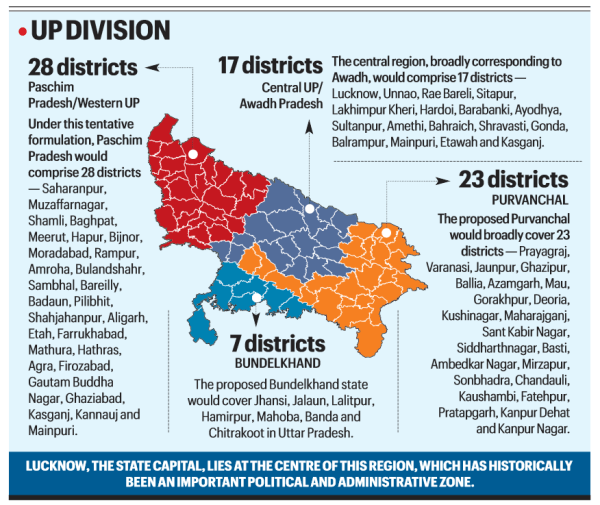
• The resolution was sent to the Centre but was not pursued further by the Samajwadi Party (SP) government that came to power in 2012.
Do You Know:
• As per Article 3 of the Indian constitution, “Parliament may by law… form a new State by separation of territory from any State or by uniting two or more States or parts of States or by uniting any territory to a part of any State… provided that no Bill for the purpose shall be introduced in either House of Parliament except on the recommendation of the President and unless, where the proposal contained in the Bill affects the area, boundaries or name of any of the States, the Bill has been referred by the President to the Legislature of that State for expressing its views thereon within such period as may be specified in the reference or within such further period as the President may allow and the period so specified or allowed has expired.”
• What is crucial here is that while the President must recommend such a Bill — thus showing the keen intent of the Centre — and the state Assembly must be consulted and given a finite time period to express its views, the latter’s views are not binding on Parliament. And what is required to alter the boundaries of a state is just a simple majority of both Houses of Parliament, making it relatively easy for Parliament to alter boundaries of the state by ordinary legislation even without the consent of the state’s Assembly.
Other Important Articles Covering the same topic:
📍Lucknow to Purvanchal: How a 4-state map of UP was drawn in 2011
Previous year UPSC Mains Question Covering similar theme:
📍Many State Governments further bifurcate geographical administrative areas like Districts and Talukas for better governance. In light of the above, can it also be justified that more number of smaller States would bring in effective governance at State level? Discuss. (UPSC, GS2, 2013)
📍Growing feeling of regionalism is an important factor in generation of demand for a separate State. Discuss. (UPSC, GS1, 2013)
📍In the context of the diversity of India, can it be said that the regions form cultural units rather than the States? Give reasons with examples for your viewpoint. (UPSC, GS1, 2017).
📍Unity in diversity remains the defining feature of Indian society despite the challenges from communalism and regionalism. Comment (UPSC, GS1, 2026).
The Ideas Page
Dialogue, not agitation, holds key to Ladakh’s political future
Syllabus:
Preliminary Examination: Indian Polity and Governance
Main Examination: General Studies II: Government policies and interventions for development in various sectors and issues arising out of their design and implementation.
What’s the ongoing story: Ashish Kundra Writes- Last September, a political protest in Leh went awry. Four young people were killed in police action against a demonstration that turned violent; dozens more, including police personnel, were injured. It was a monumental tragedy. A judicial inquiry was ordered. Ladakh was shrouded in grief. A year later, the process of political dialogue and engagement with Ladakh’s leadership continues. The tangible progress deserves to be judged on its substance, not rhetoric.
Key Points to Ponder:
• What history says about Ladakh?
• What were the demands in Ladakh?
• Why has Ladakh been demanding constitutional safeguards?
• What is the Sixth Schedule?
• How are the new regulations different from existing provisions?
• How do they compare with Jammu & Kashmir’s protections?
• Part XXI of the constitution says what?
• What Article 371 of the constitution?
• What protections does Article 371 offer?
Key Takeaways:
• The current negotiations between Ladakh’s representatives and the Centre revolve around a single demand: A democratic structure that protects land, jobs, culture and a fragile environment. The Centre’s approach has been one of accommodation and constructive engagement. A new constitutional arrangement has been offered under Article 371, with a directly elected UT-level body holding legislative, executive and financial powers.
Do You Know:
• The roots of Ladakh’s political demands go back much further than last September. Ladakh was once its own kingdom, sitting astride the Silk Route. Its sovereignty ended in 1834, when Dogra forces overran the region, subsuming it into the princely state of Jammu and Kashmir. After 1947, Ladakh’s Buddhist and Shia communities found themselves governed from Srinagar, in a political system centred largely around the Kashmir Valley. A political movement took birth, demanding direct rule from Delhi. In 2019, the central government acquiesced, carving Ladakh out as a Union Territory. It was a significant concession, even if it did not settle every grievance.
• Ladakh’s population is more heterogeneous than is imagined. Buddhists of Tibetan descent, Muslim communities including Baltis, Sunnis, Shias and Noorbakhshis, and Christian, Hindu and Sikh minorities are spread across 60,000 sq km, sandwiched in the borderlands between Pakistan and China. Leh and Kargil have been the fulcrums of administration. In response to demands for more decentralised governance, five new districts have been created, each slated to get an elected Hill Development Council. Preparations are underway for panchayat elections. The goal is to ensure a genuine devolution of administrative and political power.
• The Sixth Schedule, under Article 244 of the Constitution, provides for autonomous administrative divisions called Autonomous District Councils, or ADCs, which enjoy a degree of legislative, judicial and administrative autonomy within a state. ADCs can make laws, rules and regulations relating to subjects such as land, forests, water, agriculture, village councils, health, sanitation, inheritance, social customs and mining.
• The Sixth Schedule currently applies to tribal areas in Assam, Meghalaya, Mizoram and Tripura. In September 2019, the National Commission for Scheduled Tribes recommended that Ladakh be brought under the Sixth Schedule, noting that the new Union Territory was overwhelmingly tribal and had a distinct cultural heritage requiring protection. However, no region outside the Northeast has so far been included under the Sixth Schedule.
Other Important Articles Covering the same topic:
📍Ladakh’s 7 councils & the decentralisation debate
Previous year UPSC Prelims Question Covering similar theme:
6) The provisions in Fifth Schedule and Sixth Schedule in the Constitution of India are made in order to (UPSC, CSE, 2015)
(a) protect the interests of Scheduled Tribes
(b) determine the boundaries between States
(c) determine the powers, authority and responsibilities of Panchayats
(d) protect the interests of all the border States
Previous year UPSC Mains Question Covering similar theme:
📍Recent directives from Ministry of Petroleum and Natural Gas are perceived by the ‘Nagas’ as a threat to override the exceptional status enjoyed by the State. Discuss in light of Article 371A of the Indian Constitution. (UPSC, GS2, 2013)
Economy
Rural-urban divide in tourism widens, families from Tamil Nadu holiday most
Syllabus:
Preliminary Examination: Economic and Social Development
Mains Examination: General Studies III: Indian Economy and issues relating to planning, mobilization, of resources, growth, development and employment.
What’s the ongoing story: Households from Tamil Nadu account for almost a quarter of all overnight trips made by Indians for holidays, comfortably higher than Maharashtra in second and Karnataka in third. Meanwhile, families from Uttar Pradesh, West Bengal, and Bihar are together responsible for more than 30% of all ‘health and medical’ related overnight trips, a new government survey conducted from July 2025 to June 2026 showed, with the numbers also indicating a growing divide in the travels of rural and urban Indians.
Key Points to Ponder:
• What Ministry of Statistics and Programme Implementation’s (MoSPI) Domestic Tourism Expenditure Survey says?
• What is domestic tourism?
• What is the significance of domestic tourism for India’s economic development and regional integration?
• What are the major purposes of domestic overnight travel in India?
• What factors are responsible for the prominence of pilgrimage and religious travel?
• Why terms like overnight trips, same-day trips and tourist households used in official tourism statistics are important for policy formulation?
• What is the role of the National Statistical Office (NSO) and the National Sample Survey system in generating data for evidence-based policymaking in India?
• What does the growing importance of religious tourism indicate about the relationship between culture, economy and regional development in India?
Key Takeaways:
• The previous survey was conducted from July 2014 to June 2015.
• As per the Ministry of Statistics and Programme Implementation’s (MoSPI) Domestic Tourism Expenditure Survey – released on Wednesday – an estimated 10 crore overnight trips were made in the 365 days prior to households being quizzed. These were for a variety of ‘leading purposes’, or main reasons: holidaying, leisure and recreation; pilgrimage and religious; health and medical; and shopping. And while households who travel are doing so more frequently now, the fraction of rural families taking trips has reduced.
• As per the latest survey, the percentage of rural households who took at least one overnight trip declined to 35.2% from 36.6% in 2014-15. Meanwhile, the percentage for urban households rose from 35.7% to 37.7%.
• Further, for every 100 rural households, the number of overnight trips for holidays and recreation completed in the last 365 days declined to 4 in 2025-26 from 5 in 2014-15. For urban families, the number increased from 12.7 to 13.5. As such, urban households are taking more holidays than before, while rural families are taking fewer such trips.
• The latest Domestic Tourism Expenditure Survey covered 2.46 lakh households from across the country, except villages in the Andaman and Nicobar Islands which are difficult to access. Of the surveyed households, 1.43 lakh were from rural areas and 1.04 lakh from urban.
• MoSPI cautioned that the results of the latest survey are not “strictly comparable” with the 2014-15 one. This is because the 2025-26 survey sought information on overnight trips for ‘pilgrimage and religious activities’ in the reference period of 365 days prior to the household being questioned.
Do You Know:
• Overall, the 2025-26 survey showed holidaying was the main purpose for 22% of trips, pilgrimage and religious trips 48%, and health and medical reasons were behind almost 30% of them. Tamil Nadu accounted for 23.8% of overnight holiday trips, followed by Maharashtra (9.6%), and Karnataka (8.6%).
• Tamil Nadu also led in the ‘pilgrimage and religious’ category and was responsible for 14.8% of these trips, followed by Uttar Pradesh (13.6%), and Rajasthan (9.2%).
• The largest contributors to health and medical trips were Uttar Pradesh (12.1%), West Bengal (10.9%), and Bihar (8.9%). The most money was spent on health and medical trips.
• In rural areas – state-wise estimates were not available – households spent Rs 29,454 on trips in the last 365 days where the leading purpose of travel was medical and health related. For urban areas, the figure was Rs 41,649. The all-India average was Rs 32,167.
In comparison, the amount spent on overnight holiday trips was Rs 11,723, while that on religious trips was Rs 7,694.
• Expenditures include any relevant spending – irrespective of the mode of payment – even if it was made before or after the trip. Interestingly, only 11% of overnight trips completed in the previous 365 days for the purpose of holidaying, pilgrimage and religious, health and medical, and shopping reasons used a tour operator or guide.
Other Important Articles Covering the same topic:
📍Union Budget 2026: Experiences, medical tourism, job creation part of big tourism push
Previous year UPSC Mains Question Covering similar theme:
📍How can the mountain ecosystem be restored from the negative impact of development initiatives and tourism? (UPSC, GS1, 2019)
📍The states of Jammu and Kashmir, Himachal Pradesh and Uttarakhand are reaching the limits of their ecological carrying capacity due to tourism. Critically evaluate. (UPSC, GS1, 2015)
|
PRELIMS ANSWER KEY |
|
1.(c) 2.(d) 3.(a) 4.(c) 5.(c) 6.(a) |
For any queries and feedback, contact priya.shukla@indianexpress.com
Subscribe to our UPSC newsletter. Stay updated with the latest UPSC articles by joining our Telegram channel – IndianExpress UPSC Hub, and follow us on Instagram and X.

Priya Kumari Shukla is a Senior Copy Editor in the Indian Expre... Read More
 Share


