
UPSC Key: Swachh Vayu Sarvekshan, Antibiotic Resistance and Dogri Language
Why Gram-negative bacteria is relevant to the UPSC exam? What is the significance of topics such as BRICS, defence acquisition council and earth observation satellite on both the preliminary and main exams? You can learn more by reading the Indian Express UPSC Key for September 8, 2026.
 UPSC Key August 2026: Here's what you should be reading from the September 8, 2026 edition of The Indian Express.
Important topics and their relevance in UPSC CSE exam for September 8, 2026. If you missed the September 7, 2026 UPSC CSE exam key from the Indian Express, read it here
FRONT PAGE

Noida protest NSA: Allahabad HC says note ‘displeasure’ in DM’s service records
Syllabus:
Preliminary Examination: Indian Polity and Governance
Main Examination: General Studies II: Structure, organization and functioning of the Executive and the Judiciary and Role of civil services in a democracy.
What’s the ongoing story: Describing as “worthy of derision” the decision by the District Magistrate of Gautam Buddha Nagar to invoke the National Security Act (NSA) against Aakriti Chaudhary for her alleged role in the of April, the Allahabad High Court has ordered that its “displeasure” with the official and other officers involved be “noted in their service records”.
Key Points to Ponder:
• What is “Orwellian Dystopia”?
• Why the District Magistrate of Gautam Buddha Nagar invoked the National Security Act (NSA) against Aakriti Chaudhary?
• What exactly Allahabad HC said?
• What is preventive detention?
• What is the National Security Act (NSA) ?
• Who can order detention under the NSA?
• How the National Security Act which was intended to address exceptional threats, is misused by the authorities?
• How should administrative discretion be controlled in a constitutional democracy?
• How does judicial review act as a safeguard against arbitrary exercise of executive power?
• What you understand by the terms—law and order, public order and security of the State?
• ‘Civil-service neutrality is a faithful adherence to the Constitution and law and not meant to abide to every direction of the political executive’—Discuss
Key Takeaways:
• The order, issued by a bench of Justices Atul Sreedharan and Achal Sachdev, also held the District Magistrate, IAS officer Medha Roopam, “guilty of violating her oath of allegiance, making this a fit case for the imposition of compensation to the petitioner”.
• The court granted Rs 5 lakh as compensation to the petitioner, to be “recovered from the salary of the District Magistrate…who has passed this order of detention without application of mind and from all such other officers who may have been responsible, right down to the SHO of the Police Station, who had prepared the initial report warranting the detention of the petitioner under the provisions of the NSA”.
• The court granted Rs 5 lakh as compensation to the petitioner, to be “recovered from the salary of the District Magistrate…who has passed this order of detention without application of mind and from all such other officers who may have been responsible, right down to the SHO of the Police Station, who had prepared the initial report warranting the detention of the petitioner under the provisions of the NSA”.
Do You Know:
• Under the NSA, a person is taken into custody to prevent him or her from acting in any manner prejudicial to “the security of the state” or for “maintenance of the public order.”
• It is an administrative order passed either by the Divisional Commissioner or the District Magistrate — and not detention ordered by police based on specific allegations or for a specific violation of the law.
• Even if a person is in police custody, the DM can slap NSA against him. Or, if a person has been granted bail by a trial court, he can be immediately detained under the NSA. If the person has been acquitted by the court, the same person can be detained under the NSA.
• The law also takes away an individual’s constitutional right to be produced before the magistrate within 24 hours as is the case when the accused is in police custody; the detained person also does not have the right to move a bail application before a criminal court.
Also, the DM who passed the detention order is protected under the Act: no prosecution or any legal proceeding can be initiated against the official who carried out the orders.
• Therefore, the writ of Habeas Corpus is the only protection guaranteed under the Constitution against the unchecked state power of taking people into custody under the NSA.
• The higher judiciary has held that the preventive detention under NSA has to be strictly construed keeping in view the “delicate balance between social security and citizen freedom”. The Supreme Court has held that to prevent “misuse of this potentially dangerous power, the law of preventive detention has to be strictly construed” and “meticulous compliance with the procedural safeguards” has to be ensured.
• One crucial procedural safeguard under the NSA is granted under Article 22(5), where all the detained persons have the right to make an effective representation before an independent advisory board, which consists of three members; and the board is chaired by a member who is, or has been, a judge of a High Court.
Other Important Articles Covering the same topic:
📍Detention despite bail: Why District Magistrates love the NSA
Previous year UPSC Prelims Question Covering similar theme:
1) Consider the following statements: (UPSC CSE, 2023)
1. According to the Constitution of India, the Central Government has a duty to protect States from internal disturbances.
2. The Constitution of India exempts the States from providing legal counsel to a person being held under preventive detention.
3. According to the Prevention of Terrorism Act (POTA), 2002, a confession made by the accused to the police cannot be used as evidence.
How many of the above statements are correct?
(a) Only one
(b) Only two
(c) All three
(d) None
BRICS meet: Focus on talks with China over tech import, investment curbs
Syllabus:
Preliminary Examination: Current events of national and international importance.
Mains Examination: General Studies II: Bilateral, regional and global groupings and agreements involving India and/or affecting India’s interests.
What’s the ongoing story: Ahead of the 18th BRICS Summit in New Delhi on September 12-13, which Chinese President Xi Jinping is expected to attend with a sizeable business delegation, the Ministry of Commerce and Industry has reached out to consult with Indian industry groups.
Key Points to Ponder:
• What is the immediate BRICS context?
• Why is China so important to India’s manufacturing?
• ‘BRICS provides India an opportunity to combine its China diplomacy with its broader Global South agenda’—Comment
• How can BRICS contribute to creating more resilient and diversified global value chains?
• What is the role of reciprocity in India’s trade and investment negotiations with China?
• What are Global Value Chains?
• How can India increase its participation in higher-value segments of GVCs while reducing strategic supply-chain vulnerabilities?
• BRICS-Know in detail
• Map Work-BRICS Countries
• Evolution of BRICS-Know in Detail
• Evolution of BRICS from Russia-China (RC) to Russia-India-China (RIC) to Brazil- Russia-India-China (BRIC) to Brazil-Russia-India-China-South Africa (BRICS) to BRICS 2.0
• What is the Fortaleza Declaration?
• Brazil, Russia, India, China and South Africa (BRICS) Economy-Key Features
• RIC (Russia-India-China) out of BRICS-Significance and Stature in World Politics?
Key Takeaways:
• Indications are that the high-level talks with Chinese counterparts, on the side-lines of the BRICS Summit, could see the Indian side flag concerns over investment restrictions faced by companies in China and Customs roadblocks on import of high-tech items from the country.
• A government official said the China desk of the Commerce and Industry Ministry has been working on several restrictions on key tech-related items imposed by Chinese Customs, which was hurting Indian manufacturing.
• The Indian automobile industry had already been finding workarounds due to delays in exports of rare earth magnets from China. It is likely that the Indian side will push for some measure of reciprocity in easing procedural bottlenecks and restrictions on sourcing norms.
• A senior executive in the renewable energy sector with sourcing exposure in China told The Indian Express that Beijing’s growing restrictions on the export of critical technologies and raw materials across several sectors have become a high priority for the government ahead of the BRICS Summit.
• “China has imposed restrictions on the export of ingot and wafer technology, battery cells and cell technology,” the executive said. “For example, in the transmission sector, exports of High Voltage Direct Current (HVDC) and specialised components are also being restricted.
• HVDCs are critical for long-distance power transmission with reduced transmission losses, and considered essential for integrating renewable energy sources and grid stability.
Do You Know:
• India-China trade relations have seen a significant thaw in recent times — from easing of restrictions on foreign direct investments from land-bordering countries, to reopening of India-China border trade via Nathu La, and resumption of direct flights.
• For the first time since India pulled out of the China-led Regional Comprehensive Economic Partnership (RCEP) negotiations in 2019, Commerce and Industry Minister Piyush Goyal also held bilateral talks with his Chinese counterpart Wang Wentao, on the sidelines of the 14th World Trade Organisation (WTO) interministerial conference in Cameroon, in April this year.
• The acronym BRIC was first used in 2001 by Goldman Sachs in their Global Economics Paper, ‘The World Needs Better Economic BRICs’. The paper projected that Brazil, Russia, India, and China would be among the world’s largest economies in the next 50 years or so.
• As a formal grouping, BRIC started after the meeting of the leaders of Russia, India and China in St. Petersburg on the margins of the G8 Outreach Summit in 2006. The grouping was formalised during the first meeting of BRIC Foreign Ministers on the margins of the UNGA in New York in 2006.
• The first BRIC Summit was held in Yekaterinburg, Russia, in 2009. It was decided to include South Africa at the BRIC Foreign Ministers’ meeting in New York in 2010, and accordingly, South Africa attended the 3rd BRICS Summit in Sanya, China, in 2011.
Other Important Articles Covering the same topic:
📍China This Week | From SCO to upcoming BRICS summit in Delhi, diplomacy in focus for Beijing
Previous year UPSC Prelims Question Covering similar theme:
2) Consider the following statements with regard to BRICS: (UPSC CSE, 2025)
I. The 16th BRICS Summit was held under the Chairship of Russia in Kazan.
II. Indonesia has become a full member of BRICS.
III. The theme of the 16th BRICS Summit was Strengthening Multiculturalism for Just Global Development and Security.
Which of the statements given above is/are correct?
(a) I and II
(b) II and III
(c) I and III
(d) I only
Previous year UPSC Mains Question Covering similar theme:
📍Compare the significance of IBSA and BRICS in the context of India’s multilateral diplomacy. (UPSC, GS2, 2012)
NATION
Lucknow air cleanest, Indore’s second best among cities with million-plus people
Syllabus:
Preliminary Examination: Current events of national and international importance.
Main Examination: General Studies III: Conservation, environmental pollution and degradation, environmental impact assessment.
What’s the ongoing story: Lucknow, the capital of Uttar Pradesh, topped the million-plus population category in the 2026 ‘Swachh Vayu Sarvekshan’ for its efforts to improve air quality. The city’s measures included adding electric vehicles to its waste collection fleet, deploying mechanised sweepers to control road dust, and managing legacy waste.
Key Points to Ponder:
• What is Swachh Vayu Sarvekshan?
• How Swachh Vayu Sarvekshan is different from the AQI ranking?
• What is PM10 and PM2.5?
• Why the PM10 number matters
• What are the major sources of urban air pollution in India?
• What are the limitations of city-centric approaches to controlling air pollution?
• Know the National Clean Air Programme as an institutional framework for addressing urban air pollution in India.
• ‘Road dust, construction activity and solid-waste mismanagement are often overshadowed by the focus on vehicular emissions in India’s air-pollution discourse’—How far you agree with this statement?
• If Lucknow tops the clean-air survey but its PM10 remains above the national standard, is the ranking meaningful?
Key Takeaways:
• Indore, India’s cleanest city, secured the second spot, while Jabalpur finished third in the million-plus cities category. Meanwhile, Chennai, Jamshedpur, Kota, Kolkata, and Madurai ranked in the bottom five in this category, while Delhi and Mumbai ranked 30th and 37th, respectively.
• Although it won the top prize in the million-plus cities category, Lucknow has yet to meet the PM 10 annual ambient air quality standard of 60 ug/m3 (micrograms/cubic metre) prescribed under the national standards, as per the NCAP portal. However, since the programme began, annual PM10 concentrations have declined from 250 ug/m3 in 2017-18 to 137 ug/m3.
• Jabalpur’s achievements included a waste-to-energy plant, 100 per cent waste collection and scientific disposal, mechanised street sweeping, and promotion of electric vehicles.
• Last year, Indore topped the million-plus population category, followed by Jabalpur, while Agra and Surat jointly secured third place. In the category of cities with a population between 3-10 lakh people, Rourkela topped, followed by Firozabad and Guntur in joint second place, and Amravati in third place. In category 3 – cities with less than 3 lakh people – Kalinga Nagar won the first position, Angul the second, and Talcher got the third place.
• The rankings were declared in the national capital Monday, and National Green Tribunal (NGT) chairperson Justice Prakash Shrivastava conferred the honours on all winning cities and towns. Awards were also conferred for the first time for municipal wards that have improved their air quality.
• Efforts in waste management, road dust control, dust management from construction and demolition waste, and reductions in vehicular and industrial pollution are key parameters used to assess cities for final ranking. Improvements in the reduction of particulate matter 10 concentrations are given only a 2.5 per cent weightage.
Do You Know:
• The National Clean Air Programme was launched in January 2019 and covers 130 cities. The target for these cities is to reduce particulate matter (PM) 10 concentration by up to 40 per cent by 2025-26 compared with 2019-20 levels.
• Cities and towns are divided into population-based categories: million-plus cities, cities with 3-10 lakh population, and cities with population under 3 lakh. A cash prize and mementoes are awarded to the top three cities or towns. A state-level monitoring committee assesses the cities and towns, the Central Pollution Control Board evaluates them, and independent committees verify them in the field.
• Multiple sources of funding disbursed through the Union Environment Ministry, 15th Finance Commission grants, and additional convergence of funds through the Ministry of Housing and Urban Affairs and the Ministry of Heavy Industries are used to improve air quality.
• Of the 130 cities covered under NCAP, only 14 met National Ambient Air Quality Standards in the first target period between 2019 and 2025-26. Of the 131 cities covered under the NCAP, 47 fall in the million-plus city category, 44 in the 3-10 lakh population category, and 40 in the 3 lakh population category.
• Swachh Vayu Survekshan is an annual assessment of 130 cities under the NCAP. Launched in 2022-23, it is an initiative of the MoEFCC. The assessment covers measures addressing major pollution sources and implementation of City-specific Clean Air Action Plans. It promotes healthy competition, innovation and accelerated action among cities to improve air quality.
Other Important Articles Covering the same topic:
📍Lucknow is known for traffic and dust. How did it top India’s clean-air ranking?
Previous year UPSC Prelims Question Covering similar theme:
3) In the context of WHO Air Quality Guidelines, consider the following statements: (UPSC CSE, 2022)
1. The 24-hour mean of PM2.5 should not exceed 15 µg/m³ and annual mean of PM2.5 should not exceed 5 µg/m3.
2. In a year, the highest levels of ozone pollution occur during the periods of inclement weather.
3. PM10 can penetrate the lung barrier and enter the bloodstream.
4. Excessive ozone in the air can trigger asthma.
Which of the statements given above are correct?
(a) 1, 3 and 4
(b) 1 and 4 only
(c) 2, 3 and 4
(d) 1 and 2 only
Previous year UPSC Mains Question Covering similar theme:
📍What are the key features of the National Clean Air Programme (NCAP) initiated by the government of India? (UPSC GS3, 2020)
DAC approves acquisition proposals worth Rs 1.1 L cr
Syllabus:
Preliminary Examination: Current events of national and international importance.
Main Examination: General Studies II: Government policies and interventions for development in various sectors and issues arising out of their design and implementation.
What’s the ongoing story: The Defence Acquisition Council (DAC), India’s key defence body for approving major military procurements, on Monday gave the green signal for acquisitions worth about Rs 1,10,000 crore for the armed forces.
Key Points to Ponder:
• Defence Acquisition Council-About, Role and Functions
• Why Defence Acquisitions Council was created?
• What is Defence acquisition?
• Why Defence Procurement Procedure (DPP)?
• Defence Procurement Procedure (DPP)-know its key features
• How much India spends in defence as compared to other sectors?
• What is budget for defence imports?
• What Stockholm International Peace Research Institute (SIPRI) says about India’s defence and defence expenditure?
• When it comes to defence exports then why exports of defence products from India are limited to few countries like Vietnam?
• India can recalibrate not reduce the defence expenditure-do you agree?
Key Takeaways:
• The approved procurements include Chemical, Biological, Radiological and Nuclear (CBRN) Recce Vehicles, High Mobility Vehicles (HMVs), Advanced Light Helicopters (ALHs), Arudhra Radars, Marine Gas Turbines (MGT) and Ground-Based Multi-Purpose Jammers, among others.
• In a brief statement, the Ministry of Defence said that the DAC has accorded the Acceptance of Necessity (AoN) for procuring CBRN Recce Vehicles, High Mobility Vehicles (HMV), Self-Propelled Mechanical Mine Layers (MML), Advanced Light Helicopters (ALHs), Trawl Tanks and Sarvatra Bridge System for the Indian Army.
• Grant of AoNs or an in-principle administrative approval to proposed acquisitions is the first step in the defence procurement process. However, obtaining an AoN does not always lead to a final order.
• The Defence Ministry statement noted that the CBRN recce vehicles will be capable of detecting, identifying, monitoring and marking areas contaminated with CBRN agent
• The HMVs will enhance operational capabilities, logistic support and mobility in challenging terrains, while the MMLs will achieve the desired operational capability in terms of fast and responsive minelaying in difficult terrains. It added that the indigenous ALHs will execute complex missions across all terrains and operational situations for the Indian Army and the Indian Air Force, and the Trawl Tanks and Bridge System will be utilised to provide composite crossings to fighting formations during operations in varied terrains.
Do You Know:
• The Arudhra Radar is an indigenous 4D multi-function phased array radar developed by India’s DRDO and manufactured by Bharat Electronics Limited (BEL). It has electronic steering in both azimuth and elevation for surveillance, detection and tracking of aerial targets. The system will have target identification based on interrogations from a co-located Identification Friend or Foe system. Its successful trials have already been conducted by the Indian Air Force.
• The DAC is among the top bodies for clearing major capital acquisitions for defence. The Defence Acquisition Council, which is headed by the Defence Minister, is among the top bodies for clearing major capital acquisitions for defence. The Acceptance of Necessity (AoN) is only the first step in the long defence procurement process. Grant of an AoN does not necessarily lead to a final order. The AoN is only the first step in the long defence procurement process; it does not necessarily lead to a final order.
Other Important Articles Covering the same topic:
📍Explained: What are defence offsets? Here’ everything you need to know
Previous year UPSC Prelims Question Covering similar theme:
4) Consider the following statements about Mission Sudarshan Chakra of India: (UPSC CSE, 2026)
1. It aims to enhance India’s air defence, ballistic missile defence and aerial offensive capabilities.
2. This Mission is being designed to enhance rapid, precise, and powerful defence responses, reinforcing India’s strategic autonomy.
3. One of the aims of this Mission is to cover all public places of India by an expanded nationwide security shield by 2035.
Which of the statements given above is/are correct?
(a) 1, 2 and 3
(b) 1 and 2 only
(c) 2 and 3 only
(d) 1 only
Previous year UPSC Mains Question Covering similar theme:
📍How is S-400 air defence system technically superior to any other system presently available in the world? (UPSC, GS3, 2021)
NATION
ISRO: EOS-05 to be placed in elliptical geosynchronous orbit
Syllabus:
Preliminary Examination: Current events of national and international importance.
Main Examination: General Studies III: Awareness in the fields of IT, Space, Computers, robotics, nano-technology, biotechnology and issues relating to intellectual property rights.
What’s the ongoing story: The Indian Space Research Organisation’s (Isro) Earth Observation Satellite, EOS-05, launched on September 4, has settled into a geosynchronous orbit that will allow continuous observation of the subcontinent from an altitude ranging between 34,903 km and 35,884 km.
Key Points to Ponder:
• What are the key features of Earth Observation Satellite (EOS-05)?
• Why are satellites placed in Polar Orbits?
• What is the difference between geostationary and polar orbit?
• What are the types of orbits?
• What is the polar orbit of the Earth?
• Do you know about Low Earth Orbit (LEO), Medium Earth Orbit (MEO), and Geostationary Earth Orbit (GEO) (also known as High Earth Orbit)?
• Why can’t rockets place satellites directly in geosynchronous orbits?
• Why do we need satellites in geosynchronous orbit?
Key Takeaways:
• “The third and final orbit-raising manoeuvre to increase the perigee of EOS-05 completed successfully at 8.57 pm on September 07, 2026. The LAM engine fired for 1247 seconds and the estimated orbit after manoeuvre is 34,903 km x 35,884 km,” Isro said on Monday night. “The satellite health is normal,” it added.
• Over the next few days, the satellite is expected to undergo health and systems checks before its imaging systems are activated and the first Earth observation images are beamed back from its nearly stationary perch along the equator.
• The EOS-5 satellite is the first Earth observation satellite launched into a geosynchronous orbit by Isro. It has been placed in a slightly elliptical geosynchronous orbit instead of a circular geostationary orbit.
• “Once the EOS 05 is operationalised in orbit, it will become India’s first dedicated imaging satellite from the geo orbit providing important strategic data for our country,” Isro chairman V Narayanan said after the launch on September 4. While weather forecasting is one of the intended uses of EOS-5, it is also set to service the imaging requirements of the Indian Navy in a strategic capacity.
• The EOS-05 satellite was launched by ISRO’s GSLV F17 rocket—the heaviest mission for the GSLV class of rockets—and was placed in a sub-geostationary transfer orbit of 171 km perigee (nearest distance to Earth) and 31,000 km apogee (furthest distance from Earth).
• On September 5 and 6, orbit-raising manoeuvres put EOS-05 in a more circular orbit with a 20,000 km perigee and 35,786 km apogee.
Do You Know:
According to NASA and ESA websites—
• The European Space Agency (ESA) defines “orbit” as the curved path that an object in space follows around another object owing to gravity. In the case of satellites, the curved path they follow is around the Earth.
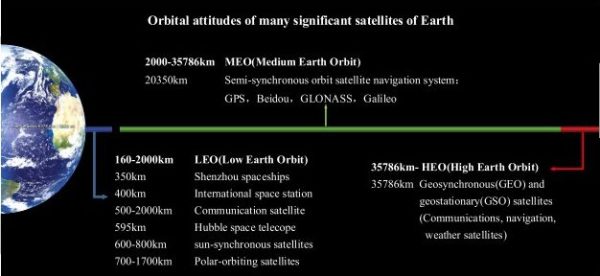 The different types of orbit.
Scientists broadly categorise Earth’s orbits into three primary altitude classes. Each serves a different purpose.
• Low Earth Orbit, or LEO, is the zone immediately surrounding our planet. It is typically defined as the region between 160 km and 2,000 km above Earth’s surface.
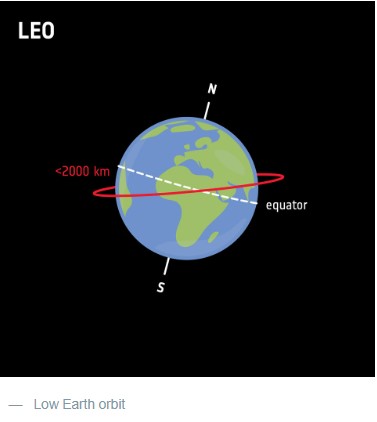 The extent of low Earth orbit. (European Space Agency)
• An orbit is the curved path that an object in space (like a star, planet, moon, asteroid or spacecraft) follows around another object due to gravity.
• An object in motion will stay in motion unless something pushes or pulls on it. This statement is called Newton’s first law of motion. Without gravity, an Earth-orbiting satellite would go off into space along a straight line. With gravity, it is pulled back toward Earth. A constant tug-of-war takes place between the satellite’s tendency to move in a straight line, or momentum, and the tug of gravity pulling the satellite back.
• The International Space Station is in low Earth orbit, or LEO. LEO is the first 100 to 200 miles of space. LEO is the easiest orbit to get to and stay in. One complete orbit in LEO takes about 90 minutes.
• Satellites that stay above a location on Earth are in geosynchronous Earth orbit, or GEO. These satellites orbit about 23,000 miles above the equator and complete one revolution around Earth precisely every 24 hours. Geosynchronous orbits are also called geostationary.
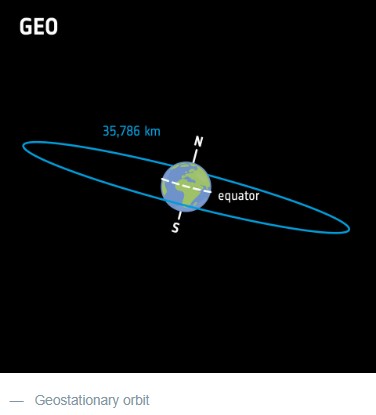 Geostationary orbit. (European Space Agency)
• Polar orbits are a type of low Earth orbit, typically between 200 to 1000 km in altitude. Satellites in polar orbits usually travel around Earth from, roughly, one pole to the other, rather than from west to east. They do not need to pass exactly over the North and South Poles; a deviation of 10 degrees is still classed as a polar orbit.
• Polar orbits are particularly useful for global Earth coverage, as satellites orbiting ‘up’ and ‘down’ Earth’s surface can see every inch of the planet over time as it also rotates below.
• The EOS-05 is a heavy satellite, weighing 2,367 kg. Directly launching it towards geosynchronous orbit would require immense amounts of fuel. “Typically, ISRO takes satellites bound for GEO to a geosynchronous transfer orbit (GTO) — or, in some cases, a lower-energy sub-GTO — and leaves them there. The satellite then uses its own propulsion, rather than the rocket’s, to raise and circularise its orbit and reduce its inclination until it reaches its operational orbit”, Rao told The Indian Express.
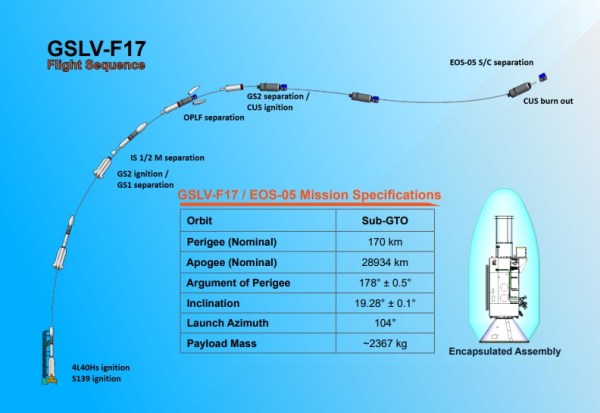 The GSLV flight sequence. (ISRO)
• The GSLV (which stands for Geosynchronous Satellite Launch Vehicle) on Friday deposited the EOS-05 satellite in sub-GTO, at an altitude of more than 190 km from Earth.
“ISRO used its second most powerful rocket whose published GTO capacity was below the mass of EOS-05, as opposed to the LVM3,” Prasad said.
After being released, the satellite uses its own propulsion system to reach the final geosynchronous orbit.
• Traditionally, most imaging and observation satellites operate in lower Earth orbit. There is, however, a caveat attached to LEO observation satellites. Due to their proximity to the surface, they must travel at breakneck speeds to counteract the effects of the Earth’s gravitational pull. As a result, they can only observe a specific patch of Earth for a brief window before they hurtle past. This creates significant gaps in coverage.
 A simulation of a Starlink satellite megaconstellation. SpaceX/Starlink
• Lt General A K Bhatt (retd), Director General of Indian Space Association, an industry body, said: “The geosynchronous imaging capabilities of EOS-05 satellite will enable persistent, high-frequency observation of large regions rather than relying only on periodic satellite revisits, which is increasingly critical for India.
Other Important Articles Covering the same topic:
📍Shedding ‘naughty boy’ tag, GSLV carries India’s first geo-imaging satellite
Previous year UPSC Prelims Question Covering similar theme:
5) An artificial satellite orbiting around the Earth does not fall down. This is so because the attraction of Earth (UPSC CSE, 2011)
(a) does not exist at such distance
(b) is neutralized by the attraction of the moon
(c) provides the necessary speed for its steady motion
(d) provides the necessary acceleration for its motion
6) Satellites used for telecommunication relay are kept in a geostationary orbit. A satellite is said to be in such as orbit when: (UPSC CSE, 2011)
1. The orbit is geosynchronous.
2. The orbit is circular.
3. The orbit lies in the plane of the earth’s equator.
4. The orbit is at an altitude of 22,236 km.
Select the correct answer using the codes given below:
(a) 1, 2 and 3 only
(b) 1, 3 and 4 only
(c) 2 and 4 only
(d) 1, 2, 3 and 4
Previous year UPSC Mains Question Covering similar theme:
📍Mention salient features of ‘Mission Drishti’. Discuss the imaging techniques used in the satellite launched on 3rd May 2026. Why it is being considered world’s first satellite of its kind ? (UPSC, GS3, 2026)
EXPLAINED
Antibiotic-resistant infections: Risks, costs
Syllabus:
Preliminary Examination: Current events of national and international importance
Main Examination: General Studies II: Issues relating to development and management of Social Sector/Services relating to Health, Education, Human Resources.
What’s the ongoing story: A major study of hospitalised patients across India has found that infections caused by antibiotic-resistant “Gram-negative” bacteria are more likely to be fatal and more expensive to treat than infections caused by drug-susceptible strains.
Key Points to Ponder:
• What is antibiotic resistance?
• What is the difference between antimicrobial resistance (AMR) and antibiotic resistance?
• What are Gram-negative bacteria?
• What exactly study of hospitalised patients across India has found?
• What is Carbapenems?
• What does carbapenem resistance mean?
• Why does India’s AMR response require integration of healthcare, veterinary, agricultural and environmental policies?
• What is the role of surveillance, diagnostics and antimicrobial stewardship in India’s response to antimicrobial resistance?
• What is the One Health approach to antimicrobial resistance?
Key Takeaways:
• The researchers, part of the Indian Council of Medical Research’s (ICMR) antimicrobial resistance surveillance network, conducted the study across 20 tertiary-care hospitals between April 2022 and April 2025, analysing data from 1,59,336 hospitalised patients.
• They compared patients infected with carbapenem-resistant bacteria with those infected by susceptible strains of the same bacteria. “Carbapenem resistance should be regarded as a major threat to patient survival, particularly in severe and bloodstream infections,” says Dr Kamini Walia, co-author of study and senior scientist at the Division of Epidemiology and Communicable Diseases, Indian Council of Medical Research (ICMR), New Delhi.
• Anti-microbial resistance (AMR) is the result of a complex interaction between antibiotic selection pressure, infection-control practices, transmission within healthcare settings and delayed or inadequate diagnosis.
Do You Know:
• Gram-negative bacteria are a group of bacteria that can cause infections in different parts of the body, including the lungs, urinary tract, wounds and bloodstream. They include common hospital pathogens such as Escherichia coli (commonly known as E. coli), Klebsiella pneumoniae, Acinetobacter baumannii and Pseudomonas aeruginosa. These bacteria can be particularly difficult to treat when they develop resistance to antibiotics. One important group of antibiotics used for serious infections is carbapenems. When these bacteria become resistant to carbapenems, doctors have fewer effective medicines available to treat patients.
Other Important Articles Covering the same topic:
📍Antibiotic-resistant infections kill more patients and cost more, finds major India study
Previous year UPSC Prelims Question Covering similar theme:
7) Which of the following are the reasons for the occurrence of multi-drug resistance in microbial pathogens in India? (UPSC CSE, 2019)
1. Genetic predisposition of some people
2. Taking incorrect doses of antibiotics to cure diseases
3. Using antibiotics in livestock farming
4. Multiple chronic diseases in some people
Select the correct answer using the code given below.
(a) 1 and 2
(b) 2 and 3 only
(c) 1, 3 and 4
(d) 2, 3 and 4
Fading alphabet to fresh paint: Dogri scripts a comeback on Jammu signboards
Syllabus:
Preliminary Examination: Indian Polity and Governance
Main Examination: General Studies II: Indian Constitution—historical underpinnings, evolution, features, amendments, significant provisions and basic structure.
What’s the ongoing story: Last week, several new public signboards came up in Jammu carrying area names in a third script, alongside the usual Devanagari for Hindi and Roman for English.
This was “Namey Dogra Akhar” — the script of the Dogri language, primarily spoken in Jammu.
Dogri has long been written in Devanagari, with its own script falling into disuse. Now, civic authorities in Jammu are attempting to revive it by putting up signboards at prominent locations and institutions.
Key Points to Ponder:
• What is Dogri?
• Is Dogri language included in the Eighth Schedule of the Constitution?
• The 92nd Constitutional Amendment Act, 2003 included which all languages?
• How many languages are currently in the Eighth Schedule?
• What is Namey Dogra Akhar?
• How did Namey Dogra Akhar come into being?
• When did the use of this new script start declining?
• How Dogri can preserve its linguistic and script diversity while ensuring effective communication and national integration?
Key Takeaways:
• Dogri is an Indo-Aryan language, a major branch of the Indo-European language family that includes Hindi, Bengali and Punjabi, and belongs to the Western Pahari group, a cluster of related languages found mainly in the western Himalayas.
• Dogri is primarily spoken by the Dogras, the original inhabitants of Jammu and Kashmir’s Jammu division, besides smaller groups in the adjoining states of Punjab and Himachal Pradesh, and Pakistan-occupied Kashmir. According to the 2011 census, Dogri was the primary language of nearly 2.6 million people in India. It was recognised as one of the 22 scheduled languages of India under the Eighth Schedule in 2003 and declared one of the official languages of the Union Territory of Jammu & Kashmir in 2020.
• In 1944, the Dogri Sanstha, a literary organisation, adopted the Devanagari script to popularise Dogri literature. While this helped Dogri gain recognition from the Sahitya Akademi in 1969, it also contributed to the eventual decline of Namey Dogra Akhar.
Subsequent years saw efforts to popularise the language, but not the script.
• In 1971, the University of Jammu established a Dogri Research Cell which later got upgraded into a full fledged Dogri department with Master of Arts and PhD courses. The language was introduced as a formal subject in degree colleges affiliated with the university in 1987. At all these places, the language has been taught in Devanagari script.
• In 1990, a Dogri Action Committee led by Dogri poet Ved Pal Deep held demonstrations to get Dogri introduced in schools. Two years later, an umbrella group called Dogri Sangharsh Morcha formally launched an agitation to get Dogri included in the Eighth Schedule. After years of struggle, it was introduced at the primary level as a third language in 2002. In December the following year, the Union government included the language in the Eighth Schedule. Its script, however, remained Devanagari.
Do You Know:
• Namey Dogra Akhar is a modified version of Takri, the original Dogri language script that had been used until the reign of Maharaja Gulab Singh.
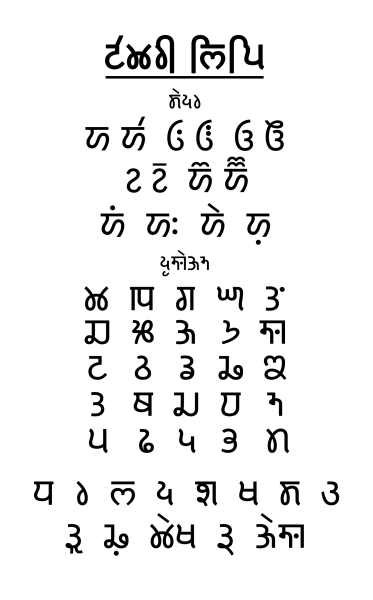 The alphabet of the original Takri script.
• Gulab Singh was the first Dogra ruler of Jammu and Kashmir, which, at the time, also included areas such as Gilgit, Skardu and Hunza that are in present-day Pakistan-occupied Kashmir. As he devoted his energies to expanding the boundaries of his empire up to Tibet, he found little time to promote and develop the Takri script. He abdicated the throne owing to poor health in 1846.
• Gulab Singh’s son, Ranbir Singh, who ascended the throne in 1856, was a scholar of Sanskrit and Persian languages. Known for his cordial relations with the British, he introduced several reforms including the compilation of the civil and criminal laws into the famous Ranbir Penal Code. During his rule, it was felt that transcription of official orders and other documents in Takri script was not possible owing to the absence of vowel signs. To rectify this, he asked writers to borrow the vowels from Devenagari.
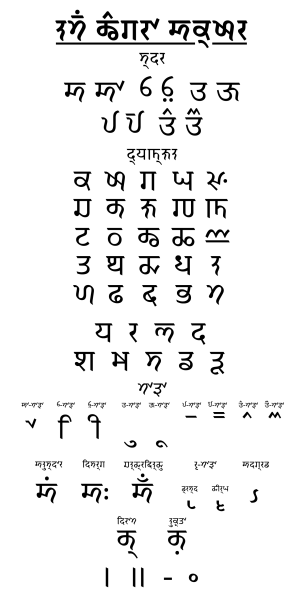 The Dogri alphabet. The vowels are grouped at the top.
• This led to the emergence of the Namey Dogra Akhar — literally, new Dogri script — in administrative work, apart from Persian, which was already in use, said Archana Kesar, former dean of Research Studies and of the Arts Faculty of Jammu University. Kesar has also headed the university’s post graduate departments of Dogri and Punjabi.
• After the death of Maharaja Ranbir Singh on September 12, 1885, his son Pratap Singh came to power. Pratap Singh was known for implementing a wide range of reforms — education, connectivity infrastructure, farm, land, labour and health. He also took a fateful decision that would begin the decline of the script. Much of the official work then used to be done in Persian and Namey Dogra Akhar. To simplify administrative work, he replaced Persian with Urdu as the official language of Jammu & Kashmir as it was widely used among the local population. The Dogri script, however, continued to be used by many locals for several years.
Other Important Articles Covering the same topic:
Previous year UPSC Prelims Question Covering similar theme:
8) The Constitution (71st Amendment) Act, 1992 amends the Eighth Schedule to the Constitution to include which of the following languages? (UPSC CSE, 2024)
1. Konkani
2. Manipuri
3. Nepali
4. Maithilis
Select the correct answer using the code given below:
(a) 1, 2 and 3
(b) 1, 2 and 4
(c) 1,3 and 4
(d) 2.3 and 4
|
PRELIMS ANSWER KEY |
|
1.(b) 2.(a) 3.(b) 4.(a) 5.(d) 6.(a) 7.(b) 8.(a) |
For any queries and feedback, contact priya.shukla@indianexpress.com
Subscribe to our UPSC newsletter. Stay updated with the latest UPSC articles by joining our Telegram channel – IndianExpress UPSC Hub, and follow us on Instagram and X.


Priya Kumari Shukla is a Senior Copy Editor in the Indian Expre... Read More
 Share


