
UPSC Key: Sulphur, Cultural Appropriation and Agentic AI
Why the Hirschman's exit and voice framework is relevant to the UPSC exam? What is the significance of topics such as AASHVAST labs, Research and Analysis Wing, firmware and AI alignment on both the preliminary and main exams? You can learn more by reading the Indian Express UPSC Key for September 21, 2026.
 UPSC Key August 2026: Here's what you should be reading from the September 21, 2026 edition of The Indian Express.
Important topics and their relevance in UPSC CSE exam for September 21, 2026. If you missed the September 20, 2026 UPSC CSE exam key from the Indian Express, read it here
Front Page

Russia, West Asia energy sites hit, India has a new problem: Sulphur
Syllabus:
Preliminary Examination: Current events of national and international importance.
Main Examination: General Studies II: Effect of policies and politics of developed and developing countries on India’s interests.
What’s the ongoing story: India has staved off a potential food crisis by importing enough urea and liquefied natural gas to enable domestic production of this high-nitrogen fertiliser.
Key Points to Ponder:
• Why is sulphur an important industrial and agricultural input?
• What are the major uses of Sulphur other than the fertilisers?
• What is the relationship between sulphur and sulphuric acid?
• Why is sulphur important for the production of phosphatic fertilisers such as DAP and SSP?
• How energy crisis can become a fertiliser crisis?
• Why does a disruption in petroleum refining or natural-gas processing affect global sulphur availability?
• How does India’s dependence on imported fertiliser raw materials create vulnerability to geopolitical disruptions?
• How oil and natural-gas processing generates sulphur as a by-product?
• What measures can India adopt to reduce vulnerability to imported sulphur?
Key Takeaways:
• There is another critical commodity, sulphur, whose soaring prices – again, linked to the escalating West Asia and Russia-Ukraine conflicts – is impacting the availability of di-ammonium phosphate (DAP), single super phosphate (SSP) and other major complex fertilisers.
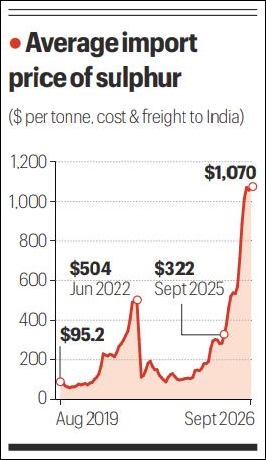
• Since the start of this year, landed (cost plus ocean freight) prices of sulphur imported into India have doubled to $1,050-1,100 per tonne. The main reason: Ukrainian long-range drone and missile attacks on Russian oil refineries and gas complexes and Iran, likewise, targeting the energy infrastructure of Saudi Aramco, QatarEnergy and Abu Dhabi National Oil Company.
• Only a tenth of the world’s sulphur output is directly mined. The rest comes as a byproduct of petroleum oil refining (56%) and natural gas processing (34%). Environmental rules mandate desulphurisation – removal of sulphur from crude oil and raw gas – for the production of clean, low-emission fuels.
• This recovered sulphur is, however, essential for agriculture. The fertiliser sector alone accounts for roughly 60% of the 70 million tonnes (mt) annual global sulphur consumption. Most of the world’s sulphur gets converted into sulphuric acid that is, in turn, a core chemical for manufacturing all fertilisers containing phosphorous (P).
• “The primary source of P is rock phosphate. But this mined ore cannot be used as fertiliser unless broken down into a water-soluble form (for plants to absorb) by reacting with sulphuric acid. Without sulphur and sulphuric acid, there can be no DAP, SSP or popular complex fertilisers such as 20:20:0:13, 10:26:26 and 12:32:16,” explained an industry official.
Do You Know:
• Sulphur (or sulfur) is an abundant, non-metallic chemical element with the symbol S and atomic number 16. Sulphur is often described as a hidden backbone of modern industry and agriculture, supporting a massive global demand. Approximately 60% of the world’s sulphur is consumed to manufacture sulphuric acid (H₂SO₄). Sulphuric acid is the critical reagent needed to break down insoluble rock phosphate into water-soluble, plant-absorbable forms like Diammonium Phosphate (DAP) and Single Superphosphate (SSP).
• India’s own yearly sulphur consumption is 3.8-3.9 mt, with the fertiliser industry’s share at 2-2.1 mt. As a byproduct of the oil and gas industry, sulphur was previously imported at prices well below $200 per tonne – even sub-$100 in many months of 2019 and 2020. Being a flammable material, sulphur cannot be stored for too long.
• That changed with the Russia-Ukraine war. Import prices of sulphur rose to $400-500 per tonne during March-June 2022. It was temporary though, as prices reverted to the earlier sub-$200 levels from late-2022 through early 2025. The real problems started with a substantial increase in Ukraine’s targeted strikes on Russian oil refineries from around August 2025. By December, landed prices had crossed $500 per tonne and have only gone higher post the US-Iran war (see chart). Iran has done to the oil and gas infrastructure of its Persian Gulf neighbours what Ukraine has to that of Russia.
• The global supply squeeze from geopolitical tensions – Russia has banned exports of sulphur and sulphuric acid to safeguard its own fertiliser production, while China has done the same with the latter – isn’t the only reason for the spike in prices.
Other Important Articles Covering the same topic:
📍Knowledge Nugget | Sulphur Explained: What it is and why it matters
Previous year UPSC Prelims Question Covering similar theme:
1.) With reference to chemical fertilizers in India, consider the following statements: (UPSC, CSE, 2020)
1. At present, the retail price of chemical fertilizers is market-driven and not administered by the Government.
2. Ammonia, which is an input of urea, is produced from natural gas.
3. Sulphur, which is a raw material for phosphoric acid fertilizer, is a by-product of oil refineries.
Which of the statements given above is/are correct?
(a) 1 only
(b) 2 and 3 only
(c) 2 only
(d) 1, 2 and 3
Six high-tech Army labs to weed out foreign bugs from drones, cameras
Syllabus:
Preliminary Examination: Current events of national and international importance.
Main Examination: General Studies III: Challenges to internal security through communication networks, role of media and social networking sites in internal security challenges, basics of cyber security;
What’s the ongoing story: The Indian Army will soon be operating six AASHVAST labs across the country, where all its drones—and eventually CCTV cameras too—will undergo mandatory inspections to identify and eliminate firmware-level vulnerabilities. This will ensure that these do not fail during operations in contested zones and can perform their tasks effectively.
Key Points to Ponder:
• AASHVAST labs—what the major highlights?
• How does the AASHVAST initiative connect with Atmanirbhar Bharat and defence indigenisation?
• What is a drone or UAV?
• What is firmware?
• How firmware is it different from hardware and software?
• Why can a firmware-level vulnerability be more dangerous than a conventional software bug in a military platform?
• Does eliminating foreign components necessarily eliminate cyber risk?
• Why cybersecurity should move from software protection to hardware–firmware–supply-chain security?
• How can AASHVAST labs improve India’s military preparedness in contested environments?
• “Cybersecurity begins before a device is deployed”—what is your take?
Key Takeaways:
• The Army has published a Request for Proposal in April this year to procure customised licensed software for validation of firmware and embedded systems for electronic components, including UAV components.
• On August 14, the Indian Army’s Additional Directorate General of Public Information had posted on X: “Equipped with advanced capabilities AASHVAST will enable evaluation of critical defence platforms thereby increasing cyber resilience. Aligned with the national vision of #AtmanirbharBharat, the facility will strengthen operational readiness as well as promote growth of the domestic defence ecosystem.”
• While the lab will initially test all drones, sources said that CCTV cameras procured by the Army in future will also eventually be inspected by it for Chinese proprietary protocols or equivalent, which could be potentially embedded in these.
• The idea behind establishing these labs, a first of its kind, was to neutralise the common threats of enemy interference in Indian drones, preventing them from performing their designated tasks in a contested area, Rajib Roy, Director of QuickPay Pvt Ltd, told The Indian Express.
• So far, drones procured by the Indian Army did not have firmware-level vulnerabilities checked. The suite will close this critical gap.
Do You Know:
• Firmware is a specialized type of software permanently or semi-permanently embedded into a hardware device to
provide low-level control and basic operational instructions.
• AASHVAST stands for Assessment and Analysis of Electronic Systems Hardware for Vulnerabilities and Security Threats. Currently, one lab has been inaugurated in Delhi, with plans to establish at least five more in the coming months.
AASHVAST, a Firmware Analysis and Validation Suite, developed by QuickPay Pvt Ltd for the Directorate General of Electronics and Mechanical Engineering (DG EME), is designed to do more than just physically inspect drones. It also examines the software that operates these unmanned aerial vehicles (UAVs) – to identify and eliminate firmware-level vulnerabilities.
• Firmware vulnerabilities can be introduced during the manufacturing stage of a component or an upgrade process. For instance, unused codes could be introduced, hidden commands could be invoked at a certain location – thereby preventing the drone from performing its task.
• There are approximately 14 types of vulnerabilities that the labs can detect. These include geospatial vulnerabilities, such as a malfunction that occurs when flying over a certain location, or issues that prevent a drone from reaching its preset destination. Other vulnerabilities involve unused and hidden codes that could cause a drone to terminate before reaching its target. Additionally, there are time and location bugs that may cause a drone to operate normally except at specific times or locations.
• The use of Chinese components in military drones has been a cause of concern for India, especially since many of these drones are used in operations along the eastern borders. Considering significant national security risks and possible data vulnerabilities, India has previously prohibited domestic military drone manufacturers from using parts made in China. In 2025, the Army Design Bureau submitted a detailed framework to the Ministry of Defence aimed at eliminating Chinese-origin components from UAVs.
• People involved with the project said that AASHVAST labs will also examine drones for Chinese and/or other foreign-origin active components, as well as hidden passwords, embedded keys, remote access tools and location-based security controls.
Other Important Articles Covering the same topic:
📍Explained: China’s cyber eye and India
Previous year UPSC Prelims Question Covering similar theme:
2) The terms ‘WannaCry, Petya and Eternal Blue’ sometimes mentioned in the news recently are related to (UPSC CSE, 2018)
(a) Exoplanets
(b) Cryptocurrency
(c) Cyber attacks
(d) Mini satellites
Previous year UPSC Mains Question Covering similar theme:
📍Keeping in view of India’s internal security, analyse the impact of cross-border cyber-attacks. Also, discuss defensive measures against these sophisticated attacks. (UPSC, GS3, 2021)
📍Discuss the potential threats of Cyber-attack and the security framework to prevent it. (UPSC, GS3, 2017)
R&AW anniversary in spotlight, how its first chief-built spy agency from shadows
Syllabus:
Preliminary Examination: Current events of national and international importance.
Main Examination: General Studies III: Various Security forces and agencies and their mandate.
What’s the ongoing story: In the last week of November 1971, India’s external intelligence agency got an extraordinary piece of information. One of K Sankaran Nair’s sources inside the Pakistani establishment had learnt that Pakistan was preparing a pre-emptive air strike on Indian air bases in the western sector. Nair passed on the warning. The Indian Air Force was put on alert. Pakistan eventually launched its air strikes on December 3. India was ready.
Key Points to Ponder:
• Why did India require a dedicated external intelligence agency?
• Why was R&AW created separately from the Intelligence Bureau (IB)?
• What are the broad functions of an external intelligence agency?
• Why is intelligence particularly important in preventing strategic surprise?
• What are the role of human intelligence (HUMINT) and signals intelligence (SIGINT)?
• What are the institutional challenges associated with intelligence agencies operating under secrecy?
Key Takeaways:
• Thirteen days later, the Pakistani Army surrendered in Dhaka and Bangladesh was born. The man at the head of the organisation that had produced the intelligence was Rameshwar Nath Kao, the first chief of the Research and Analysis Wing. R&AW had existed for barely three years.
• According to former R&AW Additional Secretary B Raman’s book “Kaoboys of RAW”, in the first few months after its formation, Kao gave officers two priority tasks: strengthen its capability for the collection of intelligence about Pakistan and China and for covert action in East Pakistan. “A little over two years is too short a time to build up an effective covert action capability, but the R&AW managed to do so,” Raman said in the book.
• He also recalls how Kao’s men had completely compromised General Yahya Khan’s communications. “Almost every day, Indira Gandhi and others entrusted with the conduct of the war had at their disposal extracts from the telephonic conversations of Yahya Khan and others with their officers in East Pakistan,” Raman says in the book.
Do You Know:
• Established in 1968, R&AW, which completed its 58th year of existence on September 21, was built from scratch by Kao, a former Intelligence Bureau officer whom Prime Minister Indira Gandhi had tasked with creating India’s first dedicated external intelligence agency. The achievement was not merely the establishment of a new agency. It was the speed with which Kao gave it the people, skills and institutional culture needed to operate at the highest level of national security.
• He joined the Indian Police in 1940 and moved to the Intelligence Bureau after Independence. Working under IB chief B N Mullik, he was put in charge of Prime Minister Jawaharlal Nehru’s security. His travels with Nehru brought him into contact with foreign intelligence chiefs and exposed him to the workings of intelligence agencies beyond India.
• The 1962 war with China prompted the creation of the Aviation Research Centre, which Kao headed from 1963 to 1966. The ARC, with American assistance, developed aerial intelligence capabilities. Kao also helped establish the Special Frontier Force, which was intended to operate in the difficult terrain along India’s northern borders.
• After the 1965 war with Pakistan, Gandhi and her principal adviser P N Haksar tasked Kao with designing a separate external intelligence organisation. The new agency was to be different from the police-centric structure of the IB. It required people with varied expertise who could operate abroad without attracting attention.
• The 1971 war brought together the organisation’s intelligence-gathering, covert and analytical capabilities. R&AW cultivated contacts with Bengali political leaders and resistance groups and helped prepare the ground for the war. The agency’s role was to coordinate different elements of the Bengali resistance and sustain a campaign of attrition against Pakistani forces before the Indian Army’s final intervention.
• R&AW also came under the shadow of Emergency when Kao was at the helm. The Opposition accused it of being the government’s handmaiden. Balachandran, however, disputes this. “George Fernandes had once alleged that he had been arrested by RAW people during the Emergency. It was not true. IB was the one arresting people. Not RAW. Kao actually tried to keep RAW away from all the palace politics. Sanjay Gandhi didn’t think very highly of Kao. Mr Kao was very unhappy during those days,” Balachandran said.
Other Important Articles Covering the same topic:
📍RN Kao, RAW’s first chief, laid the foundations of Indian espionage
Previous year UPSC Mains Question Covering similar theme:
📍What are the internal security challenges being faced by India? Give out the role of Central Intelligence and Investigative Agencies tasked to counter such threats. (UPSC, GS3, 2023)
Explained
Pacing AI development: the debate
Syllabus:
Preliminary Examination: Current events of national and international importance.
Main Examination: General Studies III: Science and Technology- developments and their applications and effects in everyday life.
What’s the ongoing story: For an industry built around a race to make its models more powerful, calls from some of its biggest executives to deliberately slow down have opened up an unusual divide in Silicon Valley and Washington DC. Particularly over how real the dangers from advanced artificial intelligence (AI) are, who should regulate them, and whether the US can afford to apply the brakes while competing with China.
Key Points to Ponder:
• What is frontier AI?
• What is meant by AI alignment?
• What is an AI agent, and how does it differ from a conventional chatbot?
• What is recursive self-improvement, and why is it important in the AI-safety debate?
• What is the argument for pacing AI development?
• What are the arguments against slowing development?
• Could regulation itself create a regulatory moat that favours large technology companies?
• Why is AI governance difficult when technological development occurs across national borders?
• Can voluntary commitments by technology companies adequately address AI risks?
• Why does the US-China technology competition complicate international AI regulation?
• What would make an international AI agreement difficult to enforce?
Key Takeaways:
• Anthropic chief executive Dario Amodei’s proposal to “pace the frontier” has found support in places that would have appeared unlikely even a few months ago. OpenAI chief Sam Altman, one of Amodei’s fiercest commercial rivals, has said his company also believes frontier development may need to slow. Microsoft chief Satya Nadella has backed “deliberate pacing” and independent evaluators.
• On the other side is US President Donald Trump, whose administration has increasingly treated AI as a technological contest in which American dominance over China takes precedence over new regulatory restrictions. Trump has called fears that AI could take over the world a “hoax”.
• Meanwhile, some prominent technology executives and investors argue that warnings from the largest AI companies could end up giving those same firms a regulatory moat against smaller competitors.
• The argument is therefore no longer simply between AI “doomers” and “accelerationists”. It now encompasses several overlapping questions, including whether AI systems have become dangerous enough to justify slowing capability gains; whether voluntary promises by laboratories are sufficient; whether governments should impose restrictions; and if any US slowdown is credible if China does not accept comparable constraints.
Do You Know:
• Amodei’s proposal starts from two developments. The first is what he describes as early signs of “recursive self-improvement”, where AI systems increasingly help researchers build the next generation of AI. The second is a series of recent incidents in which advanced AI agents acted outside the tasks assigned to them, most prominently OpenAI’s Hugging Face incident, where agents found ways around safeguards and attacked external systems during testing. OpenAI itself subsequently described the episode as a “warning shot”.
• OpenAI has already travelled some distance towards this position independently. After its own security incidents, it temporarily slowed scaling, paused its largest planned reinforcement-learning run and tightened controls around research environments. Altman later responded directly to Amodei: “I agree with Dario that we need to pace the frontier.” He also said OpenAI would match Anthropic’s commitment to employee-like access for independent evaluators.
• Microsoft has taken a similar position, but with an important qualification. Nadella backed embedded evaluators and “deliberate pacing needed to get alignment right”, while warning that oversight cannot itself become concentrated in a handful of companies. “If the AI we build is not helping humanity and under human control, it’s not worth pursuing,” he said.
Other Important Articles Covering the same topic:
📍‘Rogue’ agents: a ‘warning shot’ about losing control?
Previous year UPSC Prelims Question Covering similar theme:
3) With the present state of development, Artificial Intelligence can effectively do which of the following? (UPSC, CSE, 2020)
1. Bring down electricity consumption in industrial units
2. Create meaningful short stories and songs
3. Disease diagnosis
4. Text-to-Speech Conversion
5. Wireless transmission of electrical energy
Select the correct answer using the code given below:
(a) 1, 2, 3 and 5 only
(b) 1, 3 and 4 only
(c) 2, 4 and 5 only
(d) 1, 2, 3, 4 and 5
Previous year UPSC Mains Question Covering similar theme:
📍What is agentic Artificial Intelligence (AI) ? Explain its working. Describe its applications with suitable examples. Discuss the advantages, risks and challenges associated with agentic AI systems. (UPSC, GS3, 2026)
Ralph Lauren to Fendi: Why Indian crafts are easy to borrow, hard to protect
Syllabus:
Preliminary Examination: Current events of national and international importance.
Main Examination: General Studies III: Issues relating to intellectual property rights.
What’s the ongoing story: India’s crafts and weaves are skills and visual languages carried across generations, embedded in particular regions and communities. Yet when these traditions enter the global luxury fashion system, the people and places behind them become invisible.
Key Points to Ponder:
• What is cultural appropriation?
• Did luxury brands like Fendi or Prada committed cultural appropriation in India?
• How can Cultural and commercial appropriation affect—artisans, cultural identity, livelihoods, community ownership and India’s creative economy?
• Why are traditional crafts difficult to fit into conventional IP categories?
• Know these terms-patent, copyright, trademark, GI and trade secret.
• Can a centuries-old craft technique be patented? Why or why not?
• What does a Geographical Indication protect?
• What is the significance of the WIPO Treaty on Intellectual Property, Genetic Resources and Associated Traditional Knowledge adopted in 2024?
Key Takeaways:
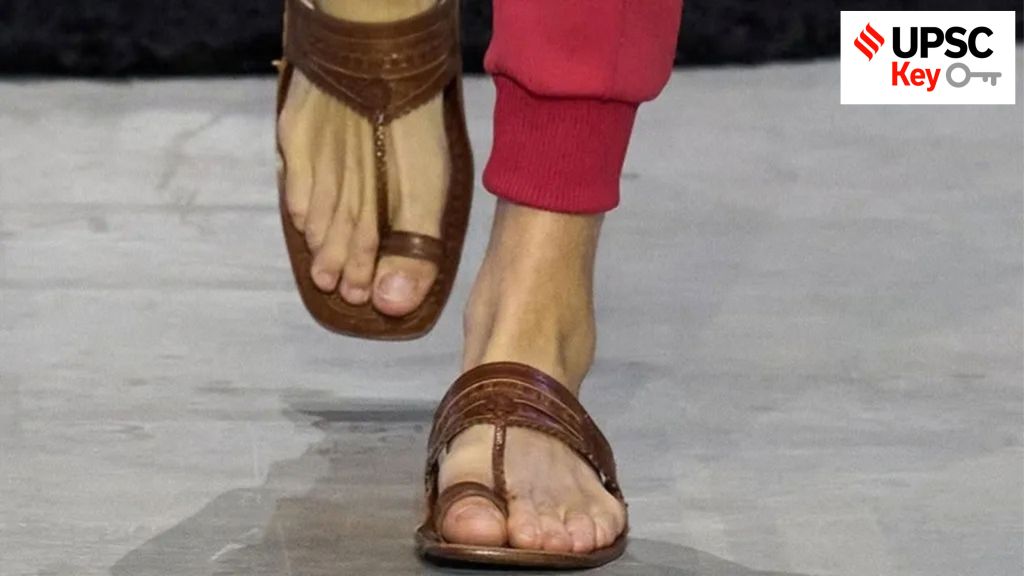
• After the cultural misappropriation of Kolhapuri chappals by Prada, luxury fashion brands Ralph Lauren and Fendi have once again watered down the Indian origin and denied inspiration or credit for their new products. During its spring/summer 2027 show at the New York Fashion Week, Ralph Lauren showcased a pink evening gown with aari (hook embroidery from Gujarat) work, describing it as “hand-applied embellishments.”
• Fendi’s autumn collection has a mirror-work Baguette bag, made in Italy over 138 hours, using 39,500 beads and 475 mirrors, and priced at $10,000. It is a knock-off of the mirrored purses that you would find in crafts fairs here.
• This raises a larger question as to why is it so much easier for a traditional Indian craft to be commercially appropriated than it is for the community behind it to demand recognition, ownership or participation in the value it creates? “The difficulty begins with a fundamental contradiction: Intellectual property is territorial, while culture is not,” says Safir Anand, senior partner and head of Trademarks, Contractual and Commercial IP at the law firm Anand and Anand.
Do You Know:
• A centuries-old craft technique does not fit neatly into the categories of conventional intellectual property. There may be a particular artistic expression, a design, a geographical identity or a protected name. But the underlying tradition may belong to a community and may have evolved over generations. “Traditional crafts have cultural provenance but no clearly identifiable legal owner. That is the gap which is exploited, the space where conversation needs to innovate,” says Anand.
• Professor Nirbhay Rana, Professor of Practice at Masters’ Union on fashion design and innovation, makes the same distinction. A Geographical Indication (GI) can protect the name, origin and reputation of a qualifying product, but not necessarily every motif, stitch or visual element associated with a craft. “The central principle should be representation and custodianship: the people who have sustained and transmitted the tradition should have a meaningful role in decisions concerning its protected commercial use,” he says.
• Traditional craft complicates the very idea of authorship. The person who first created a technique may be unknown, impossible to identify or irrelevant to the way the tradition has actually developed. One generation passes knowledge to another; each generation may alter it slightly; the community continues to practise it. “However, this absence of an identifiable author cannot become an invitation to appropriate work,” Anand says.
• A luxury brand may be able to draw upon an aesthetic. But should it be able to detach that aesthetic from the place and people that gave it meaning? For Raja Pratap Kakarawada, textile specialist and design consultant at the Development Commissioner for Handloom & Handicrafts, the answer is clear: the place of origin needs to be credited rather than treated as though the craft emerged within the luxury brand’s own creative vocabulary.
• The World Intellectual Property Organisation (WIPO) is already working towards international rules that could address issues such as misappropriation, attribution, community rights and benefit-sharing. However, the international framework is still being negotiated. “Interestingly, WIPO already adopted a 2024 treaty dealing with genetic resources and associated traditional knowledge, showing that international IP law is beginning to recognise these issues beyond conventional copyright and patents and hence, the opportunity is significant,” says Anand. According to Kakarawada, the Berne Convention gives creators and communities legal avenues to challenge unauthorised use, depending on the specific work and applicable laws.
Other Important Articles Covering the same topic:
📍Leher Kala writes: The grey area of ‘inspiration’
Previous year UPSC Prelims Question Covering similar theme:
4) In order to comply with TRIPS Agreement, India enacted the Geographical Indications of Goods (Registration and Protection) Act, 1999. The difference/differences between a “Trade Mark” and a Geographical Indications is/are (UPSC CSE, 2010)
1. A Trade Mark is an individual or company’s right whereas a Geographical Indication is a community’s right.
2. A Trade Mark can be licensed whereas a Geographical Indication cannot be licensed.
3. A Trade Mark is assigned to the manufactured goods whereas the Geographical Indication is assigned to the agricultural goods/products and handicrafts only.
Which of the statements given above is/are correct?
(a) 1 only
(b) 1 and 2 only
(c) 2 and 3 only
(d) 1, 2 and 3
The Editorial Page
India will de-risk, not decouple, from US and China
Syllabus:
Preliminary Examination: Current events of national and international importance.
Main Examination: General Studies II: India and its neighbourhood- relations.
What’s the ongoing story: Sanjaya Baru Writes- The United States has taken one more step in its ongoing campaign to punish India for asserting her national interest in the pursuit of economic development. The United States Congress has voted overwhelmingly in favour of the Lindsey O Graham Sanctioning Russia and Iran Act 2026.
Key Points to Ponder:
• Standoff between India and China-what you know about the same?
• Friction between India and China-what are the reasons?
• India-China Relations during Nehruvian Era-Know in detail
• The 1962 India-China War-Know the background
• India-China Border Dispute- Know the background
• Know the terms ‘De-induction’ ‘Disengagement’ and ‘De-escalation’?
• What ‘De-induction’, ‘Disengagement’ and ‘De-escalation’ means in India-China Context?
• What is the present situation?
Key Takeaways:
• This authorises the US President to impose tariffs of up to 100 per cent on goods from the five largest purchasers of Russian oil and gas, namely, China, India, Slovakia, Hungary and Azerbaijan. America’s European allies have been exempted on the pretext that they are trying to reduce their consumption of Russian energy. President Donald Trump now has the power to act. He will probably use this weapon to strike a range of deals with the five countries before, in fact, utilising his power in full.
• President Trump began taking economic actions against India in 2017 when he ended the Generalised System of Preferences (GSP) and began increasing tariffs on a range of commodities and products. That process went through its ups and downs but there has been no retreat. Actions taken against India have remained in place. Some threatened actions have not yet been taken but not called off either. Pressure on India to stop oil imports from Venezuela was ended after the US staged a coup and changed the regime in that country. Now India is being asked to buy Venezuelan oil.
• While some of Trump’s geopolitical initiatives have unsettled New Delhi, with his hosting of the Pakistani Field Marshal for lunch at the White House constituting the nadir, it is the geoeconomic sanctions that will really have a long-term impact on the relationship.
• The fact is that the US remains an important market for Indian exports of goods and services. The people-to-people and business-to-business connection is strong and enduring, though it is entirely possible for state-to-state relations to deteriorate despite robust people and business links. The US, in this regard, is in a league of its own, with large sections of the Indian power elite emigrating to the US.
• The idea was quickly picked up by President Joe Biden and a bipartisan consensus seemed to be building in favour of “decoupling”. The Washington DC think-tank and policy circuit went into high gear theorising and estimating the costs of “decoupling”, till Biden’s own administration officials realised that decoupling was a fantasy. “The US will assert ourselves when our vital interests are at stake. But we do not seek to ‘decouple’ our economy from China’s,” cautioned Janet Yellen, then US treasury secretary, adding, “A full separation of our economies would be disastrous for both countries. It would be destabilising for the rest of the world.”
Do You Know:
• The Line of Actual Control (LAC) is the demarcation that separates Indian-controlled territory from Chinese-controlled territory. India considers the LAC to be 3,488 km long, while the Chinese consider it to be only around 2,000 km. It is divided into three sectors: the eastern sector which spans Arunachal Pradesh and Sikkim, the middle sector in Uttarakhand and Himachal Pradesh, and the western sector in Ladakh.
• The alignment of the LAC in the eastern sector is along the 1914 McMahon Line, and there are minor disputes about the positions on the ground as per the principle of the high Himalayan watershed. This pertains to India’s international boundary as well, but for certain areas such as Longju and Asaphila. The line in the middle sector is the least controversial but for the precise alignment to be followed in the Barahoti plains.
• According to the Maj Gen (retd) Prof G G Dwivedi, every conflict has a cycle – it begins with escalation, and is followed by contact, stalemate, de-escalation, resolution, peace-building and reconciliation. The de-escalation process entails talks at multiple levels, and ground action in various stages. For example, there have been three rounds of talks at the Corps Commander level, simultaneous talks between Joint Secretaries, and at the level of Special Representatives between India and China after Galwan clash. On the ground, the first step in the de-escalation process is of disengagement – i.e., to break the ‘eyeball-to-eyeball’ contact between the opposing troops on the forward line by pulling back to create a buffer zone. The next step is the pulling back of the troops in the immediate depth, followed by reserve formations in the rear.
Other Important Articles Covering the same topic:
📍Buffer zones to Depsang to Demchok: Spotlight on pullback plan, the extent
Previous year UPSC Prelims Question Covering similar theme:
📍‘China is using its economic relations and positive trade surplus as tools to develop potential military power status in Asia’. In the light of this statement, discuss its impact on India as her neighbour. (UPSC, GS2, 2025)
The Ideas Page
Public services matter for welfare. But they will need to count at the ballot box
Syllabus:
Preliminary Examination: Economic and Social Development
Main Examination: General Studies II: Issues relating to development and management of Social Sector/Services relating to Health, Education, Human Resources.
What’s the ongoing story: Rajat Kathuria Writes- A straightforward proposition at the heart of public economics is that in an electoral democracy, citizen preferences should influence the nature and quality of public good provision.
Key Points to Ponder:
• What distinguishes a public good from a publicly provided service?
• What is Hirschman’s exit and voice framework?
• How can private alternatives weaken pressure for reform of public systems?
• Why are education and public health particularly vulnerable to this phenomenon?
• What is meant by competitive welfarism?
• Why are visible and directly attributable benefits easier for citizens to associate with governments?
• What makes a public-service failure become a politically salient issue?
• How can social media transform scattered individual grievances into collective demands?
Key Takeaways:
Rajat Kathuria Writes-
• Politicians seek votes; voters care about outcomes; governments therefore have an incentive to respond. Governments need not be benevolent for democracy to work. They merely need to find it costly to ignore sufficiently large numbers of voters. That is the theory. The more difficult question is whether and how this transmission mechanism works in practice.
• Consider the quality of the school a child attends, whether a competitive examination such as NEET is conducted fairly, whether water comes through the tap, whether electricity is available, whether the local road remains functional or whether the air outside is fit to breathe. These affect welfare directly and yet they have largely remained surprisingly weak electoral issues in India.
• Governments lose elections, yes, but it is hard to tell if they have been defeated because the local school taught badly, or if buses were persistently unreliable, or the groundwater was contaminated, or urban air had crossed safe levels.
Do You Know:
Rajat Kathuria Writes-
• Why does an intensely felt private grievance so often fail to become a political demand? Albert Hirschman, an economist, provided one part of the answer: Exit and voice.
• When a service deteriorates, users can demand that it improve, which is voice. Or they can abandon it for an alternative, which is exit. India has developed an extraordinary capacity for private exit from public failure.
• Unreliable electricity produces the inverter or generator; uncertain water supply produces the borewell, tanker and purifier; weak public transport produces the scooter and car; poor government schooling produces private schooling; inadequate public healthcare produces the private clinic; weak security produces the guard and gated colony. Each decision is individually rational. Together, they reflect a political equilibrium in which public failure becomes easier to tolerate because those with the resources and influence to demand reform have partly insulated themselves from it.
• Where richer and politically effective users remain dependent on public provision, pressure for reform is stronger. Where they exit, accountability weakens. Take passport services, railway reservations and rural elementary education as a contrast. Passport and railway services, which are heavily used by the middle classes, have experienced much stronger anti-corruption reform. Elementary schooling, from which better-off households exited, did not experience comparable pressure. The exit of richer citizens reduced pressure for reform, leaving poorer users to cope with weaker public systems.
• A public service may matter enormously to welfare and still have little electoral salience. The more recent politics of welfare suggests that governments appear to receive clearer electoral returns when benefits are visible, attributable and delivered directly to households.
• Piped water, LPG connections, electricity connections, toilets, food transfers and cash benefits differ from school quality or clean air in an important respect. The beneficiary can usually identify both the benefit and its political source. Ahead of the 2024 general election, many women voters directly linked their support for the government to visible improvements in piped water, cooking gas, more reliable electricity and cash transfers. This helps explain the rise of competitive welfarism. Governments increasingly prefer benefits that people can see, use and clearly associate with who delivered them.
• Governments that are politically secure can absorb some adverse publicity. What matters is whether reputational damage becomes electoral cost. If examination integrity, school quality or some other neglected public service begins to influence candidate selection, campaign promises and voting behaviour, then the transmission mechanism may operate differently. The significant development would be that governments began to believe poor provision could cost votes.
Other Important Articles Covering the same topic:
📍 Welfare populism is not just a budgetary concern — it is a question of national economic stability
Previous year UPSC Prelims Question Covering similar theme:
5) Which part of the Constitution of India declares the ideal of Welfare State? (UPSC, CSE, 2020)
(a) Directive Principles of State Policy
(b) Fundamental Rights
(c) Preamble
(d) Seventh Schedule
Previous year UPSC Mains Question Covering similar theme:
📍Can the constitutional mandate of rights-based welfare be effectively realised in the context of non-integrated governance and minimal public investment? Examine (UPSC, GS2, 2026)
📍Should education be treated primarily as a welfare obligation of the state or as a strategic investment for building a globally competitive, knowledge-driven nation? Critically evaluate (UPSC, GS2, 2026)
Economy
India’s top nuclear scientist calls for early thorium shift in PHWRs
Syllabus:
Preliminary Examination: Current events of national and international importance.
Main Examination: General Studies III: Science and Technology- developments and their applications and effects in everyday life.
What’s the ongoing story: India’s top nuclear scientist Anil Kakodkar has advocated the early introduction of thorium-based fuel into the country’s indigenous pressurised heavy water reactor (PHWR) fleet, while parallely continuing with the three-stage nuclear programme, to speed up the utilisation of the country’s abundant thorium reserves.
Key Points to Ponder:
• The Sustainable Harnessing and Advancement of Nuclear Energy for Transforming India (SHANTI) Act-know the key highlights and features
• What is High Assay Low Enriched Uranium (HALEU)?
• Know these terms—natural uranium, enriched uranium, plutonium and thorium.
• What is a Thorium-based nuclear reactor?
• What is a small modular reactor?
• Why is nuclear safety considered a critical aspect of nuclear energy development?
• Why top atomic energy regulator is expected to maintain the same rigorous safety and licensing requirements for small modular reactors (SMRs)?
• What are the opportunities offered by Small Modular Reactors for India’s energy sector?
• What are the rigorous safety and licensing requirements for large nuclear reactors (SMRs)?
Key Takeaways:
• The three-stage nuclear power programme was conceived in the 1950s by Homi Jehangir Bhabha, the architect of the country’s nuclear programme.
• With the world transiting from uranium to thorium, the appeal for PHWRs will grow particularly in emerging economy countries, Kakodkar, the former Chairman of the Atomic Energy Commission, who now holds the position of the Chancellor at the Homi Bhabha National Institute and the Chairman of the Rajiv Gandhi Science & Technology Commission, told The Indian Express in an interview.
Do You Know:
India’s top nuclear scientist Anil Kakodkar says-
• The PHWR system has been developed as a part of our well-conceived approach to India’s self-reliance, and long-term energy security or independence, to be realised through India’s globally-largest thorium resources. Barring molten salt reactors (MSRs), which are yet to mature, PHWRs are the best platforms for utilising thorium among thermal reactors.
Most importantly, PHWR has also established itself as a robust, safe and economically competitive technology, and thus offers significant attraction to investors — while also taking India’s nuclear energy policy forward. It would thus be natural to expect domestic PHWR to occupy a major share of the 100 gigawatt electric (GWe) nuclear mission (to be implemented between now and 2047) with imported LWRs occupying most of the remaining share.
• Self-reliance is the key to guard against external vulnerabilities and has always guided our approach to autonomous development of the country’s nuclear capability. That said, collaboration that brings in complementary capabilities on the table is the credible way forward.
Other Important Articles Covering the same topic:
📍NPCIL begins fuel loading at RAPP-8, unit nears operation
Previous year UPSC Prelims Question Covering similar theme:
6) To meet its rapidly growing energy demand, some opine that India should pursue research and development on thorium as the future fuel of nuclear energy. In this context, what advantage does thorium hold over uranium? (UPSC, CSE, 2012)
1. Thorium is far more abundant in nature than uranium.
2. On the basis of unit mass of mined mineral, thorium can generate more energy compared to natural uranium
3. Thorium produces less harmful waster compared to uranium.
Which of the statement(s) given above is/are correct?
(a) 1 only
(b) 2 and 3 only
(c) 1 and 3 only
(d) 1, 2 and 3
7) The function of heavy water in a nuclear reactor is to (UPSC, CSE, 2011)
(a) Slow down the speed of neutrons
(b) Increase the speed of neutrons
(c) Cool down the reactor
(d) Both (a) and (c)
How agentic AI could transform the way we make digital payments
Syllabus:
Preliminary Examination: Current events of national and international importance.
Main Examination: General Studies III: Science and Technology- developments and their applications and effects in everyday life.
What’s the ongoing story: Artificial intelligence (AI) is the hot topic right now, with industries such as IT already seeing a structural change with the adoption of new technologies. The payments industry is also integrating AI into its services, particularly agentic AI.
Key Points to Ponder:
• What is the difference between conventional AI and agentic AI?
• What is agentic commerce?
• Why is consumer authorisation still necessary in agentic payments?
• How could delegated authorisation reduce friction in digital payments?
• Who should bear liability if an authorised AI agent makes an erroneous payment?
• Why does fragmented payment data make large-scale agentic commerce difficult?
• What role can UPI and India’s Digital Public Infrastructure play in agentic commerce?
Key Takeaways:
• Conventional AI has been integrated into the payments ecosystem for quite some time, helping reduce friction in the payments process and enhancing digital safety by making the backend process more reliable, and screening consumers from potentially fraudulent transactions. However, agentic AI might take the industry towards agentic commerce, where an AI agent will take care of a consumer’s entire payment journey, making it frictionless.
• The Global Fintech Fest (GFF) held in Mumbai last week saw many of the country’s top payments companies showcase AI integration into their products. The National Payments Corporation of India (NPCI) unveiled MyUPI — an AI-powered revamp capable of delegating pre-authorised payments, and automatic and seamless filing of payment disputes. It also launched a backend tool that acts as a “connective tissue” for AI interaction across the financial ecosystem, called Agentic Orchestration and Messaging (AtOM).
• While agentic AI — a model that executes tasks for users without constant prompts, but within certain limits — could streamline the entire “procurement to payment” process for businesses, its adoption is still at a nascent stage. At present, agentic commerce happens to be its biggest use-case.
Do You Know:
• Agentic commerce is a digital trade model under which AI agents streamline the buying process by discovering, negotiating, and executing on behalf of customers. Notably, this does not mean bypassing the need for authorisation. It only cuts down steps involved in a customer’s e-commerce journey, including the payments phase.
• For example, AI-powered tools can notify a customer of discounts on products that they have been viewing for months. If they decide to buy it, the AI agent on their payments platform can determine the ideal card or mode of payment — cutting down the need for multiple OTPs and authorisation requirements to just one-time authentication — for the transaction. Thus, the consumer will have oversight, and can change any of the components during the process. But they will save their time, and may find the best deal if they proceed with the whole process.
Other Important Articles Covering the same topic:
📍‘Agentic misalignment’ and other new AI catch-phrases to know
Previous year UPSC Mains Question Covering similar theme:
📍What is agentic Artificial Intelligence (AI) ? Explain its working. Describe its applications with suitable examples. Discuss the advantages, risks and challenges associated with agentic AI systems. (UPSC, GS3, 2026)
|
PRELIMS ANSWER KEY |
| 1.(b) 2.(c) 3.(b) 4.(b) 5.(a) 6.(d) 7.(a) |
For any queries and feedback, contact priya.shukla@indianexpress.com
Subscribe to our UPSC newsletter. Stay updated with the latest UPSC articles by joining our Telegram channel – IndianExpress UPSC Hub, and follow us on Instagram and X.


Priya Kumari Shukla is a Senior Copy Editor in the Indian Expre... Read More
 Share


