
UPSC Key: Semiconductor, US Fed Tapering and Glacial Retreat
Why the Lindsey O. Graham Sanctioning Russia and Iran Act of 2026 is relevant to the UPSC exam? What is the significance of topics such as Leopardus tilcayo, orangutans, and GDP debate on both the preliminary and main exams? You can learn more by reading the Indian Express UPSC Key for September 18, 2026.
 UPSC Key August 2026: Here's what you should be reading from the September 18, 2026 edition of The Indian Express.
Important topics and their relevance in UPSC CSE exam for September 18, 2026. If you missed the September 17, 2026 UPSC CSE exam key from the Indian Express, read it here
The World

In Bolivia, a new cat species identified— first in over a century
Syllabus:
Preliminary Examination: Current events of national and international importance.
What’s the ongoing story: A diminutive wild cat that inhabits Bolivia’s cloud forest has been identified as a previously unknown species, marking the first time a new living feline species has been formally named and described in more than a century.
Key Points to Ponder:
• What is the newly identified species Leopardus tilcayo?
• What is the IUCN status of the Leopardus tilcayo?
• Where has it been found?
• Map Work-Bolivia and the Yungas region
• What does the term cryptic species mean?
• What limitations can arise when species identification relies primarily on morphological characteristics?
• How can genetic data help establish whether an animal represents a distinct species?
• Why is the description of a “new living feline species” particularly significant?
• What is the difference between species discovery and species evolution?
Key Takeaways:
• The cat, called tilcayo by local communities, is part of a group called tiger cats found across much of South America. It was found in Bolivia’s lush Yungas forest, a mountainous region where forests are often covered by clouds and surrounded by high humidity, according to researchers. It measures about 18in (46cm) long and weighs about 3lb (1.4kg), making it smaller than the average domestic cat. Researchers used genetic data to confirm that the cat is a new species, and gave it the scientific name Leopardus tilcayo, retaining its local name.
• “Its fur is light brown … with irregularly shaped rosettes across its body,” said Paola Nogales-Ascarrunz, a National Geographic explorer and one of the authors of the study describing the newly identified species published on Thursday in the journal Current Biology.
• Little is yet known about the cat’s biology and lifestyle. Remains of small rodents in scat samples suggest they may form part of its diet, while camera-trap evidence indicates it could be more active at night, Nogales-Ascarrunz said.
Tiger cats are so-called cryptic species, meaning they cannot easily be distinguished merely by appearance, said evolutionary biologist and study co-lead author Jonas Lescroart of the University of Antwerp in Belgium.
• Tiger cats previously had been considered a single species, but genetic studies decades ago suggested the existence of multiple species.
• The International Union for Conservation of Nature (IUCN) red list tracking the status of species currently treats tiger cats as two “vulnerable” species with declining populations.
• Genetic analysis suggested that the Tilcayo lineage separated from other tiger cats about 1.4 million years ago.
Do You Know:
• Leopardus tilcayo, commonly known as the tilcayo tiger cat, is a newly identified species of small wild cat native to the mountain cloud forests of Bolivia’s Yungas region.
• A cryptic species is a species that is difficult to distinguish from another closely related species because the differences in external appearance may be very small or absent. This creates a taxonomic problem. The Bolivian tiger-cat case is an example of why genetic investigation can be important in resolving such taxonomic uncertainty. Two populations may appear almost identical but have sufficiently distinct genetic characteristics to indicate that they represent separate evolutionary lineages.
• The tilcayo cat measures approximately 18 inches (45 centimetres) from its head to the end of its body and weighs three pounds (1.3 kilograms) – making it smaller than the average domestic cat. It’s differentiated from the oncilla (known as the northern tiger cat) by its larger spot markings, a larger, more slender tail, and a muted fur colour.
Other Important Articles Covering the same topic:
📍One of India’s rarest wild cats spotted in Kuno: Why it matters
Previous year UPSC Prelims Question Covering similar theme:
1) The “Red Data Books” published by the International Union for Conservation of Nature and Natural Resources (IUCN) contain lists of (UPSC, CSE, 2011)
1. Endemic plant and animal species present in the biodiversity hotspots.
2. Threatened plant and animal species.
3. Protected sites for conservation of nature and natural resources in various countries.
Select the correct answer using the codes given below;
(a) 1 and 3
(b) 2 only
(c) 2 and 3
(d) 3 only
Front Page
PM pitches India as trusted base for chip manufacturing
Syllabus:
Preliminary Examination: Current events of national and international importance.
Main Examination: General Studies III: Science and Technology- Developments and their applications and effects in everyday life and Infrastructure: Energy, Ports, Roads, Airports, Railways etc.
What’s the ongoing story: The world needs new and trusted bases for semiconductor manufacturing and India is readying itself to meet that requirement, Prime Minister Narendra Modi said Thursday, as he pitched the country as an alternative manufacturing hub at a time when chip companies are looking to diversify their global supply chains.
Key Points to Ponder:
• What is a semiconductor?
• Know the terms—Semiconductor, integrated circuit, chip, electronic device, memory chips and logic chips
• What is India Semiconductor Mission (ISM) 2.0?
• How India Semiconductor Mission (ISM) 2.0 is different from India Semiconductor Mission (ISM) 1.0?
• How can India move from assembly and packaging towards higher-value design, fabrication and materials capabilities?
• How semiconductors are different from traditional chips?
• What is the most basic component of a semiconductor chip?
• Where does India stand in the semiconductor industry?
• What are the current challenges of the semiconductor industry in India?
• The Government of India has undertaken several initiatives to promote electronics manufacturing-Know the important schemes
Key Takeaways:
• “The world needs new and trusted locations for chip manufacturing and India is preparing itself for this,” Modi said, inaugurating SEMICON India 2026 in New Delhi. He said India had now entered the second phase of its semiconductor journey, moving beyond policy announcements and construction of plants towards commercial production of chips.
• The Prime Minister said India had achieved in about four years what generally takes countries around a decade to build, but described semiconductor manufacturing as a “never-ending journey”. 12 semiconductor projects were approved under the first phase of the India Semiconductor Mission, spanning fabrication, packaging and other parts of the chip value chain. Three of these have already started commercial production.
• The government has now moved to Semicon 2.0, a Rs 1.27 lakh crore programme that widens the focus beyond large chip factories to areas such as semiconductor equipment, materials, design, research and development, supply chains and skilled manpower. Modi said the next phase would see the number of projects increase further, as India sought to build the wider ecosystem needed around semiconductor fabs.
• Modi sought greater participation from private companies in research and development, saying the country needed industry to play a bigger role in developing advanced technologies. “I urge industry leaders to lead R&D in the country,” Modi said, while also calling on young Indian researchers, including those working overseas, to participate in the sector’s growth. The government, he added, was opening more avenues for international companies to work with Indian start-ups and chip design firms.
• Lam Research, meanwhile, has announced plans to invest around Rs 10,000 crore in India over the next several years to establish its first silicon-component manufacturing facility in the country and expand its advanced R&D operations. The proposed facility will cover silicon ingot production and processing for advanced semiconductor technologies, while building on Lam’s existing engineering and R&D presence in India.
• Other global semiconductor executives also pointed to the shift from plans to production. Micron Technology CEO Sanjay Mehrotra said the company’s Sanand facility in Gujarat had begun shipping DRAM (Dynamic Random-Access Memory) and NAND memory products to customers globally. Micron expects to assemble and test tens of millions of chips at the plant this year and scale that to hundreds of millions next year. Its Indian teams have also contributed to more than 3,700 patents, inventions and disclosures, he said.
Infineon Technologies CEO Jochen Hanebeck said India had the potential to strengthen its position across the global semiconductor value chain as its domestic market and technological capabilities expanded. The German chipmaker now has more than 2,800 employees in India.
Do You Know:
• India is witnessing rapidly rising semiconductor demand. It is projected to reach $110 billion by FY30 and exceed $200 billion by FY35, while domestic manufacturing remains at a nascent stage. India spent almost $150 billion on semiconductor product imports between FY17–FY25. Imports grew at a CAGR of 23% during this period, and if this trend continues, annual imports could reach $240 billion by 2035. The government, therefore, has identified building a comprehensive semiconductor ecosystem as an urgent national priority.
• At Semicon India, 2026 fresh investments were also announced from two of the world’s biggest semiconductor equipment companies. Applied Materials announced its India Vision 2035, under which it will invest $5 billion over the next decade, including on R&D, expanding the domestic semiconductor supply chain and developing talent. The company also announced a new 140-acre advanced semiconductor research park, and said it aims to expand its India-based supply-chain capacity ten-fold by 2035.
• Semiconductor design and production are critical to building tech products such as laptops, phones and AI models today, and this design push seeks to address a key gap in India’s semiconductor ambitions. While the country has emerged as a major global base for chip-design engineers, much of this work is currently done for multinational semiconductor companies.
• Semicon 2.0 seeks to build more Indian-owned intellectual property and fabless semiconductor companies — firms that design and sell chips while outsourcing the work of physical fabrication.
• The operational framework notified on August 31 puts chip design at the front of the new semiconductor mission. Of the programme’s six pillars and 10 categories, the first pillar is entirely focused on design, with separate tracks for chips required for national and strategic priorities, commercial semiconductor products, and a deployment-linked incentive for newly developed chips.
Other Important Articles Covering the same topic:
📍Semicon 2.0: What is India’s new Rs 1.27 lakh-crore push for chip design?
Previous year UPSC main Question Covering similar theme:
📍India aims to become a semiconductor manufacturing hub. What are the challenges faced by the semiconductor industry in India? Mention the salient features of the India Semiconductor Mission. (UPSC, GS3, 2025)
The Editorial Page
Release 2017-18 consumption data, put all doubt to rest
Syllabus:
Preliminary Examination: Economic and Social Development
Mains Examination: General Studies III: Indian Economy and issues relating to planning, mobilization, of resources, growth, development and employment.
What’s the ongoing story: Surjit Bhalla writes-The ‘unintended’ consequences of that censorship have become evident since then: No matter how good the data produced in India is, there will always be doubt, one that is exploited by political opponents.
Key Points to Ponder:
• What is a household consumption expenditure survey?
• Why is consumption expenditure used as an indicator of household welfare?
• How is consumption different from income as a measure of economic well-being?
• Know the terms—household income data, consumption expenditure data, savings data and national income data
• Why might consumption data be particularly useful in economies with substantial informal employment and income under-reporting?
• What is the role of sampling design, questionnaire design and recall periods in household surveys?
• How can changes in methodology affect the interpretation of trends?
• Why does the credibility of official statistics matter for policymaking?
• What institutional safeguards can strengthen public confidence in official statistics?
• Should statistical data be released even when its findings are politically or economically inconvenient?
• “Statistical transparency is a component of good governance”—What is your take?
Key Takeaways:
Surjit Bhalla writes-
• There has been considerable discussion in these pages on the accuracy and/or credibility of the GDP data for March-June 2026. My guess is that internationally also this debate has assumed importance. Given this, I hope I can be excused for penning another op-ed on the subject.
• It is important to separate the commentary on Indian data into two broad categories — national accounts data, and other data. I have had the privilege of being a member of several government committees since 1998. In 2006, I was appointed a member of India’s first statistical commission (2006-2009) under the leadership of the late Suresh Tendulkar. Interacting frequently with staff members of the NSS and national accounts division, I emerged with the following observation on keepers of the statistical frame (and flame): “Don’t build a road because you may have an accident”. Stated more favourably, official Indian statisticians would err on the side of “accuracy” or “precision”. If a road is not built, if knowledge is not advanced, so be it — we purists cannot be wrong.
• It is for this reason that India has not undertaken the task of conducting a household income distribution survey. I have begged the authorities to do an income distribution survey since 1998.
• Note that in conducting consumption surveys India has been a pioneer in world statistical surveys; and we have not worried about survey consumption ranging between 55 and 60 per cent of consumption estimated via national accounts. India was the first country to outline poverty measurement. The World Bank’s famous dollar-a-day poverty line was the Indian poverty line! The first household panel survey was conducted by NCAER, the Additional Rural Incomes Survey, 1968-69 to 1970-71; an honour shared with the University of Michigan Panel Study of Income Dynamics, which conducted the first panel in 1968.
• South Asian countries like Sri Lanka, Pakistan and Bangladesh have been conducting income distribution surveys for years, and India has finally joined the world in this endeavour. Given the dissection and healthy criticism of Indian data, it is important to point out the overwhelmingly unhealthy analysis, let alone criticism, of one of the most successful development transitions in history — China.
• There is a lesson from what the Indian government had previously done when survey “findings” were unpalatable. NSS consumption surveys had been on a five-year schedule since 1983. The 2009-10 consumption survey results were released in mid-July 2011. Because of the fear that there was a severe drought in 2009-10 (rainfall data did not confirm a drought) and the dampening effects of the Great Financial Crisis, the government had commissioned an unprecedented additional consumption survey for the agricultural year 2011-12 (July 2011 to June 2012). In other words, a new survey was already in the field when the results of the “old” survey were announced.
• The Indian government had acted in the best, pioneering nature of the Indian statistical system. Be conservative (no income distribution survey!) but do not ever censor data.
• The tragedy, and mistake, is deeper. I have participated in several analyses of Indian poverty data, including an analysis of what likely happened to consumption and poverty in 2017-18. In a 2019 article, co-authored with Karan Bhasin, we wrote: “It is important to release the unit-level data, if for no other reason than to let the world know just how bad the CES data is”.
Do You Know:
• The GDP debate in India centers on a major controversy surrounding the official Q1 FY27 real GDP growth print of 7.8% released by the Ministry of Statistics and Programme Implementation (MoSPI).
• The government announced a robust 7.8% real GDP and 10.3% nominal GDP growth for the April–June quarter, backed by a newly revised base year of 2022–23. Former Finance Secretary Subhash Chandra Garg and political opposition leaders challenged the figures, arguing that comparing new-series metrics to older data points toward a sluggish nominal growth closer to 2.6%.Economists and MoSPI defended the data, explaining that critics mixed incompatible statistical series (“apples and oranges”) by contrasting new base-year calculations with outdated legacy baselines.
• A deflator is a statistical tool used to remove the effects of inflation from economic data so you can compare values across different time periods.
• India’s GDP deflator measures economy-wide inflation by dividing nominal GDP by real GDP. There are other measures of inflation too like Consumer Price Index (CPI) and Wholesale Price Index (or WPI); however GDP deflator is a much broader and comprehensive measure. Since Gross Domestic Product is an aggregate measure of production, being the sum of all final uses of goods and services (less imports), GDP deflator reflects the prices of all domestically produced goods and services in the economy whereas, other measures like CPI and WPI are based on a limited basket of goods and services, thereby not representing the entire economy (the basket of goods is changed to accommodate changes in consumption patterns, but after a considerable period of time).
Other Important Articles Covering the same topic:
📍The GDP debate: India’s growth numbers have a credibility problem
Previous year UPSC Prelims Question Covering similar theme:
2) In the context of Indian economy, consider the following statements: (UPSC, CSE, 2011)
1. The growth rate of GDP has steadily increased in the last five years.
2. The growth rate in per capita income has steadily increased in the last five years.
Which of the statements given above is/are correct?
(a) 1 only
(b) 2 only
(c) Both 1 and 2
(d) Neither 1 nor 2
Previous year UPSC main Question Covering similar theme:
📍Define potential GDP and explain its determinants. What are the factors that have been inhibiting India from realizing its potential GDP? (UPSC, GS3, 2020)
📍Explain the difference between computing methodology of India’s Gross Domestic Product (GDP) before the year 2015 and after the year 2015. (UPSC, GS3, 2021)
Explained
Russia sanctions Bill: Tool for Trump, worry for India
Syllabus:
Preliminary Examination: Current events of national and international importance.
Mains Examination: General Studies II: Bilateral, regional and global groupings and agreements involving India and/or affecting India’s interests.
What’s the ongoing story: The US House of Representatives has passed a Bill that could give President Donald Trump additional leverage to curb Indian exports to the US.
Key Points to Ponder:
• What are the key highlights from the Lindsey O. Graham Sanctioning Russia and Iran Act of 2026?
• What are economic sanctions?
• What has been India’s immediate response?
• What options India have?
• What are primary sanctions and secondary sanctions?
• How proposed US sanctions Bill against major buyers of Russian energy can impact India-Russia economic relations?
• How does the Russia sanctions issue highlight the issue between India’s strategic partnership with the United States and its longstanding defence, energy and economic ties with Russia?
• What percentage of India’s crude imports currently comes from Russia?
• How U.S. tariff bill can influence India’s decisions on oil import diversification?
Key Takeaways:
• The ‘Lindsey O. Graham Sanctioning Russia and Iran Act of 2026’ gives Trump the powers to slap duties of up to 100% on foreign nations that purchase Russian oil and natural gas — India and China are among its biggest importers.
• The Bill had been cleared by a wide majority by the US Senate (the country’s upper house) last month. On Wednesday, the US House (the lower house) passed it by 262 votes to 159, as 58 Democrats broke with party leaders to join all but seven Republicans in favour. All that’s needed now is Trump’s approval.
• The US President in February this year had lost the authority to impose “reciprocal tariffs” after the US Supreme Court had struck down the US president’s lack of authority under the 1977 International Emergency Economic Powers Act (IEEPA) to impose broad import duties. Since then, the administration has been finding newer ways to impose trade restrictions.
• Before his powers were struck down, Trump used reciprocal tariffs as leverage in trade negotiations with India; New Delhi, however, is yet to officially sign a deal. Government officials have maintained that India is looking for a tariff advantage over other competitors to sign a trade deal with the US.
• The Ministry of External Affairs (MEA) said on Thursday that it remains committed to ensuring the nation’s energy security “through diversified sourcing and on the basis of evolving market dynamics”. It added that the proposed legislation’s implications for the India-US relationship as well as the global energy market have been flagged in discussions with US representatives.
• Trade experts said that Congressional approval places such Russian oil-related tariffs on stronger legal ground. After the Act is signed, the US Trade Representative will identify the targeted countries and recommend tariff rates. These countries would normally have 180 days to reduce Russian energy imports or negotiate with Washington. However, the president can shorten this period.
Do You Know:
• While India had not signed a trade agreement with the US, both countries had reached a deal in February and had also released a joint statement. Besides, New Delhi has been quietly opening its market in sectors of US interest during the last several months.
• India has so far agreed to several US demands as part of the trade deal, particularly in the digital sector. Most prominently, during the last Union Budget, India announced a tax holiday to foreign companies for setting up data centres in the country until 2047, seemingly acting on a key US demand.
• For India, the developments are significant. The country depends on imports to meet over 88% of its crude oil needs, and Russia currently accounts for nearly half of these imports. It remains to be seen if and when Trump turns the Bill into law through his signature, and how his administration implements its provisions, given the prevailing energy market crisis amid the West Asia conflict.
• The new version of the Bill proposes tariffs of up to 100% on the top five buyers of Russian oil and natural gas, against the proposal of a blanket 500% tariff on buyers of Russian energy in the original version that had been hanging fire.
While this reduction in proposed tariffs appears meaningful on paper, the cap is still too high for India, which is also working to finalise a trade deal with the US. Importantly, from New Delhi’s point of view, the new Bill does give powers to the US president to waive the application of its provisions.
For New Delhi, meaningfully reducing Russian oil imports is just not an option in the prevailing circumstances of global energy supply tightness amid the West Asia crisis. Even for Washington, taking away millions of barrels of Russian oil from the global market when energy flows from West Asia remain highly constrained wouldn’t be prudent.
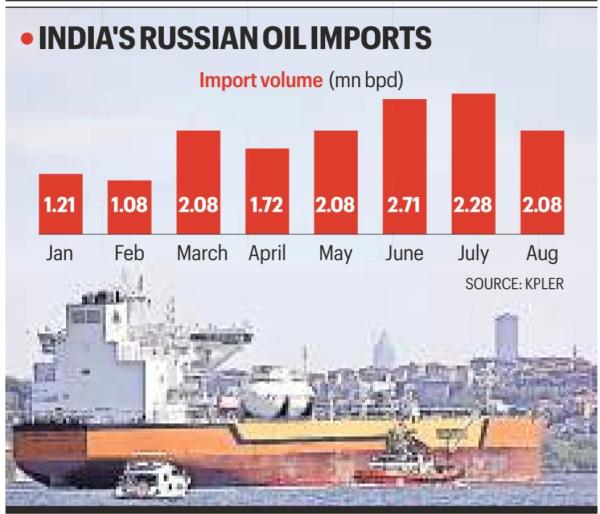 India’s total oil imports in August stood at 4.62 million bpd, down 8.4% from July’s 5.04 million bpd. (Source: Kpler)
• In that context, it’s worth noting that earlier this week, Trump called on Ukraine to halt strikes on Russian refineries, given the runaway oil and petroleum product prices amid stifled supplies in the global market. So will he now risk taking more Russian oil off the market by imposing punitive tariffs on countries buying Russian crude in large quantities? At least till the West Asia crisis persists, Trump might want to exercise restraint and caution in implementing the proposed legislation in full force.
Other Important Articles Covering the same topic:
📍As Trump gets power to punish Russia partners, India warns of ‘potential implications’ for ties
Previous year UPSC main Question Covering similar theme:
📍What is the significance of Indo-US defence deals over Indo-Russian defence deals? Discuss with reference to stability in the Indo-Pacific region. (UPSC, GS2, 2020)
How melting glaciers could ‘put 20% of GDP at risk’
Syllabus:
Preliminary Examination: Indian and World Geography
Mains Examination: General Studies I: Important Geophysical phenomena such as earthquakes, Tsunami, Volcanic activity, cyclone etc., geographical features and their location-changes in critical geographical features (including water-bodies and ice-caps) and in flora and fauna and the effects of such changes.
What’s the ongoing story: The recent floods in Nepal have put the Himalayas’ melting glaciers under the spotlight. But damage from the warming Himalayas does not always come in the form of a spectacular disaster. It also means slow economic drain, as glaciers retreat, water supplies become less reliable and the rivers that sustain agriculture, industry, cities and hydropower change. A new report puts a number to the economic dependence: more than one-fifth of India’s GDP is underpinned by the Himalayas.
Key Points to Ponder:
• What exactly the report, ‘A resilient Himalaya: protecting a region at risk and securing future prosperity’ says?
• What is snow-albedo effect?
• Why glaciers matter to India’s economy?
• Why are glaciers described as natural water-storage systems?
• What major river systems originate in or are sustained by the Himalayan region?
• What is glacial retreat?
• How is glacial mass balance affected by temperature, precipitation and other climatic factors?
• Why is Himalayan conservation a downstream issue, rather than merely a concern for mountain states?
Key Takeaways:
• The report, ‘A resilient Himalaya: protecting a region at risk and securing future prosperity’, was compiled by the global consultancy Systemiq, in partnership with Integrated Mountain Initiative, and supported by the International Centre for Integrated Mountain Development (ICIMOD), Nepal, and GB Pant National Institute of Himalayan Environment, Uttarakhand.
• The report estimates that Rs 64.8 lakh crore, or 21.5% of India’s FY24 GDP, is dependent on the Himalayas. This does not mean that glacier melt would wipe out 21.5% of India’s GDP. The report describes the figure as a measure of economic activity that can be traced to dependence on Himalayan water, rather than an estimate of climate damages.
• “The rivers that carry risk downstream also carry the water that sustains India’s economy: wheat and rice across the Indo-Gangetic plain, tea in Assam and Bengal, hydropower in the Northeast, and pilgrimage economies in downstream towns,” the report says.
• About how it calculated the 20% of the GDP figure, the report explains the three layers it used, “(1) direct: GSDP of Himalayan states; (2) indirect: downstream agriculture, manufacturing, hydropower, and services reliant on Himalayan-fed rivers and groundwater recharge (rain-fed production excluded); and (3) induced: supply-chain (e.g., tractors sold from southern states to IndoGangetic Plains) and wage-spending effects (e.g., spent on food and services).”
• The report also highlights that the Himalayas are already a major disaster hotspot. They account for 18% of India’s land but around 35% of its disasters. Disasters can create food and water insecurity, disrupt supply chains, displace people and increase macroeconomic and sovereign-debt pressures, creating a cycle in which reconstruction spending leaves less money for future resilience.
Do You Know:
• Glaciers act as natural stores of water. They hold water as ice and release meltwater into rivers, particularly during the dry season. But as warming accelerates melting, this extra flow cannot continue indefinitely. Himalayan river basins are expected to reach “Peak Water” around the middle of this century — the point at which glacier meltwater reaches its maximum, after which flows begin to decline as the ice reserve shrinks.
• On current trajectories, the Hindu Kush Himalaya could lose up to 80% of its present glacier volume by 2100, the report says. That matters because the Himalayas feed the Indus, Ganga and Brahmaputra river systems, supporting agriculture, cities and industry downstream.
• The report also highlights that the Himalayas are already a major disaster hotspot. They account for 18% of India’s land but around 35% of its disasters. Disasters can create food and water insecurity, disrupt supply chains, displace people and increase macroeconomic and sovereign-debt pressures, creating a cycle in which reconstruction spending leaves less money for future resilience.
• The report identifies black carbon — soot produced by incomplete combustion — as a polluter that is causing damage and which India can control faster.
Other Important Articles Covering the same topic:
📍What are ‘hanging glaciers’ and why are they a major risk for India?
Previous year UPSC Prelims Question Covering similar theme:
3) With reference to the water on the planet Earth, consider the following statements: (UPSC, CSE, 2021)
1. The amount of water in the rivers and lakes is more than the amount of groundwater.
2. The amount of water in polar ice caps and glaciers is more than the amount of groundwater.
Which of the statements given above is/are correct?
(a) 1 only
(b) 2 only
(c) Both 1 and 2
(d) Neither 1 nor 2
Previous year UPSC main Question Covering similar theme:
📍‘Climate change’ is a global problem. How India will be affected by climate change? How Himalayan and coastal states of India will be affected by climate change? (UPSC, GS3, 2017)
Orangutans in Odisha: The laws governing animal trade and repatriation
Syllabus:
Preliminary Examination: General issues on Environmental ecology, Bio-diversity and Climate Change – that do not require subject specialization.
Main Examination: General Studies III: Conservation, environmental pollution and degradation, environmental impact assessment.
What’s the ongoing story: Last week, the Odisha Forest department rescued five baby orangutans, a critically endangered animal, from a forest in Balasore district. As orangutans are native to the rainforests of Indonesia and Malaysia, the incident prompted multiple questions — How did they reach India’s shores? Were they smuggled? And does India need to return them?
Key Points to Ponder:
• What are orangutans?
• What are the major orangutan species?
• Have you heard of Bornean orangutan, Sumatran orangutan and Tapanuli orangutan
• Why are orangutans in Odisha unusual?
• What is Wildlife Crime Control Bureau (WCCB)?
• Why wildlife trafficking is a major environmental issue
• What is Convention on International Trade in Endangered Species of Wild Fauna and Flora (CITES)?
• Is India Party to CITES?
• Is international wildlife trade allowed, and what rules govern it?
Key Takeaways:
• After the rescue, all eyes are also now on their safe return, with the sight of their condition raising public attention on their welfare. The incident also brings to the fore a trend that has been repeatedly flagged by anti-wildlife trade experts and advocates: That India is no more just a transit route, but is fuelling demand for exotic pets.
• There are three species of orangutans — Bornean, Sumatran and Tapanuli. All of them are found only in the islands of Borneo and Sumatra (in Malayasia and Indonesia), and are listed under Appendix-I of CITES. This means their trade is strictly restricted to non-commercial purposes, such as research, transfers between recognised zoos and breeding projects.
• The orangutans found in Odisha are suspected to be from Sumatra. Since they appear to have been traded for commercial purposes, in alleged violation of CITES , the treaty’s provisions and the 1972 Act mandate certain steps for their welfare and return.
Indeed, Indonesia’s Ministry of Forestry has reached out to Indian authorities. It is learnt to be “preparing the technical requirements” for their repatriation if investigations confirm they are from Indonesia.
• Under CITES, it is recommended that the management authority implementing its provisions — in this case, the Environment Ministry — consult with the scientific authorities and, if possible, the state of export or origin of the species before taking a call on repatriation. If repatriation is feasible, it has to be carried out at the expense of the state of origin. If it is not feasible, it has to be sent to a rescue centre or “such other place” as the management authority deems appropriate. The treaty does not make it obligatory to return animals to the wild.
Do You Know:
• The international trade of wildlife, their body parts and trophies is not prohibited. But is strictly regulated and governed through the Convention on International Trade in Endangered Species of Wild Fauna and Flora (CITES). The international treaty entered force in 1975, and India became a party to it in 1976. The treaty’s aim is to ensure that cross-border trade in wildlife and plants is legal, sustainable and traceable without harming their survival in the wild.
• It is essentially a licensing system that puts in checks and controls on the import, export and re-export of live animals and plants, wildlife body parts, and trophies. The controls are implemented via an exhaustive “CITES species-list”, which is divided into three appendices. These appendices determine the level of protection accorded to those species.
• CITES protects around 6,700 species of animals, comprising 339 mammals, 159 birds, 113 reptiles, 24 amphibians, 26 fish, and 69 invertebrates. Appendix-I listed species are those facing the threat of extinction. Trade in specimens of these species is generally prohibited, permitted only in exceptional circumstances and mostly never for commercial reasons; trade in Appendix-II species is also controlled strictly.
• Appendix-I species can be traded with valid permits — provided they are captive-bred and are for conservation purposes. Protection for species or fresh entries are made routinely during intergovernmental meetings — Conference of Parties — based on their conservation status and proposals from parties. Some notable and controversially allowed trade related to charismatic species includes elephant ivory, rhino horn, elephant and lion trophy hunting, and crocodile skin.
• India’s Wild Life (Protection) Act, 1972, was amended in 2022 to harmonise it with CITES. The amendment added a Schedule to include CITES-listed species.
Other Important Articles Covering the same topic:
📍Five baby orangutans spotted in Odisha, cops suspect smuggling
Previous year UPSC Prelims Question Covering similar theme:
4) In India, if a species of tortoise is declared protected under Schedule I of the Wildlife (Protection) Act, 1972, what does it imply? (UPSC, CSE, 2017)
(a) It enjoys the same level of protection as the tiger.
(b) It no longer exists in the wild, a few individuals are under captive protection; and now it is impossible to prevent its extinction.
(c) It is endemic to a particular region of India.
(d) Both (b) and (c) stated above are correct in this context.
Economy
After US Fed and others, will RBI also raise interest rates in Oct?
Syllabus:
Preliminary Examination: Current events of national and international importance.
Mains Examination: General Studies II: Effect of policies and politics of developed and developing countries on India’s interests,
What’s the ongoing story: A new Chairman at the helm of the US Federal Reserve was supposed to push forward President Donald Trump’s agenda to lower interest rates in the world’s largest economy. However, economic realities and responsibilities are not so easily ignored.
Key Points to Ponder:
• What you understand by US Fed Tapering?
• US Federal Reserve Policies and its Impact on India-connect the dots
• How is inflation measured in USA?
• Inflation measured in USA and inflation measured in India-Compare and Contrast
• What goods or services are driving the increase in prices in USA and also in India?
Key Takeaways:
• The US central bank’s rate-setting panel, the Federal Open Market Committee (FOMC), increased the federal funds rate target range by 25 basis points (bps) to 3.75-4%. This was the Fed’s first rate-hike in three years. One basis point is a hundredth of a percentage point. Strikingly, all 12 FOMC members voted to increase the key interest rate, including new Fed Chair Kevin Warsh, who was appointed by Trump after the end of Jerome Powell’s term earlier this year.
• The White House was not particularly happy with the decision. A spokesman called it “rather unfortunate” and not backed by a “particularly compelling economic case” from the point of view of the Trump administration. The Fed, though, thinks US economic activity is expanding at a “solid” pace.
• The Fed wasn’t the only central bank to raise interest rates on Wednesday: central banks in UAE and Bahrain both raised their main interest rates by 25 bps to 3.9% and 4.5%, respectively, mirroring the decision in the US. “The risks to Japanese inflation are skewed to the topside,” ANZ economists said in a note last week. “There is no resolution in sight to the conflict in the Middle East or indication of when traffic through the Strait of Hormuz will normalise. The JPY (yen) remains weak, which is contributing to higher import price pressures; and strong AI demand could add to goods and services prices,” they further said, adding that with wage growth high and growth above the its potential, there is a greater risk than before of elevated oil and import prices being passed on to domestic inflation.
Do You Know:
• The RBI’s Monetary Policy Committee (MPC) is scheduled to meet October 5-7 and it is increasingly expected to announce a 25-bps rate hike of its own. This would be the first rate hike by the RBI in three-and-a-half years and take the repo rate to 5.5%.
• Like the rest of the world, India has its own inflation troubles. In August, all measures of inflation – for households, wholesalers, and producers – increased. The RBI’s main indicator of price levels, the Consumer Price Index CPI), rose 4.82% in August, marking the third straight month it had come in above target. The RBI is mandated to target CPI inflation of 4% within a tolerance band of 2-6%. While CPI inflation is within this range, some economists see it jumping to 5.7% in September. The RBI expects CPI inflation to average 4.7% in July-September, 5.9% in October-December, 5.5% in January-March 2027, and 5.3% in April-June 2027.
• Even the Fed is expected to follow up its rate hike on Wednesday with another one before 2026 ends. Every alternate FOMC meeting sees its members release forecasts for several key economic indicators, including the interest rate. And the latest predictions show another 25-bps rate hike is seen this year, before the FOMC stands pat in 2027.
Other Important Articles Covering the same topic:
📍US Federal Reserve hikes interest rates by 25 basis points; first time since 2023
Previous year UPSC Prelims Question Covering similar theme:
5) Indian Government Bond Yields are influenced by which of the following? (UPSC, CSE, 2021)
1. Actions of the United States Federal Reserve
2. Actions of the Reserve Bank of India
3. Inflation and short-term interest rates
Select the correct answer using the code given below.
(a) 1 and 2 only
(b) 2 only
(c) 3 only
(d) 1, 2 and 3
|
PRELIMS ANSWER KEY |
|
1.(b) 2.(d) 3.(b) 4.(a) 5.(d) |
For any queries and feedback, contact priya.shukla@indianexpress.com
Subscribe to our UPSC newsletter. Stay updated with the latest UPSC articles by joining our Telegram channel – IndianExpress UPSC Hub, and follow us on Instagram and X.


Priya Kumari Shukla is a Senior Copy Editor in the Indian Expre... Read More
 Share


