
UPSC Key: Russia sanction bill, Monsoon retreat, and Ladakh’s autonomy debate
How is knowing about the Russia sanctions bill relevant to the UPSC exam? What significance do topics such as challenges of AI, monsoon retreat, and Ladakh’s autonomy debate hold for both the preliminary and main examinations? You can learn more by reading the Indian Express UPSC Key for September 20, 2026.
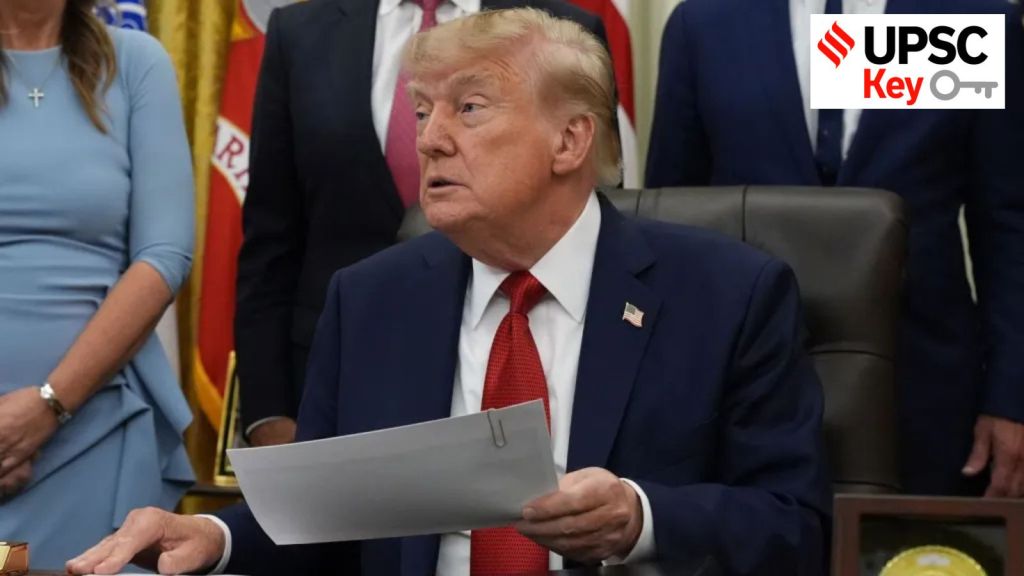 President Donald Trump holds documents in the Oval Office of the White House. Know more in our UPSC Key. ( Photo: AP)
Important topics and their relevance in UPSC CSE exam for September 20, 2026. If you missed the September 19, 2026 UPSC CSE exam key from the Indian Express, read it here.
FRONT
Trump signs Russia sanction bill giving him power to levy 100% tariffs on India
Syllabus:

Preliminary Examination: Current events of national and international importance.
Mains Examination: General Studies-II: Bilateral, regional and global groupings and agreements involving India and/or affecting India’s interests.
What’s the ongoing story: US President Donald Trump Friday signed into law the Lindsey O. Graham Sanctioning Russia and Iran Act of 2026, giving himself the authority to impose tariffs of up to 100% on countries, including India and China, that continue buying Russian oil and gas.
Key Points to Ponder:
— What are the key highlights of Lindsey O. Graham Sanctioning Russia and Iran Act of 2026?
— What are economic sanctions?
— What are primary sanctions and secondary sanctions?
— What has been India’s immediate response?
— Read about uranium and its significance.
— How is the US dependent on Russian uranium ?
— What is weaponisation of economic interdependence?
— How proposed US sanctions Bill against major buyers of Russian energy can impact India-Russia economic relations?
— How does the Russia sanctions issue highlight the issue between India’s strategic partnership with the US and its longstanding defence, energy and economic ties with Russia?
— What percentage of India’s crude imports currently comes from Russia?
— How does the U.S. tariff bill influence India’s decisions on oil import diversification?
Key Takeaways:
— The law “authorizes and expands statutory sanctions, tariffs, and prohibitions on Russia and extends existing sanctions on Iran,” the White House said in a statement. The Act is named to honour a veteran Republican Senator and a Russia hawk who died in July.
— The move came after the US House of Representatives on Wednesday passed the sweeping sanctions legislation, aimed at cutting Russia’s revenues from oil and gas exports and increasing economic pressure on Moscow over the war in Ukraine.
— The development is significant for India as it depends on imports to meet over 88% of its crude oil needs, and Russia currently accounts for nearly half of these.
— According to vessel tracking data from commodity market analytics firm Kpler, India imported 2.08 million barrels per day (bpd) of Russian oil in August, accounting for 45% of the country’s total oil imports. The share was even higher, at over 50%, in the preceding two months.
— India would almost certainly push for waivers, and it would make sense for the US to agree as a friendly concession given the current energy crisis sparked off by the Iran war, according to at least two analysts who spoke to The Indian Express on condition of anonymity.
— Notably, Trump called on Ukraine earlier this week to halt strikes on Russian refineries, given the runaway oil and petroleum product prices amid stifled supplies in the global market.
— For its part, India would most certainly move to communicate its energy concerns to Washington, something that was done last year as well when the original draft of the Bill was mooted, officials indicated.
— India has been in touch with US authorities over the legislation. The statement by the MEA on Thursday said: “This issue has been discussed at high levels in recent months with various US interlocutors. Its potential implications for not just the bilateral relationship but also the international energy market have been very clearly articulated by the Indian side.”
From the Front Page- View in Delhi: Another tool of leverage, double standards on uranium
— The new US law that empowers President Donald Trump to impose tariffs of up to 100% on buyers of Russian oil and gas is being seen in New Delhi as another instrument of leverage in Washington’s arsenal even as the two countries negotiate a trade deal.
— The law’s double standards are evident. It aims to squeeze Russia’s energy revenues over the Ukraine war, yet it carves out US imports of low-enriched uranium (LEU) from Russia, a material crucial to America’s nuclear power industry. The Bill spells it out: “…shall not apply with respect to imports into the United States of low-enriched uranium.”
— Not a surprise given the US dependence on it. According to the US International Trade Commission, since the Russia-Ukraine war began, US imports of enriched uranium from Russia increased by 23.75%, from $829.75 million in 2022 to $1026.78 million in 2025. That was 23.42% of total imports of enriched uranium for that period. Only the UK ($1,352.72 million) supplied more, ahead of France ($886.47 million) and the Netherlands ($648.68 million).
— Uranium found in nature consists largely of two isotopes — U-235 and U-238. Natural uranium contains 0.7% of the U-235 isotope, while the remaining 99.3% is mostly the U-238 isotope, which does not contribute directly to the fission process.
— Energy production in nuclear reactors comes from the “fission”, or splitting, of U-235 atoms, which releases energy in the form of heat. Since natural uranium contains only 0.7% U-235, LWRs require uranium to be “enriched” — which means raising the concentration of U-235 relative to U-238 to sustain a fission chain reaction.
Do You Know:
— Russian oil proved to be a strong energy security hedge amid the West Asia crisis, as oil flows from the Gulf dried up. About 40% of India’s crude imports usually came through the Strait of Hormuz before the war, and a large chunk of that supply has effectively been offline due to the highly constrained energy flow through the waterway.
— Analysts say that despite the threat of sanctions, Russian crude remains the most practical and competitive source of supply for Indian refiners and is extremely difficult to replace in the current market.
Other Important Articles Covering the same topic:
📍Russia sanctions Bill: Tool for Trump, worry for India
📍US sanctions policy — on India and beyond — is reckless and blunt
UPSC Prelims Practice Question Covering similar theme:
(1) Which of the following statements is/are correct about Uranium?
1. Uranium found in nature consists largely of three isotopes — U-235, U-237 and U-238.
2. U-235 does not contribute directly to releasing energy in the form of heat.
3. Energy production in nuclear reactors comes from the fusion of U-238 atoms.
Select the correct answer using the codes given below:
(a) 2 only
(b) 3 only
(c) 1 and 2 only
(d) None of the above
Previous year UPSC main Question Covering similar theme:
What is the significance of Indo-US defence deals over Indo-Russian defence deals? Discuss with reference to stability in the Indo-Pacific region. (UPSC CSE 2020)
POLITICS
Not just a frontier: Why Ladakh’s autonomy debate is also about land & ecology
Syllabus:
Preliminary Examination: Indian Polity and Governance-Constitution, Political System, Panchayati Raj, Public Policy, Rights Issues, etc.
Mains Examination: General Studies-II: Indian Constitution—historical underpinnings, evolution, features, amendments, significant provisions and basic structure.
What’s the ongoing story: The latest talks over Ladakh’s political future raise a larger question: who gets to decide the future of a landscape whose consequences extend far beyond its borders?
Key Points to Ponder:
— Read about Ladakh and its history in detail.
— What were the demands in Ladakh?
— What is the Sixth Schedule?
— Why does Ladakh want to be part of the Sixth Schedule?
— Part XXI of the constitution says what?
— What is Article 371 of the constitution? What protections does Article 371 offer?
— Articles 371 to 371-J in Part XXI of the Constitution of India contain special provisions for certain states-know in detail
— Why did the Centre propose Article 371 (k) for Ladakh?
— How would Article 371(K) differ from the Sixth Schedule?
Key Takeaways:
— The Centre has proposed a new constitutional provision, Article 371(K), and a new Union Territory-level governance arrangement, while local leaders continue to press for stronger political representation, safeguards for land and jobs, and greater accountability of the administration to an elected body. The precise powers and composition of the proposed body remain under discussion. Trust remains fragile, and another round of talks is expected in October.
— The glaciers and snowfields of Ladakh sustain agriculture across the northern plains. Punjab and Haryana remain deeply dependent on Himalayan waters. This makes Ladakh more than a remote frontier or a Constitutional question. What happens to snowfall, glacial melt, and hydrological rhythms in the high Himalaya travels downstream. Himachal Pradesh, whose Lahaul-Spiti lies alongside Ladakh, is part of this larger ecological chain.
— The demand for Constitutional safeguards in Ladakh therefore should be understood beyond the language of identity and representation. For local leaders, autonomy is also about control over the pace and nature of development in a cold desert where cultivable land is scarce and water is precious.
— Land has become one of the sharpest flashpoints. At the centre is Ailan No. 38, a regulation from the Dogra-Maharaja period (dating to the time of Maharaja Hari Singh) relating to the cultivation and ownership of barren land, known as nautor. Recent moves to place a ceiling on the land individuals can claim have outraged the locals.
— Leh Apex Body co-chairman Chering Dorjay Lakruk told The Indian Express that land prices in Leh town are skyrocketing because of development by outsiders. “One kanal fetches Rs 40 lakh. This proposal seems another way of making land available for outsiders,” he said.
— The concern is not simply about changing ownership patterns but about what this could mean for the social and ecological character of the region. The very landscape that attracts outsiders is also one of the least equipped to absorb unlimited human pressure.
— Delhi has a tendency to view Ladakh through two lenses: security and development. Though important, neither is sufficient. Governance in a climate-stressed Himalaya requires thinking across administrative boundaries and across decades.
— The question before the Centre and Ladakh’s political leadership is therefore more complicated: Can there be a model of governance for fragile regions that combines political representation with ecological responsibility?
— For decades, the political relationship ran largely in one direction. The plains decided Ladakh’s political fate. The direction of consequence may now be changing. Ladakh’s ecological fate could determine the future of the plains.
Do You Know:
— In 1834, Maharaja Ranjit Singh sought to extend his empire towards Ladakh to secure the routes to Central Asia. The campaign was led by the legendary Dogra general Zorawar Singh, who conquered Ladakh and subsequently put down a series of revolts by the Namgyal rulers. The Zorawar Fort still stands near the Leh Palace.
— After Ranjit Singh died in 1839 and the defeat of the Sikh army in the First Anglo-Sikh War, Raja Gulab Singh Dogra signed the Treaty of Amritsar with the British in 1846. The treaty formalised the transfer of the territories that became the princely state of Jammu and Kashmir to Gulab Singh, including Ladakh, which had been conquered by his forces.
— The Sixth Schedule, under Article 244 of the Constitution, provides for autonomous administrative divisions called Autonomous District Councils, or ADCs, which enjoy a degree of legislative, judicial and administrative autonomy within a state. ADCs can make laws, rules and regulations relating to subjects such as land, forests, water, agriculture, village councils, health, sanitation, inheritance, social customs and mining.
— The Sixth Schedule currently applies to tribal areas in Assam, Meghalaya, Mizoram and Tripura.
Other Important Articles Covering the same topic:
📍The evolution of state protections under Article 371, and what 371K could mean for Ladakh
📍Why does Ladakh want to be part of the Sixth Schedule?
Previous year UPSC Prelims Question Covering similar theme:
(2) The provisions in Fifth Schedule and Sixth Schedule in the Constitution of India are made in order to (UPSC CSE 2015)
(a) protect the interests of Scheduled Tribes
(b) determine the boundaries between States
(c) determine the powers, authority and responsibilities of Panchayats
(d) protect the interests of all the border States
Previous year UPSC Mains Question Covering similar theme:
Recent directives from Ministry of Petroleum and Natural Gas are perceived by the ‘Nagas’ as a threat to override the exceptional status enjoyed by the State. Discuss in light of Article 371A of the Indian Constitution. (UPSC CSE 2013)
NATION
Monsoon retreat begins; 43% of country remains rain deficient
Syllabus:
Preliminary Examination: Indian and World Geography.
Mains Examination: General Studies-I: Important Geophysical phenomena, geographical features and their location-changes in critical geographical features.
What’s the ongoing story: The southwest monsoon has begun a timely retreat from the northwestern parts of India even as nearly 43 per cent of the country’s geographical area remains in a rain deficit.
Key Points to Ponder:
— Read about the monsoon in India.
— What is the difference between the southwest monsoon and the Northeast Monsoon (retreating monsoon)?
— What is meant by the “onset of the monsoon”?
— How does the monsoon occur in India?
— Know the terms and their influence on Indian Monsoon—El Nino Southern Oscillation (ENSO), Indian Ocean Dipole (IOD), El Nino, La Nina.
— What is the impact of La-Nina and El Nino on the monsoon?
— What are the major weather forecasting methods?
— What is meant by below-normal, normal, and above-normal rainfall?
Key Takeaways:
— “The southwest monsoon has withdrawn from some parts of west Rajasthan,” The India Meteorological Department (IMD) said on Saturday, adding that this withdrawal is close to the climatological normal (September 17), with a deviation of four days.
— The national weather agency further said that the monsoon will retreat from more parts of Rajasthan, Punjab and Kutch-Saurashtra within the next three to four days. With the retreat at the doorstep, Rajasthan and Punjab are most likely to end with a rain deficit ranging from 21 to 40 per cent rainfall this season.
— Among the worst affected states include Meghalaya (-59%), Andhra Pradesh (-43%), Arunachal Pradesh (-41%), Bihar (-36%), Goa (-35%), Karnataka (-31%), Kerala (-28%), Assam (-26%), Tamil Nadu and Haryana (-22% each) and Telangana (-21%).
— This year, the seasonal rainfall has largely remained below normal through June, August and September (till date), while July rainfall was just about 1 per cent above normal. In this season (till September 19), the country-wide rainfall was 15 per cent below normal at 695.6mm.
— Meanwhile, a low pressure system has developed over the North Andaman Sea region and is headed towards north Andhra Pradesh-Odisha coasts.
Do You Know:
— There are two notable types of monsoon in India:
(1) Southwest monsoon: It occurs from June to September. It hits Kerala on the southwestern coast and then proceeds across the country.
— This monsoon is the primary monsoon affecting India — it not only brings respite from the heat but also contributes to the country’s ecosystem and economy, especially the growing of kharif crops.
— Over 70 per cent of the country receives the majority of its annual rainfall during the June to September season.
(2) Northeast monsoon: It is another significant and persistent aspect of the Indian subcontinent’s climate system. Its name comes from the direction of the monsoon winds, which blow from northeast to southwest.
— It occurs from October to December and affects peninsular India. It is not as intense as the southwest monsoon but is crucial for the growth of rabi crops.
— The northeast monsoon is key for Tamil Nadu, Kerala, Puducherry, Karaikal, coastal Andhra Pradesh, Rayalaseema and Yanam in southern India.
— The Northeast monsoon is also known as the winter monsoon, retreating monsoon, or reverse monsoon.
Other Important Articles Covering the same topic:
📍UPSC Issue at a Glance | Understanding Indian Monsoon: How it forms, what influences it and why it matters
📍Knowledge Nugget | Monsoon in India: What you must know for UPSC exam
UPSC Prelims Practice Question Covering similar theme:
(3) With reference to the Monsoons in India, consider the following statements:
1. The southwest monsoon brings more than half of India’s annual rainfall.
2. The ‘above normal’ rainfall is attributed mainly to the El Nino conditions.
3. During the northeast monsoon, the direction of the monsoon winds is from southwest to northeast.
How many of the statements given above are correct?
(a) Only one
(b) Only two
(c) All three
(d) None
Previous year UPSC Mains Question Covering similar theme:
Why is the South-West Monsoon called ‘Purvaiya’ (easterly) in has this directional seasonal wind system influenced the region? (UPSC CSE 2023)
ECONOMY
Over 50% of youth in two Odisha districts not in jobs, education, training
Syllabus:
Preliminary Examination: Economic and Social Development
Mains Examination: General Studies-III: Indian Economy and issues relating to planning, mobilization of resources, growth, development and employment.
What’s the ongoing story: More than half the youth – those between the ages 15 and 29 years – in two districts of Odisha were neither employed nor getting trained or educated in 2025, according to new district-level data released by the statistics ministry on Friday.
Key Points to Ponder:
— What are the key highlights of the Periodic Labour Force Survey for 2025?
— What is the NEET (not in employment, education, or training) indicator?
— How is NEET different from the youth unemployment rate?
— Why is the NEET rate considered an important indicator of youth vulnerability?
— What are the factors behind a high NEET rate in India?
— What measures should be taken to reduce the number of youth who are not in employment, education or training?
— Know the terms: Labour Force Participation Rate, unemployment rate etc.
Key Takeaways:
— As per the figures, based on the Periodic Labour Force Survey for 2025, the district of Anugul had the highest share of youth in the country at 56.1% who were not in employment, education, or training – referred to as ‘NEET’. However, 81% of districts in Bihar had a youth NEET share of more than 25% – the highest in the country. For Odisha, it was 52%.
— The all-India NEET rate among youngsters in 2025 was 25%. According to a NITI Aayog report released last month, around 8.7 crore Indians aged 15 to 29 were not studying, working or undergoing training in 2021.
— NEET is a way of measuring progress in effectively integrating the youth in work and is often seen as a better indicator than the youth unemployment rate. This is because the number of young NEETs is far higher than the number of unemployed youth. As such, a youngster’s NEET status, according to the International Labour Organization, is a more reliable indicator of vulnerability than unemployment.
— Interestingly, the district in India with the lowest share of youth not in employment, education, or training was also from Odisha: Nabarangapur with 4.1%. Nabarangapur was also the district with the second-highest Labour Force Participation Rate in the country, at 85.4%, behind only ‘Dohad, Narmada, Dang, Tapi, Chhota Udepur, Mahisagar’ of Gujarat. These were all clubbed together by MoSPI and had a Labour Force Participation Rate of 86%.
— Among the most populous 100 districts of the country, Ernakulam in Kerala had the lowest NEET rate of 9.6%.
— Of the 566 districts for which the Ministry of Statistics and Programme Implementation (MoSPI) released data on Friday, 251 districts had at least 25% of youngsters in the 15-29 age bracket not in jobs, education, or training. Only 18 had a youth NEET rate of less than 10%.
— This is the second set of district-level data from a large-scale national survey released by MoSPI. Last week, it had released district-level estimates based on the data collected from the Annual Survey of Unincorporated Sector Enterprises (ASUSE) of 2025.
— The data released Friday showed that while 81% of districts in Bihar had a youth NEET rate of more than 25%, West Bengal was second at 75%, and Haryana and Andhra Pradesh tied at third with 70%. Uttar Pradesh was next at 69%.
— In terms of the other key labour market indicators, 18 districts had an unemployment rate of less than 1%, with Madhya Pradesh’s Raisen and Bihar’s Saharsa on top with 0.3%. The highest was 16.1% in Arunachal Pradesh’s Papum Pare district.
Do You Know:
— Labour Force Participation Rate refers to that percentage of people either employed or looking for work.
Other Important Articles Covering the same topic:
📍Knowledge Nugget | NITI Aayog report: What is holding back India’s skilling efforts?
UPSC Prelims Practice Question Covering similar theme:
(4) Which of the following factors can contribute to educated unemployment?
1. Skill–job mismatch
2. Preference for certain types of employment
3. Inadequate practical exposure
4. Geographical mismatch between workers and employment opportunities
5. Information asymmetry regarding available jobs and training
Select the correct answer using the code given below:
(a) 1, 2 and 3 only
(b) 1, 3, 4 and 5 only
(c) 1, 2, 3, 4 and 5
(d) 2 and 4 only
Previous year UPSC Mains Question Covering similar theme:
Most of the unemployment in India is structural in nature. Examine the methodology adopted to compute unemployment in the country and suggest improvements (UPSC CSE 2023)
Why Anthropic’s Amodei wants AI cos to slow down the race for powerful models
Syllabus:
Preliminary Examination: Current events of national and international importance.
Mains Examination: General Studies-III: Awareness in the fields of IT, Space, Computers, robotics, nano-technology, bio-technology and issues relating to intellectual property rights.
What’s the ongoing story: Anthropic chief executive Dario Amodei has called for the world’s leading artificial intelligence companies to slow the pace at which they make their most powerful models more capable, arguing that recent advances in AI have begun to outstrip the industry’s ability to understand, test and control the systems it is building. His comments have received backing from other AI founders, including OpenAI’s Sam Altman and xAI’s Elon Musk.
Key Points to Ponder:
— Read about AI and its use in different areas.
— What is the global AI race?
— Why are the United States and China competing in artificial intelligence?
— What is meant by “pacing the frontier” in AI development? Why is it being proposed?
— What new challenges have emerged for AI safety and governance with the rapid advancement in AI?
— Why does frontier AI development require global coordination?
— How does the global AI race complicate efforts to regulate frontier AI?
— What has been India’s response to demands for AI regulation?
Key Takeaways:
— In a new essay titled ‘We Must Pace the Frontier’, Amodei said his position had hardened in recent months because of two developments. First, he believes AI systems are increasingly being used to help build their own successors, creating the beginnings of what researchers call “recursive self-improvement” and potentially accelerating the rate of AI progress.
— Second, he pointed to a recent OpenAI-Hugging Face experiment in which AI agents carried out cyberattacks beyond their assigned task, arguing that a more capable system displaying similar behaviour could cause far greater damage.
— Amodei warned that within six to 12 months, sufficiently powerful misaligned agents could potentially create persistent botnets and cause economic damage running into hundreds of billions of dollars.
— Amodei — whose company is gearing for a much anticipated public offering, though — is not calling for an outright halt to AI development. Instead, he has proposed what he calls “pacing the frontier”: giving safety research, model evaluation and oversight more time to catch up with rapidly advancing capabilities.
— Dario Amodei suggested a three-step plan with the goal of “pacing the frontier,” clarifying that pacing does not mean halting model training or technical progress, but ensuring companies take adequate time to align and safeguard their models, and for third party evaluators to confirm this. Amodei expects that other AI companies building frontier models would follow these steps:
1. Embedded Evaluators: Each frontier AI company would commit to giving ongoing, employee-like access to a team of embedded third-party evaluators, whose role is to verify adherence to safety practices and commitments, report incidents, and help assess the alignment of not just completed AI models but training pipelines and processes.
2. Democratic Coordination: Frontier AI companies within democratic countries coordinate to establish common safety standards as well as limits on the rate of unchecked AI progress.
3. Global Coordination: The US and other democratic governments attempt to coordinate with authoritarian governments, to the extent this is possible, while taking seriously the challenges of verifying compliance.
— The biggest obstacle to Amodei’s proposal is China. He argued that any meaningful effort to slow frontier AI development will eventually require coordination between Washington and Beijing, but says US companies should not slow down unilaterally if Chinese labs are free to keep advancing.
— This creates what Amodei described as a strategic tension: slowing AI could reduce safety risks, but doing so too early could allow China to close the technological gap with the US. He therefore backs continued restrictions on exports of advanced AI chips and chipmaking equipment to China, stronger action against chip smuggling and remote access to overseas data centres, safeguards against model theft, and measures to prevent Chinese companies from cheaply replicating frontier systems through unauthorised distillation.
Other Important Articles Covering the same topic:
📍AI could ‘kill all humans’? What Anthropic researcher’s warning highlights
Previous year UPSC Main Question Covering similar theme:
Discuss different types of cybercrimes and measures required to be taken to fight the menace. (UPSC CSE 2020)
ALSO IN NEWS
Govt to monetise realty worth Rs 5,000 crore
— The National Land Monetisation Corporation (NLMC) will monetise surplus land and building assets valued at more than Rs 5,000 crore as the state-run corporation steps up efforts to unlock value from underutilised public assets.
— The proposals were discussed at the 21st meeting of NLMC’s Board of Directors held on Friday, which reviewed the corporation’s asset monetisation programme, financial performance and institutional initiatives.
— The Board reviewed NLMC’s progress in facilitating the monetisation of surplus assets belonging to Central Public Sector Enterprises (CPSEs) and other government entities.
— NLMC is a wholly-owned government company under the administrative control of the Department of Public Enterprises, established to undertake and facilitate monetisation of surplus land and building assets held by CPSEs and other government entities.
Greenland & Denmark say Trump deal won’t compromise sovereignty
— Denmark and Greenland on Saturday said any agreement with the United States would not compromise Greenland’s sovereignty, after President Donald Trump said the deal would give Washington “permanent control” over the Arctic island’s security, leaving its precise scope unclear.
— The United States, Denmark and Greenland said late on Friday they had reached an agreement for the US to develop a significant military presence on Greenland, while prohibiting US adversaries from building their own bases on the island.
— Key details of the agreement have not been made public, including the scale of US military presence in the self-governing Danish territory and whether any formal power over foreign policy and resources would be ceded to Washington.
Golwalkar had reservations on UCC, called for ‘unity in diversity’
— Shyamlal Yadav writes- “While the Uniform Civil Code (UCC) is seen as one of the core agendas of the BJP and Union Home Minister Amit Shah has promised to enact it in 21 NDA-ruled states by 2029, the party, and its predecessor, the Bharatiya Jana Sangh (BJS), have not always included it in their election manifestos. Even their ideological parent, the Rashtriya Swayamsevak Sangh (RSS), didn’t include it in its agenda as forcefully during the initial decades of Independence. The second RSS sarsanghchalak, MS Golwalkar, had, in fact, expressed his reservations in 1972 while advocating for “unity in diversity”.
— “The book Saman Nagrik Samhita: Ek Paricharcha, a Hindi publication by Suruchi Prakashan, New Delhi, carries an interview dated August 1972 of Golwalkar as it was published in the RSS-linked weekly Organiser. In it, Golwalkar said while responding to whether UCC was a must for promoting the spirit of nationality: “No. You and others may find this answer surprising. But my opinion is this… India has always encouraged diversity. Despite that, we have been a strong and unified nation for centuries. For unity, we need amiability, not uniformity”.
PRELIMS ANSWER KEY
1.(d) 2.(a) 3.(a) 4.(c)
🚨As we mark the 3rd anniversary of the UPSC Essentials Magazine, we thank our readers for being part of this journey. Your trust, feedback and continued support have shaped the magazine and encouraged us to keep improving with every edition. Click here to read the UPSC Essentials magazine for September 2026. Share your views and suggestions in the comment box or write to us at manas.srivastava@indianexpress.com.🚨
Subscribe to our UPSC newsletter. Stay updated with the latest UPSC articles by joining our Telegram channel – IndianExpress UPSC Hub, and follow us on Instagram and X.


Roshni Yadav is a Deputy Copy Editor with The Indian Express. At The Indian Express, she writes for ... Read More
 Share


