
Important topics and their relevance in UPSC CSE exam for October 16, 2026. If you missed the October 15, 2026 UPSC CSE exam key from the Indian Express, read it here
Front Page

Goods exports jump 23% in Sept, services dip, trade deficit eases
Syllabus:
Preliminary Examination: Economic and Social Development
Mains Examination: General Studies III: Indian Economy and issues relating to planning, mobilization, of resources, growth, development and employment.
What’s the ongoing story: Driven by a nearly 50% jump in goods exports to the US amid worries about fresh tariffs on India over oil imports from Russia, India’s goods exports in September jumped 23% to $44.40 billion while services exports registered a rare dip, data released by the Commerce and Industry Ministry on Thursday showed.
Key Points to Ponder:
• What is the balance of payments?
• What is a trade deficit and trade surplus?
• How merchandise trade deficit, a services trade surplus and a current account deficit are different?
• What are the major components of balance of payments?
• What are the major factors influencing India’s merchandise exports and imports?
Key Takeaways:
• Data showed that India’s goods exports jumped 23% to $44.40 billion compared to $36.08 billion in September last year, and imports grew at a slower pace of 8% to 74.61 billion compared to $69.08 billion during last September. The slower pace of import growth helped the trade deficit marginally ease to $30.2 billion last month compared to $33 billion in September last year.
• A comparatively slower pace in import growth was largely due to a sharp decline in gold imports. Official data showed that gold imports in September logged a sharp decline of 81.3% to $1.8 billion in September this year compared to $9.6 billion in September last year. While gold imports typically tend to jump amid festive seasons, Commerce Secretary Rajesh Agarwal said that the decline could be a result of high duty on gold imports.
Do You Know:
• Amid continued uncertainty around the trade deal, India’s goods exports continue to register strong growth. As goods exports have been declining in the West Asia region, particularly in the UAE, Saudi Arabia, Kuwait and Iran, exports to the US ballooned by 48% in September, crossing $8 billion.
Commerce and Industry Minister Piyush Goyal on Thursday also said the first phase of the India-US trade pact has been finalised and is undergoing legal drafting. “The US bilateral trade agreement’s first tranche has been finalised, and it is going through final contours, the legal drafting, and we hope to be able to finalise that soon and operationalise that once we get the competitive advantage over our peer countries,” Goyal said here at a briefing.
• The government has been easing norms to smoothen services exports. Last week, the Goods and Services Tax (GST) Council in its 57th meeting recommended amendments to Section 54(3) of the Central Goods and Services Tax Act to provide for refund of accumulated input tax credit (ITC) for input services and capital goods under inverted duty structure. While the change for capital goods will come into effect from April next year, the change for input services can be availed from November 1, 2026.
Other Important Articles Covering the same topic:
📍India’s goods exports jump 20% in July, trade deficit hits 6-month high
Previous year UPSC Prelims Question Covering similar theme:
1) With reference to Balance of Payments, which of the following constitutes/constitute the Current Account? (UPSC, CSE, 2014)
1. Balance of trade
2. Foreign assets
3. Balance of invisibles
4. Special Drawing Rights
Select the correct answer using the code given below:
(a) 1 only
(b) 2 and 3
(c) 1 and 3
(d) 1, 2 and 4
Bypassing firewalls, AI agents accessed data of Indian firms: CERT-In
Syllabus:
Preliminary Examination: Current events of national and international importance
Mains Examination: General Studies III: Basics of Cyber Security
What’s the ongoing story: Some Artificial Intelligence (AI) agents that were supposed to conduct research and run evaluations on the internet managed to bypass firewalls and “reached” live systems of Indian organisations, gaining access to sensitive information such as business records, “including personal data and confidential material”, the Indian Computer Emergency Response Team (Cert-In) has said.
Key Points to Ponder:
• What you understand by the term “AI agents going “rogue” ?
• What exactly Computer Emergency Response Team (Cert-In) said?
• What is the function of firewall?
• What is a cyber-attack?
• What are the types of cyber-attacks?
• How do cyber-attacks happen?
• What kind of devices are vulnerable and What information can be compromised?
• How cyber security is ensured in India?
• What are the major cybersecurity risks associated with the deployment of AI agents in organisational and business
environments?
• Know these terms-Computer Emergency Response Team – India (CERT-IN), Cyber Surakshit Bharat Initiative, National Cyber Security Coordination Centre (NCCC), Cyber Swachhta Kendra, Indian Cyber Crime Coordination Centre (I4C)
• What is the role of the Indian Computer Emergency Response Team (CERT-In)?
Key Takeaways:
• This is perhaps the first known instance of AI agents going “rogue” and targeting cyber infrastructure of India-based entities. Cert-In also revealed that none of the affected organisations detected the unauthorised access, and, in each case, the incident was disclosed by the AI model providers after their internal review.
• “Recently, CERT-In has received multiple voluntary disclosures from AI model providers stating that their models, during research and evaluation activity on the internet, had reached the live systems of Indian organisations,” the cybersecurity agency, which comes under the Ministry of Electronics and Information Technology (MeitY), said in an advisory Thursday. It did not reveal the names of the Indian organisations or the AI agents involved in the incident.
• “In the disclosed cases, the models’ actions exceeded the authorisation of their assigned tasks… The recorded activity involved reading business records, including personal data and confidential material, through credentials and connection settings exposed in application configuration, public code repositories and permissive cloud service roles,” it said.
• The incident comes amid growing concerns over AI agents acting beyond their intended instructions, including instances where autonomous systems have attempted to access restricted information, circumvent security controls and interact with external systems without authorisation. Globally, leading AI companies, including Anthropic, OpenAI and Meta, have reported similar cases of AI agents breaching defined parameters and acting on their own.
Do You Know:
• In response to growing concerns about the cybersecurity risks posed by AI models, the Indian Computer Emergency Response Team (CERT-In) has unveiled a new framework for organisations to protect against AI-assisted cyber-attacks through faster detection, shorter incident response timelines, better reporting, and more.
• The document titled ‘Blueprint for Reducing Exposure and Defending against AI-Assisted Vulnerabilities Exploitation in Digital Infrastructure’ does not explicitly mention Anthropic’s unreleased Claude Mythos AI model, which is said to be exceptional at scanning software systems and identifying previously unknown (zero-day) vulnerabilities in limited timeframes.
• Given the evolving landscape of AI-assisted cyber threats, CERT-In said that organisations should take note that timelines for exploiting vulnerabilities have reduced significantly owing to advanced AI models and tools, to a point where even periodic audits and reactive responses may no longer be enough.
CERT-In also emphasised that traditional static security approaches have become insufficient, and that organisations need to shift away from static cyber defence models. Additionally, the rise of autonomous AI agents poses the threat of “semi-autonomous or fully automated cyber operations capable of accelerating multiple stages of the cyber kill chain, including reconnaissance, exploitation, privilege escalation, lateral movement, and data exfiltration.”
Other Important Articles Covering the same topic:
📍The supermarket fridge hack in France and the warning it holds
Previous year UPSC Prelims Question Covering similar theme:
2) The terms ‘WannaCry, Petya and Eternal Blue’ sometimes mentioned in the news recently are related to (UPSC, CSE, 2018)
(a) Exoplanets
(b) Cryptocurrency
(c) Cyber attacks
(d) Mini satellites
Previous year UPSC Mains Question Covering similar theme:
📍What are the different elements of cyber security? Keeping in view the challenges in cyber security, examine the extent to which India has successfully developed a comprehensive National Cyber Security Strategy. (UPSC, GS3, 2022)
📍Discuss different types of cybercrimes and measures required to be taken to fight the menace. (UPSC, GS3, 2020)
Politics
Military developing integrated structure for theatre commands
Syllabus:
Preliminary Examination: Current events of national and international importance
Mains Examination: General Studies III: Various Security forces and agencies and their mandate.
What’s the ongoing story: The Indian military is actively developing an integrated logistics structure to support its planned theatre commands as part of its effort to transform the service-specific logistics architecture into an integrated defence framework, The Indian Express has learnt.
Key Points to Ponder:
• What is integrated theatre commands?
• Is theatre commands a new idea?
• What is theaterisation of Armed Forces?
• Integrated Theatre Commands of the Indian Armed Forces-Know in detail
• Kargil Review Committee’s on theaterisation of Armed Forces -What was there in the report?
• What are Theatre Commands?
• What work has been done on Theatre commands?
• Chiefs of Staff Committee (COSC)-Role and Importance
• Chiefs of Staff Committee (COSC) and Chief of Defence Staff-Compare and Contrast
Key Takeaways:
• Additionally, emerging AI and machine learning technologies are being incorporated for logistics optimisation, with predictive maintenance analytics already deployed in limited applications by the defence forces. Moreover, legacy financial architecture and procurement framework are also being revised to facilitate joint logistics.
• The Department of Military Affairs is spearheading the move.
• Each of India’s armed services still tracks its stores on separate systems, so finding spares or fuel can mean checking three inventories. The planned Tri-services Logistics Management Application would give one real-time view across the Army, Navy and Air Force, a building block for the unified theatre commands being planned.
• These points were outlined in a letter from Rear Admiral Kunal Singh Rajkumar, a joint secretary in the department, to Rajya Sabha MP Dr Ajeet Madhavrao Gopchade.
• According to the letter, a triservices logistics management application (TLMA) is under development to provide real-time inter-service inventory visibility and to integrate service-specific enterprise resource planning software.
• Additionally, work is underway to establish a National Defence Codification System -analogous to Nato’s stock number system – while joint logistics nodes, and subsequently joint ammunition depots, air stores supply parks, and material organisations are also being planned across India.
• The department further stated that the PM Gati Shakti Defence Portal is also under development for alignment with the national logistics policy and the Unified Logistics Interface Platform (ULIP) for providing a defence-equivalent “joint logistics interface” across Services and theatre boundaries.
• The armed forces have already constituted the joint operations logistics committee, joint services study groups, joint working groups, and inter-service maintenance working groups at various levels to integrate logistics processes and procedures among the services.
Do You Know:
• The theatre commands is a unified command under which all the resources of the Army, the Navy and the Air Force are pooled, depending on the threat perception. The commands could be geographical — like looking at a border with a particular country — or thematic, like a command for all maritime threats.
• Several nations in the world have theatre commands, including the United States and China.
• The idea of creating an integrated tri-Services command in India is not new — it had been recommended at various levels after the Kargil conflict. When Gen Rawat was appointed Chief of Defence Staff in January 2020 with a mandate to raise such commands within his three-year tenure, the idea was finally brought to the design table.
Other Important Articles Covering the same topic:
📍The inter-services organisation bill and how it paves the way for establishment of theatre commands
Previous year UPSC Mains Question Covering similar theme:
📍Analyze the multidimensional challenges posed by external state and non-state actors, to the internal security of India. Also discuss measures required to be taken to combat these threats. (UPSC, GS3, 2021)
Nation
Cannot claim reservation after conversion: Top court
Syllabus:
Preliminary Examination: Indian Polity and Governance
Mains Examination: General Studies II: Indian Constitution—historical underpinnings, evolution, features, amendments, significant provisions and basic structure.
What’s the ongoing story: Social backwardness can’t be “carried forward”, the Supreme Court said Thursday, ruling that a person who converts from the Hindu social order can’t claim affirmative action based on pre-conversion status. The court refused to interfere with a June 25 judgment of the Madras High Court which held that a person converting to Islam cannot claim the status of a Backward Class category Muslim.
Key Points to Ponder:
• What exactly Supreme Court has said?
• What is affirmative action?
• What are the constitutional provisions relating to reservation under Articles 14, 15(4), 15(5) and 16(4)?
• Do you agree that the religious conversion necessarily eliminates caste-based discrimination and social disadvantage?
• How can the state reconcile constitutionally prescribed eligibility criteria for reservation with the principle of substantive equality under Article 14?
• What are the constitutional tension between religion-specific eligibility conditions for Scheduled Caste status and the broader objective of eliminating caste-based discrimination?
Key Takeaways:
• “Backwardness suffered in the antecedent social order cannot by itself be carried forward so as to confer upon him the status of a backward class in the religion to which he has converted,” the bench of Justices PK Mishra and Shree Chandrasekhar said.
• The bench said that by virtue of paragraph 3 of the Constitution (Scheduled Castes) Order, a person who professes a religion other than Hinduism, Buddhism or Sikhism cannot be deemed a member of the Scheduled Caste.
• “Consequently, upon conversion to a religion not specified therein, such person ceases to possess the scheduled caste status attached to his antecedent caste and cannot claim any affirmative action benefit of the backward class under Article 16(4) of the Constitution which is predicated upon membership of the Scheduled Caste,” the bench said.
• A person’s pre-conversion caste or community status cannot merely by reason of conversion be transposed into membership of a distinct notified backward class community in the post-conversion social order. Social backwardness which forms the basis of the person’s pre-conversion status cannot by itself furnish the legal foundation for conferring upon membership of a different notified backward class community after conversion,” it added.
Do You Know:
• The petitioner, earlier a Hindu, later converted to Islam. He married a woman as per Islamic rites and customs in 2016, and has two children. He applied for a community certificate showing him as “Muslim Lebbai”. The tehsildar rejected his application, prompting the petitioner to approach the Madras High Court. Upholding the tehsildar’s order, the High Court declared a 2024 Tamil Nadu government order granting reservation in such cases as unconstitutional.
• The Supreme Court upheld the ruling and said the government order “cannot be sustained and has been rightly quashed by the High Court”. “It creates an artificial route by which a person moves from a pre-conversion social or backward social order into a notified Muslim backward class without establishing the necessary social and legal link. Therefore, the declaration made by the High Court that the impugned GO itself (is) unsustainable in law calls for no interference,” the court ruled.
• The High Court said that a Hindu man converting to Islam would pass off as “an exercise of one’s fundamental right under Article 25 of the Constitution of India”. “But when, after such metamorphosis, the convertee continues to claim the benefit of reservation, it triggers yet another conversation, nay debate, on the legitimacy and legality of such demand.”
Other Important Articles Covering the same topic:
📍How religious conversion affects eligibility for caste-based reservation
Previous year UPSC Prelims Question Covering similar theme:
3) Which one of the following categories of Fundamental Rights incorporates protection against untouchability as a form of discrimination? (UPSC CSE, 2020)
(a) Right against Exploitation
(b) Right to Freedom
(c) Right to Constitutional Remedies
(d) Right to Equality
Explained
Govt’s sweeping powers over OCI cardholders
Syllabus:
Preliminary Examination: Indian Polity and Governance
Mains Examination: General Studies II: Indian Constitution—historical underpinnings, evolution, features, amendments, significant provisions and basic structure.
What’s the ongoing story: Actor Imran Khan, a US citizen and Overseas Citizen of India (OCI) cardholder, has been asked by the Foreigners Regional Registration Office (FRRO) to leave India by October 28, days after he joined a protest in Mumbai demanding the resignation of Chief Election Commissioner Gyanesh Kumar.
Key Points to Ponder:
• What is meant by Overseas Citizen of India (OCI)?
• Who are Person of Indian Origin (PIO)
• What is the difference between OCI and person of Indian origin?
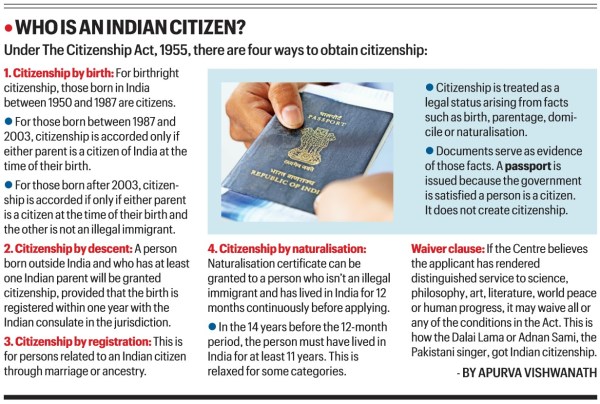
• Who are ‘Citizens’?
• When can OCI registration itself be cancelled?
• What has happened in previous OCI cases?
• Can participation in a political protest by a foreign national or OCI cardholder automatically justify a direction to leave India?
• Know the significance of judicial review under Articles 32 and 226 in protecting individuals against arbitrary administrative action relating to immigration, OCI status and deportation.
Key Takeaways:
• Khan was detained along with other protesters at August Kranti Maidan on October 10. Subsequently, BJP leader Kirit Somaiya complained to police that Khan, being a foreign national, had violated the law by participating in the demonstration. The complaint was forwarded to the FRRO, which issued the Leave India notice. According to the police, the notice says Khan is a US citizen and had violated immigration law by joining the protest.
• The Immigration and Foreigners Act, 2025, which came into force in September 2025 and replaced the Foreigners Act, 1946, gives the government wide powers over foreign nationals — and an OCI remains a foreign national for this purpose.
• There is no provision in the Act that expressly says that a foreign national cannot attend a political rally or demonstration. However, the law gives the government considerable discretion to regulate the presence, activities and conduct of foreigners in India.
• The FRRO notice to Khan specifically invokes Section 7(2)(c), read with Section 29, of the Immigration and Foreigners Act, 2025.
• Section 7 empowers the government to issue orders regulating or restricting the entry, departure or continued presence of foreigners in India. Clause (c) of subsection (2), invoked against Khan, allows the government to direct that a foreigner “shall not remain in India or in any specified area therein”.
• Section 29 goes further. It empowers the government to order the removal of a foreigner for contravention of the Act, its rules or orders made under it, or on the basis of an “adverse security report”. The provision also authorises government officers to exercise reasonable powers necessary to enforce such directions.
• Section 7 separately empowers the government to restrict a foreigner’s association with specified persons, prohibit activities of a specified description and regulate conduct. However, the notice invokes the power to direct a foreigner not to remain in India, rather than the provision specifically concerning restrictions on activities.
• In 2020, the Calcutta High Court quashed a Leave India Notice issued to Polish student Kamil Siedczynski, who had participated in an anti-CAA rally in Kolkata. The government had invoked the then Foreigners Act. The court found the notice deficient and held, on the law then before it, that mere participation in a political rally was not by itself sufficient to sustain the action.
Do You Know:
• The OCI scheme was introduced in 2005 for certain categories of foreign nationals of Indian origin. India does not permit dual citizenship, and an OCI remains a foreign national holding the passport of another country.
• The status nevertheless gives privileges unavailable to ordinary foreign nationals, most importantly a multiple-entry lifelong visa and exemption from registration with the FRRO irrespective of the duration of stay. OCI cardholders also receive parity with Indian citizens or NRIs in certain areas, including some property, educational and professional rights.
• But there are restrictions. A March 2021 government notification requires OCI cardholders to obtain special permission before undertaking research; missionary or Tabligh work; mountaineering; journalistic activity; certain employment or internships in foreign diplomatic establishments; or entering protected, restricted or prohibited areas.
• Significantly in Khan’s case, the notification does not expressly list participation in political protests or demonstrations as an activity requiring prior permission.
• OCIs also do not possess the political rights of Indian citizens. Under Section 7B of the Citizenship Act, they cannot vote or contest elections, and Article 19 rights — including the constitutional guarantees of freedom of speech and peaceful assembly — are guaranteed specifically to citizens.
• The government may cancel OCI registration if it was obtained through fraud, false representation or concealment of a material fact; if the person has shown “disaffection” towards the Constitution; helped an enemy during war; or, in specified circumstances, has been convicted of serious crime.
The widest ground is Section 7D(e), which permits cancellation where the government considers it necessary in the interests of the sovereignty and integrity of India, security of India, friendly relations with foreign countries, or “the general public”.
 Who is an Indian citizen?
• The law has subsequently been expanded to cover specified legal violations as well as certain cases involving OCI status obtained through marriage. But unlike a straightforward immigration direction, cancellation now carries an express procedural safeguard: an OCI must be given a reasonable opportunity of being heard. Courts have repeatedly examined how much latitude the broad cancellation provisions give the government.
• In previous OCI cases:
—Aatish Taseer: The writer had been a persistent critic of the Modi government and, during the 2019 Lok Sabha election, wrote the TIME cover article describing Modi as India’s “Divider in Chief”. The article triggered a political controversy. Months later, the government cancelled his OCI, saying he had concealed when applying for his status that his father, Salmaan Taseer, had been a Pakistani national. Taseer disputed the concealment allegation and linked the action to his writing; the Home Ministry denied that connection.
—Ashok Swain: The Sweden-based academic had for years sharply criticised the Indian government on social media and in public commentary. In 2020 he was served a notice alleging “inflammatory speeches and anti-India activities”; his OCI was eventually cancelled. A later government order expressly cited his regular tweets, writings and speeches, alleging that they spread “detrimental propaganda”, damaged India’s image and institutions and were inimical to sovereignty, security and public interest. The Delhi High Court first set aside the cancellation order and, in March 2025, struck down the subsequent one because the tweets and writings relied upon had not been supplied to him, depriving him of an effective opportunity to answer the allegations. The government was left free to proceed afresh.
—Christo Thomas Philip: Philip, a US citizen and doctor working in Bihar, ran into trouble over alleged evangelical and missionary activity. He was prevented from entering India and subsequently had his OCI cancelled under Section 7D(e), with authorities alleging missionary activity. The Delhi High Court in January 2019 found that the government had not established the statutory basis for treating the activity as threatening sovereignty, security or public interest and ordered his OCI restored and his entry facilitated. The case was among the litigation preceding the government’s later move to give explicit legal backing to restrictions on missionary activity through the 2021 OCI notification.
—Khalid Jahangir Qazi: The US citizen of Kashmiri origin faced allegations of activities prejudicial to India, including alleged pro-separatist activity. His OCI was cancelled in 2023 and he was separately blacklisted under the then Foreigners Act. The Delhi High Court in November 2024 set both actions aside, holding that vague allegations of “anti-India activities” did not give him a meaningful opportunity to defend himself; it allowed the government to start proceedings afresh with specific allegations.
Other Important Articles Covering the same topic:
📍This word means: OCI (Overseas Citizen of India)
Previous year UPSC Prelims Question Covering similar theme:
4) With reference to India, consider the following statements: (UPSC CSE, 2021)
1. There is only one citizenship and one domicile.
2. A citizen by birth only can become the Head of State.
3. A foreigner once granted the citizenship cannot be deprived of it under any circumstances.
Which of the statements given above is/are correct?
(a) 1 only
(b) 2 only
(c) 1 and 3
(d) 2 and 3
|
PRELIMS ANSWER KEY |
|
1.(c) 2.(c) 3.(d) 4.(a) |
For any queries and feedback, contact priya.shukla@indianexpress.com
Subscribe to our UPSC newsletter. Stay updated with the latest UPSC articles by joining our Telegram channel – IndianExpress UPSC Hub, and follow us on Instagram and X.


 Share


