
UPSC Key: Orangutans, Brain Circulation and My Feed-My Way Initiative
Why Loss and Damage Fund is relevant to the UPSC exam? What is the significance of topics such as Mercator map, potential G3 group and demographic divergence on both the preliminary and main exams? You can learn more by reading the Indian Express UPSC Key for September 9, 2026.
 UPSC Key August 2026: Here's what you should be reading from the September 9, 2026 edition of The Indian Express.
Important topics and their relevance in UPSC CSE exam for September 9, 2026. If you missed the September 8, 2026 UPSC CSE exam key from the Indian Express, read it here
THE WORLD

Australian social media users can choose to opt out of algorithms
Syllabus:
Preliminary Examination: Current events of national and international importance.
Mains Examination: General Studies II: Effect of policies and politics of developed and developing countries on India’s interests.
What’s the ongoing story: Australia on Tuesday proposed giving social media users the option to select the content they see on their feeds, marking the next step in the government’s push to improve online safety, following its world-first social media ban for children.
Key Points to Ponder:
• What exactly is Australia proposing?
• What is Australia’s proposed Digital Duty of Care framework?
• What is “My Feed, My Way” initiative?
• What is the concept of algorithm, nudging and manipulation in social media platforms
• How social media algorithms amplify addictions and extremism?
• Why Australian government want to regulate algorithms?
• How does the algorithmic recommendation systems have transformed social-media platforms from passive information intermediaries into active information gatekeepers?
• What are the major challenges associated with regulating algorithmic decision-making in India?
• What are the legal framework governing social media platforms in India?
• What are the issues and challenges in regulating social media platforms in India?
• How Australia’s proposed Digital Duty of Care framework will impact India?
Key Takeaways:
• Under draft laws proposed by the centre-left Labor government, social media platforms will be required to notify users and offer them a choice over their default feed.
• Users can choose to opt in to having their default feed include personalised content recommended by an algorithm. Alternatively, they can opt out of algorithmically recommended content and instead see posts only from the friends and creators they choose to follow.
• Australia follows in the footsteps of the European Union’s Digital Services Act, which has since 2024 required platforms to offer users the option of switching off profiling. However, the rollout had a bumpy start, with regulators complaining that platforms did not make it simple enough for users to opt out.
• Social media companies face growing scrutiny around the world over concerns that algorithms have been designed to encourage addictive behaviour, with users drawn into prolonged viewing through recommendations that push them toward similar content.
• Albanese said the “My Feed, My Way” initiative would also require digital platforms to document the measures taken to address identified risks of harm to Australian users and ensure those measures remain effective over time.
• Failure to comply could attract penalties of up to A$109.2 million ($79 million), with Australia’s internet regulator, eSafety, responsible for compliance and enforcement.
Do You Know:
• According to ORF, social media algorithms are computerised rules that examine user behaviour and rank content based on interactive metrics such as likes, comments, shares, and timelines. They also use machine learning models to make customised recommendations. This process also works as an amplifier because posts with higher engagement or shares quickly tend to gain popularity, and viral trends sometimes emerge in this process. Algorithms may also create echo chambers if they only show similar viewpoints repeatedly to keep users engaged.
• Hashtags are another vital factor. They serve as keywords to classify content, making it discoverable to a broader audience. When a hashtag is used, it assists the algorithm in recognising the topic of a post and linking it to users searching for or following that hashtag. Posts with trending or niche-specific hashtags are prioritised, with high engagement boosting their visibility further. Algorithms and hashtags amplify content by targeting specific audiences and promoting posts aligned with the user’s interests and behaviours
• Social media regulation in India is primarily governed by the Information Technology (IT) Act, 2000 and its evolving framework of secondary rules administered by the Ministry of Electronics and Information Technology (MeitY). The regulatory landscape has shifted significantly from providing a standard “safe harbour” (immunity from user-generated content) to enforcing strict, proactive platform accountability
Other Important Articles Covering the same topic:
📍Explained: How India is trying to regulate children’s social media use — and why gaps remain
Previous year UPSC Mains Question Covering similar theme:
📍Social media and encrypting messaging services pose a serious security challenge. What measures have been adopted at various levels to address the security implications of social media? Also suggest any other remedies to address the problem (UPSC, GS3, 2024)
📍Child cuddling is now being replaced by mobile phones. Discuss its impact on the socialization of children. (UPSC, GS1, 2023)
FRONT PAGE
2,843 km, 400-plus trains: Corridors cut time and cost, offer last-mile link
Syllabus:
Preliminary Examination: Economic and Social Development
Main Examination: General Studies III: Infrastructure: Energy, Ports, Roads, Airports, Railways etc.
What’s the ongoing story: Among the projects that Prime Minister Narendra Modi inaugurated in Vadodara on Tuesday were the last three sections of the Western Dedicated Freight Corridor (WDFC), together covering 326 kilometres and developed at a cost of over Rs 20,700 crore.
Key Points to Ponder:
• What do you understand by the Dedicated Freight Corridor?
• What is the Western Dedicated Freight Corridor (WDFC)?
• What is the current status of the Western Dedicated Freight Corridor (WDFC)?
• What is the Eastern Dedicated Freight Corridor (EDFC)?
• Map Work-routes of Western Dedicated Freight Corridor and Eastern Dedicated Freight Corridor.
• How does the PM Gati Shakti and the National Logistics Policy complement infrastructure projects such as Dedicated Freight Corridors is improving India’s logistics efficiency?
• How Dedicated Freight Corridors is a gamechanger in India’s logistics costs and manufacturing competitiveness?
• How transport corridors influence the spatial distribution of industries and urbanisation?
Key Takeaways:
• These three sections between Gujarat and Maharashtra — New Sanand (N)-New Makarpura, New Umbergaon-New Saphale, New Saphale-New Jawaharlal Nehru Port Trust (JNPT) — mark the completion of the 1,506-km WDFC, which runs from JNPT in Navi Mumbai to Dadri (Uttar Pradesh) near Delhi.
• Traffic on the western corridor mainly comprises ISO containers from JNPT and Mumbai Port in Maharashtra, and Pipavav, Mundra and Kandla ports in Gujarat, headed for Inland Container Depots (ICDs) located in north India, mostly at Tughlakabad (Delhi), Dadri (UP), Dhandari Kalan (Punjab) and Khatuwas (Rajasthan). The corridor is also expected to see the transport of fertilisers, foodgrain, salt, coal, iron, steel and cement.
• With the last remaining stretch on the WDFC, between Vaitarna (Saphale) and JNPT in Maharashtra, now operational, freight loading on the corridor is expected to increase further, driven by the direct connectivity to JNPT.
• The alignment of the EDFC, which was fully commissioned in October 2023, takes a detour to bypass densely populated towns like Mirzapur, Allahabad, Kanpur, Etawah, Firozabad, Tundla, Hathras, Aligarh, Hapur, Meerut, Muzaffarnagar, Ambala, Rajpura, Sirhind, Doraha and Sahnewal.
• These special freight corridors are one of the biggest infrastructure projects undertaken by the Railways. Currently, a total of about 426 freight trains run on both corridors daily.
• While the current share of freight traffic by rail is around 27%, the National Rail Plan has envisaged an increase to 45% by 2030 i.e 3,000 million tonnes. The Railways recorded its highest ever loading of 1,670 million tonnes in the 2025-26 financial year.
Due to their separation from the passenger network, the DFCs offer reduced transit time, less cost, and last mile connectivity at certain places.
Do You Know:
• The DFC project was first discussed at a Japan-India meeting in April 2005. It was included in the declaration of co-operation signed between the two sides. A feasibility study report was prepared in October 2007 and a special purpose vehicle — the Dedicated Freight Corridor Corporation of India Limited (DFCCIL) — was set up for construction, operation and maintenance of the corridors.
• The projects were financed through debt funding from World Bank (Rs 14,900 crore) and Japan International Cooperation Agency (Rs 38,722 crore), with gross budgetary support accounting for the remaining amount. In its Budget this year, the government announced plans for a third corridor, connecting Dankuni in West Bengal to Surat in Gujarat. The detailed project report is being prepared.
• The 1,337-km Eastern Dedicated Freight Corridor (EDFC) runs from Ludhiana (Punjab) to Sonnagar (Bihar), and caters mostly to coal and mineral traffic from eastern India. The EDFC has two distinct segments — an electrified double-line segment of 936 km between Sonnagar (Bihar) and Dadri (UP), and an electrified single-track segment of 401 km between Ludhiana (Sahnewal) in Punjab and Khurja in UP.
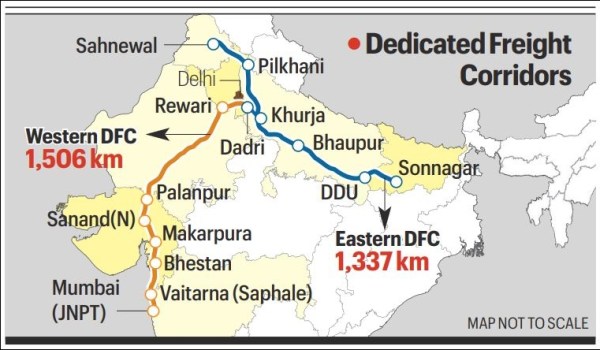 Currently, a total of about 426 freight trains run on both corridors daily.
• The Western Dedicated Freight Corridor (WDFC) is a 1,506-kilometer, fully electrified, double-track rail route running exclusively for freight traffic between Dadri in Uttar Pradesh and the Jawaharlal Nehru Port Terminal (JNPT) near Mumbai, Maharashtra
Other Important Articles Covering the same topic:
📍Attempted blast on Punjab railway track: What are dedicated freight corridors?
NATION
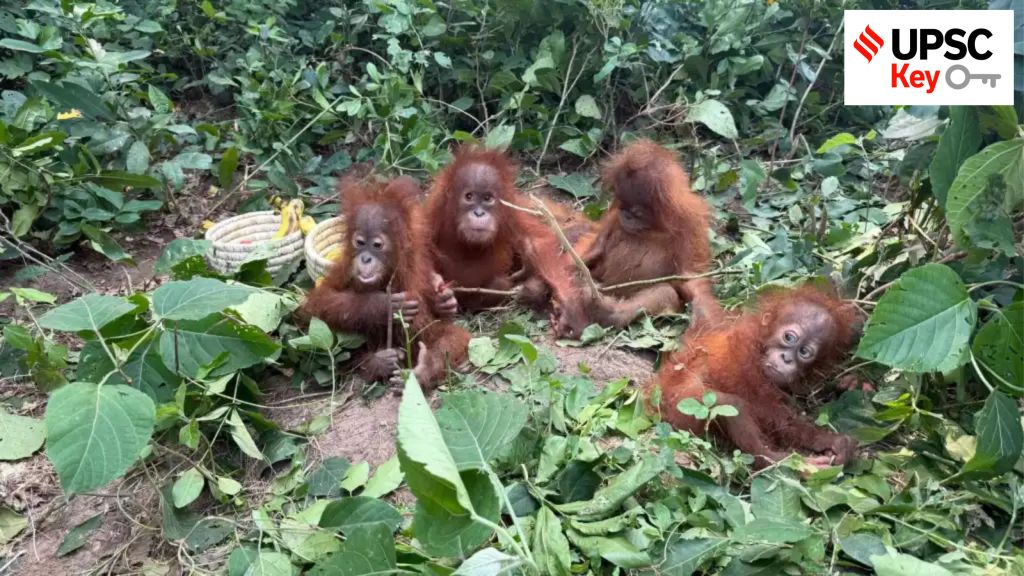
Five baby orangutans spotted in Odisha, cops suspect smuggling
Syllabus:
Preliminary Examination: General issues on Environmental ecology, Bio-diversity and Climate Change – that do not require subject specialization.
Main Examination: General Studies III: Conservation, environmental pollution and degradation, environmental impact assessment.
What’s the ongoing story: Local residents roaming about a forest area near a village in Odisha’s Balasore district had an unusual sighting on Tuesday — five tiny orangutans.
Key Points to Ponder:
• What are orangutans?
• What are the major orangutan species?
• Have you heard of Bornean orangutan, Sumatran orangutan and Tapanuli orangutan
• Why are orangutans in Odisha unusual?
• What is Wildlife Crime Control Bureau (WCCB)?
• Why wildlife trafficking is a major environmental issue
• What is Convention on International Trade in Endangered Species of Wild Fauna and Flora (CITES)?
• Is India Party to CITES?
• How Ape is different from monkey?
Key Takeaways:
• As the news of the rare visitors spread rapidly, thousands of onlookers gathered within an hour, forcing the forest department to step in and rescue the wild animals.
• The orangutans were spotted near the Badapai village forest in Bhograi area of the coastal district around 6 am.
• The Wildlife Crime Control Bureau (WCCB), a multi-disciplinary agency by the Centre, would probe into the matter as the state government suspects involvement of international smuggling racket, said Odisha’s forest and environment minister Ganesh Ram Singh Khuntia.
Do You Know:
• The orangutans are the Asia’s only great ape, and the largest tree-dwelling mammal on Earth — found nowhere in the wild except two islands, thousands of kilometres from where five juveniles were just found in an Odisha forest. Orangutans are Asia’s only great apes and hold the title of the largest tree-dwelling (arboreal) mammals on earth. Native only to the rainforests of Borneo and Sumatra, these highly intelligent primates are currently facing a severe survival crisis, with all three species classified as Critically Endangered on the IUCN Red List.
• Orangutans spend nearly all of their lives above the forest floor, using extraordinary arm strength and grip to move hand over hand through the canopy rather than leaping like monkeys. Wild orangutans exist only in the rainforests of Borneo and Sumatra in Southeast Asia. There is no natural land corridor connecting these islands to India — which is why officials say the Odisha sighting could not have been a natural migration.
Other Important Articles Covering the same topic:
📍As 5 orangutans find new home in Odisha, a probe into how they landed there
Previous year UPSC Prelims Question Covering similar theme:
1) With reference to the International Union for Conservation of Nature and Natural Resources (IUCN) and the Convention on International Trade in Endangered Species of Wild Fauna and Flora (CITES), which of the following statements is/are correct? (UPSC CSE, 2015)
1. IUCN is an organ of the United Nations and CITES is an international agreement between governments.
2. IUCN runs thousands of field projects around the world to better manage natural environments.
3. CITES is legally binding on the States that have joined it, but this Convention does not take the place of national laws.
Select the correct answer using the code given below.
(a) 1 only
(b) 2 and 3 only
(c) 1 and 3 only
(d) 1, 2 and 3
THE EDITORIAL PAGE
India’s young can power the world’s ageing economies
Syllabus:
Preliminary Examination: Economic and Social Development
Main Examination: General Studies I: Population and associated issues
What’s the ongoing story: Ajay Khanna, Arnab Bhattacharya Writes-This is why global skills mobility must now be viewed not simply as migration policy, but as a strategic pillar of economic diplomacy, workforce development, and international cooperation.
Key Points to Ponder:
• What are the significance of large young working-age population?
• What is demographic dividend?
• How demographic dividend is different from demographic transition?
• Why would ageing economies need Indian workers?
• What is the concept of ‘brain circulation’?
• How Brain circulation is different from brain drain?
• How global demographic divergence is creating both opportunities and risks for India?
• How can India leverage international labour mobility to convert its demographic dividend into sustainable economic growth?
Key Takeaways:
Ajay Khanna, Arnab Bhattacharya Writes-
• The global economy is entering a period of profound demographic transition. Across advanced economies, declining fertility rates, ageing populations, and shrinking workforces are creating structural labour shortages that curtail economic growth.
• Healthcare systems are struggling to recruit nurses and caregivers. Infrastructure programmes require skilled technicians and tradespeople. Digital economies continue to demand engineers, coders, and specialised professionals.
• India is placed uniquely. For decades, countries have leveraged their natural resources as instruments of economic and geopolitical influence. The Gulf economies used oil. Australia built strength around coal, iron ore, and uranium. China leveraged its control over rare earth minerals. India’s greatest strategic resource may well be raw talent.
• In a rapidly ageing world, India has the largest reservoir of young human capital. There are 450 million Indians currently aged between 18 and 35 years, as per the UN’s population estimates.
• A significant share of this generation is English-speaking, digitally literate, culturally adaptable, and globally connected. Most importantly, they possess a level of collective aspiration unmatched in modern economic history. However, raw talent alone is not enough. Language capability, technical training, certification, cultural preparedness and professional discipline are needed for Indian talent to thrive in global markets.
• If India can prepare its youth for global workforce participation, Indian workers can become catalysts of economic growth across ageing societies, through flows of remittances and talent, while simultaneously strengthening India’s soft power and international influence. This is why global skills mobility must now be viewed not simply as migration policy, but as a strategic pillar of economic diplomacy, workforce development, and international cooperation.
• The significance of this opportunity is already visible. India received over $110.47 billion in worker remittances in FY 2025-26, a 26 per cent increase compared to the previous year. The outdated narrative of “brain drain” is increasingly giving way to a more sophisticated reality of “brain circulation”.
• But this opportunity cannot be built on fragmented recruitment systems or opaque intermediaries. The future must rest on trusted institutions, ethical mobility frameworks, worker protection, transparent standards, and international partnerships. None of this can be built without confronting an uncomfortable reality: Political appetite for migration is shrinking in the economies that need workers most. Across much of Europe, parties running on explicitly anti-immigration platforms — from Germany’s AfD to Austria’s Freedom Party — have moved from the margins into government, and “remigration” has entered political vocabulary.
Do You Know:
Ajay Khanna, Arnab Bhattacharya Writes-
• Circular mobility — temporary, socially accretive, and economically expansive — offers a genuinely different proposition, distinct from the OECD’s recent migration experience, and the evidence that it works politically as well as economically already exists. Singapore’s work-permit system, Hong Kong’s helper and skilled-worker system, and the Gulf’s kafala-linked systems recognise that temporariness, not restriction, is what has made large-scale labour mobility politically sustainable. Governments have a critical role in negotiating mobility agreements, harmonising standards, and ensuring worker welfare. Industry must move beyond short-term placement targets toward long-term workforce development.
• India’s ambition should be to become the global hub for trusted talent mobility. In the coming decades, nations that can reliably produce globally employable talent at scale will possess a decisive strategic advantage. India has the demographic strength, the aspiration, and the human capability to lead this transformation. The question is how quickly it can build the institutions, standards, and strategic frameworks required to convert this demographic moment into a lasting national advantage. The answer will shape not only the future of millions of Indians overseas and at home but also the influence India will wield going forward.
Other Important Articles Covering the same topic:
📍Young India is done calling every setback a ‘skill issue’
Previous year UPSC Prelims Question Covering similar theme:
2) India is regarded as a country with “Demographic Dividend’’. This is due to (UPSC CSE, 2011)
(a) Its high population in the age group below 15 years.
(b) Its high population in the age group of 15 to ¬64 years.
(c) Its high population in the age group above 65 years.
(d) Its high total population.
Previous year UPSC Mains Question Covering similar theme:
📍Critically examine the challenges of demographic transition in contemporary India. (UPSC, GS1, 2026)
THE IDEAS PAGE
A possible G3 is casting a shadow over BRICS
Syllabus:
Preliminary Examination: Current events of national and international importance.
Main Examination: General Studies II: Bilateral, regional and global groupings and agreements involving India and/or affecting India’s interests.
What’s the ongoing story: C. Raja Mohan Writes- The Europeans worry that an accommodation with Moscow could be made at their expense. Asian allies fear that a bargain with Beijing could weaken American commitments to regional security.
Key Points to Ponder:
• What are the expectations from the 18th BRICS Summit?
• What is a “G3” highlighted by the author?
• The author compares a potential G3 to the Yalta System-what do you know about Yalta system?
• What do you understand by the terms—Unipolar world, Bipolar world and Multipolar world?
• Do you think that BRICS is becoming less coherent?
• What does a potential G3 mean for India?
• In an increasingly multipolar world, how should India balance its engagement with great powers and middle powers?
Key Takeaways:
C. Raja Mohan Writes-
• When its leaders meet in Delhi this week, BRICS will add more layers of cooperation, ranging from agriculture and health to digitalisation. While BRICS moves slowly, the larger political world around it is changing fast. Even as the forum seeks to counter American domination of the world, its principal driving forces, Russia and China, are exploring separate and joint accommodations with the United States.
• International interest in the BRICS summit is less about the lengthy declaration it will produce. The last summit, in Rio de Janeiro, issued a declaration of 126 paragraphs but did not set the world on fire. In Delhi, the focus will be on the presence of leaders such as China’s Xi Jinping, Russia’s Vladimir Putin and Iran’s Masoud Pezeshkian.
• The Indian media will focus on Prime Minister Narendra Modi’s bilateral meetings. Expect particular attention to his potential meeting with Xi, who is visiting India for the first time since 2019. The two leaders are expected to stabilise the boundary situation and reset economic relations.
• BRICS may be the god of small things, but its problems with big issues are becoming harder. Its expansion has made it less coherent. The Iran war has opened a sharp divide between Tehran and Abu Dhabi, now fellow members of BRICS. Iran wants the grouping to condemn American and Israeli military action. The UAE, which has suffered Iranian attacks and disruption to commerce through the Strait of Hormuz, stresses sovereignty, the protection of civilian infrastructure and freedom of navigation. Their differences prevented the BRICS foreign ministers from issuing a consensual joint statement in Delhi in May.
• Meanwhile, engagement among the US, China and Russia is entering a new phase and casting a shadow over BRICS. US President Donald Trump has long believed that good personal relations with Putin and Xi could reduce global strategic tensions and produce major political and economic deals.
• There are three answers to a potential G3 world for India.
—The first is internal reform and accelerated economic development.
—Second, Delhi should stop confusing multipolarity with anti-American bloc politics. Russia and China use BRICS to expand their diplomatic options while preserving the freedom to negotiate with Washington. India must approach the emerging order with the same realism.
—Third, India must intensify its bilateral and minilateral cooperation with the Anglosphere, Brazil, Europe, Japan, Korea, and other middle powers that have no enthusiasm for a G3 world. As India’s work in BRICS continues, its place in the changing global architecture will depend on how rapidly it builds national power and how deeply it develops partnerships beyond BRICS.
Do You Know:
• India prepares to host the 18th BRICS Summit in New Delhi (on September 12 and 13) as the grouping marks 20 years since its formalisation in 2006. This anniversary is an occasion to assess whether BRICS has remained true to the concerns that brought it together, and how it must adapt to a rapidly changing global order.
• In 2000, Brazil, Russia, India and China together accounted for roughly 23% of global GDP on a purchasing power parity (PPP) basis, while the G7 held nearly 52%. By 2024, the positions had reversed: the expanded 11-member BRICS accounted for approximately 36.8% of global GDP (PPP), while the G7’s share fell below 29%.
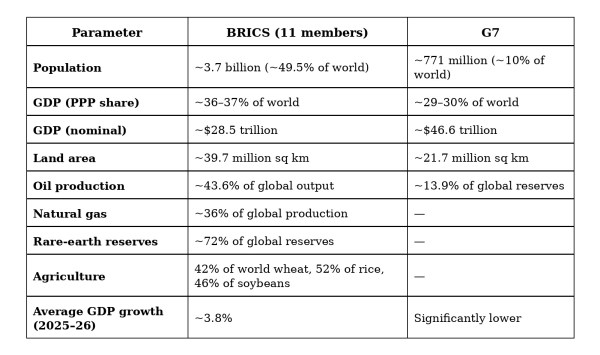 As can be seen from the table, BRICS is ahead of the G7 on almost all the parameters.
• BRICS now represents roughly a quarter of global trade, with intra-BRICS merchandise trade reaching $1.17 trillion in 2024, a nearly 13-fold increase from $84 billion in two decades. The grouping holds an estimated $5.2 trillion in combined foreign reserves and accounts for 78.2% of global mineral coal production. On growth, BRICS nations are projected to average 3.8% in 2025 and 3.7% in 2026, more than three times the G7 average.
Yet the per-capita GDP tells a different story: the G7 averages around $53,000, while BRICS averages roughly $8,200. The bloc’s aggregate weight is driven by population and resource scale, not by individual prosperity.
• BRICS began as BRIC, Brazil, Russia, India and China, in 2006, following a Goldman Sachs projection identifying these economies as future engines of global growth. It evolved from a foreign ministers’ dialogue into a leaders’ forum, with its first summit held in Yekaterinburg, Russia, in 2009.
• South Africa joined in 2010, and the grouping expanded dramatically in 2024 with the addition of Egypt, Ethiopia, Iran, Saudi Arabia and the UAE. Indonesia became the 11th full member in January 2025.
• India’s involvement in BRICS reflects its broader strategy of multi-alignment, underpinned by strategic autonomy. New Delhi participates simultaneously in BRICS, the G20, the Quad and the Shanghai Cooperation Organization without being tied to alliance commitments. BRICS emerged during an early phase of India-US strategic convergence, and India’s multi-alignment has been less about choosing between competing power centres and more about creating room for manoeuvre.
• India has made substantive institutional contributions. At the 2012 New Delhi summit, India proposed a BRICS development bank, which became the New Development Bank (NDB). By mid-2026, the NDB had approved approximately $44 billion across 141 projects. India’s broader objective has been to shape debates on climate change, sustainable development and trade, enhancing its agenda-setting capacity.
Other Important Articles Covering the same topic:
📍With India as host, here are better goals for BRICS than ‘confronting the West’
Previous year UPSC Prelims Question Covering similar theme:
3) Consider the following statements with regard to BRICS: (UPSC, CSE, 2025)
I. The 16th BRICS Summit was held under the Chairship of Russia in Kazan.
II. Indonesia has become a full member of BRICS.
III. The theme of the 16th BRICS Summit was Strengthening Multiculturalism for Just Global Development and Security.
Which of the statements given above is/are correct?
(a) I and II
(b) II and III
(c) I and III
(d) I only
Previous year UPSC Mains Question Covering similar theme:
📍 “BRICS acts as a powerful counterweight in global governance, actively amplifying the voice and influence of the Global South.” Explain the role of BRICS in projecting itself as an alternative to other groupings (UPSC, GS2, 2026)
EXPLAINED
Why a flat map fails to accurately depict Earth
Syllabus:
Preliminary Examination: Indian and World Geography-Physical, Social, Economic Geography of India and the World.
What’s the ongoing story: The United Nations has adopted a resolution to shift away from the 16th-century Mercator map of the world towards one that more accurately depicts Africa’s vast size.
Key Points to Ponder:
• What is the Mercator map?
• How did the Mercator map come to be the most commonly used depiction of the world?
• Why is the Mercator map controversial?
• Why a flat map fails to accurately depict Earth?
• “No map projection can accurately represent all the properties of the Earth’s surface simultaneously.” Argue the geographical basis of this statement.
• Why the Mercator map nevertheless remain important in cartography and navigation?
• Know the major types of map projections and their suitability for different geographical purposes.
• Compare and contrast great-circle and rhumb-line routes.
Key Takeaways:
• At a UN General Assembly session, 164 countries (including India) voted to adopt the 2018 Equal Earth design — with the US voting against the Togo-led resolution, and six countries abstaining. Since UN resolutions are not binding, it remains to be seen if or when governments, organisations and classrooms adopt it.
• The 2018 Equal Earth design, developed by an international team of cartographers, also comes with its own limitations. But its supporters say it will help reverse “colonial” perceptions of Africa.
• No flat map can accurately portray the three-dimensional Earth. Every projection involves trade-offs, depending on its purpose.
• The Mercator layout was introduced by the Flemish (present-day Belgium) geographer and mapmaker Gerardus Mercator in 1569 to help sailors navigate the world.
It is a conformal, cylindrical map. This means Mercator projected the Earth’s surface as if unwrapped from a cylinder around the globe. “In the 18th century, it became the standard map projection for navigation due to its property of representing rhumb lines as straight lines,” said Siva Kumar.
• So, if you drew a straight line from Mumbai to Muscat on a Mercator map, you could point your ship in the same compass direction throughout the journey and reach your destination. This was a major advantage over other map projections, where a constant-direction route would appear curved.
• The Mercator projection has a grid pattern with longitudes and latitudes at 90-degree angles. The longitudes (vertical lines) are evenly spaced, but the distances between the latitudes (horizontal lines) increase as one moves away from the equator towards the poles.
Do You Know:
• The Mercator layout has been the world’s most widely used projection for centuries. But it has also long been
criticised for exaggerating the size of regions towards the poles relative to those closer to the equator. The most infamous example of these distortions is its depiction of the African continent, which appears similar to Greenland — an island 14 times smaller and about the size of the Democratic Republic of the Congo.
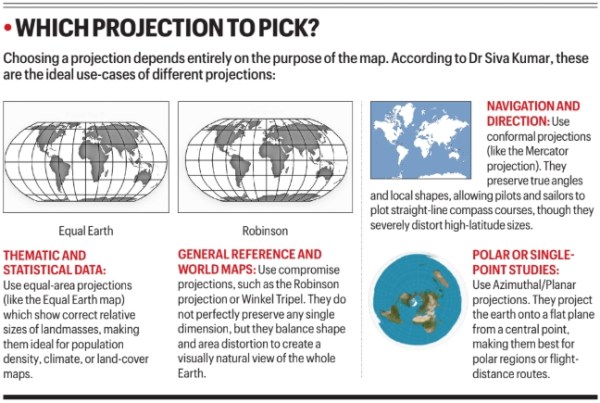 Choosing a projection depends entirely on the purpose of the map.
• In 1855, Scottish clergyman James Gall presented a new projection. In 1973, German historian Arno Peters unveiled a very similar map which gained widespread attention. While it preserves area accurately, it makes landmasses look stretched or squashed. In 2017, schools in Boston introduced it.
• In 1963, geographer Arthur H Robinson devised the Robinson projection which tried to better balance the sizes and shapes of land masses and sought to solve the “Greenland problem”. It’s a compromise projection (which we explained above), with meridians curving gently towards the poles.
• In 1921, German cartographer Oswald Winkel devised the similar Winkel Tripel projection, seeking to reduce distortion across area, distance and direction. In 1998, it replaced the Robinson projection in world maps made by the National Geographic Society. Schools and textbooks followed, as did the World Bank. This is also a compromise projection.
Other Important Articles Covering the same topic:
📍World map we use is ‘lying’ about size of Africa. The UN wants to fix it
Behind Nepal’s compensation demand for devastating flood
Syllabus:
Preliminary Examination: Current events of national and international importance.
Main Examination: General Studies II: Effect of policies and politics of developed and developing countries on India’s interests.
What’s the ongoing story: Nepal has suffered a catastrophic flash flood, with more than 1,000 dead, thousands still missing nearly 10 days later, and whole villages, bridges and roads swept away. The impact appears to have been heightened as the Himalayas now stand much impacted by heavy infrastructure development by the Chinese in Tibet.
Key Points to Ponder:
• What exactly Nepal is demanding?
• What is the Loss and Damage Fund?
• Loss and damage and compensation—Compare
• Do you agree that the Nepal’s claim is morally legitimate?
• What do you understand by the term ‘Climate justice’?
• ‘The Climate justice requires reconciling the principles of historical responsibility, present capability and vulnerability’—how far you agree?
• Do you think that the Nepal’s floods are Himalayan disasters and no longer purely national disasters?
• What are the challenges in establishing liability for climate-induced disasters?
Key Takeaways:
• The Himalayas are referred to as the third pole given their huge reservoirs of ice and water. For years, melting of their glaciers has been noticed, with climatologists warning of severe consequences.
The US is the leading contributor, at 25%, to the key cause of climate change, CO2 accumulated in the atmosphere. Europe is next at around 20% with the Chinese now fast catching up at15% of the global stock. India’s contribution, on the other hand is under 4%. Moreover, India’s per-capita CO2 emissions at around 2 tonnes per year are half of the global average of 4.5 tonnes.
• After the floods, Nepal, whose own emissions are very little, said it is bearing the consequences of a problem it did not create.
• Nepal’s foreign minister, Shishir Khanal, said the country has written to the UN’s fund for responding to loss and damage. This fund was set up in 2022 to help countries respond to economic hits from extreme events, in addition to financing mitigation and adaptation. Contributions to it are voluntary. Khanal had earlier said that the Himalayan country had decided to shift its diplomatic position to claim ‘compensation’ for natural disasters instead of aid.
• The enormity of the rehabilitation task makes it imperative for Nepal to access international funding. An approach of eschewing ‘aid’, the go-to of previous times, and instead seeking international solidarity fits in with the new Nepal with a young and globally aware government.
• The US and China, as the largest emitters, seemed obvious inclusions in the compensation demand, but why India? To many, this appeared to follow the usual Nepali quest of balancing its two neighbours, India and China — although the clever minds of European NGOs, busy for long in Nepal, cannot be dismissed placing such hints. Europe, an emitter of much bigger consequence than India, was not mentioned in these reports.
Do You Know:
• Around $822 million has been pledged to the UN’s loss and damage fund, but around $350 million is allotted for disbursement.
• The UAE has provided $100 million. Much of the other contribution has come from Europe.
The US, which had pledged around $17 million, has now pulled out of this funding mechanism, with climate change itself being referred to as a ‘hoax’ by President Donald Trump.
• The Loss and Damage Fund (officially the Fund for Responding to Loss and Damage (FRLD)) is a global climate finance mechanism designed to provide financial rescue and rehabilitation to vulnerable developing nations suffering from the irreversible impacts of climate change.
• First established at COP27 in 2022 and operationalised at COP28 in 2023, the fund addresses both sudden extreme weather events (like catastrophic floods and cyclones) and slow-onset crises (like rising sea levels and desertification)
• Currently, the fund is facing a critical real-world test following devastating floods in Nepal, which prompted an immediate formal request from Nepal’s government for aid and sparked calls for an extraordinary board meeting to allocate disaster relief.
Other Important Articles Covering the same topic:
📍Loss and damage fund approved at COP28 summit: All you need to know
Previous year UPSC Prelims Question Covering similar theme:
4) Consider the following statements with reference to India’s response to climate change: (UPSC, CSE, 2026)
I. India’s Long-Term Low Emission Development Strategy (LT-LEDS) is a crucial tool for achieving net-zero emissions by 2070.
II. India’s 4th Biennial Update Report (BUR-4) submitted in December, 2024 recorded around 8% decrease in Greenhouse gas emissions in 2020 over 2019.
III. Climate-resilient development necessarily depends on quick and short-term achievement of emission reduction targets.
Which of the following relationships among the above statements is/are correct?
1. Statement I is empirically supported by statement II.
2. Statement III contradicts the approach implicit in statement I.
3. Statement I and statement III together establish the premise of long-term sustainability.
Select the answer using the code given below:
(a) 1 only
(b) 1 and 2
(c) 2 and 3
(d) 3 only
Previous year UPSC Mains Question Covering similar theme:
📍‘Climate change’ is a global problem. How India will be affected by climate change? How Himalayan and coastal states of India will be affected by climate change? (UPSC, GS3, 2017)
|
PRELIMS ANSWER KEY |
|
1.(b) 2.(b) 3.(a) 4.(b) |
For any queries and feedback, contact priya.shukla@indianexpress.com
Subscribe to our UPSC newsletter. Stay updated with the latest UPSC articles by joining our Telegram channel – IndianExpress UPSC Hub, and follow us on Instagram and X.


Priya Kumari Shukla is a Senior Copy Editor in the Indian Expre... Read More
 Share


