
UPSC KEY: India’s first LNG-powered train, Election Commission, and GST regime
How is knowing about India’s first LNG-diesel dual-fuel train relevant to the UPSC exam? What significance do topics such as GST regime, coal stocks, and Election Commission hold for both the preliminary and main examinations? You can learn more by reading the Indian Express UPSC Key for October 4, 2026.
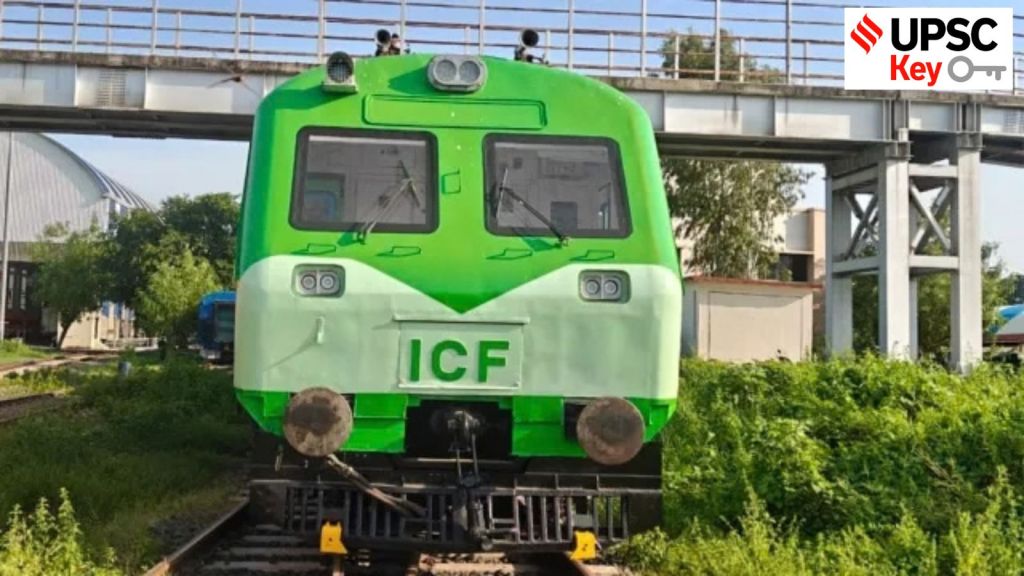 The train uses a dual-fuel system, which allows the same engine to use both LNG and diesel. Know more about the India’s first LNG-diesel dual-fuel train in our UPSC Key. (Image: Ahmedabad Division/Railways)
Important topics and their relevance in UPSC CSE exam for October 4, 2026. If you missed the October 3, 2026 UPSC CSE exam key from the Indian Express, read it here
ECONOMY
Despite near 100% electrification, why Railways launched LNG train
Syllabus:

Preliminary Examination: Current events of national importance.
Mains Examination: General Studies-III: Infrastructure: Energy, Ports, Roads, Airports, Railways etc.
What’s the ongoing story: The Railways on September 27 launched its first train that can run on liquefied natural gas (LNG).
Key Points to Ponder:
— What are DEMU trains?
— How are DEMU trains different from conventional locomotive-hauled trains?
— What is the rationale behind converting diesel-powered DEMU trains into dual-fuel LNG-diesel trains?
— What are the potential benefits of LNG-powered trains?
— What are the challenges associated with the use of LNG in Indian Railways?
— Read about India’s first hydrogen train.
— How does the new LNG-diesel dual-fuel train differ from India’s first hydrogen train?
— How Fuel diversification can complement railway electrification in India?
Key Takeaways:
— The eight-coach non-AC train, flagged off from Sabarmati station in Gujarat, is not a new train, though. It is a modified version of an existing diesel-electric multiple unit (DEMU) train — which means it can run both on diesel and LNG. DEMUs, to be clear, are self-propelled trains (but more on that later).
— Using LNG will result in lower emissions than diesel. The national transporter, therefore, is planning to add LNG systems to more DEMU trains. In Indian Railways, most trains are hauled by heavy, standalone engines, called locomotives. However, DEMU trains — and EMU (electric multiple unit) trains — are “train sets” that don’t have a separate locomotive.
— Instead, their movement and control systems are built into passenger coaches at both ends — these coaches are called driving power cars, or DPC. Half of the space of a DPC is taken up by the power packs while the remainder is meant for passengers.
— In the case of EMUs, the tractive power — essentially the energy to move the trains — is provided by overhead electric wires. In the case of DEMUs, a diesel engine generates electricity which then powers the train’s electric traction motors.
— Since these DEMU trainsets do not have the provision to attach a separate locomotive, they cannot be hauled by an electric one. That is why the conversion to dual-fuel systems with LNG have been found as an alternative to reduce emissions.
— In fact, the Railways recently launched a hydrogen train by modifying a DEMU rake (or train set). This, however, is not a dual-power train and may not be viable for a mass rollout because handling hydrogen is difficult.
— A senior official of the Ahmedabad railway division said that the latest DEMU-LNG conversion was done at a cost of Rs. 1.86 crore. The train will use 40% LNG and 60% diesel during its operation. It has dedicated electronic fuel controls, LNG storage, gas leakage detection and associated safety systems. The DPC retains the capability to operate entirely on diesel whenever required.
— The Railway official also said that the initiative complements the electrification programme with fuel diversification and there is an export potential for such assets as well.
Do You Know:
— The DEMU was first introduced in Indian Railways in 1994 for non-electrified routes, with a 700-horsepower configuration. In 2002, the Integral Coach Factory developed 1,400-horsepower DEMUs, which were inducted in Railways to replace existing slow-moving locomotive-hauled passenger trains on non-electrified mainline sections and for low-traffic-density branch line services. The high acceleration potential of DEMUs made the fast passenger services between cities suitable.
— Developed by Chennai-based Integral Coach Factory (ICF), the new train uses an LNG-diesel dual-fuel system which allows its engine to run on both LNG and diesel. The move is aimed at reducing diesel consumption, fuel costs and emissions while encouraging the use of alternative fuels in railway operations.
— The LNG-diesel dual-fuel system gives the train flexibility because it does not have to depend entirely on LNG. Depending on fuel availability, the engine can switch between LNG and diesel. This also means that train operations can continue even if LNG is not available. Another benefit is that LNG can allow the train to cover a longer distance before refuelling.
Other Important Articles Covering the same topic:
📍Knowledge Nugget | How does India’s first LNG-powered train work and differ from hydrogen trains?
📍PM flags off India’s first hydrogen train: How they work, and why they haven’t picked pace globally
UPSC Prelims Practice Question Covering similar theme:
(1) Consider the following statements regarding India’s first LNG-powered train:
1. It uses an LNG-diesel dual-fuel system.
2. LNG can replace around 40 per cent of diesel used by the train.
3. The train uses a hydrogen fuel-cell system to generate electricity onboard.
Which of the statements given above is/are correct?
(a) 1 only
(b) 2 and 3 only
(c) 1 and 2 only
(d) 1, 2 and 3
Coal stocks down 66%, raising concerns ahead of next summer
Syllabus:
Preliminary Examination: Current events of national importance, economic and social development.
Mains Examination: General Studies-II, III: Government policies and interventions for development in various sectors, Infrastructure: Energy.
What’s the ongoing story: Rebuilding coal inventories ahead of next summer was the “main concern”, officials said amid a “neck-to-neck situation” as stocks at domestic coal-based power plants plunged 66% — from around 54.9 million tonnes at the beginning of April to 18.6 million tonnes by the end of September.
Key Points to Ponder:
— What are the key factors behind the decline in coal stocks at India’s thermal power plants?
— What are battery energy storage systems (BESS)?
— How can BESS help address India’s electricity supply challenges?
— Why are the advantages and limitations of coal blending with imported coal?
— What are the concerns associated with the rising reliance on coal-based power?
— How is the West Asia crisis affecting India’s energy security?
— What are the challenges associated with the clean energy transition in India’s power sector?
Key Takeaways:
— The depletion of coal inventories at domestic coal-based power plants this year is the highest in the past three years.
— Officials expect the situation to improve with better availability of railway rakes for transporting coal to power plants, along with an increase in coal production.
— Coal India Limited, the country’s largest coal miner that accounts for about 83% of the coal supplied to the power sector in India, also reported a 9.18% increase in coal production during September compared to the same month last year.
— Coal supplies to thermal power plants depend heavily on logistics, particularly the availability of railway rakes, as a large share of India’s operational coal-based generation capacity is located away from the coal mines.
— This year, higher-than-projected demand has already raised concerns over power availability, with the government moving to take additional measures to maximise generation from available capacity. Among these measures, the power ministry has directed around 112 captive coal-based power plants to operate at maximum capacity from October 1 to December 31.
— Apart from this, there has also been discussion on directing thermal power plants to blend imported coal with domestic supplies, officials aware of the matter told The Indian Express. However, no final decision has been taken on the issue so far.
— At the same time, there is a push to add more battery energy storage systems (BESS) over the next six months, particularly at the inter-state transmission system (ISTS) level.
— The move is aimed at addressing the growing gap between the availability of solar power during the day and the higher demand for electricity after sunset, when generation from solar projects falls sharply.
Do You Know:
— BESS technology stores electricity chemically and discharges it when needed. Lithium-ion batteries, particularly lithium iron phosphate (LFP) batteries, are currently the dominant technology for grid-scale storage because of their falling costs, high efficiency and long operational life
Other Important Articles Covering the same topic:
📍UPSC Weekly Concepts Snapshot: Energy storage technologies, Bond Yield and ENSO
FRONT
Arrest powers under GST regime likely to be removed
Syllabus:
Preliminary Examination: Current events of national importance, Economic and social development.
Mains Examination: General Studies- II, III: Government policies and interventions, Indian Economy and issues relating to planning, mobilisation of resources, growth, development and employment.
What’s the ongoing story: More than nine years after its rollout in July 2017, the Goods and Services Tax (GST) regime is set to see a major overhaul — removal of arrest powers.
Key Points to Ponder:
— What is Goods and Services Tax (GST), and how does it work?
— What is the tax system in India?
— What is input tax credit?
— What is the role and function of the GST council?
— How are decisions taken in the GST council?
— What are the major concerns related to the arrest powers under the GST regime?
— What are the major forms of GST fraud in India?
— How does GST fraud affect tax revenue?
— What are the key GST 2.0 institutional reforms?
Key Takeaways:
— In a bid to boost investor sentiment and allay concerns about overreach by tax authorities, the upcoming GST Council meeting, on October 7, will take up the proposal to decriminalise offences under the indirect tax regime, two persons aware of the development told The Indian Express.
— The Centre and the states are learnt to have held several meetings over the last eight-nine months, including involvement at the top levels of the Union government, to reach a broad consensus on removal of the arrest provisions under GST, which were being seen as a major impediment for traders and businesses.
— The move is viewed as urgent as several arrests of high-ranking functionaries were made in recent times under the GST provisions that were termed by industry leaders as an overreach.
— For intentional frauds and deceit under GST, the authorities will proceed with prosecution and arrests will be through the country’s criminal code, Bharatiya Nyaya Sanhita, a source said.
— After the rollout of GST in July 2017, authorities have grappled with multiple instances of frauds, involving broadly similar modus operandi. Typically, such cases involve fake identities or mule accounts to undertake fraudulent GST transactions in a bid to avail input tax credit, or fake bills without actual supply of goods.
— Many suppliers also undervalue their final goods and show purchase of raw materials at lower rates. Or, they supply taxable goods and services without due payment of GST to the central and state governments.
— In 72,393 cases of GST offences from 2021-22 to 2024-25, 887 arrests were made by central GST formations. The arrests by state authorities will be in addition to this number.
— Under the Central GST Act, non-compliance can result in penalty under Section 122, interest under Section 50, and recovery of tax. However, violations involving deliberate intent to evade tax attract arrest and prosecution under the criminal provisions of the CGST Act.
— Section 69 of the CGST Act provides for the power to arrest after approval by the Commissioner. Sub-section (1) provides that where the Commissioner has “reasons to believe” that a person has committed any offence related to fake invoices, fraudulent availment of input tax credit, he may, by order, authorise any officer of central tax to arrest such person. The “reasons to believe” have to be backed by credible material and evidence, and mere suspicion is not sufficient, with all the reasons required to be recorded in writing.
— The concern about arrest powers under GST laws is not new. It was flagged by several states in the early meetings of the GST Council, even before the 2017 rollout of the indirect tax regime.
Do You Know:
— The GST came into effect in 2017 and was billed as an attempt to simplify the existing tax structure in India, where both the Centre and states levied multiple taxes, and to make it uniform.
— The President set up the GST Council as a joint forum of the Centre and the states, under Article 279A (1) of the amended Constitution.
— If the power to arrest is removed, the GST regime, in a way, will be similar to the Value Added Tax regime that existed before the rollout of the indirect tax regime in July 2017 and did not have any provisions for arrest.
— The government has been moving towards decriminalisation of offences on the direct tax side as well. The Central Board of Direct Taxes (CBDT) had, in September, removed arrest and detention provisions from the tax recovery rules with retrospective effect from April 1, 2026, barring tax officials from undertaking arrest in case of tax default.
— In a notification dated September 17, the CBDT had brought in Income-Tax (Fourth Amendment) Rules, 2026, which also removes “arrest and detention” from the tax recovery rules in case of death of the defaulter.
Other Important Articles Covering the same topic:
📍 As GST 2.0 kicks in, what changes for consumers and industry?
📍Explained: What is the GST Council, and what does it do?
Previous year UPSC Prelims Question Covering similar theme:
(2) What is/are the most likely advantages of implementing ‘Goods and Services Tax (GST)’? (UPSC CSE 2017)
1. It will replace multiple taxes collected by multiple authorities and will thus create a single market in India.
2. It will drastically reduce the ‘Current Account Deficit’ of India and will enable it to increase its foreign exchange reserves.
3. It will enormously increase the growth and size of the economy of India and will enable it to overtake China in the near future.
Select the correct answer using the code given below:
(a) 1 only
(b) 2 and 3 only
(c) 1 and 3 only
(d) 1, 2 and 3
Previous year UPSC Mains Question Covering similar theme:
Enumerate the indirect taxes which have been subsumed in the Goods and Services Tax (GST) in India. Also, comment on the revenue implications of the GST introduced in India since July 2017. (UPSC CSE 2019)
OPINION
A confrontation that reshaped the Election Commission
Syllabus:
Preliminary Examination: Current events of national and international importance.
Mains Examination: General Studies–II: Appointment to various Constitutional Posts, Powers, Functions and Responsibilities of various Constitutional Bodies.
What’s the ongoing story: Shubham Kumar writes- “In October 1993, TN Seshan was away in Pune when Delhi altered the institution he had come to personify. A former Cabinet Secretary, TN Seshan had taken over as Chief Election Commissioner (CEC) in December 1990. The President, on October 1, appointed two Election Commissioners alongside him: MS Gill, a senior IAS officer who would later succeed Seshan as CEC, and GVG Krishnamurty. An ordinance issued the same day laid down that the business of the commission would, as far as possible, be transacted unanimously and, where its members disagreed, by majority.”
Key Points to Ponder:
— Read about the Election Commission of India (ECI) in detail.
— Read Article 324 of the Constitution. What powers and responsibilities does it give to the ECI?
— How is the ECI constituted? What does the Constitution say about the number of Election Commissioners?
— How are the Chief Election Commissioner (CEC) and other Election Commissioners appointed?
— What is the role of the CEC in the Commission?
— Why was the ECI made a multi-member body? How are decisions taken in a multi-member Election Commission?
— Read about the Chief Election Commissioner and Other Election Commissioners (Appointment, Conditions of Service and Term of Office) Act, 2023.
— What are the constitutional and statutory safeguards for the independence of the ECI?
Key Takeaways:
— “Three years into office, Seshan had brought the Election Commission into public consciousness by taking on governments over the conduct of elections and forcing politicians accustomed to a relatively unobtrusive poll body to reckon with an increasingly assertive one.”
— “The Constitution, however, had never confined the Election Commission to a single member. Article 324 provided for a Chief Election Commissioner and “such number of other Election Commissioners, if any”, as the President might from time to time fix.”
— “For much of independent India, the commission had functioned with only the CEC. But it briefly had a multi-member body, when, in October 1989, weeks before the general election, the Rajiv Gandhi government appointed SS Dhanoa and VS Seigell as Election Commissioners alongside CEC RVS Peri Sastri. After a change in government, the President, on January 1, 1990, returned the commission to its single-member form.”
— “Dhanoa challenged the abolition of his post before the Supreme Court. The court rejected his case in 1991, holding that while the Constitution required a CEC, the appointment of more Election Commissioners was not obligatory. The judgment, however, left unresolved the question that would soon become central to Seshan’s own case.”
— “Two years later, the appointments of Gill and Krishnamurthy changed the way power was exercised within the Election Commission. The ordinance issued on October 1, 1993, gave both commissioners an equal voice in the commission’s decisions and provided that where unanimity was not possible, the majority would prevail. For Seshan, the institutional consequences were immediate. A CEC who had come to embody the institution in public life could now be outvoted within it.”
— “The dispute quickly reached the Supreme Court. Journalist and political commentator Cho Ramaswamy filed the first challenge on October 13, 1993. Seshan followed with his own petition on October 26, challenging both the ordinance and the appointments of Gill and Krishnamurthy. By December, the court had concluded that the questions raised went directly to the interpretation of Article 324 and referred the matter to a Constitution Bench. While the petitions were pending, the ordinance was replaced without material change by legislation on January 4, 1994.”
— “Seshan’s argument rested substantially on the special position Article 324 gave the CEC. The Constitution protects the CEC from removal except in the same manner and on the same grounds as a judge of the Supreme Court. Other Election Commissioners may be removed on the CEC’s recommendation. To Seshan, these distinctions suggested that the Constitution had placed the chief above the other members of the commission and that this hierarchy should extend to the commission’s decision-making as well.”
— “A five-judge Constitution Bench led by Chief Justice AM Ahmadi rejected that proposition in July 1995. It upheld the 1993 arrangement and the appointments of Gill and Krishnamurty, holding that the CEC’s stronger protection against removal did not translate into superior decision-making authority.”
— “The court treated the CEC’s stronger protection from removal as a safeguard for institutional independence, not as a source of greater voting power. Once a multi-member commission had been constituted, its members were to decide matters collectively. Any other reading, the court reasoned, would reduce the other Election Commissioners to little more than advisers.”
— “In practical terms, the settlement placed the CEC in the position commonly associated with primus inter pares, or first among equals, in the commission’s decision-making. The CEC was chairperson, but where unanimity failed, the statutory rule of majority would govern.”
Do You Know:
— The Part XV of the Constitution of India deals with Elections. It has the following articles (Articles 324–329) to empower the Election Commission and provide insight into the potential roles and functions of the commission.
— Article 324: The superintendence, direction and control of the preparation of the electoral rolls for, and the conduct of, all elections to Parliament and the Legislature of every state and of elections to the offices of President and Vice-President.
— Article 325: No individual to be excluded from electoral rolls on the basis of religion, race, caste, sex or any of them.
— Article 326: Adult suffrage shall be the basis for elections to the House of the People and to the Legislative Assemblies of States.
— Article 327: Parliament may, according to the provisions of this Constitution, from time to time enact laws with respect to all matters relating to elections to Parliament and Legislative Assemblies of States.
— Article 328: A state’s Legislature may from time to time by law make provision with respect to all matters relating to, or in connection with, the elections to the House or either House of the Legislature.
— Article 329: The article prohibits the courts from becoming involved in electoral matters.
Other Important Articles Covering the same topic:
📍Conflict and Consensus in the ECI’s functioning
📍 ‘Illegal, unauthorised’: Election Commissioners objected to Form 6 change
Previous year UPSC Prelims Question Covering similar theme:
(3) Consider the following statements: (UPSC CSE, 2017)
1. The Election Commission of India is a five-member body.
2. Union Ministry of Home Affairs decides the election schedule for the conduct of both general elections and bye-elections.
3. Election Commission resolves the disputes relating to splits/mergers of recognised political parties.
Which of the statements given above is/are correct?
(a) 1 and 2 only
(b) 2 only
(c) 2 and 3 only
(d) 3 only
THE WORLD
Saudi plans assault to break Houthi blockade in Red Sea
Syllabus:
Preliminary Examination: Current events of international importance.
Mains Examination: General Studies-II: Effect of policies and politics of developed and developing countries on India’s interests, Indian diaspora.
What’s the ongoing story: Saudi Arabia is planning an offensive against Iran-backed Houthi militants in Yemen, with options being considered including a coastal push to secure the Red Sea shipping route or an assault on multiple fronts, regional and Western officials told Reuters.
Key Points to Ponder:
— Read about the Houthis.
— How has the role of the Houthi group evolved throughout the Yemen Civil War?
— What is the “axis of resistance”?
— What is the strategic importance of the Bab el-Mandeb Strait?
— How has the Yemen conflict affected maritime security and global shipping in the Red Sea region?
— What is the role of Saudi Arabia in the Yemen conflict? What challenges it faces in dealing with the Houthi movement?
— What is the strategic importance of Yemen in the geopolitics of West Asia?
— Know about Mayun Island. What is its strategic significance?
— Map work: Locate Saudi Arabia’s East-West oil pipeline, Mayun Island, Red sea, Bab el-Mandeb, Saudi Arabia, Persian Gulf , Strait of Hormuz.
Key Takeaways:
— The operation, expected to be launched in the coming weeks, will be led by Yemeni forces on the ground, which are overseen by Riyadh, and supported by Saudi air strikes, according to six people with knowledge of the preparations.
— While the US is already providing intelligence to support Riyadh’s operations in Yemen, and some regional and European nations are providing mainly defensive military aid to the kingdom, the Saudi allies aren’t expected to play a direct role in combat operations, said the people who requested anonymity to discuss security matters.
— A key objective of the planned Saudi offensive, which hasn’t been previously reported, is aimed at reversing the rapid gains made by the Houthis last month when they advanced down the coast and seized control of the Bab el-Mandeb strait, according to the people with knowledge of the plans who include Gulf and Yemeni officials and Western diplomats.
— The Saudis are considering two possible options for the assault, the Gulf and Yemeni officials said: Either a narrowly focused attack on the area around Bab el-Mandeb or a broader offensive that also includes other synchronized attacks on multiple fronts around Yemen, in the governorates of Al-Bayda, Marib, Taiz and Al-Jawf.
— Spokespeople for the Saudi and Yemeni governments, the Houthi group and the US military didn’t immediately respond to requests for comment about the Saudi plans.
Do You Know:
— Saudi Arabia entered neighboring Yemen’s civil war in 2015 at the head of an Arab coalition in support of the internationally recognised government, which the Houthis had driven out of the capital Sanaa. A truce agreed between the warring parties in 2022 largely held until this year when the Houthis launched missile and drone attacks on Saudi shipping and oil infrastructure in a spillover from the Iran war.
— Bab el-Mandeb is the southern exit passage of the Red Sea, a key shipping route between the Mediterranean and Asia that’s assumed even more importance this year as an alternative to the Strait of Hormuz, which has been effectively closed by the Iran conflict.
— The Houthis are a large clan belonging to the Zaidi Shia sect, with roots in Yemen’s northwestern Saada province. Zaidis make up around 35 per cent of Yemen’s population.
— The Zaidis ruled over Yemen for over a thousand years until 1962, when they were overthrown and a civil war followed, which lasted until 1970. The Houthi clan began to revive the Zaidi tradition from the 1980s, resisting the increasing influence of the Salafists, who were funded by the state.
Other Important Articles Covering the same topic:
📍Who are the Shia Houthis, and why are they aligned with the Sunni Palestinian Hamas?
UPSC Prelims Practice Question Covering similar theme:
(4) Consider the following pairs:
1. Houthis: Yemen
2. Hezbollah: Lebanon
3. Hayat Tahrir al-Sham: Syria
Which of the pairs given above is/are correct?
(a) 1 and 2 only
(b) 2 and 3 only
(c) 1 and 3 only
(d) 1,2 and 3
ALSO IN NEWS
G20 discussed curbing impact of govt-backed excess mfg capacities
— G20 trade ministers have discussed preventing large production capacities, created with government support in some geographies, from hurting manufacturing in countries that follow fair trade practices, including India, the US and Europe, Commerce and Industry Minister Piyush Goyal has said.
— Replying to questions from the Indian diaspora in Chicago about the G20 trade ministers meeting, which concluded late evening on Friday in Milwaukee, Goyal said the members also discussed the future of several elements of the World Trade Organisation (WTO), which is currently under severe stress, including the fact that many countries are using predatory pricing as they have overcapacity, and are dumping goods, much to the detriment of honest and fair trade.
Marxist to Hindutva: How NCERT history book rows mirror a battle for India’s past
— In its newly released Class 9 social science textbook, Understanding Society – India and Beyond, the NCERT has in a chapter on medieval history focused on resistance local kings offered to “foreign invaders” —the Delhi Sultans and the Mughals — with only a cursory mention of the alliance between the Mughals and Rajputs.
— This marks a break: for decades, medieval history textbooks did discuss battles but also discussed in detail instances of cooperation between the Mughals and Hindu princes, apart from pointing out that the medieval times saw the development of a composite culture in India with the mixing of Indo-Islamic influences. The period being talked about is the same, but the interpretation of the past has undergone a discernible change.
Prelims Answer Key
1. (c) 2. (a) 3. (d) 4. (d)
Click here to read the UPSC Essentials magazine for September 2026. Subscribe to our UPSC newsletter. Stay updated with the latest UPSC articles by joining our Telegram channel – Indian Express UPSC Hub, and follow us on Instagram and X


Roshni Yadav is a Deputy Copy Editor with The Indian Express. At The Indian Express, she writes for ... Read More
 Share


