
UPSC KEY: India-Belgium Relations, Super El Niño and NASA’s Roman Telescope
Why is knowing about India-Belgium strategic deals relevant to the UPSC exam? What significance do topics such as the Sone Water Dispute, NASA's Roman Telescope, Super El-Nino and Feminism hold for both the preliminary and main examinations? You can learn more by reading the Indian Express UPSC Key for September 4, 2026.
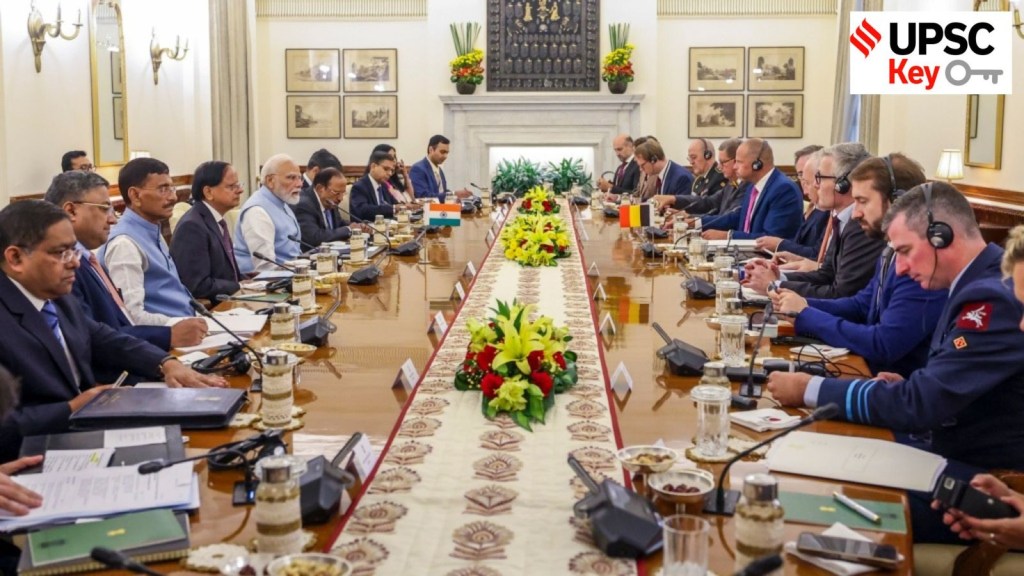 PM Narendra Modi during a meeting with his Belgian counterpart Bart De Wever in Delhi, Thursday. (PTI)
Important topics and their relevance in UPSC CSE exam for September 4, 2026. If you missed the September 3, 2026 UPSC CSE exam key from the Indian Express, read it here.
POLITICS
From defence to fintech, India and Belgium give ties a major boost
Syllabus:

Preliminary Examination: Current events of national and international importance.
Mains Examination: General Studies II: Bilateral, Regional and Global Groupings and Agreements involving India and/or affecting India’s interests.
What’s the ongoing story: India and Belgium agreed to strengthen defence and Intelligence-sharing, establish an investment fast-track mechanism, double bilateral trade, boost partnership on semiconductors and enter a pact on renewable energy, as Prime Minister Narendra Modi met the visiting Prime Minister of Belgium, Bart De Wever, on Thursday.
Key Points to Ponder:
— Locate Belgium on the world map and identify its neighbouring countries.
— What is the European Union (EU)? Identify its member countries and understand its key institutions.
— Is Belgium a member of the EU?
— What is NATO? Identify its members and understand its role in European and transatlantic security.
— Identify the major areas of India-Belgium bilateral relations.
— Examine the significance of Antwerp in India-Belgium trade.
— How can India-Belgium cooperation in drones, munitions, rockets and other defence technologies contribute to India’s defence capabilities?
— Examine the potential for India-Belgium cooperation in semiconductors and emerging technologies.
— Why is maritime security becoming an important area of cooperation between India and European countries?
Key Takeaways:
— After the bilateral meeting, PM Modi said, “I am confident that today’s discussions mark the beginning of a new chapter in our bilateral relations.”
— “Defence and security cooperation is a key pillar of our relationship. Today, we agreed to enhance military exchanges and training cooperation between the two countries. The agreements between our governments and defence industries will open up new opportunities for defence co-development and co-production. We will also further strengthen Intelligence-sharing and cooperation between our agencies in combating crime,” he said.
— Belgian PM De Wever said, “The exchange of the letter of intent we have just witnessed gives that cooperation a new framework – from government to government contacts and military exchanges to research, innovation, co-development, and hopefully co-production. And alongside it, a series of additional defence-related MoUs are being concluded, bringing companies and institutions from both countries closer together. Security too is something we strengthen by working with partners we can trust.”
— Defence delegations from the two sides met and agreed to strengthen cooperation in defence industries, which includes drones, anti-mine systems, rockets, tanks, munitions. Representatives from about 15 Belgian defence companies accompanied the Belgian Prime Minister and interacted with the Indian defence industry players as well.
Also from POLITICS page: India and Belgium sign strategic deals, underline maritime security and drone tech
— From maritime security to military hardware, from drones to rockets — India and Belgium decided to cooperate and pacts were signed between the two sides, as Belgian Defence minister Theo Francken met Defence minister Rajnath Singh on Thursday.
— Belgian minister Francken, who has the portfolio of defence and foreign trade, is accompanying Belgian Prime Minister Bart de Wever and met Defence minister Rajnath Singh.
— According to Belgian officials, the mission focuses on the “growing interconnectedness of security in Europe and the Indo-Pacific, closer military cooperation and concrete opportunities for our defence companies”. At least 15 companies are part of the delegation.
Do You Know:
— Belgium is an important economic partner for India in Europe. Bilateral trade reached $13.01 billion in 2025-26. Diamond trade, with Antwerp as a major global hub, remains a significant component of bilateral commerce.
— Belgium is also an important source of investment in India. FDI inflows from Belgium amounted to approximately $4.2 billion between April 2000 and December 2025.
Other Important Articles Covering the same topic:
📍Belgium keen to continue collaboration with India on building telescopes, astronomy instruments
Previous year UPSC Prelims Question Covering similar theme:
(1) Which of the following countries are members of the European Union? (UPSC CSE, 2026)
1. Belarus
2. Poland
3. Germany
4. Switzerland
Select the answer using the code given below :
(a) 1, 2 and 4
(b) 1 and 4 only
(c) 2 and 3
(d) 2 and 4 only
FRONT
Exports push GDP growth, but low margin shipments struggle
Syllabus:
Preliminary Examination: Current events of national and international importance.
Mains Examination: General Studies III: Indian Economy and issues relating to Planning, Mobilization of Resources, Growth, Development and Employment; Inclusive Growth and issues arising from it.
What’s the ongoing story: India’s goods exports bucked expectations to record their best-ever June, with outbound shipments jumping to a record $44.24 billion at the peak of the disruption caused by the crisis in West Asia. This performance helped drive GDP growth in April-June to an unexpectedly high 7.8%.
Key Points to Ponder:
— How are net exports reflected in national income accounting?
— Examine the significance of export-led growth for a developing economy such as India.
— What are the major objectives and key features of India’s Foreign Trade Policy 2023?
— Understand the concept of competitive advantage.
— Identify the major categories of goods exported by India and examine how their composition has changed over time.
— Which sectors are labour -intensive? Why are labour-intensive exports important for inclusive growth?
— How can diversification of export products and markets reduce India’s vulnerability to external shocks?
— What role can Free Trade Agreements (FTAs) play in expanding India’s exports?
— Discuss the policy measures that can help India achieve sustained and broad-based export growth.
Key Takeaways:
— But under the headline number, most labour-intensive and low-margin exports did not fare well.
— Overall goods exports in April-June rose 15% year-on-year to $129.32 billion while non-petroleum, non-gems and jewellery shipments were up 12% at $99.04 billion – well above the 6.5% growth exhibited over the previous two financial years.
— On Monday, Chief Economic Adviser (CEA) V Anantha Nageswaran attributed the “brisk” growth in India’s core exports to the signing of free trade agreements (FTAs), export diversification efforts, and “possibly rising competitiveness”.
— According to economists, net exports added 3 percentage points to GDP growth in April-June 2026 and this was driven by a decline in real imports as the conflict in West Asia weighed on import volumes.
— While high-end products such as engineering goods, electronics and pharmaceuticals grew 18.1%, 22.6% and 6.8%, respectively, during the April-June quarter, several labour-intensive sectors registered a sharp decline.
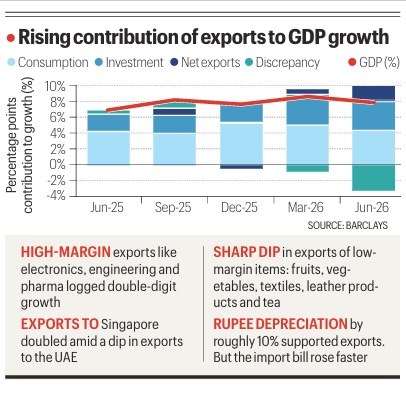
— Textile exports slipped 12.4% while leather products declined 4.7%. Exports of low-margin products such as fruits and vegetables, ceramics and glassware, and jute products fell 10.3%, 25%, and 13.4%, respectively. Tea exports were under particular pressure, falling 17.5%. Of the 31 export sectors, 11 posted a year-on-year decline in April-June.
Do You Know:
— Swift diversification and higher export absorption by countries with which India has signed FTAs helped cushion the impact of the West Asia crisis. When Indian exports came under pressure, particularly those going to UAE, exporters turned their attention to Singapore, another transhipment hub.
— Data shows that Indian exports to Singapore nearly doubled during April-June from a year earlier. While exports to the UAE fell 11% year-on-year to $7.9 billion from $9 billion, exports to Singapore jumped 101% to $6.5 billion from $3.2 billion. The UAE is India’s second-largest export market after the US.
— India’s exports to FTA countries, particularly Australia and the UK, also showed significant growth. Exports to the UK rose 11% during the quarter, while shipments to Australia jumped 25%. Exports to China also increased, rising 25% to $5.6 billion, although this was dominated by inputs rather than finished goods.
Other Important Articles Covering the same topic:
📍Why resilient export data tells only half the story of West Asia disruption
Previous year UPSC Prelims Question Covering similar theme:
(2) Consider the following statements: (UPSC CSE, 2023)
1. Statement-I: India accounts for 3.2% of global export of goods.
2. Statement-II: Many local companies and some foreign companies operating in India have taken advantage of India’s ‘Production-linked Incentive’ scheme.
Which one of the following is correct in respect of the above statements?
(a) Both Statement-I and Statement-II are correct and Statement-II is the correct explanation for Statement-I
(b) Both Statement-I and Statement-II are correct and Statement-II is not the correct explanation for Statement-I
(c) Statement-I is correct but Statement-II is incorrect
(d) Statement-I is incorrect but Statement-II is correct
Apex court: Bar councils have no disciplinary powers over law students
Syllabus:
Preliminary Examination: Indian Polity and Governance – Constitution, Political System, Panchayati Raj, Public Policy, Rights Issues, etc.
Mains Examination: General Studies II: Functioning of the Executive and the Judiciary; Statutory, Regulatory and various Quasi-judicial Bodies.
What’s the ongoing story: The Supreme Court held Thursday that the Bar Council of India (BCI) and State Bar Councils have no power to take disciplinary action against law students before they are enrolled as lawyers, holding that such matters fall exclusively within the domain of their educational institutions.
Key Points to Ponder:
— What is the Bar Council of India (BCI)?
— What are the major functions and powers of the Bar Council of India and State Bar Councils under the Advocates Act, 1961?
— Who is an advocate under the Advocates Act, 1961?
— Distinguish between a law student, law graduate and enrolled advocate in the context of the Advocates Act, 1961.
— What is the role of the Bar Council of India in legal education?
— What reasonable restrictions can be imposed on freedom of speech under Article 19(2)?
— Examine the balance between freedom of expression, institutional discipline and academic autonomy.
Key Takeaways:
— “We are of the opinion that the Advocates Act, 1961, where under BCI has been statutorily created, does not confer any express or implied power upon the BCI or any State Bar Council to take any disciplinary action against the students of law; such a power is preceded by registration of a law graduate as an advocate under the said Act,” a three-judge bench presided by Chief Justice of India Surya Kant said.
— “So far as students are concerned, it is their parent institution or the authority prescribed under the regulations/bye laws of such institution who alone are competent to take disciplinary action,” said the bench, also comprising Justices Joymalya Bagchi and V Mohana.
— The bench made the observation while declaring that all communications issued by the BCI on August 13, following opposition by a group of NALSAR University of Law students to inviting Chief Justice of India Surya Kant to the university’s annual convocation, were “without any authority of law”.
Do You Know:
— The Bar Council of India is a statutory body established by the Parliament under the Advocates Act, 1961 to regulate and represent the Indian Bar.
— The Advocates Act, 1961 creates a two-tier structure: State Bar Councils under Section 3 and the Bar Council of India under Section 4.
— The BCI consists of members elected from each State Bar Council, the Attorney General of India, and the Solicitor General of India who is an ex-officio member. The members from the State Bar Councils are elected for a period of five years.
— The Council elects its own Chairman and Vice-Chairman for a period of two years from among its members. Presently, Manan Kumar Mishra is the Chairman of the BCI.
Other Important Articles Covering the same topic:
📍NALSAR row: Can Bar Council of India stop enrolment of law graduates?
Previous year UPSC Prelims Question Covering similar theme:
(3) With reference to India, consider the following statements: (UPSC CSE, 2022)
1. Government law officers and legal firms are recognized as advocates, but corporate lawyers and patent attorneys are excluded from recognition as advocates.
2. Bar Councils have the power to lay down the rules relating to legal education and recognition of law colleges.
Which of the statements given above is/are correct?
(a) 1 only
(b) 2 only
(c) Both 1 and 2
(d) Neither 1 nor 2
NATION
WMO warns of ‘very’ strong El-Nino, to last until February 2027
Syllabus:
Preliminary Examination: Indian and World Geography – Physical, Social, Economic Geography of India and the World.
Mains Examination: General Studies I: Salient features of World’s Physical Geography.
What’s the ongoing story: The World Meteorological Organization (WMO) on Thursday warned of an impending “very strong” El Nino that could last till February of next year and could alter temperature and rainfall patterns globally.
Key Points to Ponder:
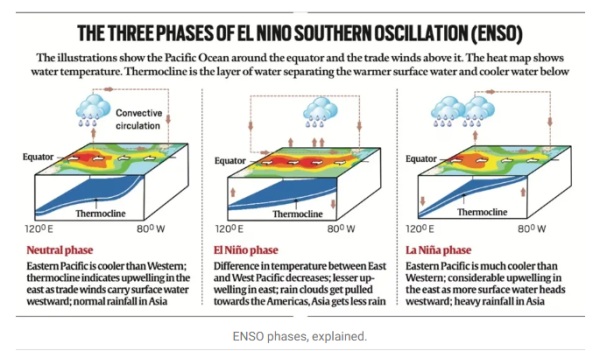
— What is El Niño Southern Oscillation (ENSO)? Identify its three phases.
— What changes in the trade winds, sea-surface temperatures and atmospheric circulation during an El Niño event?
— What is the Niño 3.4 region?
— How is sea-surface temperature anomaly in this region used to identify and assess El Niño?
— What is meant by a “Super El Niño”? How does it differ from an ordinary/strong El Niño?
— Explain the relationship between El Niño and Indian monsoon variability.
— What is the Indian Ocean Dipole? Distinguish its three phases.
— How can other ocean-atmosphere phenomena like the Indian Ocean Dipole (IOD) and Western Disturbances modify the influence of El Niño on the Indian monsoon?
— How does El Niño affect Indian agriculture, water availability, food prices and the wider economy?
Key Takeaways:
— “El Nino is firmly established and is expected to strengthen. It has the potential to deliver a massive blow to communities and economies across the world. We are already seeing disruption and devastation from droughts and floods and we expect these impacts to increase as El Niño intensifies,” said WMO Secretary-General Celeste Saulo at a press briefing on Thursday.
— The intensity of El Nino is determined by the sea surface temperature average over three months in the Nino 3.4 region along the equatorial Pacific Ocean.
— In recent months, this temperature index value surpassed 1.5 degrees Celsius above normal during May-July and further escalated 2 degrees Celsius above normal in July, confirming the rapid intensification.
— Europe, this year, witnessed one of the hottest summers in recent decades and August, according to many global weather agencies, reported record temperatures in many parts of the globe.
— The UN agency’s chief noted that this El Nino episode was pushing resources to their limits and will require extensive preparations and coordination to tide over the extreme weather.
— The India Meteorological Department (IMD), earlier this month, confirmed that the monsoon rainfall in the later half of August came under the cloud of El Nino. But, with three-fourths of the season over, the monsoon has largely escaped the developing El Nino.
Do You Know:
— Sea surface temperature (SST) and atmospheric pressure are the two main factors affecting global ocean circulation. The El Niño Southern Oscillation (ENSO) is a periodic ocean-atmospheric fluctuation in sea surface temperatures and air pressure across the equatorial Pacific Ocean.
— The chemical composition of ancient coral skeletons reveals that ENSO has been happening for the past thousands of years. It has three distinct phases: warm or El Niño, cold or La Niña, and neutral.
— The term ‘El Niño’ was first used by South American fishermen in the 1600s. It comes from Spanish and literally means the Christ Child or Little Boy, as this phenomenon typically peaks around Christmas. Therefore, the full name the fishermen used was El Niño de Navidad (“The Christmas Child”).
— El Nino is a natural ocean-atmosphere phenomenon that is caused when the equatorial Pacific Ocean warms significantly and interferes with weather patterns globally. It is known to trigger extreme weather — heatwaves, wet spells and extreme temperatures.
Other Important Articles Covering the same topic:
📍How El Niño development during May-June is likely to affect India
📍What is El Nino and how it impacts the monsoon
Previous year UPSC Prelims Question Covering similar theme:
(4) With reference to ‘Indian Ocean Dipole (IOD)’ sometimes mentioned in the news while forecasting Indian monsoon, which of the following statements is/are correct? (UPSC CSE, 2017)
1. IOD phenomenon is characterised by a difference in sea surface temperature between tropical Western Indian Ocean and tropical Eastern Pacific Ocean.
2. An IOD phenomenon can influence an El Nino’s impact on the monsoon.
Select the correct answer using the code given below:
(a) 1 only
(b) 2 only
(c) Both 1 and 2
(d) Neither 1 nor 2
EXPLAINED
Perils of comparing GDP from different base years
Syllabus:
Preliminary Examination: Current events of national and international importance.
Mains Examination: General Studies III: Indian Economy and issues relating to Planning, Mobilization of Resources, Growth, Development and Employment.
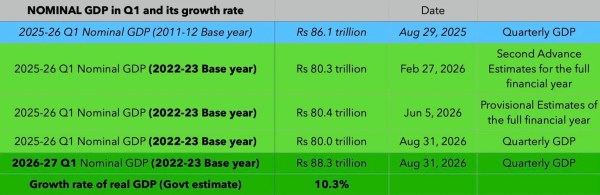
What’s the ongoing story: On Monday, the last day of August as is the norm, India’s Ministry of Statistics and Programme Implementation (MoSPI) released the country’s economic output data for the first quarter (Q1 covering April, May and June) of the current financial year.
Key Points to Ponder:
— What is Gross Domestic Product (GDP)?
— How is GDP calculated? Identify the three approaches to measuring GDP and understand the relationship between them.
— What is the GDP expenditure approach? Identify its major components.
— What is the relationship between GDP and economic growth?
— What is the difference between GDP, GVA, GNP and NNP?
— What is the difference between nominal GDP and real GDP?
— What is a GDP deflator? How is it different from other measures of inflation?
— What is a base year in national income accounting? Why is the base year periodically revised?
— Who is responsible for compiling and releasing India’s GDP and national income estimates?
— What is per capita GDP? How is it different from aggregate GDP?
— What is potential GDP? What determines an economy’s potential output?
Key Takeaways:
— At the start of this quarter, the world was in the midst of the US-Iran war, and most analysts were dialling down growth expectations, given that geopolitics was disrupting all economies around the world.
— India, in particular, was expected to experience slower growth because it is heavily dependent on imports from West Asia for its energy (crude oil etc.) needs.
— However, as the weeks went by, the data for different sectors of the economy showed that the Indian economy continued to grow at a faster-than-expected rate. By the time the quarter ended in June, most economists who track data expected a growth rate of around 7.5%.
— That is, the total economic output produced in the country in these three months was expected to grow by 7.5% over what it was in the same three months in 2025. Some expected the growth rate to be even higher, around 7.8%.
— The GDP column last week explained why the Q1 growth rate is likely to be 7.8% — far better than most expectations at the start of the quarter. It also provided reasons why one should be cautious in leaping to the conclusion that India has yet again entered a “Goldilocks” kind of optimal phase.
Do You Know:
— The Ministry of Statistics and Programme Implementation (MoSPI) has released a new series of national income accounts, shifting the base from 2011-12 to 2022-23, alongside methodological reforms intended to align national accounts with existing economic realities.
— The GDP is the central metric to assess the annual economic growth or the overall size of an economy and the so-called “base year” refers to the year that works as a starting point for calculations. The GDP in 2022-23 is used as a “base” over which the GDP growth of any following year is calculated. This is the eighth such revision.
— In a major move, the new GDP series does not use the single-deflator method at all and instead uses double-deflation, adjusting input and outputs by their respective inflation rates – with deflators also being used at a more granular level. This allows for more accurate measurement of real GDP growth.
Other Important Articles Covering the same topic:
📍The GDP debate: India’s growth numbers have a credibility problem
📍ExplainSpeaking: Understanding the ‘discrepancies’ in India’s new GDP data
Previous year UPSC Mains Questions Covering similar theme:
(1) Explain the difference between computing methodology of India’s Gross Domestic Product (GDP) before the year 2015 and after the year 2015. (UPSC CSE 2021)
(2) Define potential GDP and explain its determinants. What are the factors that have been inhibiting India from realising its potential GDP? (UPSC CSE, 2020)
How Roman Telescope can help decode universe’s mysteries
Syllabus:
Preliminary Examination: Current events of national and international importance.
Mains Examination: General Studies III: Awareness in the fields of IT, Space, Computers, Robotics, Nano-technology, Bio-technology and issues relating to Intellectual Property Rights.
What’s the ongoing story: NASA on Sunday (August 30) launched a powerful, next-generation space telescope that can search for clues for some of the universe’s deepest mysteries, including mysterious phenomena such as dark matter and dark energy.
Key Points to Ponder:
— What is the Nancy Grace Roman Space Telescope? What are its major scientific objectives?
— How is it different from the Hubble Space Telescope and the James Webb Space Telescope?
— What is dark matter? What evidence suggests its existence?
— What is dark energy? How is it related to the expansion of the universe?
— What is gravitational lensing? How can it help scientists study the distribution of matter in the universe?
— What is the Big Bang theory?
— What is meant by the expansion of the universe? How is it observed?
— What are stars made of? What is the role of nuclear fusion in stars?
— What factors determine the lifespan of stars?
— Know about Chandrashekhar limit.
— What is a Lagrange point?
— Where is Lagrange Point 2 (L2) located? Why is it useful for astronomical observations?
— What is the difference between visible, infrared and other regions of the electromagnetic spectrum?
Key Takeaways:
— The telescope, launched on a SpaceX rocket, is named after the late Nancy Grace Roman — known as the “mother of Hubble” owing to her role in the creation of the Hubble Space Telescope, which has been operating since 1990.
— In terms of scientific capabilities, the Nancy Grace Roman Space Telescope lies between the Hubble Space Telescope and the James Webb Telescope. It will be able to scan vast swathes of the cosmos and may provide new insights about dark matter, dark energy and exoplanets.
— This telescope will conduct the most detailed dark matter studies ever, potentially helping to map how it is structured and distributed throughout the cosmos, especially during the process of early star birth.
— Besides this, this telescope will help measure how gravity subtly bends the path of light across vast distances (a phenomenon known as gravitational lensing). The Roman telescope will, therefore, provide a comprehensive three-dimensional map of the distribution of galaxies and galaxy clusters across the universe.
— The Roman Space Telescope, weighing about 8,000 kgs and about the size of a tour bus, will operate from the Lagrange Point 2 — a vantage point between Earth and Sun located approximately 1.2 million kilometres from Earth.
Do You Know:
— The prevalent belief is that the universe came into being nearly 13.8 billion years ago with a massive explosion in an extremely small ‘subatomic ball’ with unimaginably small volume and infinite temperature and density, known as the singularity.
— This is widely known as the “Big Bang” — the most acknowledged theory of our existence and the evolution of our universe. All matter that exists today in the universe sprung forth from that single point in an epic explosion.
— Scientists estimate that ordinary matter makes up only about 5% of the universe. The rest is composed of little-understood phenomena called dark matter and dark energy.
— Scientists believe that dark matter, which makes up about 27% of the universe, is an invisible glue that holds galaxies together.
— On the other hand, dark energy, estimated to make up around 68% of the universe, is believed to be a repulsive force that has expedited the universe’s expansion since the Big Bang.
Other Important Articles Covering the same topic:
📍Dark matter mystery: Why there is no light yet after decades of search
📍Knowledge Nugget | CosmoCube : How a tiny satellite could reveal the early universe
Previous year UPSC Prelims Question Covering similar theme:
(5) Consider the following statements: (UPSC CSE, 2024)
1. Statement I: Giant stars live much longer than dwarf stars.
2. Statement-II: Compared to dwarf stars, giant stars have a greater rate of nuclear reactions.
Which one of the following is correct in respect of the above statements?
(a) Statement-I and Statement-II are correct and Statement-II explains Statement-I.
(b) Both Statement-I and Statement-II are correct, but Statement-II does not explain Statement-I.
(c) Statement-I is correct, but Statement-II is incorrect.
(d) Statement-I is incorrect, but Statement-II is correct.
Inside Jharkhand and Bihar’s 25 year Sone dispute
Syllabus:
Preliminary Examination: Current events of national and international importance.
Mains Examination: General Studies II: Issues and Challenges Pertaining to the Federal Structure.
What’s the ongoing story: The 25-year-old dispute between Bihar and Jharkhand over the sharing of Sone River water was resolved on Monday with the signing of an inter-state Memorandum of Understanding (MoU) in Delhi, under which Bihar will receive 5.75 million acre-feet (MAF) and Jharkhand 2 MAF of water.
Key Points to Ponder:
— How does the river-basin geography of India contribute to inter-State water disputes?
— What is the relationship between Entry 17 of the State List and Entry 56 of the Union List?
— What does Article 262 provide regarding inter-State river-water disputes?
— How has Parliament used its power under Article 262 to create a framework for resolving inter-State river-water disputes?
— Read about the Inter-State River Water Disputes Act, 1956.
— Under what circumstances can the Centre constitute a water disputes tribunal?
— What is the River Boards Act, 1956? What was its objective?
— What is the role of negotiation and inter-State agreements in resolving river-water disputes?
— Identify the major inter-State river-water disputes in India and the States involved.
— What is the significance of environmental flows in river-water management?
— What is the constitutional basis for the Supreme Court’s jurisdiction in disputes between States?
Key Takeaways:
— The agreement is expected to pave the way for long-delayed irrigation, reservoir and river-linking projects in the drought-prone regions of both states.
— The dispute dates back to November 2000, when Jharkhand was carved out of Bihar. It inherited major upper catchment areas and tributaries of the Sone River, while lower riparian agricultural hubs remained in Bihar.
— The core of the dispute traces back to the 1973 Bansagar Agreement, a tripartite agreement involving Madhya Pradesh and Uttar Pradesh, under which undivided Bihar was allocated 7.75 MAF of Sone water out of the total basin yield.
— After Bihar’s division, no binding formula existed to split that 7.75 MAF allocation between Bihar and the newly formed state of Jharkhand.
— Under the pact, the two states agreed that Bihar will receive a water allocation of 5.75 million acre-feet (MAF), while Jharkhand will receive 2 MAF of Sone water.
Do You Know:
— Article 246 of the Constitution provides a framework to distribute legislative powers between the states and the Centre through the Seventh Schedule, which includes the Union List, the State List and the Concurrent List.
— Entry 17 of the State List deals with water – covering water supplies, irrigation and canals, drainage and embankments, water storage and water power – subject to the provisions of entry 56 of the Union list.
— Entry 56 of the Union List provides that the regulation and development of inter-State rivers and river valleys is declared by Parliament by law. Article 262 further provides Parliament with powers related to the adjudication of inter-state river water disputes related to its use, control, distribution, etc.
— In addition, under Article 262, Parliament has enacted the Inter-State River Water Disputes (ISRWD) Act, 1956, for the adjudication of disputes relating to waters of inter-state rivers and river valleys. The act has been amended four times, with the last amendment being in 2002.
Other Important Articles Covering the same topic:
📍Sharing water post Indus Waters Treaty: The road ahead for India, Pakistan
📍Rising water stress and inter-state river disputes
Previous year UPSC Mains Question Covering similar theme:
Constitutional mechanisms to resolve the inter-state water disputes have failed to address and solve the problems. Is the failure due to structural or process inadequacy or both? Discuss. (UPSC CSE, 2013)
Inside Gloria Steinem’s legacy, the debate over many waves of feminist movements
Syllabus:
Preliminary Examination: Current events of national and international importance.
Mains Examination: General Studies I: Role of Women and Women’s Organizations.
What’s the ongoing story: Gloria Steinem, considered among the most well-known feminist activists of the 20th century, passed away on Thursday (September 3) at 92.
Key Points to Ponder:
— What is feminism? Understand its real meaning.
— What are the major concerns addressed by feminist thought and movements?
— What is the difference between gender equality, gender equity and women’s empowerment?
— What are the major waves of feminism? What issues were associated with each wave?
— What is intersectionality? Why is it important for understanding women’s experiences?
— What role did social reformers play in addressing issues concerning women in colonial India?
— How did women’s education contribute to the emergence of women’s movements in India?
— What role did women play in the Indian national movement?
— What role have self-help groups and collective action played in women’s empowerment?
Key Takeaways:
— Steinem was a pioneering figure of the Second Wave of the Feminist Movement of the 1960s and ’70s, which saw women fight for rights in the workplace and in making reproductive choices.
— It followed First Wave feminists of the late 19th century who waged the struggle for voting rights — a key step towards being considered full citizens. The second wave broadened the fight to areas seen as strictly part of private life until then, such as reproduction.
— Coming from humble beginnings, Steinem went on to work as a journalist and even went undercover as a Playboy employee to reveal the exploitative inner workings of clubs run by the men’s entertainment enterprise. She also visited India in 1957 in her early 20s as part of a fellowship at Miranda House, the women’s college in Delhi University.
— Steinem grew up when women in the United States lacked legal safeguards in public life. By the 1960s, however, the tide was turning, and several civil rights movements — including for women and Black Americans — emerged.
— One prominent figure was Betty Friedan, who wrote The Feminine Mystique in 1963, identifying women’s desire to go beyond the domestic sphere. “We can no longer ignore that voice within women that says: ‘I want something more than my husband and my children and my home.’”’
Do You Know:
— In the US, women’s associations led by the likes of Steinem, and writings like those of Friedan’s, helped shift the momentum in the 1960s. The decade saw landmark laws, like the Equal Pay Act of 1963, which banned discrimination based on sex for doing the same work.
— Title VII of the Civil Rights Act of 1964 prohibited employment discrimination based on race, colour, religion, sex and national origin.
— Later court rulings also focused on rights such as access to contraception, allowing women to better plan their careers. The US Supreme Court’s Roe v. Wade judgment of 1973 gave women the constitutional right to abortion.
Other Important Articles Covering the same topic:
📍The feminist lessons Gloria Steinem carried from India to America
📍For Gloria Steinem, being the ‘face of feminism’ came at a cost
Previous year UPSC Mains Question Covering similar theme:
(1) The women’s movement in India has not addressed the issues of women of lower social strata. (UPSC CSE, 2018)
(2) The women’s questions arose in modern India as a part of the 19th-century social reform movement. What were the major issues and debates concerning women in that period? (UPSC, CSE 2017)
ALSO IN NEWS
Not buying Russia oil will not stop war: Jaishankar
— Days after Prime Minister Narendra Modi called on Russian President Vladimir Putin to move from “endless war” to “end of war”, External Affairs Minister S Jaishankar said in Kyiv on Thursday that stopping purchase of Russian oil will not “dissolve” the conflict, and underlined the need for “dialogue and diplomacy”. He said India was ready to “help in any manner” to end the Russia-Ukraine war.
— Demonstrating a diplomatic balancing act, Jaishankar’s bilateral visit to Ukraine comes at a time when Modi is meeting Putin twice within weeks — on the sidelines of the Shanghai Cooperation Organisation (SCO) leaders’ summit in Bishkek on August 31, and at the BRICS summit in New Delhi on September 12-13.
Set up preparedness for glacial lake outbursts: MHA to states
— The ministry of Home Affairs has asked Himalayan states and Union Territories to step up preparedness against glacial lake outburst floods (GLOFs) and snow avalanches, stressing the need to move from response-based planning to preventive mitigation and community-level readiness, an MHA spokesperson said.
— Union Home Secretary Govind Mohan chaired a meeting here on Thursday to review the preparedness of Uttarakhand, Himachal Pradesh, Sikkim, Arunachal Pradesh and Jammu and Kashmir against the risks posed by GLOFs and snow avalanches.
— According to the spokesperson, the meeting reviewed the evolving risk of GLOFs in the Himalayan region and focused on strengthening early warning systems, monitoring of vulnerable glacial lakes and snow-covered areas, identification of high-risk locations, flow-path mapping, timely dissemination of alerts, evacuation preparedness and strengthening response mechanisms.
After slow start, IPO market comes back to life
— India’s initial public offering (IPO) market has heated up again, with some major issues such as Jio Platforms and National Stock Exchange (NSE) still in the pipeline. After a slowdown earlier in the year, July and August saw many companies finally enter the market, easing some of the “pent-up” demand as market conditions improved.
— Companies raised nearly Rs 29,000 crore in August and around Rs 26,500 crore in July through mainboard IPOs, which together accounted for around 73% of the around Rs 75,518 crore raised so far in 2026, according to data compiled from the NSE.
‘India should avoid becoming a conduit for unethical trade’
— Commerce Minister Piyush Goyal on Thursday said that India should not become a trade conduit for goods originating from another country and should aim for genuine value addition. Goyal said that India’s “country of origin” certificates should carry weight.
— “No transshipment should happen in India. We should not become a conduit for anything unethical. We should be trusted partners of the world. We don’t want to become like Vietnam, which brings goods from one country and exports to another country after marginal value addition,” Goyal said.
Why top scientist wants India to move early to thorium fuels
— One of India’s top nuclear scientists, Anil Kakodkar, has advocated introducing thorium-based fuel into the country’s indigenous pressurised heavy water reactor (PHWR) fleet alongside the ongoing three-stage nuclear programme, arguing that this could accelerate the utilisation of India’s abundant thorium reserves and help the country become self-reliant in nuclear fuel.
— The commercial acceptability of indigenous PHWRs and plans to deploy around half of India’s targeted 100 gigawatts-electric (GWe) of nuclear capacity through the technology create an opportunity to introduce thorium at an earlier stage, Kakodkar said at the 6th International Climate Summit on Wednesday.
PRELIMS ANSWER KEY
1.(c) 2.(d) 3.(b) 4.(b) 5.(d)
🚨 Click Here to read the UPSC Essentials magazine for August 2026. Share your views and suggestions in the comment box or at manas.srivastava@indianexpress.com🚨
Subscribe to our UPSC newsletter. Stay updated with the latest UPSC articles by joining our Telegram channel – IndianExpress UPSC Hub, and follow us on Instagram and X.


Raveena Baneta is a consultant with the UPSC section of The Indian Express where she writes on Ethic... Read More
 Share


