Prerequisites:
— Read about plastic pollution, its sources and effects
— What is unmanaged waste?
Key takeaways:
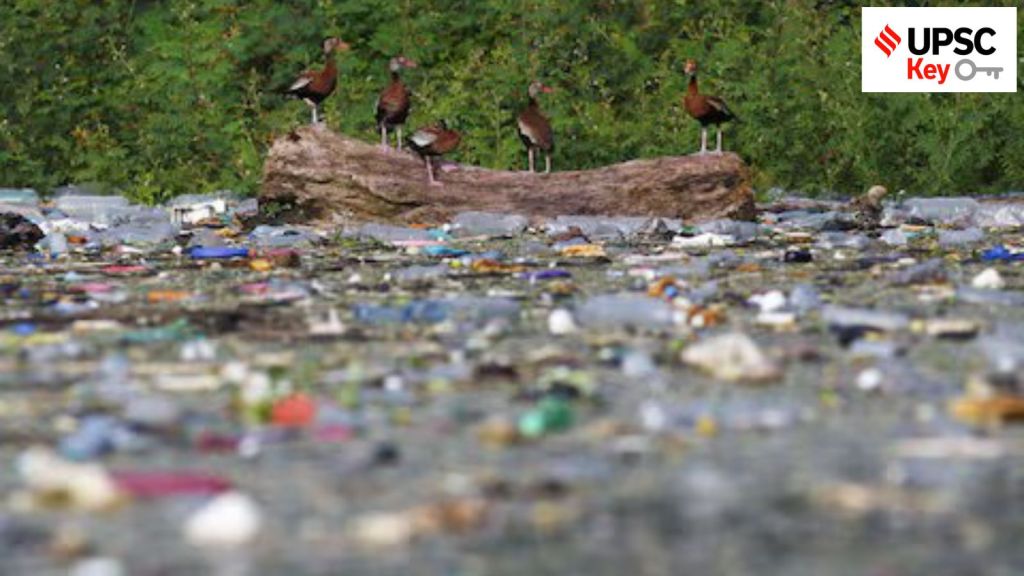
— The study, conducted by University of Leeds scholars Joshua W Cottom, Ed Cook, and Costas A Velis, projected that approximately 251 mt of plastic garbage is produced each year, enough to fill approximately 200,000 Olympic-sized swimming pools. Approximately one-fifth of this garbage (52.1 mt) is “emitted” into the environment, uncontrolled.
— The authors define “managed” waste as that which is collected by municipal entities and recycled or disposed of in a landfill. The majority of plastic trash suffers the latter destiny.
— “Unmanaged” waste winds up in the environment either as debris — fouling every possible spot on Earth from the heights of Mount Everest to the depths of the Mariana Trench in the Pacific Ocean — or as a result of plastic burning in open, uncontrolled fires. The latter emits fine particulates and hazardous gases such as carbon monoxide, which have been linked to heart disease, respiratory illnesses, cancer, and neurological issues.
— Unburned debris accounts for approximately 43% of unmanaged garbage (22.2 mt), while the remaining 29.9 mt is burned either in dumpsites or locally.
For Your Information:
— The study discovered a significant Global North-South split in terms of plastic pollution. “On an absolute basis, we find that plastic waste emissions are highest across countries in Southern Asia, Sub-Saharan Africa and South-eastern Asia,” according to the report. In fact, 20 countries account for around 69% (or 35.7 million tonnes per year) of global plastic pollution, none of which are High-Income Countries. This is despite the fact that all of these HICs are in the so-called Global North and generate more plastic garbage than nations in the South. Not a single HIC is “ranked in the top 90 polluters, because most have 100% collection coverage and controlled disposal,” the study said.
— Open burning is the most common form of plastic pollution in the Global South (with the exception of Sub-Saharan Africa, where uncontrolled debris accounted for a bigger share of the pollution pie), as opposed to the Global North, where plastic pollution was primarily consisted of uncontrolled debris. According to the researchers, this is merely a symptom of poor or non-existent waste management systems, as well as a lack of public infrastructure to support them.
Points to Ponder:
— What is open burning?
— What is uncontrolled debris?
— Paris Agreement on climate change in 2015
— How can the problem of plastic pollution be solved or controlled?
Post Read Question:
(1) When plastic is burned in an open environment, it releases:
1. Particulate matter
2. Carbon monoxide
3. Polycyclic organic matter
4. Sulphur dioxide
Select the correct answer using the codes given below:
(a) 1, 2 and 4 only
(b) 2 and 4 only
(c) 1, 2, 3 and 4
(d) 3 and 4 only
Other Important Articles Covering the same topic:
The planet’s plastic problem: why we need a global plastics treaty
India among 12 nations responsible for 60% of world’s mismanaged plastic waste: Report
UPSC Syllabus:
Preliminary Examination: Current events of National & International importance, General Science.
Mains Examination: GS-III: Science and Technology, Challenges to internal security through communication networks.
What’s the ongoing story- As the use of artificial intelligence (AI) by the world’s militaries grows, the political effort to regulate the way revolutionary technology is used in warfare is growing too. If the ongoing wars in Ukraine and Gaza are emerging as “AI labs” for warfare, there is also a diplomatic push to establish at least some general norms on how to limit the dangers of its military use.
Prerequisites:
— Read about Artificial Intelligence (AI)
— What are AI labs?
— Recent incidents of ongoing wars in Ukraine and Gaza
Key takeaways:
— India, which has been actively engaged in the development and safe use of AI in the civilian sphere, has stood out from the rising worldwide discussion on limiting the technology’s military applications. However, when new global frameworks for ‘AI arms control’ arise, Delhi must steer the process rather than ignore it.
— The conference on Responsible Use of Artificial Intelligence in the Military Domain (REAIM), which begins Monday (September 9) in Seoul, South Korea, is part of a new global diplomacy aimed at shaping global norms on AI’s military applications. The summit is co-hosted by Kenya, the Netherlands, Singapore, and the United Kingdom.
— This is the summit’s second incarnation; the first was held in The Hague in February 2023, hosted by the Dutch government. Although there were no dramatic outcomes from The Hague summit, it extended the global discourse on AI’s military implications and drew in a wider spectrum of players.
— Until recently, the discussion over military AI had focused on autonomous weapons, or ‘killer robots’. Fears that computers and algorithms would take over the conduct of conflict prompted calls for weapons control. Keeping people in the decision-making loop about the use of force has been a major goal of this discussion.
For Your Information:
— The REAIM approach broadened the debate beyond ‘killer robots’ to include a broader range of challenges by acknowledging that AI systems are finding increasingly useful applications in conflict. While leading militaries have long employed AI for inventory management and logistical planning, in recent years, its usage in battlefield intelligence, surveillance, and reconnaissance has grown dramatically.
— Major militaries see AI’s ability to transform the collection, synthesis, and analysis of massive amounts of battlefield data as beneficial in raising situational awareness, increasing the time available for decision-making on the use of force, improving targeting precision, limiting civilian casualties, and increasing the tempo of warfare. Many sceptics have warned that the alleged benefits of AI in warfare may be false and hazardous.
— The growth of so-called AI decision-making support systems (AI-DSS) and their ramifications are among the topics being discussed in the REAIM process. The Hague summit called for continued dialogue, and the second summit wants to formalise some kind of agreement on these topics. The Korea summit has three goals: understanding the implications of military AI on global peace and security, implementing new standards for using AI systems in military affairs, and developing proposals for long-term global control of AI in the military domain.
Points to Ponder:
— Where do the world, India, and China stand on AI use in weapons?
— What is the Hague summit?
— Why is there a focus on the responsible use of AI in military affairs?
— Summit on Responsible Use of Artificial Intelligence in the Military Domain (REAIM)
Post Read Question:
(2) The summit on Responsible Use of Artificial Intelligence in the Military Domain (REAIM) was hosted by the South Korea and the co-host countries were:
1. Kenya
2. United States
3. Netherlands
4. United Kingdom
Select the correct answer using the codes given below:
(a) 1 and 3 only
(b) 1, 3 and 4 only
(c) 3 and 4 only
(d) 1 and 2 only
Other Important Articles Covering the same topic:
C Raja Mohan writes: India, ‘killer robots’ and the China challenge
AI, sovereignty and Isaac Asimov’s warning
UPSC Syllabus:
Preliminary Examination: Current events of National & International importance.
Mains Examination: GS-III: Science and Technology- developments and their applications and effects in everyday life.
What’s the ongoing story- Mumbai-based Entod Pharmaceuticals has announced that the Drug Controller General of India (DCGI) — the country’s apex drug regulator — has approved its new eye drop, which has been “specifically developed to reduce dependency on reading glasses for individuals affected by presbyopia.”
According to the company, the eye drop PresVu is the first of its kind in India, and Entod has “applied for a patent for this invention in terms of its formulation and the process”.
Prerequisites:
— Read about the Drug Controller General of India
— What is presbyopia?
— How does PresVu work?
Key takeaways:
— Presbyopia is an age-related disorder in which the eyes gradually lose their capacity to concentrate on adjacent objects. People typically develop presbyopia around the age of 40. Doctors believe that spectacles are one of the most efficient strategies to manage the illness.
— PresVu’s active ingredient is pilocarpine, a chemical molecule found in pharmaceuticals that has an effect on the body. According to Entod Pharmaceuticals, the substance compresses the iris muscles, which govern the size of the pupil and help humans see clearly, allowing their eyes to focus more on adjacent objects.
— PresVu also claims to employ “advanced dynamic buffer technology” — effectively, a base solution — to adjust to the pH level of tears. This guarantees that the eye drop has “consistent efficacy and safety for extended use, keeping in mind that such drops will be used for years at a stretch”.
— PresVu is a prescription-only medication, and experts say its effects are unlikely to endure more than four to six hours. People suffering from iris inflammation should avoid using it. PresVu use on a regular basis may cause itchiness and redness, brow pain, and eye muscle spasms.
For Your Information:
— Although Entod’s claims suggest that PresVu is a new therapy, pilocarpine, the key ingredient in the eye drop, has been available in India for decades.
— In 2021, the US Food and Drug Administration approved a pilocarpine eye drop to treat presbyopia.
Points to Ponder:
— What is pilocarpine?
— How can presbyopia be corrected?
— Read about lenses: concave and convex.
Post Read Question:
(3) Presbyopia is an age-related disorder related to:
(a) Liver
(b) Pancreas
(c) Mouth
(d) Eyes
Other Important Articles Covering the same topic:
What your eyes reveal about your health
Conjunctivitis cases surge after heavy rains: What precautions should we take to prevent redness, blurry vision and eye discomfort?
UPSC Syllabus:
Preliminary Examination: Current events of National & International importance.
Mains Examination: GS-II: Bilateral, regional and global groupings and agreements involving India and/or affecting India’s interests.
What’s the ongoing story- A parcel of land in Uttar Pradesh, previously belonging to the family of former Pakistan President Pervez Musharraf, is set to be auctioned under The Enemy Property Act.
The Union Home Affairs Ministry said in a notice erected on the plot that around 13 bighas of land in the Kotana Bangar village in Baghpat district has been directed for sale through e-auction until Thursday midnight (September 12).
Prerequisites:
— What is enemy property?
— The Defence of India Act, 1962
— How did India deal with enemy property?
Key takeaways:
— Following the India-Pakistan conflicts of 1965 and 1971, people migrated from India to Pakistan. The Government of India took over the properties and firms of persons who obtained Pakistani nationality under the Defence of India Rules, which were enacted under the Defence of India Act of 1962.
— The Custodian of Enemy Property for India received these “enemy properties” from the Centre. The same was done with property left behind by people who fled to China following the 1962 Sino-Indian War.
— The Tashkent Declaration of January 10, 1966, featured a clause stating that India and Pakistan would consider the restitution of property and assets taken over during the fight. However, the Pakistani government disposed of all such properties throughout the country in 1971.
— The Enemy Property (Amendment and Validation) Bill, 2016, was passed by Parliament in 2017, amending the 1968 Act and the 1971 Public Premises (Eviction of Unauthorised Occupants) Act.
— It broadened the definitions of “enemy subject” and “enemy firm” to include an enemy’s legal heir and successor, whether a citizen of India or a citizen of a non-enemy country, as well as the succeeding firm of an enemy firm, regardless of the nationality of its members or partners.
For Your Information:
— The amended law provided that enemy property shall continue to vest in the Custodian even if the enemy or enemy subject or enemy firm ceases to be an enemy due to death, extinction, winding up of business or change of nationality, or that the legal heir or successor is a citizen of India or a citizen of a country which is not an enemy.
— The Custodian, with the previous approval of the central government, may dispose of enemy possessions vested in him under the terms of the Act, and the government may make directives to the Custodian in this regard.
— The amendments were intended to protect against claims of succession or transfer of property left by people who went to Pakistan and China following the conflicts. The major goal was to neutralise the impact of a court decision in this matter.
— The Bill’s declaration of purposes and reasons stated: “Of late, several judgements by various courts have negatively affected the functions of the Custodian and the Government of India as granted by the Enemy Property Act, 1968. In light of such interpretations by multiple courts, the Custodian finds it difficult to justify his conduct under the Enemy Property Act of 1968.”
— One significant judgement was handed down in the matter of the former Raja of Mahmudabad in Uttar Pradesh, who held several big properties in Hazratganj, Sitapur, and Nainital.
— Following the 1968 Act, the Raja’s estate was deemed enemy property. When he died, his son laid claim to the properties. Following a legal battle, on October 21, 2005, an apex court bench composed of Justice Ashok Bhan and Justice Altamas Kabir ruled in his favour.
— The ruling paved the way for other court filings in which genuine or alleged relatives of those who had migrated to Pakistan filed gift deeds claiming to be the legal owners of enemy property.
Finally, on January 7, 2016, the President of India issued The Enemy Property (Amendment and Validation) Ordinance, 2016, which was superseded by the Bill, which became law in 2017.
Points to Ponder:
— The Enemy Property (Amendment and Validation) Bill, 2016, which amended the 1968 Act
— The Public Premises (Eviction of Unauthorised Occupants) Act, 1971.
Post Read Question:
Discuss the historical context and the legal framework governing Enemy Property in India.
Other Important Articles Covering the same topic:
Pervez Musharraf’s ancestral land in UP to be auctioned under Enemy Property Act: What it means
Explained: What is enemy property in India, and how has the government dealt with it?
Express Network
UPSC Syllabus:
Preliminary Examination: Current events of national and international importance; General Science
Mains Examination: GS-II, GS-III: Government policies and interventions, Health, Science and Technology
What’s the ongoing story- A suspected case of mpox has been identified in India, according to a statement issued by the Union Health Ministry on Sunday.
Prerequisites:
— What is Mpox and how is it transmitted?
— What is the history of Mpox outbreaks?
Key takeaways:
— “A young male patient, who recently travelled from a country currently experiencing mpox transmission, has been identified as a suspect case of mpox,” said the ministry. The patient has been isolated and is in a stable condition. His samples have been sent for testing, said the ministry.
— Mpox was declared a ‘Public Health Emergency of International Concern’ — the highest level of alert by the World Health Organization — last month.
— While India has reported at least 30 cases and one death due to the infection since it was first detected in 2022, this is the first suspected case in the current outbreak. The concern regarding the current outbreak stems from the spread of clade Ib strain of mpox, which is predominantly being transmitted through sexual contact.
— When it comes to MPXV, there are two different clades — clade I and clade II — the former deadlier than the latter. Sexual transmission of clade I infection had not been reported previously.
For Your Information:
— Mpox is a viral infection caused by mpox virus (MPXV). The most common symptoms of mpox include fever, headache, muscle aches, back pain, low energy, swollen lymph nodes and pox-like rashes that last for two to three weeks. It is a self-limiting disease but can lead to death, especially among children and those with weak immune systems.
Points to Ponder:
— How is Mpox different from COVID-19?
— What does the WHO’s declaration of a Public Health Emergency of International Concern (PHEIC) mean?
— Which diseases have been declared PHEICS by WHO?
Post Read Question:
(4) With reference to the Mpox, consider the following statements:
1. It was first discovered in humans in Nigeria.
2. It is not transmitted from animals to humans.
3. The vaccines developed for smallpox are up to 80% effective against mpox.
4. The World Health Organization (WHO) classified mpox as a global public health emergency.
How many of the statements given above are correct?
(a) Only one
(b) Only two
(c) Only three
(d) All four
Other Important Articles Covering the same topic:
UPSC Issue at a Glance | Mpox outbreak and Public Health Emergency: 5 Key Questions You Must Know for Prelims and Mains
Bangladesh-India ties should be based on equity, fairness: Yunus
UPSC Syllabus:
Preliminary Examination: Current events of national and international importance
Mains Examination: GS-II: India and its neighbourhood- relations,
What’s the ongoing story- Bangladesh Interim government’s- Chief Adviser
Muhammad Yunus Sunday said that the country wants to maintain good relations with India while asserting that it should be based on equity and fairness.
Prerequisites:
— What is the history of the Liberation of Bangladesh and what role did India play in it?
— What is SAARC?
— Map work: Location of Bangladesh and Indian states sharing boundaries with Bangladesh.
Key takeaways:
— “We need to maintain good relations with India. But it should be based onequity and faimess,” the chief adviser’s special assistant Mahfuj Alam quoted him as saying.
— He stressed reviving the South Asian Association for Regional Cooperation (SAARC) to enhance regional cooperation.
— The interim government headed by Yunus was appointed days after Hasina resigned and fled to India on August 5 following unprecedented anti-government student-led protests over a controversial quota system in government jobs.
— Last week, Yunus expressed a desire for good ties with India but insisted that New Delhi must abandon the narrative that only Hasina’s leadership ensures the country’s stability.
For Your Information:
— India and Bangladesh have deep-rooted bonds of history, language, culture, and many other commonalities. The exceptional nature of their bilateral ties is reflected in a comprehensive partnership based on sovereignty, equality, trust, and understanding.
Points to Ponder:
— What are the areas of cooperation between India and Bangladesh?
— What are the challenges in India and Bangladesh ties?
— How does the current Bangladesh turmoil present a challenge for India?
Post Read Question:
(5) How many of the following states share the borders with the Bangladesh?
1. Assam
2. West Bengal
3. Tripura
4. Mizoram
Select the correct answer using the codes given below:
(a) One only
(b) Two only
(c) Three only
(d) All four
Other Important Articles Covering the same topic:
UPSC Issue at a Glance | Bangladesh Crisis and India: 4 Key Questions You Must Know for Prelims and Mains
The Editorial Page
UPSC Syllabus:
Preliminary Examination: Current events of national and international importance
Mains Examination: GS-II: Government policies and interventions
What’s the ongoing story- The building of around 11 crore individual household latrines under the Swachh Bharat Mission (SBM) has averted 60,000-70,000 infant deaths annually, according to a recent study published in the prestigious science journal Nature.
Prerequisites:
— What is the Swachh Bharat Mission (SBM)?
— What is Jal Jeevan Mission?
— What do you understand by Infant Mortality Rate (IMR)?
Key takeaways:
— Open defecation is a known source of water and food contamination, besides disease transmission through the fecal-oral route. Repeated infections, in turn, lead to dehydration and malabsorption of nutrients.
— NFHS data shows the percentage of Indian households with no toilet facility falling from 55 to 39 between 2005-06 and 2015-16. The decline was sharper and within a shorter period to 19 per cent in the 2019-21 survey, enabled by subsidised provision of toilets at scale under SBM launched in October 2014 by the Narendra Modi government.
— It isn’t just early child mortality rates that need to come down. Equally important are stunting (low height-for-age) and wasting (low weight-for-height). These are, again, a result of both inadequate nutrition and poor absorption from recurrent diarrhea, cholera and typhoid attacks caused by contaminated food and water. That’s where a national sanitation programme like SBM could have a transformative role along with the Jal Jeevan Mission. — Jal Jeevan Mission envisions providing safe drinking water through tap connections to all rural households by 2024.
For Your Information:
— Launched on October 2, 2014, over 11 crore household toilets were built under Swachh Bharat Mission-Grameen as of 2020, and over six lakh villages were declared Open Defecation Free, according to government data. Under Swachh Bharat Mission-Urban, over 63 lakh individual household toilets and 6.36 lakh community public toilets have been built.
Points to Ponder:
— What are the risks associated with the Open defecation?
— What are the challenges of SBM?
— What steps need to be taken by the government to address these challenges?
Post Read Question:
“To ensure effective implementation of policies addressing the water, sanitation and hygiene needs the identification of the beneficiary segments is to be synchronized with anticipated outcomes.” Examine the statement in the context of the WASH scheme. (UPSC CSE 2017)
Other Important Articles Covering the same topic:
Swachh Bharat helped avert 60,000 infant deaths per year: Study
The Ideas Page
UPSC Syllabus:
Preliminary Examination: Current events of national and international importance
Mains Examination: GS-III: Economy
What’s the ongoing story- Amitabh Kant and Madhumitha Prema Ramanathan write: India’s remarkable achievement of over 80 per cent financial inclusion within just six years has garnered global acclaim, especially as a beacon of hope for the Global South. This feat demonstrates how India has successfully achieved digital and financial inclusion at scale for over a billion people
Prerequisites:
— What is the Digital Public Infrastructure?
— Which nations constitute the Global South?
— What is Citizen Stack?
Key takeaways:
— India’s G20 task force recently released a comprehensive report outlining a global strategy for digital public infrastructure development.
— As this vision unfolds, the digital landscape is bustling with diverse stakeholders — from private enterprises and government bodies to non-profit organisations and think tanks — all striving to develop and promote their DPI solutions.
— In the many digital public infrastructures, the challenge lies in identifying authenticity and maintaining the core essence of the practice.
— A good DPI should harmonise technology with societal needs, ensuring security, scalability, and inclusivity. The Citizen Stack emerges as a trusted ecosystem rooted in the proven success of the India Stack. India Stack, a comprehensive digital infrastructure platform, has already demonstrated its efficacy and security on an unprecedented scale, serving over a billion citizens. — This established foundation lends Citizen Stack a distinct advantage in terms of credibility and reliability. However, what truly sets Citizen Stack apart is its role as a regulatory body or auditor, not a manufacturer of DPIs. It certifies and authenticates DPIs, ensuring they meet stringent standards of quality and security.
— To delineate what constitutes a “good DPI”, Citizen Stack has formulated five guiding principles, or sutras. These principles serve as the benchmarks for evaluating the integrity and efficacy of DPI solutions.
— One, uphold the citizens’ relationship with the market and the state. Ensure that the digital infrastructure is free from adverse influences that could distort this relationship.
— Two, safeguard citizen empowerment and privacy. Implement a consent-based system for sharing data, prioritising individual empowerment and data privacy.
— Three, prevent lock-in by competing monopolies. Ensure interoperability to prevent citizens from being trapped by monopolistic entities.
— Four, techno-legal regulation. Combine public technology and law to govern ethical tech use, ensuring innovation, security, and societal rights in the digital age.
— Five, public plus private innovation. Promote innovation through public and private sector collaboration, while avoiding domination by corporate interests.
— Citizen Stack represents a commitment to excellence in digital infrastructure, mirroring the trust and reliability found in the most respected and time-tested practices.
For Your Information:
— DPI is a set of technology building blocks that drive innovation, inclusion, and competition at scale, operating under open, transparent and participatory governance.
— Successful DPIs in India include Aadhaar, Unified Payment Interface (UPI), and CoWin, which managed the world’s largest vaccination program. Others like Unified Health Interface (UHI), Ayushman Bharat Digital Mission (ABDM), and Open Network for Digital Commerce are in the rollout stage.
Points to Ponder:
— What are the concerns related to the misuse of the DPI?
— What are the Indian government’s initiatives for promoting DPI?
— What are the pillars of India’s DPI ecosystem?
Post Read Question:
What are the transformations brought about by India’s Digital Public Infrastructure? Discuss the emerging challenges and suggest ways to address them.
Other Important Articles Covering the same topic:
Digital Public Infrastructure: The story of India’s digital revolution

 The Hawaiian scientists are putting these roads through real-world conditions, traffic, heat and rain. (File Photo)



 Share


