
UPSC KEY: EOS-05 Satellite, OpenAI’s New Astra Model and Article 142
Why is knowing about EOS-05 satellite launched using GSLV relevant to the UPSC exam? What significance do topics such as the OpenAI's latest frontier AI model, GDP calculation methodology and Article 142 hold for both the preliminary and main examinations? You can learn more by reading the Indian Express UPSC Key for September 5, 2026.
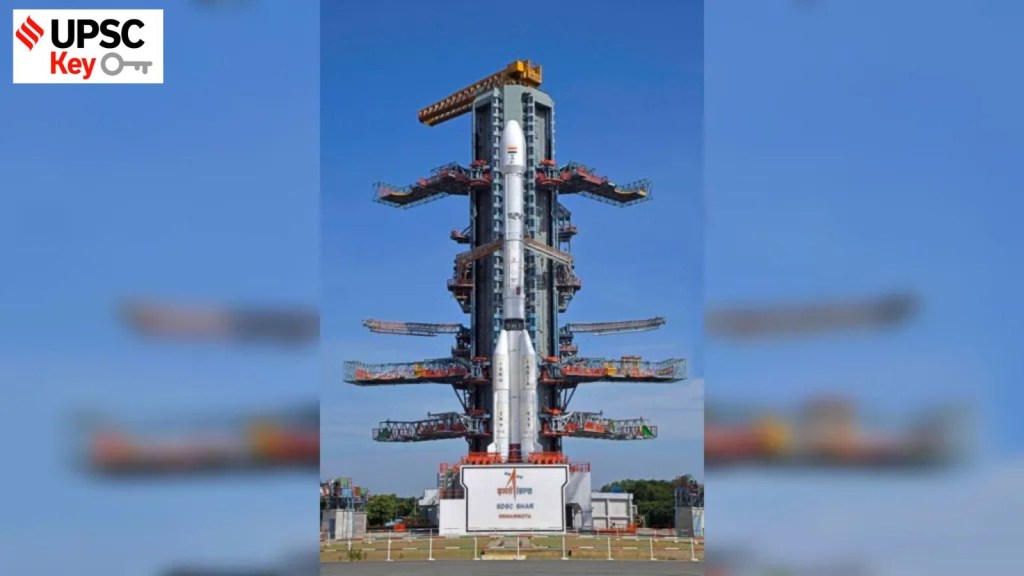 The GSLV-F-17 is the 19th flight of India's Geosynchronous Satellite Launch Vehicle. (X/@isro)
Important topics and their relevance in UPSC CSE exam for September 5, 2026. If you missed the September 4, 2026 UPSC CSE exam key from the Indian Express, read it here.
FRONT
GSLV sheds ‘naughty boy’ tag with India’s first geo-imaging satellite
Syllabus:

Preliminary Examination: Current events of national and international importance.
Mains Examination: General Studies III: Awareness in the fields of IT, Space, Computers, Robotics, Nano-technology, Bio-technology and issues relating to Intellectual Property Rights.
What’s the ongoing story: In its first launch since January, the Indian Space Research Organisation sent an earth observation satellite, EOS-05, to space early Friday morning, using a GSLV rocket. The launch breaks a slump after three failed missions in 2025 and 2026 with the satellites unable to reach their intended orbits.
Key Points to Ponder:
— What is a satellite? How does a satellite remain in orbit around the Earth?
— What is meant by orbital velocity and how does it vary with orbital altitude?
— Know about the major types of Earth orbits based on altitude?
— What is the difference between a geosynchronous orbit and a geostationary orbit?
— Why are different satellites placed in different types of orbits?
— What is a polar orbit? How is it different from an equatorial orbit?
— What is a Sun-synchronous orbit and why is it useful for Earth observation?
— What is a Geosynchronous Transfer Orbit (GTO)? Why is it used in placing satellites into higher orbits?
— What are the major differences among PSLV, GSLV, LVM3 and SSLV
— What are the objectives and applications of EOS-05?
— What is the significance of placing an Earth-observation satellite in a geosynchronous orbit?
— Examine the significance of cryogenic technology, indigenous launch capability and private-sector participation for India’s growing space sector.
Key Takeaways:
— The EOS-05 is India’s first dedicated imaging satellite to be placed in the geosynchronous orbit, about 36,000 km from Earth, from where it can keep constant watch over the country and provide real-time imaging service.
— With a 10-year mission life, the satellite is designed to image large areas of interest at frequent intervals for purposes such as monitoring natural disasters or keeping track of agriculture or forestry. It will also have defence uses.
— India has several other active earth observation satellites in the lower-earth orbits which circle Earth and periodically capture imagery over India. In the geosynchronous orbit, the satellite remains stationary relative to Earth, and is able to watch the same region continuously, without gaps.
— The GSLV-F17 rocket deposited the EOS-05 satellite in a transfer orbit, at an altitude of more than 190 km from Earth, about 18 minutes after the launch.
— From there, the satellite will perform a series of orbit-raising manoeuvres over the next few days to travel to the geosynchronous orbit, its final destination. Weighing more than 2,360-kg, the EOS-05 was the heaviest satellite to be carried by the GSLV rocket until now.
— The successful launch is a big relief for ISRO which has gone through one of its most difficult phases in the last two years. Three of the six missions launched in 2025 and 2026 turned out to be unsuccessful with the satellites unable to reach their intended orbits due to anomalies in the launch vehicle or the spacecraft engine. Because of this, subsequent missions went through extended reviews and checks to avoid another failure.
Do You Know:
— GISAT-1A or Geo Imaging Satellite — also referred to as EOS-05 under the new nomenclature system — is a replacement satellite for GISAT-1 (or EOS-03).
— The previous satellite, which was launched in 2021, failed to reach orbit after the cryogenic upper stage of the rocket failed to ignite. A failure analysis committee found that a malfunctioning valve led to insufficient pressure in the liquid hydrogen tank, causing the failure.
— This is India’s first earth observation satellite in a higher geosynchronous orbit. Most earth observation satellites are placed in low earth orbit.
Other Important Articles Covering the same topic:
📍After seven-month hiatus, ISRO to launch key satellite on September 4
📍ISRO launches EOS-05: What are the different types of satellite orbits, and why do they matter?
Previous year UPSC Prelims Question Covering similar theme:
Consider the following statements with regard to involvement of private entities in India’s space programme: (UPSC CSE, 2026)
1. The Indian National Space Promotion and Authorisation Centre (IN-SPACe) is an autonomous agency formed to facilitate participation of private entities.
2. Agnikul Cosmos launched the world’s first flight using a 3D-printed rocket engine.
3. Skyroot Aerospace has developed liquid fuel for GSLV.
Which of the statements given above is/are correct?
(a) 1 only
(b) 2 and 3 only
(c) 1 and 2 only
(d) 1, 2 and 3
EXPLAINED
The fissures driving the NRC demand in Manipur
Syllabus:
Preliminary Examination: Economic and Social Development – Sustainable Development, Poverty, Inclusion, Demographics, Social Sector Initiatives, etc.
Mains Examination: General Studies I: Population and Associated Issues.
What’s the ongoing story: The Union government Monday (September 1) decided to defer the 2027 Census in Manipur after a meeting of Union Home Minister Amit Shah, Manipur Governor Ajay Kumar Bhalla, Chief Minister Yumnam Khemchand Singh and Union Home Secretary Govind Mohan.
Key Points to Ponder:
— What is a Census? What are its major purposes in a country?
— How is a Census different from a sample survey?
— Which authority is responsible for conducting the Census in India?
— Know about the constitutional and legal framework governing the Census of India.
— What is the National Register of Citizens (NRC)? How does it differ from the Census?
— What is the legal framework governing citizenship in India?
— What are the different ways in which Indian citizenship can be acquired and lost?
— What is delimitation? Why is population data important for delimitation?
— What are the major demographic characteristics of the Northeast region of India?
— Examine the significance of the Sixth Schedule in India’s tribal governance framework.
— Locate Manipur and its neighbouring states and countries on the map.
— What is the role of the Governor in the administration of Scheduled Areas?
Key Takeaways:
— The Manipur government said the decision followed discussions on the demand that the Census be held only after implementation of the National Register of Citizens (NRC). The decision has brought into focus a demand that has been building in the state for several years.
— There are three overlapping concerns. The first is citizenship and demographic change. Civil society groups in the valley and the hill districts dominated by Nagas have long alleged that migration from Myanmar and elsewhere has altered Manipur’s demographic composition. They want an exercise to distinguish Indian citizens from illegal immigrants before population figures are recorded.
— The second is displacement caused by the ethnic conflict since May 2023. More than three years after the violence began, thousands remain displaced. Meitei groups argue that a Census conducted while people are living away from their original homes could record the demographic consequences of displacement rather than the state’s underlying population pattern. The Meitei Alliance, for instance, has said the Census should wait until internally displaced people return home.
— The third is political representation. Population figures from the Census will eventually be important for delimitation, and Manipur has not had a fresh delimitation implemented since the 1970s. Given the gap, it has the potential to change equations in the Manipur Assembly.
— The demand predates the May 2023 violence, although the influx of people from Myanmar and the conflict subsequently gave it a sharper political and security dimension.
— In June 2022, the Coordinating Committee on Manipur Integrity (COCOMI), representing Meitei civil society, and the United Naga Council (UNC) submitted a joint memorandum demanding an NRC and a State Population Commission, citing concerns over immigration and demographic change.
— On August 5 that year, the Manipur Assembly adopted a resolution seeking both. The resolution was reaffirmed on March 1, 2024.
Do You Know:
— Manipur has 60 Assembly seats: 40 in the valley and 20 in the hills. The valley is predominantly Meitei, while the hills are predominantly inhabited by Naga and Kuki-Zomi communities. The present political map goes back to the 1973 delimitation, based on the 1971 Census.
— A delimitation exercise based on the 2001 Census was undertaken nationally between 2002 and 2008, but Manipur, along with Assam, Arunachal Pradesh and Nagaland, was excluded after the Centre deferred the exercise in 2008 citing security concerns and amid challenges to the credibility of the 2001 Census data in the region.
Other Important Articles Covering the same topic:
📍Centre defers Census in Manipur following ‘NRC first’ demand by civil society groups
📍Explained: How India conducts its Census — and what is new in 2027
📍Seven years on, how Assam’s NRC process remains incomplete
Previous year UPSC Prelims Questions Covering similar theme:
(2) In the context of any country, which one of the following would be considered as part of its social capital? (UPSC CSE, 2019)
(a) The proportion of literates in the population
(b) The stock of its buildings, other infrastructure and machines
(c) The size of population in the working age group
(d) The level of mutual trust and harmony in the society
(3) With reference to India, consider the following statements: (UPSC CSE, 2021)
1. There is only one citizenship and one domicile.
2. A citizen by birth only can become the Head of State.
3. A foreigner once granted citizenship cannot be deprived of it under any circumstances.
Which of the statements given above is/are correct?
(a) 1 Only
(b) 2 Only
(c) 1 and 3
(d) 2 and 3
Where Open AI’s new Astra model stands amid rising security risks
Syllabus:
Preliminary Examination: Current events of national and international importance.
Mains Examination: General Studies III: Awareness in the fields of IT, Space, Computers, Robotics, Nano-technology, Bio-technology and issues relating to Intellectual Property Rights.
What’s the ongoing story: OpenAI has released GPT-6 Astra, its newest frontier artificial intelligence (AI) model, claiming gains in computer use, coding, long-running tasks and cybersecurity.
Key Points to Ponder:
— What is Artificial Intelligence (AI)? How is it different from traditional computer programmes?
— What is Machine Learning (ML)? How does it differ from AI?
— What is Deep Learning? How is it related to machine learning?
— What is Generative AI? How is it different from conventional AI systems?
— What are Large Language Models (LLMs)? How are they trained and what can they do?
— What is an AI agent? How is agentic AI different from a conventional chatbot?
— What is meant by autonomous decision-making in AI systems?
— What is reinforcement learning? How does it differ from supervised and unsupervised learning?
— What are the major capabilities of OpenAI’s latest frontier AI model?
— How can AI be used for cybersecurity?
— How can AI also create new cybersecurity risks?
— Know about the major applications of agentic AI.
— What are the major risks associated with increasingly autonomous AI systems?
Key Takeaways:
— It is also the first OpenAI system to cross what the company calls its “critical” cybersecurity capability threshold, under which a model can, with the right tools and access, find previously unknown security flaws and develop ways to exploit them across well-protected systems without a person guiding each step.
— This also holds importance in light of recent cases of AI agents undertaking unauthorised actions and exploiting vulnerabilities in external software.
— Astra began rolling out on Thursday (September 3) to a limited set of organisations. OpenAI said it would become available over the following days to ChatGPT Plus, Pro, Business and Enterprise users, as well as through its API and Amazon Web Services.
— OpenAI describes Astra as a model built for end-to-end work, rather than only answering prompts. In that sense, it is closer to more autonomous AI agents than models.
— It can operate computers and browsers, fill online forms, update customer records, organise calendars, conduct web research, draft material inside documents and email, analyse scientific data, generate plots, build websites, install and test software, and troubleshoot problems visible on a screen.
Do You Know:
— Artificial intelligence (AI) refers to the field of computer science which aims to make computer systems think, reason, learn, and act to solve a complex system like humans.
— This field of research was established in 1956 at a small workshop at Dartmouth College (New Hampshire, United States). It was organised by a young mathematician named John McCarthy, who had become intrigued with the idea of creating a thinking machine.
— He also persuaded Marvin Minsky of Harvard University, Nathaniel Rochester from IBM, and Claude Shannon from Bell Telephone Laboratories to help with the workshop. These four men are considered some of the founding fathers of AI.
— The term artificial intelligence was coined by McCarthy. “McCarthy later admitted that no one really liked the name — after all, the goal was genuine, not ‘artificial’, intelligence — but ‘I had to call it something, so I called it “Artificial Intelligence”,’” wrote Melanie Mitchell in her book, ‘Artificial Intelligence: A Guide for Thinking Humans’.
— To enable computer systems to imitate the way that humans learn, and perform tasks autonomously (meaning, without instructions), machine learning (ML) is used. ML is implemented by training (this term will also be explained in subsequent explainers) computers on data so that they can make predictions about new information.
Other Important Articles Covering the same topic:
📍OpenAI says upcoming model is so capable it requires stronger guardrails
📍OpenAI launches GPT-6 Astra, the AI model built to do more than answer questions
📍Runway unveils Solaris, an AI model that generates interactive app interfaces
📍AI basics: What are artificial intelligence and machine learning?
Previous year UPSC Mains Questions Covering similar theme:
(1) What is agentic Artificial Intelligence (AI) ? Explain its working. Describe its applications with suitable examples. Discuss the advantages, risks and challenges associated with agentic AI systems. (UPSC CSE, 2026)
(2) Introduce the concept of Artificial Intelligence (AI). How does AI help clinical diagnosis? Do you perceive any threat to privacy of the individual in the use of AI in healthcare? (UPSC CSE, 2023)
CJP cases scrapped: Supreme Court’s much debated powers under article 142
Syllabus:
Preliminary Examination: Indian Polity and Governance – Constitution, Political System, Panchayati Raj, Public Policy, Rights Issues, etc.
Mains Examination: General Studies II: Separation of Powers between various organs; Structure, Organization and Functioning of the Executive and the Judiciary.
What’s the ongoing story: This week, the Supreme Court used its special powers under Article 142 of the Constitution to quash FIRs filed against those who took part in the nationwide exam protests led by the Cockroach Janta Party (CJP).
Key Points to Ponder:
— Understand the Supreme Court’s constitutional position and jurisdiction.
— What is judicial review? How is it different from judicial interpretation?
— What is meant by separation of powers?
— What is Article 136? Understand the Supreme Court’s special leave jurisdiction.
— What is Article 142? What kind of power does it confer on the Supreme Court?
— How is the power under Article 142 different from the ordinary jurisdiction of the Supreme Court?
— What are the constitutional limits on the exercise of Article 142?
— Why has the exercise of Article 142 sometimes been described as raising concerns about judicial overreach?
— What issues concerning the scope and limits of Article 142 arise from the recent order?
— Examine the significance of Article 142 in protecting individual rights while maintaining the rule of law.
— Compare the recent use of Article 142 with its use in earlier landmark cases.
Key Takeaways:
— A bench led by Chief Justice of India Surya Kant and Justices Joymalya Bagchi and V Mohana closed the cases after the Centre said that it had “consciously decided“ not to pursue them, and ordered compensation, within three months, for families of students who died by suicide over the leak of the NEET-UG 2026 exam.
— All FIRs linked to the July protests were quashed except those involving roughly 2,873 individuals, said to have “serious and grave criminal antecedents”. During the hearing, CJP was also asked to make a statement in open court that it would call off a protest march planned on September 5. In effect, the court was the neutral venue to facilitate the government’s execution of a key demand made by CJP in July.
— This order, giving legal force to the government’s assurance, puts fresh focus on Article 142, a provision legal scholars have argued over since the Constitution came into force.
— The open-ended nature of Article 142 has made it one of the court’s most used tools. The provision, giving it extraordinary powers, has been invoked in a wide range of consequential cases —
(i) The 1989 Bhopal gas tragedy settlement to secure a $470 million payout from Union Carbide and quashing the criminal cases against the company.
(ii) The Ayodhya title dispute to settle the “preponderance of probability” and give five acres of land to the Muslim side.
(iii) To order the release of Rajiv Gandhi assassination case convict A G Perarivalan in 2022.
— The court can also use the provision to grant divorce if it finds the marriage has irretrievably broken down and in public interest litigations, among other cases.
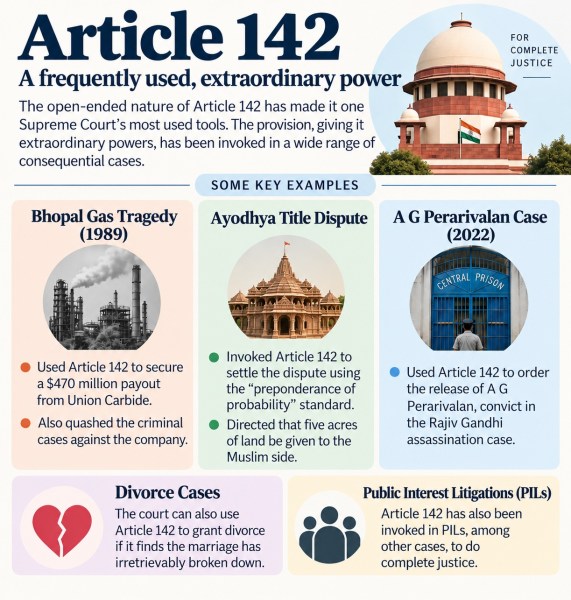 (Infographic generated by AI)
Do You Know:
— Article 142 lets the Supreme Court pass such “decree or order as it is necessary for doing complete justice in any cause or matter pending before it”. Unlike most Constitutional provisions, it does not define “complete justice” or specify when it may be used.
— The origins of this provision can be traced back to Section 210 of the Government of India Act, 1935, and beyond that, to the colonial-era practice of deciding disputes on “justice, equity and good conscience” where written law was silent.
— In the Draft Constitution, it appeared as Article 118 and was adopted by the Constituent Assembly on May 27, 1949, without a debate. Two amendments to it were moved and then withdrawn.
Other Important Articles Covering the same topic:
📍Threatening students for asking questions is misuse of power: Justice Ujjal Bhuyan
📍What is Article 142, invoked by Supreme Court to overturn Chandigarh mayoral poll results?
Previous year UPSC Prelims Question Covering similar theme:
(4) With reference to the Constitution of India, prohibitions or limitations or provisions contained in ordinary laws cannot act as prohibitions or limitations on the constitutional powers under Article 142. It could mean which one of the following? (UPSC CSE, 2019)
(a) The decisions taken by the Election Commission of India while discharging its duties cannot be challenged in any court of law.
(b) The Supreme Court of India is not constrained in the exercise of its powers by laws made by the Parliament.
(c) In the event of grave financial crisis in the country, the President of India can declare Financial Emergency without the counsel from the Cabinet.
(d) State Legislatures cannot make laws on certain matters without the concurrence of the Union Legislature.
Jobs to inflation: the likely factors behind mistrust in GDP data
Syllabus:
Preliminary Examination: Economic and Social Development – Sustainable Development, Poverty, Inclusion, Demographics, Social Sector Initiatives, etc.
Mains Examination: General Studies III: Indian Economy and issues relating to Planning, Mobilization of Resources, Growth, Development and Employment.
What’s the ongoing story: At the start of the week, the Union government released the economic growth rate for the April to June quarter, pegging growth at around 7.8%. This is, historically speaking, a very robust rate of economic growth. And yet, possibly for the first time, a section of the public is unwilling to accept the figure.
Key Points to Ponder:
— What is GDP? How is it different from GNP and GVA?
— What is the difference between real GDP and nominal GDP? Why is real GDP used to measure economic growth?
— How is India’s GDP calculated? Identify the major expenditure components of GDP.
— Understand the primary, secondary and tertiary sectors of the Indian economy..
— What is GDP deflator? How is it different from CPI and WPI?
— What is a base year? Why is it important in measuring economic growth?
— Who is responsible for compiling and releasing India’s GDP and national income estimates?
— What is per capita GDP? How is it different from aggregate GDP?
— What is potential GDP? What determines an economy’s potential output?
Key Takeaways:
— The most curious aspect of this mistrust in the latest official data is the trust placed in last year’s official data, which belongs to a now-discarded data series. What is even more odd is that this questioning seems to have been triggered by a patently flawed understanding of data by a former Finance Secretary, as explained here.
— For several years now, India’s GDP (gross domestic product, the measure of total economic output) data has been questioned by several academics, as well as international institutions such as the International Monetary Fund.
— Such critics, some of whom have earlier held senior positions in the government, have provided well-founded counters to official calculations and argued that India was overstating its economic output.
— In February this year, the government undertook a revision of the GDP series, along with that of other key data series such as retail inflation, apart from introducing new surveys to capture the economy more accurately.
— However, the first quarterly GDP data release under the new and reformed data series seems to run into mistrust. To be sure, while critics may still be demanding more transparency and improvements, none of the experts is arguing that the new series is worse than the previous one, which, demonstrated by the government’s own revision, was overstating the GDP.
Do You Know:
— The Ministry of Statistics and Programme Implementation (MoSPI) has released a new series of national income accounts, shifting the base from 2011-12 to 2022-23, alongside methodological reforms intended to align national accounts with existing economic realities.
— The GDP is the central metric to assess the annual economic growth or the overall size of an economy and the so-called “base year” refers to the year that works as a starting point for calculations. The GDP in 2022-23 is used as a “base” over which the GDP growth of any following year is calculated. This is the eighth such revision.
— In a major move, the new GDP series does not use the single-deflator method at all and instead uses double-deflation, adjusting input and outputs by their respective inflation rates – with deflators also being used at a more granular level. This allows for more accurate measurement of real GDP growth.
Other Important Articles Covering the same topic:
📍India’s industrial production index saw strong growth, but it hides weak consumer demand
📍Why India is expecting GDP surprise after best Q1 for loan growth in over a decade
📍A strong quarter quickens pace, but risks remain
Previous year UPSC Mains Questions Covering similar theme:
(1) Explain the difference between computing methodology of India’s Gross Domestic Product (GDP) before the year 2015 and after the year 2015. (UPSC CSE 2021)
(2) Define potential GDP and explain its determinants. What are the factors that have been inhibiting India from realising its potential GDP? (UPSC CSE, 2020)
ECONOMY
Why TATA Chemical’s Kenya ops are halted
Syllabus:
Preliminary Examination: Current events of national and international importance.
Mains Examination: General Studies III: Bilateral, Regional and Global Groupings and Agreements involving India and/or affecting India’s interests.
What’s the ongoing story: Kenyan President William Ruto’s order to halt Tata Chemicals’ operations in the African nation has put the Tata Group company on the defensive, with the firm saying on Friday (September 4) that it remained committed to resolving the dispute through “constructive engagement”.
Key Points to Ponder:
— What are the different forms of foreign direct investment (FDI) and how do they differ from portfolio investment?
— How does FDI contribute to economic development in the host country?
— What factors influence the decision of an Indian company to invest in a foreign country?
— How do natural resources and mineral wealth influence the economic and strategic interests of countries?
— What is meant by value addition in the context of natural-resource-based industries?
— What are the major institutional mechanisms through which Indian companies acquire or develop natural-resource assets overseas?
— Identify some major Indian public sector and private entities involved in overseas exploration, acquisition or development of natural-resource assets.
— Locate Kenya and Kajiado County on the map and examine their geographical and economic significance.
— What are the major natural resources and economic activities of Kenya?
— What is soda ash, and what are its major industrial applications?
Key Takeaways:
— This is the second major dispute between Kenya and an Indian entity after it cancelled the Adani Group’s Nairobi airport project.
— The current dispute centres on Tata Chemicals Magadi Ltd (TCML), which operates a soda ash plant at Magadi in Kenya’s Kajiado County. TCML is Africa’s largest producer of natural soda ash, used in a range of industries, such as glass manufacturing. It has been operating the facility for decades and says it remains fully compliant with regulatory requirements.
— Ruto has criticised Tata Chemicals over what he said was a lack of investment and development in Kajiado, where the Magadi operation is located. “That Tata company… had that contract for 100 years. They have not built anything in Kajiado, they have not built any factory in Kajiado,” Ruto said.
— He said the government would bring in two new companies to take over Tata Chemicals’ operations. Ruto’s main accusation is that Tata has extracted Kenya’s mineral resources without providing enough economic benefit to the local area or country.
— Specifically, he says Tata has operated under a very long-term contract but hasn’t built sufficient local industrial facilities. It has largely exported soda ash rather than creating more value-added manufacturing in Kenya.
— It hasn’t generated enough local jobs, investment and industrial development relative to the resources it extracts and has failed to meet what the government considers adequate obligations towards the local community. Tata Chemicals, however, has said that the Magadi operation has played an important role in the Kenyan economy since it acquired the plant in 2005.
— The immediate issue is a dispute between TCML and the Kenyan Ministry of Mining, Blue Economy and Maritime Affairs over matters relating to the company’s operations and regulatory compliance. TCML said it has acknowledged an official communication from the ministry dated July 28, 2026, and has submitted a comprehensive response to the matters raised by the government.
Do You Know:
— Earlier, the Adani Group proposed a long-term concession for Jomo Kenyatta International Airport (JKIA) in Nairobi, valued at roughly $2.5 billion. Under the proposal, Adani would finance major airport upgrades and operate the facility for an extended period. However, the deal quickly became controversial over concerns about transparency and due process.
— The proposal was privately initiated rather than subjected to a competitive tendering process recommended by consultants, while critics also argued that the public had not been adequately consulted.
— The proposal triggered strong protests across Kenya, with concerns ranging from airport sovereignty and user fees to employment and whether the government was offering Adani excessively favourable terms.
— The controversy intensified following bribery allegations against Gautam Adani and others in the US in 2024 — allegations Adani denied. President William Ruto subsequently cancelled the airport deal, and in February 2026, the Kenya Airports Authority formally confirmed the cancellation in court.
Other Important Articles Covering the same topic:
📍Tata Chemicals seeks regulatory resolution after Kenya President orders operations halt
📍‘Are we slaves to other people?’: Kenyan President orders Tata Chemicals to halt operations
UPSC Prelims Practice Question Covering similar theme:
(5) With reference to Indian entities involved in acquiring or developing natural-resource assets abroad, consider the following statements:
1. ONGC Videsh Limited is the overseas arm of ONGC and is engaged in exploration, development and production of oil and natural gas outside India.
2. NMDC Limited has overseas mineral interests, including through its investment in Legacy Iron Ore in Australia.
3. Khanij Bidesh India Limited (KABIL) has been established to identify, explore, acquire, develop, mine and process critical and strategic minerals and other minerals within India.
4. Oil India Limited has participating interests in overseas oil and gas assets.
Which of the statement/s given above is/are correct?
(a) 1 and 2 only
(b) 1, 2 and 4 only
(c) 2, 3 and 4 only
(d) 1, 2, 3 and 4
ALSO IN NEWS
Rubio visit likely in Oct, QUAD summit on G-20 margins in US being explored
— US Secretary of State Marco Rubio is likely to visit India in October, and officials are preparing for a possible summit of Quad leaders in December in the US, The Indian Express has learnt.
— The Quad summit — the grouping comprises the US, India, Japan and Australia — is likely to take place on the sidelines of the summit of G20 leaders which, under the US presidency, will take place at the Trump National Doral Miami in Doral, Florida, on December 14-15.
— Foreign Secretary Vikram Misri hosted a meeting of Quad Sherpas in New Delhi Thursday. It was attended by Sergio Gor, Special Envoy to South and Central Asia and Ambassador of US to India; Elly Lawson, Deputy Secretary, Strategic Planning and Coordination Group, Department of Foreign Affairs and Trade, Australia; and, Hiroyuki Namazu, Senior Deputy Minister for Foreign Affairs, Japan.
India in touch with Ukraine, Russia to help end war: EAM
— India has been in continuous touch with both Ukraine and Russia and is trying to see if there are ideas and suggestions that will contribute to the mitigation or the cessation of the conflict, External Affairs Minister (EAM) S Jaishankar said on Friday.
— Jaishankar, who is in Poland after visiting Ukraine, said that he discussed with his Poland counterpart Radoslaw Sikorski the complex global challenges, including supply chain resilience, and food, fuel and fertiliser security.
— “The Deputy Prime Minister and I also understandably discussed some major global and regional issues, notable among them is the war in Ukraine, now in its fifth year… I myself have just come here from Kyiv,” he said, referring to his visit to Ukraine a day earlier.
NSE gets SEBI node for IPO, may eye listing this month
— The decks have been cleared for what may be the country’s biggest-ever listing, as the markets regulator has approved the estimated Rs 30,000 crore IPO of the National Stock Exchange (NSE), over two months after it filed the papers, and about a decade after it first tried to hit the primary market.
— The country’s largest stock exchange may get listed as soon as this month, reports suggested. The approval clears a key regulatory hurdle for the exchange after it had first filed its IPO papers back in June. The price band for the issue is likely to be announced on September 15, with plans to list in the week starting September 21, Reuters reported, citing unnamed sources.
Forex reserves surge to new all time high of $740.8 bn
— India’s foreign exchange reserves climbed to a fresh all-time high of $740.8 billion in the week ending August 28, extending a sharp rebuilding of the country’s external buffer after the West Asia conflict had forced the Reserve Bank of India (RBI) to draw down reserves earlier this year.
— The reserves rose $11.48 billion during the week, after having jumped $12.42 billion to a then-record $729.33 billion in the previous week, according to RBI data. The latest level is an all-time high for India’s headline gross foreign exchange reserves in nominal dollar terms.
Ladakh clears new ‘nautor land’ regularisation rules, paves way for grant of proprietary rights
— Ladakh Lieutenant Governor Vinai Kumar Saxena on Friday approved the regularisation rules of ‘nautor lands’, paving the way for the grant of proprietary rights over eligible barren land and resolving a long-pending issue concerning thousands of landholders in the Union territory.
— Nautor land refers to barren or wasteland owned by the government and historically allotted to individuals for cultivation or other productive purposes. More than 60,000 acres of land in Ladakh is presently recorded in revenue records as nautor holdings.
— The new rules in Ladakh Autonomous Hill Development Councils (Nautor Regularisation) Rules, 2026, provide a comprehensive framework for granting proprietary rights over up to 10 acres of eligible nautor land to occupants across all seven districts of Ladakh, an official spokesperson said.
PRELIMS ANSWER KEY
1.(c) 2.(d) 3.(a) 4.(b) 5.(b)
🚨 Click Here to read the UPSC Essentials magazine for August 2026. Share your views and suggestions in the comment box or at manas.srivastava@indianexpress.com🚨
Subscribe to our UPSC newsletter. Stay updated with the latest UPSC articles by joining our Telegram channel – IndianExpress UPSC Hub, and follow us on Instagram and X.


Raveena Baneta is a consultant with the UPSC section of The Indian Express where she writes on Ethic... Read More
 Share


