
UPSC Key: Election Symbols, Greenland Deal and GDP deflator
Why the Article 22 of the Constitution is relevant to the UPSC exam? What is the significance of topics such as Asian Games, Rhesus Macaque, Article 371 (k) and US-China relations on both the preliminary and main exams? You can learn more by reading the Indian Express UPSC Key for September 22, 2026.
 UPSC Key August 2026: Here's what you should be reading from the September 22, 2026 edition of The Indian Express. (AP Photo)
Important topics and their relevance in UPSC CSE exam for September 22, 2026. If you missed the September 21, 2026 UPSC CSE exam key from the Indian Express, read it here
Front Page

SC raises bar on re-arrests, stresses Art 22
Syllabus:
Preliminary Examination: Indian Polity and Governance-Constitution, Political System, Panchayati Raj, Public Policy, Rights Issues, etc.
Mains Examination: General Studies II: Indian Constitution—historical underpinnings, evolution, features, amendments, significant provisions and basic structure.
What’s the ongoing story: Underlining that when an accused is released due to violation of his fundamental rights, he is not “enlarged on bail” but released from illegal and unconstitutional detention, the Supreme Court on Monday laid down strict guidelines for re-arresting a person if he was earlier released for not being provided grounds of arrest.
Key Points to Ponder:
• What Article 22 of the Constitution says?
• The Article 22 of the Constitution confers certain rights on a person who is arrested or detained under an ordinary law-What are they?
• The Article 22 of the Constitution grants protection to persons who are arrested or detained-know them in detail
• Know the Terms- Arrest, Detention, Remand, bail, Punitive detention and Preventive detention
• Establish the relationship between Articles 21 and 22 of the Constitution in safeguarding an individual’s personal liberty against arbitrary arrest and detention.
• Why is communication of the grounds of arrest considered an essential constitutional safeguard?
• What is meant by ‘due process’ in the context of arrest and criminal investigation?
• How does judicial oversight help prevent arbitrary deprivation of liberty?
Key Takeaways:
• The bench of Justices Ujjal Bhuyan and Atul S Chandurkar said the safeguards provided under Article 22 cannot be “tinkered with”.
• “Any breach or non-compliance would entail immediate release of the arrested person because such arrest is unconstitutional. We cannot tinker with the most important safeguards provided under Article 22,” the court said.
• The bench also directed high courts across the country to grant “suitable mandatory compensation” when arrests violate procedural safeguards.
• Detailing the procedure for seeking re-arrests in such cases, the bench said the accused should first be provided written grounds of arrest, and an application should be filed before a magistrate explaining why a re-arrest was necessary and why the grounds were not given the first time. It also said that the investigation should be assigned to another officer, and a departmental inquiry should be ordered into the previous arrest.
• The court said the power to re-arrest must not be “left to the discretion of the very same authority who had violated the said provision of the Constitution… It must have the judicial imprimatur”.
Do You Know:
• Article 22 is a fundamental right under the Constitution that provides for an accused to be produced before a magistrate within 24 hours of arrest, to be informed about the grounds of arrest, and to get legal representation.
• Article 22(1) applies across the spectrum including offences under the BNS or under special enactments. It is not statute specific. It is not a mere formality or a matter of procedure. It is a mandatory binding constitutional safeguard. When there is violation of the Constitution, question of prejudice or demonstrable prejudice does not arise. The safeguards adumbrated in Article 22(1) are not mere procedural safeguards; these are fundamental principles which are required to be followed in the event liberty of a person is sought to be curtailed,” the court said.
• It said the magistrate can allow re-arrest only when satisfied “that for bona fide reasons, the grounds of arrest could not be furnished to the arrestee at the first instance but furnished subsequent to his release”, and that the accused needs to be re-arrested.
• The SC ruling raises the bar for the state in arresting an individual, even in serious offences, and reiterates that procedural norms are sacrosanct when liberty is curtailed. The ruling lays down that the police would face negative consequences for violating constitutional safeguards.
• Article 22(1) provides for the accused to be informed about the grounds of arrest.
Other Important Articles Covering the same topic:
📍When detention becomes illegal: Key rulings and constitutional safeguards
Previous year UPSC Prelims Question Covering similar theme:
1) Consider the following statements: (UPSC, CSE, 2023)
1. According to the Constitution of India, the Central Government has a duty to protect States from internal disturbances.
2. The Constitution of India exempts the States from providing legal counsel to a person being held for preventive detention.
3. According to the Prevention of Terrorism Act, 2002, confession of the accused before the police cannot be used as evidence.
How many of the above statements are correct?
(a) Only one
(b) Only two
(c) All three
(d) None
In Japan’s Asiad, China’s growing footprint — on field, behind scenes
Syllabus:
Preliminary Examination: Current events of national and international importance.
Main Examination: General Studies II: Effect of policies and politics of developed and developing countries on India’s interests.
What’s the ongoing story: China arrived at the Aichi-Nagoya Asian Games as the continent’s dominant sporting power. With 38 medals, including 23 gold, they are already leading the medal table, a position they have occupied at every edition since 1982.
Key Points to Ponder:
• What are the Asian Games?
• How Asian Games is different from Olympic and Commonwealth Games?
• Asian Games 2026—Know the theme, objectives, institutional structure and significance
• How the objectives of Asian games evolved alongside changing geopolitical realities in Asia?
• How does the Asian Games includes both Olympic sports and sports with strong regional or cultural roots?
• How sporting events can contribute to international relations and people-to-people contacts?
• “The Asian Games can serve as an important instrument of India’s Act East policy and wider engagement with Asia”—
What is your opinion?
Key Takeaways:
• But there is another Chinese dominance at these Games, one that is less visible. Japan is hosting the Games, but China’s corporate presence is spread across different layers of the event, much of it away from the competition arenas.
• A Shanghai-based company is the host broadcaster, another Chinese company is involved in the opening and closing ceremonies, and there are others that have been roped in for supply of temporary power, venue technology, LED screens and sporting equipment.
• The most prominent is the China Media Group-International Media Port (CMG-IMP), the host broadcaster appointed by the Aichi-Nagoya Asian Games Organising Committee (AINAGOC) and approved by the Olympic Council of Asia (OCA).
• CMG-IMP is producing the international television footage and providing facilities and services to rights-holding broadcasters, including the beauty shots of Nagoya and Aichi prefecture. According to the OCA, 3,858 personnel are working for the host broadcaster, which is providing live coverage of 28 sports while leaving out 15.
• This is the first time that the Shanghai-based operation has been named the host broadcaster for an event held outside China. Hong Kong-based outlet Bastille Post reported that the CMG is also taking some of the production away from Japan, and doing it remotely from China.
• The broadcasting contract itself has an unusual history. AINAGOC’s first host-broadcast contract went to ISBHAO, a consortium involving Spain’s International Sports Broadcasting and China’s Yahao Sports Culture Media. This contract was later terminated, and AINAGOC conducted a new selection process. CMG-IMP eventually won the new contract for a reported sum of 5.156 billion yen (approx Rs 314 crore).
Do You Know:
• The 2026 Asian Games (also known as the XX Asiad) are currently underway in Aichi Prefecture and Nagoya, Japan, running from 19 September to 4 October 2026.
• According to Wikipedia, the 2026 Asian Games is an ongoing multi-sport event which are being held in Aichi Prefecture in Japan from 19 September to 4 October 2026, with several events starting from 10 September. Nagoya is the third Japanese city to host the Asian Games, after Tokyo in 1958 and Hiroshima in 1994. The event has returned to its traditional four-year cycle, after the 2022 edition was postponed to 2023 due to the COVID-19 pandemic. The Games marked the 75th anniversary of the 1951 Asian Games held in New Delhi, India.
Other Important Articles Covering the same topic:
📍From Asian Games to G20 Summit, how major international events have shaped Delhi through the years
📍At Asiad, all that glitters isn’t gold
Previous year UPSC Prelims Question Covering similar theme:
2) Consider the following statements in respect of the 32nd Summer Olympics: (UPSC, CSE, 2021)
1. The official motto for this Olympics is ‘A New World’.
2. Sport Climbing, Surfing, Skateboarding, Karate and Baseball are included in this
Which of the above statements is/are correct?
(a) 1 only
(b) 2 only
(c) Both 1 and 2
(d) Neither 1 nor 2
Previous year UPSC Mains Question Covering similar theme:
📍An athlete participates in Olympics for personal triumph and nation’s glory; victors are showered with cash incentives by various agencies, on their return. Discuss the merit of state sponsored talent hunt and its cultivation as against the rationale of a reward mechanism as encouragement. (UPSC, GS1, 2014)
Politics
‘Both sides will have something to say’: SC to hear TMC symbol case
Syllabus:
Preliminary Examination: Indian Polity and Governance
Main Examination: General Studies II: Salient features of the Representation of People’s Act.
What’s the ongoing story: The Supreme Court on Monday agreed to hear Mamata Banerjee’s petition challenging the Election Commission of India’s interim decision to freeze the name and ‘Flowers & Grass’ election symbol of the All India Trinamool Congress amid the factional feud within the party.
Key Points to Ponder:
• How election symbols are allotted?
• Election Symbols (Reservation and Allotment) Order, 1968-Know key highlights
• What are the Election Commission’s powers in a dispute over the election symbol?
• How did the EC deal with such matters before the Symbols Order came into effect?
• Is there a way other than the test of majority to resolve a dispute over election symbols?
• What happens to the group that doesn’t get the parent party’s symbol?
• Election Commission of India and Article 324 of the Constitution-Know in detail
• The independent and impartial functioning of the Election Commission-How it is ensured?
• Election Commission of India- Powers and Functions
• Chief Election Commissioner and the two other Election Commissioners have equal powers-True or False?
Key Takeaways:
• Senior Advocate Kapil Sibal, appearing for the petitioner, sought urgent listing of the matter. Sibal took exception to the Election Commission’s decision and said it was taken after the bypolls in two Assembly constituencies in West Bengal — Nandigram and Rejinagar — were announced.
• “Extraordinary things have happened. While the notification is on, despite the fact that the proceedings started in June, (and) we filed our reply in July, they don’t do anything, and then they issue a notification, and in the middle of the notification, they freeze the symbol. What’s going on? We just don’t understand how,” Sibal told the bench presided by Chief Justice of India Surya Kant and also comprising Justices Joymalya Bagchi and V Mohana.
• Chief Justice of India Kant pointed out that the other side will also have submissions to make and asked Sibal to wait till the matter is listed for hearing. “Both sides will have something to say. When the matter is listed, then argue. We will try to list,” the Chief Justice said.
• The Election Commission on September 18 ordered a freeze on the name and election symbol of Trinamool Congress and directed the two rival factions to select new names and symbols until the dispute is resolved.
Do You Know:
• After recognising the split in the Trinamool Congress and freezing the party’s name and symbol, the Election Commission allotted alternative names and symbols to the factions led by Mamata Banerjee and Arup Roy. The Banerjee-led faction will now be called ‘Mamata All India Trinamool Congress’ and its symbol is a ‘football player’. The rebel faction will be called the ‘Democratic Trinamool Congress’ and its symbol is an ‘envelope’.
• In its interim order, the Election Commission said, “On due consideration of the totality of information available on record…the Commission is of the opinion that there are two rival groups in All India Trinamool Congress, one led by Ms. Mamata Banerjee and the other led by Shri Arup Roy, and each group is now claiming to be the party and therefore the matter requires a substantive determination by the Commission under Para 15 of the Election Symbols (Reservation & Allotment) Order 1968.”
It added that the two factions would not be allowed to use the party’s name and “flowers and grass” symbol till the Election Commission’s final order in the dispute case. With both sides nominating candidates for the bypolls, the commission decided to issue an interim order allotting them new names and symbols for the time-being.
• The Para 15 of the Symbols Order, 1968, states: “When the Commission is satisfied… that there are rival sections or groups of a recognised political party each of whom claims to be that party the Commission may, after taking into account all the available facts and circumstances of the case and hearing (their) representatives… and other persons as desire to be heard decide that one such rival section or group or none of such rival sections or groups is that recognised political party and the decision of the Commission shall be binding on all such rival sections or groups.”
This applies to disputes in recognised national and state parties (like the LJP, in this case). For splits in registered but unrecognised parties, the EC usually advises the warring factions to resolve their differences internally or to approach the court.
Other Important Articles Covering the same topic:
📍Explained: When parties split, how does EC decide who gets the symbol?
Previous year UPSC Prelims Question Covering similar theme:
3) Consider the following statements: (UPSC, CSE, 2017)
1. The Election Commission of India is a five-member body.
2. Union Ministry of Home Affairs decides the election schedule for the conduct of both general elections and bye-elections.
3. Election Commission resolves the disputes relating to splits/mergers of recognised political parties.
Which of the statements given above is/are correct?
(a) 1 and 2 only
(b) 2 only
(c) 2 and 3 only
(d) 3 only
Previous year UPSC Mains Question Covering similar theme:
📍Discuss the procedures to decide the disputes arising out of the election of a Member of the Parliament or State Legislature under The Representation of the People Act, 1951. What are the grounds on which the election of any returned candidate may be declared void? What remedy is available to the aggrieved party against the decision? Refer to the case laws. (UPSC, GS2, 2022)
The Editorial Page
Greenland standoff ends. But with costs to NATO
Syllabus:
Preliminary Examination: Current events of national and international importance.
Mains Examination: General Studies II: Effect of policies and politics of developed and developing countries on India’s interests.
What’s the ongoing story: On the face of it, the deal between the US, Denmark and Greenland, announced last Friday, does not appear to confer on Washington powers substantially greater than those it already enjoys under the Greenland Defence Agreement.
Key Points to Ponder:
• Map Work-Denmark, Greenland and Pituffik
• The new US-Denmark deal for Greenland-What are the key takeaways?
• How much access did the US already have in Greenland?
• Why does the US want a Greenland presence?
• Greenland and Denmark-Connect the dots
• Why does Greenland matter to the US?
• What is the geopolitical significance of Greenland in the context of Arctic politics?
• “Greenland’s rich natural resources are often cited as a reason for its increasing global relevance”-What is your opinion?
• The Arctic region is often described as a “global commons.”-Why?
• What are the challenges and opportunities associated with treating Arctic territories, including Greenland, as a shared resource among nations?.
• Examine the role of international law, particularly the United Nations Convention on the Law of the Sea (UNCLOS), in resolving disputes over Arctic sovereignty and resources.
• How does Greenland fit into the United Nations Convention on the Law of the Sea (UNCLOS) framework?
Key Takeaways:
• Signed in 1951 against the backdrop of the emerging Soviet threat, that pact gave the US broad rights to construct and operate military facilities in Greenland, as well as access to its airspace and waters for military purposes. The new deal may expand the US military presence and give Washington a veto over third-party military activity and certain sensitive investments, but much of what President Donald Trump is presenting as “permanent control” appears to have roots in the existing arrangement.
• What the deal does, however, is seemingly close a chapter of repeated coercion and intimidation by Trump over his desire to “own” Greenland, a semiautonomous territory of Denmark.
• The full details of the deal are not yet public, but it appears to offer something to all parties. Trump, with an approval rating well underwater, gets to present it as a diplomatic victory to American voters ahead of the November midterm elections.
• For Greenland and Denmark, it appears to remove, at least for now, the threat of a US attempt to take control of the territory — no small achievement given that only nine months ago, Denmark and other NATO allies deployed troops to Greenland in response to Trump’s threat of a takeover. The deal’s true significance, if Trump’s overtures to Russia and his criticism of Europe over the past 18 months are anything to go by, lies in what it could mean for the unity and coherence of NATO — particularly at a time when Europe is bracing for the possibility of a Russian escalation on its eastern flank.
Do You Know:
• Greenland is a self-governing territory within the Kingdom of Denmark. Under the 2009 Self-Government Act, its government exercises wide legislative and executive powers, while Greenlanders retain the right to determine the island’s future.
• While the full text of the agreement has not been made public, statements released by the US and Denmark indicate that the deal would give the US permanent security access in Greenland while leaving Danish sovereignty intact. Trump said the US would have the ability to do what it considered necessary for Greenland’s defence and security, and that adversaries would be barred from establishing bases, a military presence or making sensitive investments there without US approval. Denmark, on the other hand, described the deal as strengthening security in the Arctic and North Atlantic, while reaffirming the sovereignty and territorial integrity of the Kingdom of Denmark and Greenlanders’ right to self-determination.
• The US already had very broad military access to Greenland under the 1951 defence agreement, including free movement between defence areas by land, sea and air. US aircraft could overfly and land in Greenland subject to the agreement. The agreement remains in force.
• Those rights were not unlimited. New US defence areas or facilities still required agreement with Denmark, and the 2004 update designated Pituffik, then Thule Air Base, as the US defence area while creating consultation mechanisms with Greenland’s government. That means Trump’s description of the new deal as “permanent control” may overstate how much has changed in practice. The US already had a military presence, access to Greenlandic airspace and the ability to operate Pituffik.
• The US has long expressed varying degrees of interest in possessing and controlling the territory. In 1867, then US Secretary of State William Seward explored the possibility of acquiring Greenland and Iceland, although Washington never made a formal claim.
• During World War II, after Nazi Germany occupied Denmark, the US entered into a 1941 agreement that allowed it to establish airfields and other defence facilities in Greenland while recognising Danish sovereignty over the island. After the war ended, US President Harry S Truman in 1946 offered $100 million to Denmark for Greenland, after previously considering exchanging some portions of Alaska for parts of Greenland.
• In 1951, the US entered into a defence agreement with Denmark, allowing it extensive military access across Greenland and the right to establish agreed defence areas. It was later supplemented by a 2004 agreement, which designated Thule Air Base, now Pituffik Space Base, as the only US defence area in Greenland.

• American interest in Greenland is rooted in geostrategy. From a military standpoint, Greenland’s location is significant, serving as a vital base of operations during the Cold War (1945-91). The US operates the sprawling Pituffik Space Base, which hosts an early-warning radar system used by the US and NATO to detect missile threats and monitor activity in the Arctic.
—Its location between North America and the Arctic also makes Greenland important to US plans for monitoring Russian and other military activity in the region. In recent years, China and Russia have reportedly scaled up their military capabilities in the Arctic, according to an Arctic Institute research paper.
—Greenland also has large deposits of rare earth elements and other critical minerals, which are extensively used in mobile phones, electric vehicles and other consumer electronics, as well as in bombs and other weapons. China is currently the leading supplier of many rare earth elements globally.
• Greenland’s mineral wealth has therefore become part of the wider strategic competition over critical-mineral supply chains. In 2021, Greenland banned mining of deposits containing uranium above a specified threshold, a decision that stalled development of the large Kvanefjeld rare-earth project.
Other Important Articles Covering the same topic:
📍‘Dream come true’: Trump on new US-Denmark deal for Greenland
📍Trump says US has ‘permanent control’ over Greenland security: What the deal actually does
Previous year UPSC Prelims Question Covering similar theme:
4) Which one of the following statements best describes the ‘Polar Code’? (UPSC, CSE, 2022)
(a) It is the international code of safety for ships operating in polar waters.
(b) It is the agreement of the countries around the North Pole regarding the demarcation of their territories in the polar region.
(c) It is a set of norms to be followed by the countries whose scientists undertake research studies in the North Pole and South Pole.
(d) It is a trade and security agreement of the member countries of the Arctic Council.
Previous year UPSC Mains Question Covering similar theme:
📍What are the economic significances of discovery of oil in Arctic Sea and its possible environmental consequences? (UPSC, GS2, 2015)
Explained
Article 371 A to J, and what K can do for Ladakh
Syllabus:
Preliminary Examination: Indian Polity and Governance-Constitution, Political System, Panchayati Raj, Public Policy, Rights Issues, etc.
Mains Examination: General Studies II: Indian Constitution—historical underpinnings, evolution, features, amendments, significant provisions and basic structure.
What’s the ongoing story: The Union government has proposed inserting a new Article 371K in the Constitution to provide special Constitutional safeguards for Ladakh. The proposal follows an “in-principle understanding” between the Ministry of Home Affairs and representatives of the Apex Body, Leh (ABL) and Kargil Democratic Alliance (KDA) to create a directly elected Union Territory-level body with legislative, executive, financial and planning powers.
Key Points to Ponder:
• What were the demands in Ladakh?
• Why has Ladakh been demanding constitutional safeguards?
• What is the Sixth Schedule?
• How are the new regulations different from existing provisions?
• How do they compare with Jammu & Kashmir’s protections?
• Part XXI of the constitution says what?
• What Article 371 of the constitution?
• What protections does Article 371 offer?
• Articles 371 to 371-J in Part XXI of the Constitution of India contain special provisions for certain states-know in detail
• What is the purpose of Article 371?
• Article 371 (k) for Ladakh-Why?
• What exactly Article 371 (k) says?
• How would Article 371(K) differ from the Sixth Schedule?
Key Takeaways:
• The proposed arrangement would provide for a directly elected governing body with legislative powers over areas including land, culture and language, forests, environment and natural resources.
• But there is no draft yet, and several key questions remain unresolved, including executive, financial and planning powers, as well as control over police and law and order. Further talks are expected in October. Representatives from Ladakh have said that without a draft spelling out the powers of the proposed body, the offer remains incomplete.
• The proposal builds on an “in-principle understanding” reached in earlier rounds of talks in May and July, when the Centre and Ladakh representatives discussed restoring democracy in the region and creating tailor-made constitutional safeguards under Article 371.
• Ladakh’s demand for greater political and constitutional protection dates back to the reorganisation of Jammu and Kashmir in August 2019. There was initially considerable enthusiasm, particularly in Leh, after Ladakh was made a separate Union Territory. The Buddhist-dominated Leh district had long sought UT status, arguing that it had been neglected by the erstwhile Jammu and Kashmir government. That waned after it became clear that while the Union Territory of Jammu and Kashmir would have a legislature, Ladakh would not.
Do You Know:
• Articles 371 and 371-A through J contain “special provisions” for specific states. These provisions vary considerably from state to state, but broadly seek to protect local political, cultural, social or economic interests.
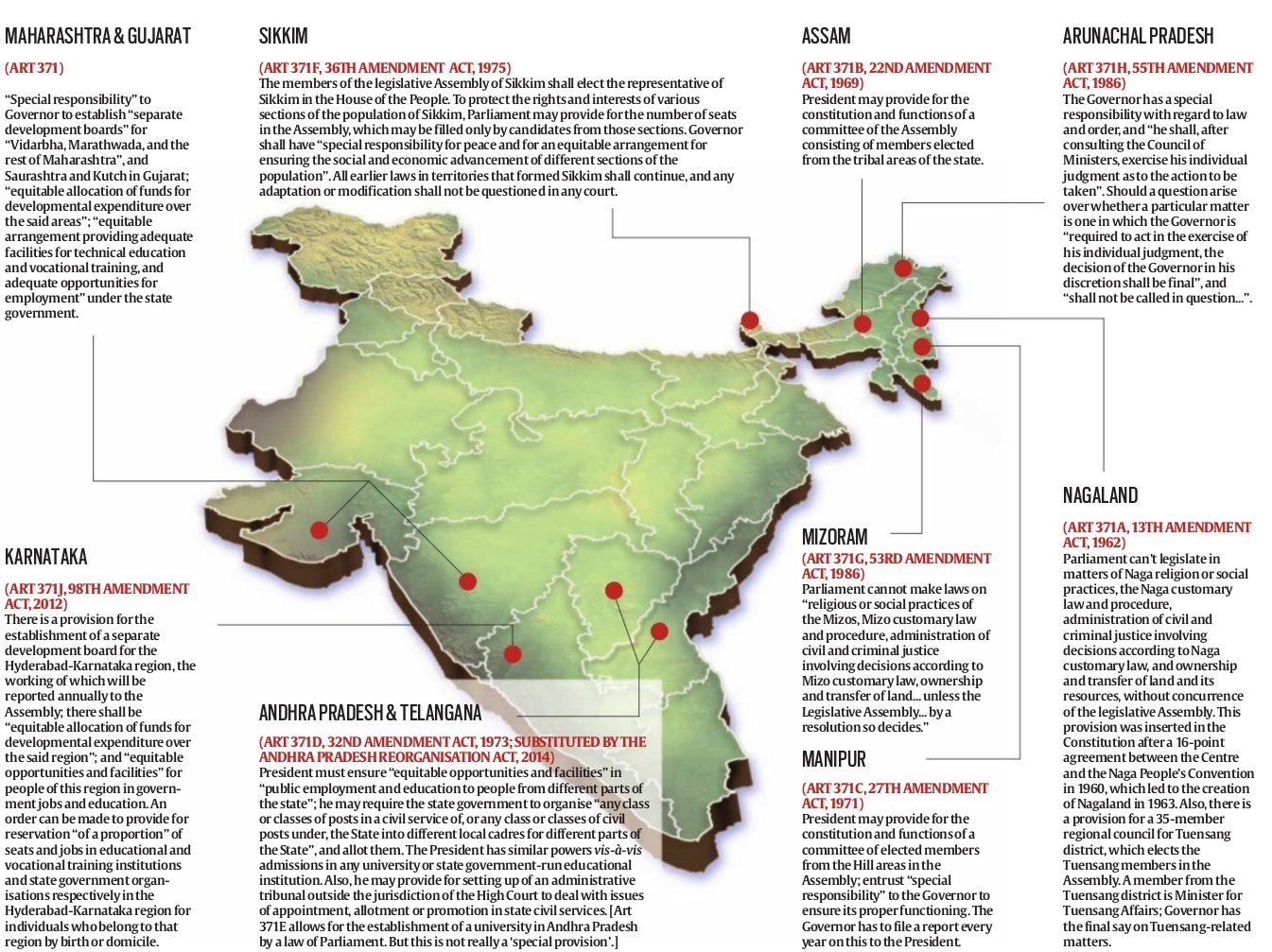 Special provisions for several states.
• When the Constitution first came into force, Article 371 required the creation of development boards for certain regions of Maharashtra and Gujarat. More provisions were added as new states were created and specific political arrangements evolved. Under Article 371-A, for example, laws made by Parliament relating to Naga religious or social practices, customary law and procedure, and ownership and transfer of land and resources do not automatically apply to Nagaland unless the state Assembly agrees. Similar protections have been extended to Mizoram under Article 371-G.
• Articles 371-B and 371-C provide for special committees within the Legislative Assemblies of Assam and Manipur, while Article 371-F provides special arrangements for representation in the Sikkim Assembly. Special provisions also exist for Arunachal Pradesh and Goa. If Article 371(K) is introduced for Ladakh, it would mark a significant departure from this pattern because Ladakh is a Union Territory, not a state.
• The Sixth Schedule creates autonomous district-level institutions with constitutionally defined powers. The proposed Article 371(K), by contrast, appears to be aimed at creating a directly elected governing body at the Union Territory level with legislative authority over specified subjects. This would give Ladakh a separate constitutional arrangement, rather than simply extending the Sixth Schedule to the Union Territory. The exact difference will depend on the wording of the draft.
Other Important Articles Covering the same topic:
📍What is Article 371(K), and what could it mean for Ladakh?
Previous year UPSC Prelims Question Covering similar theme:
5) The provisions in Fifth Schedule and Sixth Schedule in the Constitution of India are made in order to (UPSC, CSE, 2015)
(a) protect the interests of Scheduled Tribes
(b) determine the boundaries between States
(c) determine the powers, authority and responsibilities of Panchayats
(d) protect the interests of all the border States
Previous year UPSC Mains Question Covering similar theme:
📍Recent directives from Ministry of Petroleum and Natural Gas are perceived by the ‘Nagas’ as a threat to override the exceptional status enjoyed by the State. Discuss in light of Article 371A of the Indian Constitution. (UPSC, GS2, 2013)
Conservation, compensation: Tackling Himachal monkey menace
Syllabus:
Preliminary Examination: General issues on Environmental ecology, Bio-diversity and Climate Change – that do not require subject specialization.
Main Examination: General Studies III: Conservation, environmental pollution and degradation, environmental impact assessment.
What’s the ongoing story: The death of 63-year-old Satya Devi Chauhan in Shimla this month brought the unresolved question of human-wildlife conflict to the forefront once again. Chauhan, a widow, suffered grievous injuries, including spinal damage, after being attacked by a pack of rhesus macaques on the roof of her house on August 30. She was on ventilator support at the city’s Indira Gandhi Medical College & Hospital, before she passed away on September 5.
Key Points to Ponder:
• What you know about Rhesus Macaque?
• What are the key differences between a rhesus macaque and a Bonnet macaque?
• Why rhesus macaques increasingly entering human settlements?
• Rhesus monkeys are found in large numbers, so why is their protection necessary?
• How can Human-Animal conflicts be managed better?
• What is the significance of the Rhesus Macaque in ecological pyramid?
• What is the significance of the Wild Life (Protection) Act, 1972 in India’s wildlife conservation framework?
• What is meant by habitat fragmentation?
Key Takeaways:
• The incident has brought the legal and administrative position of rhesus macaques, also called rhesus monkeys, into focus. The Wild Life (Protection) Act, 1972, listed the rhesus macaque as a protected species under Part I of Schedule II, but the Wild Life (Protection) Amendment Act, 2022, removed it.
• The practical consequence has been a shift in institutional responsibility. Chief Wildlife Warden of Himachal Pradesh, Alok Prem Nagar, told The Indian Express, “Practically, the state forest departments are now no more responsible for looking after the monkey menace. A monkey is now like a stray animal, which falls under the purview of civic bodies including urban local bodies (ULBs), that is, municipal corporations, nagar panchayats, etc.”
• A senior Indian Forest Service (IFoS) officer, who is among others representing Himachal Pradesh before a Parliamentary Consultative Committee (PCC) of the Union Ministry of Environment, Forest and Climate Change (MoEFCC) on this issue, told The Indian Express, “MoEFCC constituted a PCC to address many issues pertaining to the human-wildlife conflict. The foremost issue was the changed scenario after excluding the monkeys from the list of protected animals. States like Himachal Pradesh, Uttarakhand have been facing similar problems after the changed scenario.”
• According to the IFoS officer, state forest departments earlier used to receive funds to control the monkey menace from the Compensatory Afforestation Fund Management and Planning Authority, a national-level statutory body functioning under the MoEFCC. Now, with the rhesus monkey no longer a protected animal, the officer added, ULBs across India are yet to receive any consolidated or dedicated funds towards this end from the Central government.
Do You Know:
• The rhesus macaque (Macaca mulatta) is one of the most successful, adaptable, and widely studied primates in the world. Native to South, Central, and Southeast Asia, these monkeys are highly intelligent, deeply social, and famous for their ability to thrive in close proximity to human populations.
• Human-rhesus macaque conflict is a rapidly escalating issue across South Asia, particularly in northern India (such as Himachal Pradesh and Uttarakhand) and Nepal. As highly adaptable, semi-terrestrial primates, rhesus macaques (Macaca mulatta) have transitioned from forest dwellers to urban and agricultural fixtures. This shift has resulted in severe economic losses, structural damage, and public safety crises, legally reframing how governments balance wildlife conservation with public protection.
Other Important Articles Covering the same topic:
📍Rhesus Monkeys are enough in numbers, so why do they need legal protection? An expert explains
Previous year UPSC Prelims Question Covering similar theme:
6) Which one of the following groups of animals belongs to the category of endangered species? (UPSC, CSE, 2012)
(a) Great Indian Bustard, Musk Deer, Red Panda and Asiatic Wild Ass
(b) Kashmir Stag, Cheetal, Blue Bull and Great Indian Bustard
(c) Snow Leopard, Swamp Deer, Rhesus Monkey and Saras (Crane)
(d) Lion-tailed Macaque, Blue Bull, Hanuman Langur and Cheetal
The World
Of historic significance’: China on Xi’s visit to US
Syllabus:
Preliminary Examination: Current events of national and international importance.
Mains Examination: General Studies II: Effect of policies and politics of developed and developing countries on India’s interests.
What’s the ongoing story: This Wednesday (September 23), Chinese President Xi Jinping will arrive in Washington, DC, for a state visit to the United States. US President Donald Trump, in a rare move, is expected to personally greet Xi at the Joint Base Andrews military base in Washington.
Key Points to Ponder:
• Know the evolution of China-US relations since the establishment of diplomatic relations in 1979.
• What are the major factors that have shaped China-US relationship?
• Why are China and the United States considered the two most consequential economic powers in the contemporary global order?
• The China-US trade relationship illustrates the paradox of globalisation: deep economic interdependence alongside strategic rivalry”—Do you agree?
• How can tariff wars between major economies like US and China affect India?
• What are the opportunities and challenges arising from US-China trade tensions for India?
Key Takeaways:
• Ten years after Xi last met Trump in the US for a state visit, much has unfolded in bilateral ties and the world at large, including several rounds of tariff wars and two major ongoing wars in Europe and Asia. Over the last few years, analysts have avoided predicting that such meetings might result in any breakthroughs or landmark agreements. As one headline for an opinion column in the Financial Times put it, “The main Trump-Xi summit achievement will be it happening at all”.
• While China-US relations have remained significant for the world at large over the decade, they have witnessed increasing instability and disagreements. In that context, the muted expectations make logical sense.
• That the two largest economies should find room for cooperation matters as a goal in itself. What makes the US and China’s case all the more important is the sheer scale of the brute power they wield. Looking at the simple metric of Gross Domestic Product (GDP), the US stands at $32 trillion, the Chinese economy trails with a large gap at $20 trillion, and Germany stands in third position with an even larger gap at over $5 trillion.
• Their economic might ensures that no matter the concern at hand — wars, emerging technology, climate action, or anything else — these countries can shape global debate and action. Going into this meeting, two main areas of concern stand out.
• Ahead of Xi’s visit, Chinese Vice Premier He Lifeng will lead a delegation to the US for economic and trade consultations with US Treasury Secretary Scott Bessent from September 19 to 23. Throughout 2025, too, when tariffs imposed by the US marked the beginning of a long-drawn tit-for-tat tariff war, these leaders were involved in negotiations.
Do You Know:
• US-China relations are at a critical juncture as Chinese President Xi Jinping prepares for a high-stakes state visit to the United States from September 23 to 25, 2026, at the invitation of US President Donald Trump. This marks the second in-person summit between the two leaders within six months, highlighting intensified efforts to establish “constructive strategic stability” amid profound economic, technological, and geopolitical friction.
• Following a surge of US tariffs and subsequent Chinese countermeasures, economic teams from both countries held intensive talks in New York. While Beijing continues to push for economic engagement as the relationship’s “ballast”, the upcoming summit is missing a corporate delegation from China, signaling that major business breakthroughs are unlikely.
Other Important Articles Covering the same topic:
📍Behind the Xi-Modi thaw, a larger US-China game
Previous year UPSC Mains Question Covering similar theme:
📍‘The West is fostering India as an alternative to reduce dependence on China’s supply chain and strategically to counter China’s political and economic dominance.’ Explain this statement with examples. (UPSC, GS2, 2024)
📍“The USA is facing an existential threat in the form of China, that is much more challenging than the erstwhile Soviet Union.” Explain. (UPSC, GS2, 2021)
Economy
New GDP series: 28 out of 30 mfg categories used double deflation
Syllabus:
Preliminary Examination: Economic and Social Development
Mains Examination: General Studies III: Indian Economy and issues relating to planning, mobilization, of resources, growth, development and employment.
What’s the ongoing story: The new GDP series used the ‘double deflation’ method in 28 of 30 categories for the manufacturing sector, the statistics ministry’s ‘Sources and Methods’ document, released on Monday, said. It added that work is on so that double deflation can be used in the remaining two categories too.
Key Points to Ponder:
• What is Gross Domestic Product (GDP)?
• What are the production, income and expenditure approaches to measuring GDP.
• Compare and contrast between Gross Domestic Product (GDP), Gross Value Added (GVA) and Net Domestic Product (NDP).
• Why is GVA important for analysing sectoral economic performance?
• What is a base year in national income accounting?
• Why is periodic revision of the base year necessary for measuring economic growth accurately?
• Compare and contrast between nominal GDP and real GDP.
• Why is real GDP generally preferred for assessing changes in the volume of economic activity?
• What is a GDP deflator?
• How GDP deflator differ from the Consumer Price Index (CPI) and Wholesale Price Index (WPI)?
• What are the arguments and accusations about GDP deflator?
Key Takeaways:
• The two manufacturing sector categories for which the so-called ‘single extrapolation’ method has been used are ‘production, processing and preservation of meat, fish, fruit, vegetables, oils and fats’ and ‘manufacture of pharmaceutical; medicinal chemicals and botanical products’.
• In these two categories, the share of imported inputs is high. This makes it “challenging” to directly map input items with their elementary, item-level output Producer Price Index, the Ministry of Statistics and Programme Implementation (MoSPI) said.
• To find the value added by a sector – or the Gross Value Added (GVA) – the value of inputs it uses is subtracted from the value of output it produces. This is GVA in current prices, or nominal terms. To find the GVA after accounting for changes in prices – or real GVA – the output and input values are adjusted by their respective inflation rates. This is called double deflation.
Do You Know:
• The Double Deflation Method is an economic technique used to calculate real Gross Value Added (GVA) or real GDP by separately adjusting total output and intermediate input costs for price changes.
• GDP is calculated by summing together the value created — or Gross Value Added (GVA) — by each sector, adding indirect taxes collected by the government, and subtracting subsidies given. This GVA is the difference between the value of what a sector produces (output) and the raw materials (inputs) it uses. This is the “nominal” GVA, or GVA in current prices. The trouble begins while calculating “real” GVA.
• Until now, the value of inputs and outputs for each sector and the various subcategories were “deflated” by the same number, except for agriculture and mining and quarrying.
This number was either the Consumer Price Index (retail inflation), the Wholesale Price Index (wholesale inflation) or one of their sub-indices, depending on what is to be deflated. Then the “real” input value was subtracted from the “real” output value to arrive at “real” GVA. This process is called “single deflation”.
• The single deflation method works fine when prices of inputs and outputs are changing at the same rate; when they don’t, there’s a problem. Ideally, the value of inputs should be adjusted by input inflation and outputs by output inflation. This is called double deflation and ensures that the real GVA is accurate.
• In the 2022-23 GDP series, MoSPI made the move to double deflation after repeated criticism that single deflation was leading to either underestimation or overestimation of real growth, depending on how input and output prices were moving.
Other Important Articles Covering the same topic:
📍India’s latest GDP revisions: How, and why, does GDP data get updated?
Previous year UPSC Prelims Question Covering similar theme:
7) In the context of Indian economy, consider the following statements: (UPSC, CSE, 2011)
1. The growth rate of GDP has steadily increased in the last five years.
2. The growth rate in per capita income has steadily increased in the last five years.
Which of the statements given above is/are correct?
(a) 1 only
(b) 2 only
(c) Both 1 and 2
(d) Neither 1 nor 2
Previous year UPSC main Question Covering similar theme:
📍Define potential GDP and explain its determinants. What are the factors that have been inhibiting India from realizing its potential GDP? (UPSC, GS3, 2020)
📍Explain the difference between computing methodology of India’s Gross Domestic Product (GDP) before the year 2015 and after the year 2015. (UPSC, GS3, 2021)
|
PRELIMS ANSWER KEY |
|
1.(b) 2.(b) 3.(d) 4.(a) 5.(a) 6.(a) 7.(d) |
For any queries and feedback, contact priya.shukla@indianexpress.com
Subscribe to our UPSC newsletter. Stay updated with the latest UPSC articles by joining our Telegram channel – IndianExpress UPSC Hub, and follow us on Instagram and X.


Priya Kumari Shukla is a Senior Copy Editor in the Indian Expre... Read More
 Share


