
UPSC Key: Election Commissioners meet, Maharashtra drought and Bank unions strike
How is knowing about the captive coal plants relevant to the UPSC exam? What significance do topics such as offshore mineral blocks, the Election Commission, and the Maharashtra drought hold for both the preliminary and main examinations? You can learn more by reading the Indian Express UPSC Key for September 27, 2026.
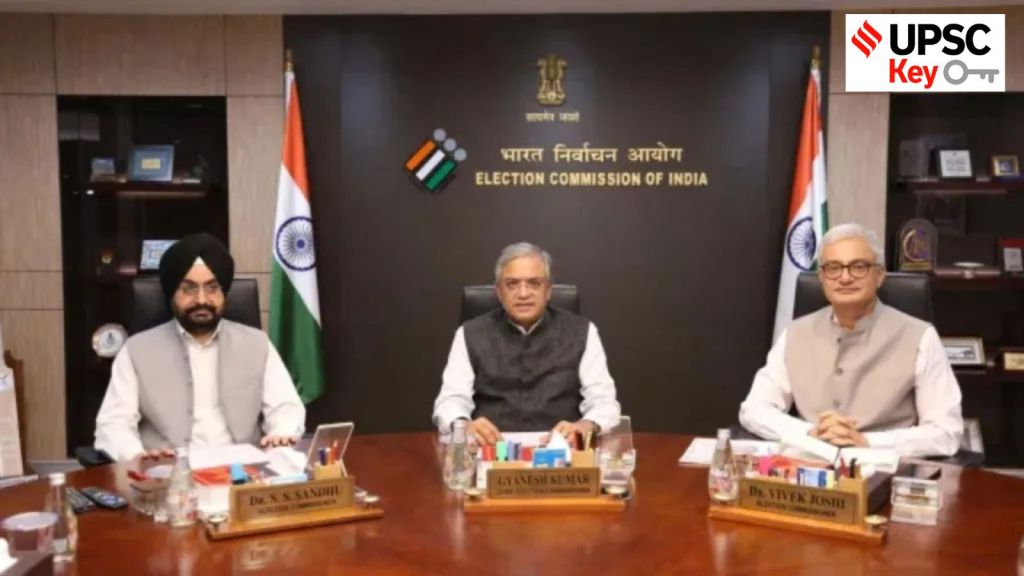 The Commission, comprising Chief Election Commissioner Gyanesh Kumar, and ECs Sandhu and Joshi, held a meeting at 3pm on Saturday. Know more in our UPSC Key. (Express photo)
Important topics and their relevance in UPSC CSE exam for September 27, 2026. If you missed the September 26, 2026 UPSC CSE exam key from the Indian Express, read it here
FRONT
Disquiet within, all three Election Commissioners meet, take first steps
Syllabus:
Preliminary Examination: Current events of national and international importance.

Mains Examination: General Studies–II: Appointment to various Constitutional Posts, Powers, Functions and Responsibilities of various Constitutional Bodies.
What’s the ongoing story: In its first meeting since The Indian Express reported on the deep divide within the Election Commission over the past 10 months, the poll panel on Saturday sought to address several concerns raised by its two commissioners Sukhbir Singh Sandhu and Vivek Joshi.
Key Points to Ponder:
— Read about the Election Commission of India (ECI) in detail.
— Read Article 324 of the Constitution. What powers and responsibilities does it give to the ECI?
— What is meant by the ECI’s “superintendence, direction and control” over elections?
— How is the ECI constituted? What does the Constitution say about the number of Election Commissioners?
— How are the Chief Election Commissioner (CEC) and other Election Commissioners appointed?
— What is the role of the CEC in the Commission?
— Why was the ECI made a multi-member body? How are decisions taken in a multi-member Election Commission?
— What is SIR? What are the concerns related to it?
— What is the ECINet portal?
— Read about the Chief Election Commissioner and Other Election Commissioners (Appointment, Conditions of Service and Term of Office) Act, 2023.
— What are the constitutional and statutory safeguards for the independence of the ECI?
Key Takeaways:
— Electors who were issued notices for “logical discrepancies” and for being “unmapped” in the ongoing Special Intensive Revision (SIR) of electoral rolls will not be required to attend hearings to establish their eligibility, a statement issued by the ECI said.
— This exemption from in-person hearings will be a relief to lakhs of electors who were issued notices in the ongoing SIR. The decision comes as hearings are being held across states on the basis of system-generated notices.
— “Unmapped” voters are those whose names did not figure in the rolls of the previous intensive revision, and who were unable to provide the names of their parents or grandparents too during that revision.
— “Logical discrepancies” refers to certain discrepancies flagged by the ECI’s centralised software based on which voters are issued notices following which they need to submit additional documentary proof to stay in the rolls.
— “In case of any person to whom notice has been issued during the ongoing SIR, for being unmapped and logical discrepancies, BLOs will visit the homes of such persons for collection of documents and thereafter upload them on the ECINet, for decision by the ERO. Such persons need not be called for hearing to ERO/AERO office. Only in exceptional circumstances, as decided by the ERO, the hearing will be held preferably online. Any adult member of the family can be authorised by the elector to attend the hearing on their behalf, if required,” the EC announced.
— The Commission, comprising Chief Election Commissioner Gyanesh Kumar, and ECs Sandhu and Joshi, held a meeting at 3pm on Saturday, the EC statement said. It underlined that the press note had the “approval of the full Commission” and released a photo of the three-member EC at the meeting.
— In its statement, the Commission also said that a declaration that was added without amendment to the voter enrolment form or Form 6, would go back to the original after the SIR. — The Indian Express had reported that the two ECs had said this addition was “illegal, unauthorised” and called for its removal so that young, first-time voters are not harassed.
— Responding to some specific concerns, the EC said agendas would be circulated in advance for all commission meetings and minutes issued. The Annual Performance Appraisal Reports of officers would be completed within the stipulated time frame, which is by December 31 each year, and that the commission’s approval will be taken for foreign trips of the officers. Further, in its statement, the EC said, “All directions issued by the Commissioners to the officers of the Commission shall be meticulously complied with.”
— The EC also clarified that the Form 6, which is the statutory form for new voter enrolment, would revert to the original one as per the Registration of Electors Rules, 1960.
— The two ECs, Sandhu and Joshi, had also flagged concerns with the centralisation of the ECINet portal. The EC on Saturday announced the setting up of a committee to review ECINet and double-check if it complies with the law.
— “Field officers have role-based access to the ECINet system as per their statutory powers. A Committee headed by Sr. Deputy Election Commissioner (DEC) and including an independent expert from IIT/IIIT will review the ECINet to double-check that it complies with the provisions of the Acts and Rules and submit report to the Commission,” it said.
Do You Know:
— Earlier this year, the EC had added a declaration to the online Form 6 that requires applicants to answer if they or their parents/grandparents were on the rolls of the previous intensive revision of electoral rolls. While a separate declaration form was created by the EC for the SIR, the declaration was inserted within the online version of the Form 6, which can only be amended by the Law Ministry. The two Election Commissioners had raised concerns with the same.
— The Part XV of the Constitution of India deals with Elections. It has the following articles (Articles 324–329) to empower the Election Commission and provide insight into the potential roles and functions of the commission.
— Article 324: The superintendence, direction and control of the preparation of the electoral rolls for, and the conduct of, all elections to Parliament and the Legislature of every state and of elections to the offices of President and Vice-President.
— Article 325: No individual to be excluded from electoral rolls on the basis of religion, race, caste, sex or any of them.
— Article 326: Adult suffrage shall be the basis for elections to the House of the People and to the Legislative Assemblies of States.
— Article 327: Parliament may, according to the provisions of this Constitution, from time to time enact laws with respect to all matters relating to elections to Parliament and Legislative Assemblies of States.
— Article 328: A state’s Legislature may from time to time by law make provision with respect to all matters relating to, or in connection with, the elections to the House or either House of the Legislature.
— Article 329: The article prohibits the courts from becoming involved in electoral matters.
Other Important Articles Covering the same topic:
📍Conflict and Consensus in the ECI’s functioning
📍 ‘Illegal, unauthorised’: Election Commissioners objected to Form 6 change
Previous year UPSC Prelims Question Covering similar theme:
(1) Consider the following statements: (UPSC CSE, 2017)
1. The Election Commission of India is a five-member body.
2. Union Ministry of Home Affairs decides the election schedule for the conduct of both general elections and bye-elections.
3. Election Commission resolves the disputes relating to splits/mergers of recognised political parties.
Which of the statements given above is/are correct?
(a) 1 and 2 only
(b) 2 only
(c) 2 and 3 only
(d) 3 only
Maharashtra declares drought in 75% of the state amid rainfall deficit
Syllabus:
Preliminary Examination: Indian and World Geography.
Mains Examination: General Studies-I: Important Geophysical phenomena such as earthquakes, Tsunami, Volcanic activity, cyclone etc., geographical features and their location-changes in critical geographical features (including water-bodies and ice-caps) and in flora and fauna and the effects of such changes.
What’s the ongoing story: With Maharashtra recording a rainfall deficit of 18% this year, the state government on Saturday declared drought in 265 of the state’s 358 tehsils — about three-fourths of Maharashtra.
Key Points to Ponder:
— What is Drought? What are the types of drought?
— What causes droughts?
— What are the effects of drought?
— What is the Drought Management Code, 2016?
— What are the reasons behind drought in Maharashtra?
— Know the impact of drought in Maharashtra
— What do these droughts say about the global climate?
— What is the difference between droughts and desertification?
— How does El Niño and La Niña affect the Indian monsoon and agricultural production?
— Map Work– Mark the key rivers in Maharashtra on map.
Key Takeaways:
— The declaration, under the Drought Management Code, 2016, will trigger crop-loss surveys and a package of immediate concessions, including waiver of land revenue, restructuring of crop loans, a stay on recovery of agriculture-related loans and relaxation of Viksit Bharat–Guarantee for Rozgar and Ajeevika Mission (Gramin) (VB–G RAM G) norms. Financial assistance for crop losses will be decided separately after the assessment is completed, government officials said.
— The declaration comes as the state enters the final days of the monsoon with a significant rainfall deficit. From June 1 to September 26, Maharashtra has received 798.2 mm of rainfall against a normal 970.9 mm, a deficit of 18%. Except for five districts, the state has recorded deficient rainfall during the period.
— The situation is particularly acute in Marathwada, where the eight districts together have recorded a 38% deficit. It ranges from 16% in Chhatrapati Sambhajinagar to 48% in Hingoli.
— In Vidarbha, the average deficit across 11 districts is 27%, with the shortfall ranging from 26% in Yavatmal to 42% in Amravati.
— The state government’s decision follows a report by the Agriculture Commissioner, which found drought-like conditions from June onwards in 265 tehsils based on rainfall deficiency and other factors.
— The first trigger under the drought assessment process, which includes a continuous dry spell of at least 21 days without significant rainfall during the monsoon, has been found applicable in these areas.
— The government’s declaration does not immediately determine the crop compensation individual farmers will receive. District administrations will first conduct panchnamas and document the condition of crops with the help of photographs and GPS coordinates. The reports will be submitted through the Agriculture Commissioner, following which the government will issue a separate order on financial assistance.
From the Front Page- Marathwada worst-hit, cloud over Rabi season
— The rainfall over Maharashtra this monsoon season has not been drastically different from other states so far. The country as a whole has a 13% rainfall deficit compared to its 18%.
— Many other states — including Assam and Bihar, which have also experienced floods this season — have much bigger deficits. What may explain the situation in Maharashtra, however, is the large regional variation in rainfall within the state.
— Marathwada and Vidarbha, the two rain-shadow regions of the state which traditionally are drought-prone, have received very little rainfall. Marathwada is particularly affected, having received 38% less rainfall than normal, while Vidarbha has a 27% deficiency.
Do You Know:
— A drought is a period of unusually persistent dry weather that continues long enough to cause serious problems such as crop damage and/or water supply shortages.
— Droughts are caused by low precipitation over an extended period of time. Atmospheric conditions such as climate change, ocean temperatures, changes in the jet stream, and changes in the local landscape are all factors that contribute to drought.
— Desertification is defined as land degradation in arid, semi-arid, and dry sub-humid areas resulting from various factors, mostly climatic variations and human activities (UNCCD, 1994).
Other Important Articles Covering the same topic:
📍Memories of Maharashtra’s 1972 drought
Previous year UPSC Prelims Question Covering similar theme:
(2) What is/are the importance/importance’s of the ‘United Nations Convention to Combat Desertification’? (UPSC CSE, 2016)
1. It aims to promote effective action through innovative national programmes and supportive international partnerships.
2. It has a special/particular focus on South Asia and North Africa regions, and its Secretariat facilitates the allocation of major portion of financial resources to these regions.
3. It is committed to bottom-up approach, encouraging the participation of local people in combating the desertification.
Select the correct answer using the code given below.
(a) 1 only
(b) 2 and 3 only
(c) 1 and 3 only
(d) 1, 2 and 3
Previous year UPSC Mains Question Covering similar theme:
Discuss the role of aeolian processes in desertification and land degradation (UPSC CSE 2026)
The interlinking of rivers can provide viable solutions to the multi-dimensional inter-related problems of droughts, floods, and interrupted navigation. Critically examine. (UPSC CSE 2020)
ECONOMY
Centre notifies 2 offshore mineral blocks near Great Nicobar
Syllabus:
Preliminary Examination: Current events of national importance.
Mains Examination: General Studies-II, III: Government policies and interventions for development in various sectors and issues arising out of their design and implementation, Indian economy.
What’s the ongoing story: The Ministry of Mines has notified two more offshore mineral blocks near Great Nicobar Island in the Andaman Sea, covering a combined area of 1,632 square kilometres, for grant of composite licences for polymetallic nodules and crusts.
Key Points to Ponder:
— What is Offshore mining?
— What’s the significance of Offshore mining ? What are the concerns related to it?
— What are polymetallic nodules and their significance?
— What are the initiatives taken by India for offshore mineral exploration?
— What is the Deep Ocean Mission program?
— What is the Samudra Manthan Scheme?
— How is deep ocean exploration regulated?
— Know about the International Seabed Authority (ISA).
— Read about the Great Nicobar Island and projects related to it.
Key Takeaways:
— The two blocks are West Sewell Ridge-01, off Great Nicobar Island, covering 1,000 square kilometres, and Sewell Rise-01, in the southern part of Sewell Rise near Great Nicobar Island, covering 632 square kilometres.
— Polymetallic nodules and crusts are seabed mineral deposits containing metals such as nickel, cobalt, manganese, copper and rare earth elements.
— The latest notification comes after the ministry failed to auction seven offshore mineral blocks containing the same minerals in the same area during the country’s first-ever auction of offshore mineral blocks.
— Situated at the southern tip of the Andaman and Nicobar Island group in the Bay of Bengal, the Great Nicobar Island is also the site of the central government’s Rs 72,000 crore mega infrastructure project, which includes a transshipment port, an airport, a gas and solar power plant, and two greenfield coastal cities.
— The project has faced criticism over its potential environmental impact, including potential harm to coral reefs, leatherback turtle nesting sites, Nicobar megapode nesting mounds, and the ancestral lands of the Great Nicobarese Scheduled Tribe community.
— Offshore mining has also faced resistance elsewhere in the country, particularly in Kerala, over concerns about its potential impact on marine biodiversity and the livelihoods of fishing communities.
— The government, however, has maintained that the Offshore Areas Mineral (Development and Regulation) Act, 2002, which governs offshore mining, contains adequate safeguards to protect — ecological balance, biodiversity and the interests of fishermen.
— “In accordance with the Offshore Areas Mineral Conservation and Development Rules, 2024, no production operations will be undertaken except in accordance with an approved production plan. The concerns of fishermen and local communities will be specifically addressed during the preparation of the production plan and Environmental Management Plan (EMP), which every lessee is required to submit before commencing exploration or production activities,” the government had earlier told the parliament.
Do You Know:
— With India’s 11,098 km-long coastline, the government has long pushed for a blue economy policy — harnessing ocean resources for economic growth. The deep ocean is home to several unexplored minerals, fuels, and biodiversity resources. It is also where a crucial medium of modern global telecommunications is found in the form of undersea cables, which are laid on the ocean floor.
— Considering the importance of the oceans on sustainability, the United Nations (UN) has declared the decade, 2021-2030 as the Decade of Ocean Science for Sustainable Development.
— The ambitious ‘Samudra Manthan’ scheme, or the National Offshore Exploration Scheme, is a Central Sector Scheme of the Ministry of Petroleum & Natural Gas.
— It will provide financial support for exploratory drilling in deep-sea and ultra-deep-sea areas and support building of common infrastructure for production of discovered hydrocarbons in offshore areas, apart from funding offshore data acquisition and developing hydrocarbon manufacturing and services zones. The outlay covers implementation through financial year 2030-31.
Other Important Articles Covering the same topic:
📍Knowledge Nugget | Why deep-ocean exploration and polymetallic nodules matter
UPSC Prelims Practice Question Covering similar theme:
(3) The National Offshore Exploration Scheme, which will provide financial support for exploratory drilling in deep-sea and ultra-deep-sea areas for:
1. Hydrocarbons
2. Polymetallic nodules
3. Rare earth minerals
Select the correct answer using the codes given below:
(a) 1 and 2 only
(b) 1 only
(c) 2 and 3 only
(d) 1, 2 and 3
Captive coal plants asked to run at full capacity from Oct 1
Syllabus:
Preliminary Examination: Current events of national importance.
Mains Examination: General Studies-II, III: Government policies and interventions, Infrastructure: Energy.
What’s the ongoing story: Amid rising power demand, the Centre on Friday invoked emergency mechanisms to issue directions to about 112 captive coal-fired power plants to operate at maximum capacity from October 1 till December 31.
Key Points to Ponder:
— What is a captive power plant?
— How is a captive power plant different from a power plant supplying electricity to the grid?
— What is Section 11 of the Electricity Act?
— What are the factors behind the high energy demand?
— What role does the Central Electricity Authority play in the power sector?
— Know about India’s energy security and what is the share of renewable energy
— How does the free electricity subsidy impact the power sector?
Key Takeaways:
— A captive power plant is a dedicated power-generation facility which is built and operated by an industrial company or a group of factories primarily to supply electricity for their own use, rather than selling power to the public grid.
— The direction has been issued under Section 11 of the Electricity Act, which allows the government to mandate power generation in extraordinary circumstances.
— The directive is applicable to all coal-based captive power plants with 50 megawatt capacity and above which will be required to “operate and generate power to the maximum extent of their available capacity.”
— The government said the move was aimed at maximising electricity availability, stating that “entire capacity of all the sources of generating electricity including the captive generating plants” needs to be utilised to the maximum possible extent.
— It also asked the generators to maintain adequate coal stock to ensure availability of fuel for operation of the plant and enable maximum generation.
— The invocation of the emergency provisions is not unprecedented. The government has invoked it in previous years during peak summer months to ensure adequate power supply.
— Typically, between April and June, authorities push power producers to ramp up output, including from high-cost sources such as gas-fired plants and imported coal-based units, while subsidising tariffs to shield consumers from price spikes.
— Under this emergency mechanism, a government-appointed committee determines the tariff at which electricity from these plants is procured, factoring in the elevated cost of imported coal.
— After issuance of Section-11 directions, a Committee, under Chairman Central Electricity Authority (CEA), is constituted for determination of tariff. This Committee takes into account all the input costs while determining the tariff of ICB or Gas Based Plants.
— According to power sector experts, the unusually high demand is being driven by a combination of persistent heat, deficient rainfall and higher irrigation demand, with weather conditions linked to El Niño adding to the pressure.
Previous year UPSC Prelims/Mains Question Covering similar theme:
(4) Which one of the following is a purpose of ‘UDAY’, a scheme of the Government? (UPSC CSE 2016)
(a) Providing technical and financial assistance to start-up entrepreneurs in the field of renewable sources of energy
(b) Providing electricity to every household in the country by 2018
(c) Replacing the coal-based power plants with natural gas, nuclear, solar, wind and tidal power plants over a period of time
(d) Providing for financial turnaround and revival of power distribution companies
Why bank unions are going on strike
Syllabus:
Preliminary Examination: Current events of national importance and economy.
Mains Examination: General Studies-III: Indian Economy and issues relating to Planning, Mobilisation of Resources, Growth, Development and Employment.
What’s the ongoing story: The United Forum of Bank Unions (UFBU), an umbrella body of seven bank unions and eight lakh employees, has called a three-day nationwide strike from September 28 to 30, with an indefinite strike threatened from October 26 if its demands remain unresolved.
Key Points to Ponder:
— What is the United Forum of Bank Unions?
— What are the key demands of UFBU?
— What is the Indian Banks’ Association?
— What is the Performance-Linked Incentive (PLI) scheme in the banking sector? Why has it faced opposition?
— How can a nationwide bank strike affect banking services and the wider economy?
— What measures can the government and banks take to minimize the impact of a bank strike?
— Is the right to strike a fundamental right in India?
Key Takeaways:
— The unions say they represent around 90% of the banking workforce. At the heart of the dispute are four demands: implementation of a five-day banking week, changes to the government’s performance-linked incentive (PLI) scheme, bilateral discussions on the scheme and resolution of other pending issues.
— The immediate flashpoint, however, is five-day banking. The proposal has been under consideration for more than two years after the Indian Banks’ Association (IBA), a representative body of banks in India, agreed to the demand and sent it to the government for approval.
— For bank employees, the five-day week is the principal unresolved demand. At present, bank branches are closed on the second and fourth Saturdays but generally operate on the first, third and where applicable, fifth Saturdays. The unions want all Saturdays to become holidays.
— PLI is the second major point of contention. The system was introduced as part of the 2020 wage settlement and was linked to the performance of individual banks. A revised government scheme for senior bank officials has since triggered opposition from bank officers’ associations. The revised PLI covered Grade 4 and above officers, while excluding lower-scale officers, prompting objections over the distribution of incentives.
— The timing of strike is particularly sensitive: September 30 is the half-yearly closing date for banks, making it important for reconciliation, provisioning and treasury and market operations. The government has warned that a three-day strike, coming immediately after the weekend, could therefore cause wider disruption.
— The biggest impact will be felt at physical bank branches, particularly those of public sector banks. Cash deposits and withdrawals, cheque clearing, account-related work and other branch-level services could face disruption. But this will not amount to a complete shutdown of banking. UPI, internet banking, mobile banking and ATMs are expected to continue functioning.
— The government and bank management have asked the unions to defer the strike and continue discussions. The Finance Ministry has said the five-day banking proposal remains under consideration and that several stakeholders have to be taken into account before a decision is made. At the same time, the government has begun contingency planning.
— The Finance Ministry has asked public sector banks and regional rural banks to keep adequate cash in ATMs and take steps to maintain essential services during the strike.
Other Important Articles Covering the same topic:
📍As bank workers strike, a brief history of how the 8-hour, 5-day workweek began
ALSO IN NEWS
Jaishankar hits back at Pak PM: Serial terror practitioner’s bid for immunity won’t stand
— A day after Pakistan Prime Minister Shehbaz Sharif raked up the issue of Kashmir and described India’s suspension of the Indus Waters Treaty as an “act of war”, External Affairs Minister S Jaishankar, referring to Pakistan as “a serial practitioner of terrorism”, told the United Nations General Assembly Saturday that attempts to “normalise terrorism and claim immunity from its consequences” will not stand and India will exercise its right to defend itself.
— He also called out “weaponisation of everything” in a world roiled by conflicts — from chokepoints to constricting market access — and flagged the “mindset of extreme competition” that is “undermining institutions”.
— Calling for strengthening stability, security and predictability, he said “if any of them are undermined, peace will inevitably be weakened.”
— “What we are actually seeing is a weaponization of everything. A mindset of extreme competition has set in, undermining institutions and establishing chokepoints. It extends from the world of finance to constricting market access, disrupting supply chains and withholding technology. Resources and connectivity have become particularly subject to leverage,” he said.
— He also called the targeting of commercial shipping as “unacceptable” — India has lost over 10 of its seafarers owing to attacks from various sides in the Strait of Hormuz and the Black Sea.
States had 67% share in cost of pvt projects sanctioned by banks in FY 26
— Six states led by Maharashtra and Gujarat accounted for 67.1% of the total project cost sanctioned by banks and financial institutions in 2025-26, as private-sector investment intentions strengthened, according to a Reserve Bank of India study.
— Maharashtra overtook Gujarat to emerge as the largest destination for projects sanctioned by banks and financial institutions, accounting for projects worth about Rs 88,880 crore, or 20.2% of the total Rs 4.4 lakh crore sanctioned during FY26. Gujarat followed with Rs 78,760 crore (17.9%), while Rajasthan accounted for Rs 48,840 crore (11.1%).
— The increase in project sanctions came against the backdrop of a strengthening investment cycle. The aggregate cost of projects sanctioned by select banks and financial institutions rose to Rs 4.4 lakh crore in 2025-26 from Rs 3.7 lakh crore in 2024-25, an increase of nearly 19%.
— The RBI study, authored by Purnendu Kumar, Snigdha Yogindran, Sukti Khandekar and Bhavyashree K, said the increase reflected sustained investment intentions in the private corporate sector. The study also said the investment outlook was expected to remain healthy in 2026-27.
— Karnataka accounted for Rs 34,760 crore, or 7.9%, while Andhra Pradesh and Tamil Nadu accounted for Rs 25,520 crore (5.8%) and Rs 18,920 crore (4.3%), respectively. Together, the six states accounted for about Rs 2.96 lakh crore, or 67.1%, of the total project cost sanctioned by select banks and financial institutions in FY26. Northern states like UP, Bihar and MP are way down in attracting projects.
China, US agree to $30 bn tariff cut, AI dialogue during Xi visit
— The United States and China have agreed to reduce tariffs on $30 billion of goods and launch a dialogue on AI, both countries said following President Xi Jinping’s visit to Washington.
— The tariff reductions would apply to US exports such as agricultural goods, wood and cosmetics, as well as US imports including small appliances, toys, decorations, a White House statement said on Friday.
— The three-day summit between Xi and President Donald Trump, which ended on Friday, showcased personal diplomacy rather than big public breakthroughs. Xi has since landed in Beijing, Chinese state news agency Xinhua reported on Saturday.
— The two sides also agreed to set up a trade council and extend the outcomes of earlier talks in Kuala Lumpur, the Chinese Foreign Ministry said.
— The agreement follows a move by the world’s two largest economies to extend by two months a trade truce that had been due to expire on November 10, allowing more time to work on a potentially bigger trade deal, US Treasury Secretary Scott Bessent said on Wednesday.
PRELIMS ANSWER KEY
1.(d) 2.(c) 3.(b) 4.(d)
🚨As we mark the 3rd anniversary of the UPSC Essentials Magazine, we thank our readers for being part of this journey. Your trust, feedback and continued support have shaped the magazine and encouraged us to keep improving with every edition. Click here to read the UPSC Essentials magazine for September 2026. Share your views and suggestions in the comment box or write to us at manas.srivastava@indianexpress.com.🚨
Subscribe to our UPSC newsletter. Stay updated with the latest UPSC articles by joining our Telegram channel – Indian Express UPSC Hub, and follow us on Instagram and X.


Roshni Yadav is a Deputy Copy Editor with The Indian Express. At The Indian Express, she writes for ... Read More
 Share


