
UPSC Key: Election Commission of India, Tarang Shakti and Semiconductor Supercycle
Why the United Nations General Assembly is relevant to the UPSC exam? What is the significance of topics such as conscientious objection, critical minerals and Ansar Allah on both the preliminary and main exams? You can learn more by reading the Indian Express UPSC Key for September 23, 2026.
 UPSC Key August 2026: Here's what you should be reading from the September 23, 2026 edition of The Indian Express.
Important topics and their relevance in UPSC CSE exam for September 23, 2026. If you missed the September 22, 2026 UPSC CSE exam key from the Indian Express, read it here
Front Page

Syllabus:
Preliminary Examination: Indian Polity and Governance
Mains Examination: General Studies II: Appointment to various Constitutional posts, powers, functions and responsibilities of various Constitutional Bodies; Salient features of the Representation of People’s Act.
What’s the ongoing story: The Election Commission of India’s (ECI) Special Intensive Revision (SIR), which began in Bihar in June 2025, an otherwise routine clean-up of the rolls, has struck more than 13 crore names off the draft voter rolls in 30 States and Union Territories. This has put the Election Commission at the centre of intense public debate over its role in deciding who gets to vote — and who doesn’t.
Key Points to Ponder:
• What is the constitutional provision of the Election Commission of India?
• Know the composition, appointment and tenure of the Chief Election Commissioner and Election Commissioners.
• What are the powers and functions of Election Commission of India under Article 324 of the Constitution?
• How Election Commission of India ensures free and fair elections in India?
• What are the constitutional, statutory and administrative functions of the Election Commission of India?
• What is Special Intensive Revision (SIR) of electoral rolls?
• What is the respective roles of the Election Commission, Electoral Registration Officers and Chief Electoral Officers in the preparation and revision of electoral rolls?
• How can increasing digitisation and centralisation of electoral-roll databases improve electoral administration?
• What is the significance of the principle “the Chief Election Commissioner is the first among equals rather than an institutionally superior Election Commissioner”?
• What institutional mechanisms are necessary to ensure accountability within the Election Commission?
• “Internal dissent within a constitutional body need not weaken democracy; lack of institutional mechanisms to resolve and record such dissent can”—What is your take?
• Do you think that the credibility of an electoral institution depends not merely on the legality of its decisions, but also on the transparency of the process through which those decisions are reached?
• The recent investigative report over differences within the Election Commission highlights a larger constitutional question—should independence, collegiality and accountability be balanced within autonomous constitutional institutions?
Key Takeaways:
• An investigation by The Indian Express reveals that questions were raised on these very issues within the three-member Election Commission (EC) itself, time and again through much of this same period. By two of the three Election Commissioners, Sukhbir Singh Sandhu and Vivek Joshi, no less.
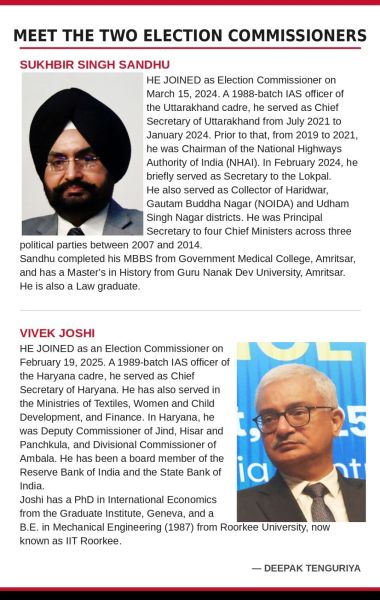 ⠀
• The national rollout of the SIR has been under the supervision of all three Commissioners. But Sandhu and Joshi have formally objected, on record, at least 14 times over the last 10 months — four times on a single day — to decisions taken and orders issued, they say, without their knowledge. The stakes couldn’t be higher.
• For, the objections relate to the core of the Election Commission’s mandate: new voter registration, deletion and restoration of voters in the rolls; filing of appeals against orders restoring voters in the SIR process; and the custody, and security, of the entire electoral roll itself. All objections related to these were copied to Chief Election Commissioner Gyanesh Kumar, too. Some were sent to Deputy Election Commissioners under their watch.
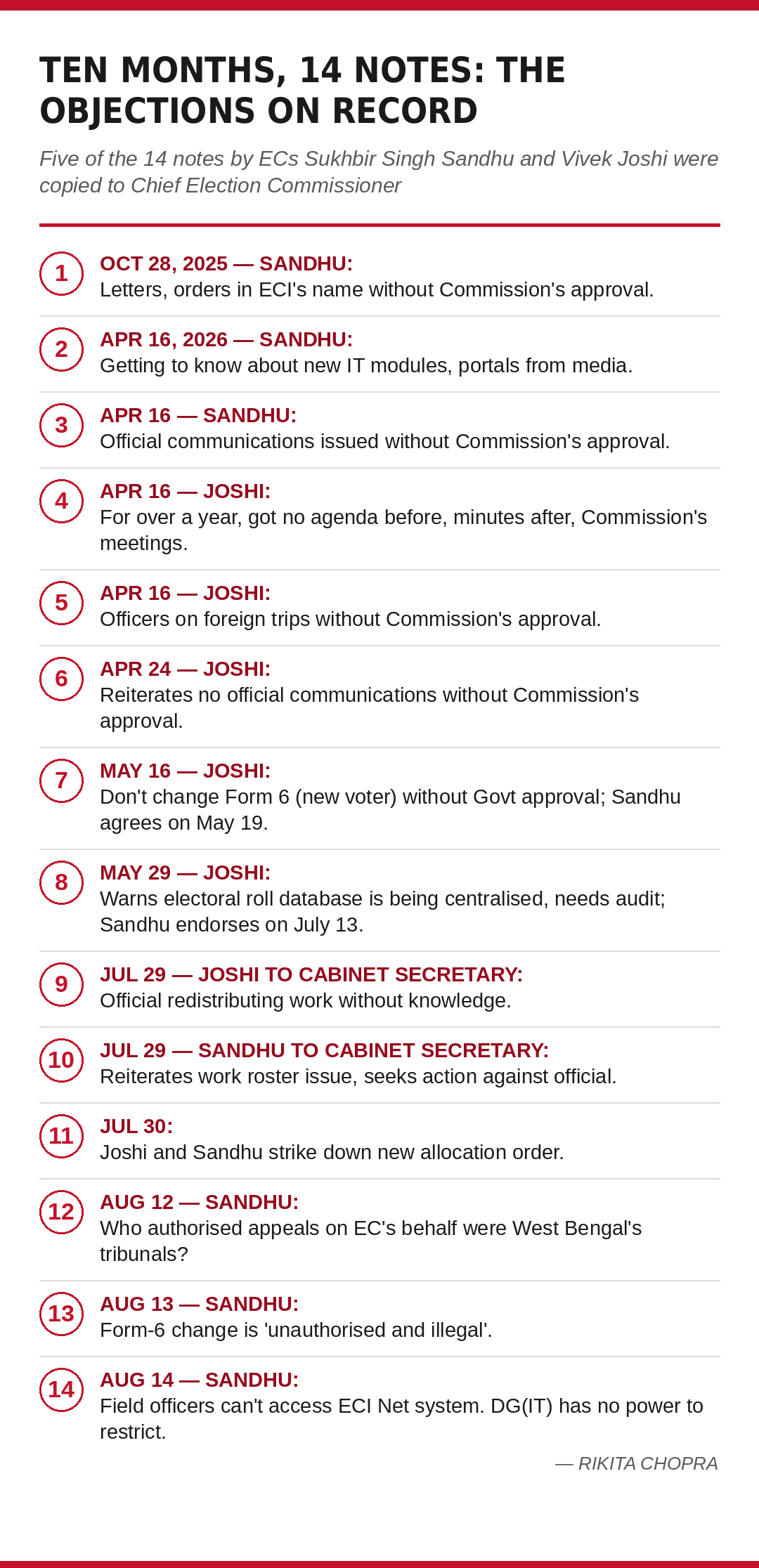 Taken together, these objections represent the sharpest and most sustained ruptures recorded inside a Constitutional authority — and touch four key issues:
• Taken together, these objections represent the sharpest and most sustained ruptures recorded inside a Constitutional authority — and touch four key issues:
—Who’s a “new voter”, why was Form-6 changed: In July this year, as first reported by The Indian Express, a form that every adult citizen has to fill to become a voter started asking a question it never did earlier. Linking the application to the SIR, it asked if the new voter or their parents/ grandparents “exist” in the “electoral roll of last SIR.” Applicants could not proceed without answering it. This despite the fact that in May, Joshi had warned on file that Form 6 could not be changed in this manner without the government amending the rules, and Sandhu had agreed. The change was made anyway.
—Who should have access to the electoral roll: The Commission’s strongest defence against every political allegation on electoral roll rigging has been that the roll preparation is decentralised. Each constituency’s voters’ list is prepared and controlled by its Electoral Registration Officer, a statutory authority on the ground. Usually, the ERO is the Sub-Divisional Magistrate. This list sits on a software, ERONet, and its successor ECINet. Over the past year, the two Commissioners have repeatedly questioned whether EROs’ access to this list is now being restricted.
This was what Joshi red-flagged in May this year — the SIR was gathering pace across states — as “gradual centralisation of the electoral roll database” and proposed an audit to certify that “no one, except the concerned statutory authorities, has credentials to make any change in the (voter) database.”
—West Bengal: who authorised the appeals: The SIR was the most deeply contested in West Bengal. There was no evidence of its role in the election outcome. Of the 294 seats that went to polls, in 49, the SIR deletions exceeded the victory margin. But in these, the spoils were almost evenly shared — 26 were won by BJP and 21 by TMC. But the manner in which names were struck off prompted the Supreme Court, in February 2026, to take the last leg of the SIR out of the Commission’s hands and get judicial officers to decide on the plight of 60 lakh voters flagged for “logical discrepancies.” Of these, 27 lakh electors were subsequently deleted by the Commission. The court then ordered tribunals of retired High Court judges to hear appeals against those decisions.
—Goa: why did the software reject eligible voters: The same centralisation, which Joshi and Sandhu had flagged repeatedly, ended up disenfranchising potential voters in Goa. On January 29, the Supreme Court ordered that voters flagged for “logical discrepancies” during the SIR be allowed to submit documents and be heard before the final roll was published. A “logical discrepancy” is a mismatch the software throws up when it tries to link a voter to a parent or relative on an older roll: a name that doesn’t match, an age gap that doesn’t add up.
Do You Know:
• The Commission is a constitutional body under Article 324, made up of the Chief Election Commissioner and two Election Commissioners who are equal in rank. The CEC is first among equals. He does not have the power to decide alone.
• Under the Chief Election Commissioner and Other Election Commissioners (Appointment, Conditions of Service and Term of Office) Act, 2023, all business of the Commission, says Section 18, “shall, as far as possible, be transacted unanimously”. If the CEC and the Election Commissioners “differ in opinion on any matter”, the matter “shall be decided according to the opinion of the majority.” The same section allows the Commission to settle its own procedure and the division of its work, but only “by unanimous decision”.
• The Indian Express investigation on the unprecedented rupture within the Election Commission has put the spotlight on Chief Election Commissioner (CEC) Gyanesh Kumar, whose time at the helm of the poll panel has been mired in controversies. The 62-year-old is the first CEC to be appointed after the contentious law for choosing the poll panel chief – the government now has an advantage in the selection panel – came into force.
Other Important Articles Covering the same topic:
📍What this rift reveals: Cloud over Commission’s conduct
📍Integrity of voter database: They even knocked on Cabinet Secretary’s door
📍‘Knew how to implement orders from above’: Understanding ‘SIR’ Gyanesh Kumar
Previous year UPSC Prelims Question Covering similar theme:
1) Right to vote and to be elected in India is a (UPSC, CSE, 2017)
(a) Fundamental Right
(b) Natural Right
(c) Constitutional Right
(d) Legal Right
2) Consider the following statements: (UPSC, CSE, 2017)
1. The Election Commission of India is a five-member body.
2. Union Ministry of Home Affairs decides the election schedule for the conduct of both general elections and bye-elections.
3. Election Commission resolves the disputes relating to splits/mergers of recognised political parties.
Which of the statements given above is/are correct?
(a) 1 and 2 only
(b) 2 only
(c) 2 and 3 only
(d) 3 only
Previous year UPSC Mains Question Covering similar theme:
📍Is the right to vote a fundamental right? Discuss the position of the Election Commission of India while undertaking the revision of electoral rolls. Can it also examine the question of citizenship of voters? (UPSC, GS2, 2026)
📍In the light of recent controversy regarding the use of Electronic Voting Machine (EVM), what are the challenges before the Election Commission of India to ensure the trustworthiness of elections in India? (UPSC, GS2, 2018)
Politics
Global order is under stress, we need reformed multilateralism: Jaishankar
Syllabus:
Preliminary Examination: Current events of national and international importance.
Mains Examination: General Studies II: Important International institutions, agencies and fora- their structure, mandate.
What’s the ongoing story: Highlighting that the global order is under stress due to intense competition and geopolitical tensions, External Affairs Minister S Jaishankar said Monday that the international community should develop frameworks and guardrails for fuel and food supplies. The comments come amid the United States passing the Russia sanctions bill, which would have huge implications on New Delhi’s energy imports from Moscow.
Key Points to Ponder:
• What is the United Nations General Assembly (UNGA)?
• Know the composition, voting system and principal functions of United Nations General Assembly (UNGA).
• The United Nations General Assembly and the United Nations Security Council—Compare and Contrast
• What is the significance of the annual general debate of the UNGA?
• What is meant by the ‘4F crisis’ highlighted by the External Affairs Minister S Jaishankar? • How fuel, food, fertiliser and finance are interconnected in the contemporary global economy.
• What is multilateralism?
• “The relevance of the United Nations in the 21st century will depend less on the number of resolutions it adopts and more on its ability to deliver legitimate, representative and effective collective action”—What is your opinion?
Key Takeaways:
• Speaking at the first-ever ‘Partners for Multilateralism, International Law, Peace and Prosperity (P4M)’ Summit held in New York on the margins of the high-level 81st session of the United Nations General Assembly (UNGA), Jaishankar said that for some decades, the world has witnessed a steady rebalancing, which was a long-expected structural evolution.
• India has co-sponsored an inaugural multilateralism summit at the UN “at a time when the global order is under stress”, when New Delhi says more participative deliberations and transparent decision-making are overdue.
• The summit comes as the 15-nation UN Security Council remains deeply polarised, with sharp divisions among its five permanent, veto-wielding members: China, France, Russia, the UK and the US. New Delhi has been pitching for a seat on the United Nations Security Council to reflect the realities of today’s world.
• Jaishankar emphasised at the summit that while ongoing conflicts persist, nations can address specific dimensions as they seek broader peace. “The ‘4F’ crisis of fuel, food, fertiliser and finance cannot be left to itself. When new capabilities and concerns arise, there is a very powerful case for frameworks and guardrails. Where there is a threat of chokepoint dominance and disruption, de-risking and diversifying must be encouraged,” he said.
• The External Affairs Minister also stressed that multilateralism will be best served when international law, rules and norms are scrupulously observed. “For multilateralism to forge ahead, its advocacy and its practice must both be strengthened. Reformed multilateralism is therefore essential. More participative deliberations and more transparent decision-making are both overdue,” he noted.
Do You Know:
• According to the UN official website, the UN General Assembly (UNGA) is the main policy-making organ of the Organization. Comprising all Member States, it provides a unique forum for multilateral discussion of the full spectrum of international issues covered by the Charter of the United Nations. Each of the 193 Member States of the United Nations has an equal vote.
The UNGA also makes key decisions for the UN, including:
—appointing the Secretary-General on the recommendation of the Security Council
—electing the non-permanent members of the Security Council
—approving the UN budget
• The Assembly meets in regular sessions from September to December each year, and thereafter as required. It discusses specific issues through dedicated agenda items or sub-items, which lead to the adoption of resolutions. Sitting arrangements in the General Assembly Hall change for each session. During the 81st Session (2026-2027), Morocco will occupy the first seat in the Hall, including in the Main Committees (followed by all the other countries, in English alphabetical order).
• According to the UN official website, established in 1945 under the Charter of the United Nations, the General Assembly occupies a central position as the chief deliberative, policymaking and representative organ of the United Nations. Comprised of all 193 Members of the United Nations, it provides a unique forum for multilateral discussion of the full spectrum of international issues covered by the Charter. It also plays a central role in the process of standard-setting and the codification of international law.
• United Nations Security Council (UNSC) is a 15 member states (5 permanent members with veto power and 10 non-permanent members elected for 2-year terms). Holds primary responsibility for maintaining international peace and security. Issues legally binding resolutions that all member states are obligated to follow. Can impose economic sanctions, order arms embargoes, and authorize the use of military force. Requires 9 votes to pass, but the 5 permanent members (US, UK, France, Russia, China) can completely veto any resolution.
Other Important Articles Covering the same topic:
📍Explained: The birth of the United Nations, and its growth in 75 years
📍81 years of the UN Charter: How did it come about?
Previous year UPSC Prelims Question Covering similar theme:
3) With reference to the United Nations General Assembly, consider the following statements: (UPSC, CSE, 2022)
1. The UN General Assembly can grant observer status to the non-member States.
2. Inter-governmental organisations can seek observer status in the UN General Assembly.
3. Permanent Observers in the UN General Assembly can maintain missions at the UN headquarters.
Which of the statements given above are correct?
(a) 1 and 2 only
(b) 2 and 3 only
(c) 1 and 3 only
(d) 1, 2 and 3
Previous year UPSC Mains Question Covering similar theme:
📍“The reform process in the United Nations remains unresolved, because of the delicate imbalance of East and West and entanglement of the USA vs. Russo-Chinese alliance.” Examine and critically evaluate the East-West policy confrontations in this regard. (UPSC, GS2, 2025)
Nation
1986 ruling holds, can’t penalise for not singing: SC at Vande Mataram hearing
Syllabus:
Preliminary Examination: Indian Polity and Governance-Constitution, Political System, Panchayati Raj, Public Policy, Rights Issues, etc.
Mains Examination: General Studies II: Structure, organization and functioning of the Executive and the Judiciary.
What’s the ongoing story: Hearing a petition by Carnatic vocalist T M Krishna who has challenged the law mandating the singing of all six stanzas of the Vande Mataram, the Supreme Court, while reminding the Centre Tuesday about its 1986 ruling on an individual’s right not to sing the national anthem, said it was up to “a conscientious objector not to recite one or all stanzas of the national song” and the person cannot be subjected to “criminal consequences”.
Key Points to Ponder:
• What is ‘Vande Mataram’?
• What are the important facts about Vande Mataram?
• Why Bankim Chandra Chattopadhyay’s Ananda Math (1882) is considered a foundational text for understanding Indian nationalism?
• What was the contribution of Vande Mataram song in the Indian freedom struggle?
• Why the song Vande Mataram holds historic importance in India?
• Why Vande Mataram not chosen as National Anthem?
• What is there in the last four stanza of Vande Mataram?
• What is the scope of Article 25 of the Constitution when it comes to “Vande Mataram”?
• What is meant by the term conscientious objection?
• What did the Supreme Court establish in Bijoe Emmanuel v. State of Kerala?
• How should the State balance respect for national song with the fundamental right to freedom of conscience and religion?
Key Takeaways:
• It said it will examine whether refusal to sing the Vande Mataram could have penal consequences. The hearing before a three-judge bench headed by Chief Justice of India Surya Kant also saw a heated exchange between Solicitor General Tushar Mehta and Senior Advocate and former judge S Muralidhar, appearing for Krishna.
• Objecting to the challenge, Mehta said “lawmaking cannot be as per Naxalite’s ideas”. Muralidhar protested and asked Mehta to withdraw the remark, but he did not. The bench, also comprising Justice Joymalya Bagchi and Justice V Mohana, said it had “not taken note” of the comment, restricting itself to “the Constitutional issue” before it.
• Krishna’s plea said the guideline on singing of all six stanzas of Vande Mataram at official functions violates the constitutional principle of secularism because the last four stanzas contain explicit Hindu references.
• Justice Bagchi said, “The national song expressing homage to a particular God or form of God would not perhaps impact secularism, but your point whether a conscientious objector can be subjected to penal consequences… may require examination.”
• The Centre has amended Section 3 of the Prevention of Insults to National Honour Act, 1971, extending the same legal protection to Vande Mataram as Jana Gana Mana.
Do You Know:
• The Supreme Court of India stated that a conscientious objector cannot face criminal prosecution or penal consequences for refusing to sing one or all stanzas of Vande Mataram on religious or moral grounds. A three-judge bench headed by Chief Justice of India Surya Kant and comprising Justices Joymalya Bagchi and V. Mohana noted that while the state can decide the scope and protocol of the National Song, it cannot violate fundamental freedoms under Articles 25 and 26. The Court invoked its landmark 1986 Bijoe Emmanuel v. State of Kerala judgment—which protected schoolchildren who stood respectfully during the national anthem but did not sing it due to personal beliefs—stating that the same principle of constitutional tolerance governs the amended law.
• Vande Mataram (Mother, I bow to thee) was composed in sanskritised Bengali by Bankim Chandra Chattopadhyay in 1875, and was first published in 1882 as part of his novel, Anandmath. Chatterjee had been inspired by freedom movements such as the 18th-century Sannyasi Rebellion and the 1857 revolt.
The song became popular during the freedom struggle and was adopted by the Indian National Congress in 1905 to rouse nationalist sentiment for the motherland.
• President Rajendra Prasad bestowed equal honour on Vande Mataram and Jana Gana Mana in the 1950 Constituent Assembly debate.
• “The composition consisting of the words and music known as Jana Gana Mana is the National Anthem of India, subject to such alterations in the words as the Government may authorise as occasion arises; and the song Vande Mataram, which has played a historic part in the struggle for Indian freedom, shall be honoured equally with Jana Gana Mana and shall have equal status with it,” he said.
• For one, the National Anthem enjoys constitutional privileges that the National Song does not. Article 51A(a) of the Constitution makes it a fundamental duty for every citizen to respect the National Anthem, while the decorum for playing or singing the National Anthem is regulated by ‘Orders relating to the National Anthem of India’ and ‘The Prevention of Insults to National Honour Act, 1971’.
• Jana Gana Mana was chosen as the national anthem for its secular, inclusive nature, celebrating the nation’s unity in diversity.
Other Important Articles Covering the same topic:
📍Vande Mataram at 150: How the National Song is different from the National Anthem
Previous year UPSC Prelims Question Covering similar theme:
4) With reference to Madanapalle of Andhra Pradesh, which one of the following statements is correct? (UPSC CSE, 2021)
(a) Pingali Venkayya designed the tricolor Indian National Flag here.
(b) Pattabhi Sitaramaiah led the Quit India Movement of Andhra region from here.
(c) Rabindranath Tagore translated the National Anthem from Bengali to English here.
(d) Madame Blavatsky and Colonel Olcott set up headquarters of Theosophical Society first here.
Previous year UPSC Mains Question Covering similar theme:
📍Examine the scope of Fundamental Rights in the light of the latest judgement of the Supreme Court on Right to Privacy. (UPSC, GS2, 2017)
Nation
Starting this week, IAF to host second edition of multinational air exercise Tarang Shakti
Syllabus:
Preliminary Examination: Current events of national and international importance.
Mains Examination:
• General Studies II: Bilateral, regional and global groupings and agreements involving India and/or affecting India’s interests.
• General Studies III: Various Security forces and agencies and their mandate
What’s the ongoing story: THE INDIAN Air Force (IAF) will host the second edition of its largest-ever multinational air exercise, Tarang Shakti-26, beginning later this week in Jodhpur. Around 40 countries are expected to participate in the exercise, which will bring together a range of advanced combat aircraft, including the US F-35s, French Rafales and UAE F-16s, along with various other aerial assets, for joint aerial operations, tactical training and interoperability drills.
Key Points to Ponder:
• Tarang Shakti-26—What are major highlights of this exercise?
• Which countries participated in the Tarang Shakti exercise?
• What is a multinational military exercise?
• How Tarang Shakti exercise can improve the interoperability and operational preparedness of participating air forces?
• How do joint military exercises contribute to confidence-building and strategic trust among participating countries?
• What are some of the exercises the Indian Air Force has participated in with other countries?
Key Takeaways:
• The exercise, to be held between September 26 and October 12 at Air Force Station, Jodhpur, and adjoining air bases will see participation from eight forces — India, Australia, Bangladesh, France, the US, Germany, Sri Lanka and UAE. Thirty-two countries will attend the event as observers. Around 10 Air Chiefs or equivalents are likely to attend the exercise. The maiden edition of the exercise took place in August-September 2024 in two phases.
• India’s Rafale, Mirage-2000, Jaguar, Tejas, MiG-29, Su-30 MKI will participate in the exercise, along with the US’s F-35, France’s Rafale, the UAE’s F-16 and Bangladesh’s C-130J, besides other air assets.
Explaining the criticality of the exercise, Vice Chief of Air Staff Air Marshal Ashutosh Dixit told mediapersons on Tuesday that Tarang Shakti has changed the earlier approach of having an operational engagement with foreign air forces largely through bilateral exercises.
Do You Know:
• Tarang Shakti-26 is the second edition of the Indian Air Force’s premier multinational air exercise, scheduled from September 26 to October 12, 2026, at Air Force Station Jodhpur in Rajasthan. India, Australia, Bangladesh, France, Germany, Sri Lanka, UAE, and the USA are participating.
• The exercise aims to analyse tactical employment philosophy against modern Air-to-Air and Surface-to-Air weapons, to enhance interoperability among the participating forces and to identify best practices in operations. It will involve Beyond Visual Range and within Visual Range combat missions, air mobility operations and dynamic targeting, air-to-air refuelling missions and combat search and rescue operations.
• Responding to questions about the exercise, Air Marshal Dixit emphasised that as the world changes rapidly and the nature of warfare evolves, recent conflicts have highlighted the critical importance of precision, integrated air defence, unmanned systems, information dominance, space-based capabilities and the ability to integrate these elements into multi-domain operations.
• The exercise, he said, would also display India’s growing defence industry, including indigenous platforms, sensors, weapons and unmanned systems.
• Tarang Shakti-26, he said, has three aims: operational learning, greater interoperability and stronger partnerships. He said India is confident of its own capabilities, open to learning from its partners and prepared to cooperate with them.
Other Important Articles Covering the same topic:
📍Knowledge Nugget | From Yudh Abhayas to LAMITIYE: Know India’s 5 recent joint military exercises
Previous year UPSC Prelims Question Covering similar theme:
5) Which of the following statements about ‘Exercise Mitra Shakti-2023’ are correct? (UPSC, CSE, 2024)
1. This was a joint military exercise between India and Bangladesh
2. It commenced in Aundh (Pune).
3. Joint response during counter-terrorism operations was a goal of this operation.
4. Indian Air Force was a part of this exercise.
Select the answer using the code given below:
(a) 1, 2 and 3
(b) 1, 2 and 4
(c) 1, 3 and 4
(d) 2, 3 and 4
Economy
Scheme to promote processing of lithium and nickel soon: Secy
Syllabus:
Preliminary Examination: Current events of national and international importance.
Mains Examination: General Studies III: Infrastructure: Energy, Ports, Roads, Airports, Railways etc.
What’s the ongoing story: The Centre is set to launch a new scheme for lithium and nickel, two critical minerals considered crucial for the battery manufacturing ecosystem, Keshav Chandra, Secretary, Ministry of Mines, said at the 60th Annual General Meeting of the Federation of Indian Mineral Industries (FIMI).
Key Points to Ponder:
• What are critical minerals?
• Compare and contrast critical minerals and rare earth minerals.
• What are the criteria used to determine the criticality of a mineral for an economy?
• Why are lithium and nickel considered important for India’s energy transition and industrial development?
• Know the role of critical minerals in the manufacturing of electric vehicles, batteries and renewable-energy
systems.
• How critical minerals, strategic minerals and conventional minerals are different from each other?
• What factors make a mineral supply chain vulnerable?
Key Takeaways:
• Further details of the scheme will be announced after the required approvals are received, he told the media on the sidelines of the event. In his address to the mining companies, Chandra also flagged two key concerns: the practice of holding on to mines despite security clearance, and the export of critical minerals.
• Talk of the scheme to promote the processing of these two minerals has been around for some time. In April, former Mines Secretary Piyush Goyal had said the ministry was in the advanced stages of framing a policy to promote critical mineral processing and had shortlisted two minerals considered critical for electric vehicles (EVs), without naming them.
• The development comes as the government has already identified four states — Andhra Pradesh, Odisha, Gujarat and Maharashtra — to promote the setting up of critical mineral processing plants.
• Odisha is being considered for nickel as the state has its own nickel reserves and its location in eastern India could make it easier to process imported nickel from Indonesia and other countries, where the mineral is available in abundance, he said. “So, the entire ecosystem for a particular mineral is being developed in these four parts,” he added.
• Notably, India has little processing capacity for critical minerals and is 100% import-dependent for some key critical minerals such as cobalt, lithium, nickel, rare earth elements, (REEs) and silicon. At the same time, China controls 90% of global critical mineral processing.
Do You Know:
• Critical minerals are raw metallic or non-metallic elements that are essential to a nation’s economy, modern technology, and national security, but face a high risk of supply chain disruption. These are minerals that are essential for economic development and national security, and the lack of availability of these minerals or the concentration of extraction or processing in a few geographical locations could potentially lead to “supply chain vulnerabilities and even disruption of supplies”. This is true for minerals such as lithium, graphite, cobalt, titanium, and rare earth elements, which are essential for the advancement of many sectors, including hightech electronics, telecommunications, transport, and defence.

• Elements such as cobalt, nickel and lithium are required for batteries used in electric vehicles or cellphones,
rare earth minerals are critical, in trace amounts, in the semiconductors and high-end electronics manufacturing. Most countries of the world have identified critical minerals as per their national priorities and future requirements.
• In India too, some efforts have been made in the past to identify the minerals that are critical for the country, including an initiative in 2011 by the Planning Commission of India (now NITI Aayog) that highlighted the need for the “assured availability of mineral resources for the country’s industrial growth”, with a clear focus on the well-planned exploration and management of already discovered resources. That report analysed 11 groups of minerals under categories such as metallic, nonmetallic, precious stones and metals, and strategic minerals. From 2017 to 2020, a big thrust was accorded to the study of exploration and development of rare earth elements in the country.
Other Important Articles Covering the same topic:
📍Why India is struggling to acquire critical mineral assets abroad
📍Centre identifies 30 critical minerals: Why, how, and importance of the exercise
Previous year UPSC Prelims Question Covering similar theme:
6) Consider the following minerals: (UPSC, CSE, 2020)
1. Bentonite
2. Chromite
3. Kyanite
4. Sillimanite
In India, which of the above is/are officially designated as major minerals?
(a) 1 and 2 only
(b) 4 only
(c) 1 and 3 only
(d) 2, 3 and 4 only
7) Recently, there has been a concern over the short supply of a group of elements called ‘rare earth metals’. Why? (UPSC, CSE, 2012)
1. China, which is the largest producer of these elements, has imposed some restrictions on their export.
2. Other than China, Australia, Canada and Chile, these elements are not found in any country.
3. Rare earth metals are essential for the manufacture of various kinds of electronic items and there is a growing demand for these elements.
Which of the statements given above is/are correct?
(a) 1 only
(b) 2 and 3 only
(c) 1 and 3 only
(d) 1, 2 and 3
Previous year UPSC Mains Question Covering similar theme:
📍Discuss the multi-dimensional implications of uneven distribution of mineral oil in the world. (UPSC, GS1, 2021)
Explained
Evolution of Houthis: Local movement to Red Sea power
Syllabus:
Preliminary Examination: Current events of national and international importance.
Mains Examination: General Studies II: Effect of policies and politics of developed and developing countries on India’s interests
What’s the ongoing story: The rapid advances made by the Yemeni armed group Houthis last week along the Red Sea coast and around the Bab el-Mandeb Strait left Saudi Arabia’s oil exports and shipping exposed in the critical sea lane. Bab el-Mandeb had emerged as an alternative sea route to the Strait of Hormuz, which Iran has effectively closed since the war in West Asia broke out in February.
Key Points to Ponder:
• Who are the Houthis?
• How Houthis (Ansar Allah) evolved from a local Yemeni movement to a significant regional actor?
• Know the geographical and strategic significance of Yemen, the Red Sea and the Bab el-Mandeb Strait.
• What were the major factors behind the Yemeni civil war and its internationalisation?
• What is the role of Iran in strengthening Houthi military capabilities?
• Map Work-Saudi Arabia, Yemen, Mecca, Red Sea, Bab-el-Mandeb and Strait of Hormuz, Perim Island
• The conflict between Saudi Arabia and Houthis-what you know so far?
Key Takeaways:
• Saudi Arabia has retaliated, and a series of intense attacks by both sides have resulted in the deaths of civilians, with tens of thousands displaced along Yemen’s coast. Both China and Pakistan have urged Iran to use its influence over the Houthis and help rein it in after Riyadh’s appeal to Beijing, according to reports.
• As the Houthis — officially known as Ansar Allah — expands its presence in the Red Sea, understanding the movement requires looking past traditional tropes of asymmetric warfare.
• Prasanta Kumar Pradhan, research fellow and coordinator, West Asia Centre, at the Manohar Parrikar Institute for Defence Studies and Analyses (MP-IDSA), New Delhi, told The Indian Express: “During the six Saada Wars (2004-2010), the central Yemeni government struggled to suppress the insurgency. Saudi Arabia directly entered the conflict in late 2009 after Houthi fighters crossed into the border region of Jizan. The Saudi military relied on heavy airpower and artillery but faced operational challenges in the rugged mountainous terrain, previewing the tactical difficulties that would characterise future campaigns.”
• The group’s worldview is articulated in its controversial slogan, the Sarkha: “God is great, death to America, death to Israel, a curse upon the Jews, victory to Islam.” Its modern ideology borrows heavily from global anti-imperialist rhetoric and Iran’s 1979 Islamic Revolution. The Houthis view themselves not merely as a local political faction but as a sovereign vanguard fighting against Western hegemony and monarchies in the neighbourhood.
Do You Know:
• Ansar Allah’s journey began in the 1990s as a Zaidi Shia religious and cultural revivalist movement against the alleged neglect the community faced at the hands of the Sunni rulers, who came to power in 1962 after a revolt against the Zaidi Imamate that ruled Yemen for over a thousand years. The Zaidi Shias, who felt marginalised amid the rapid expansion of Saudi-funded Sunni proselytisation, looked up to their leaders, including Hussein Badreddin al-Houthi, who established a group called al-Shabab al-Mu’min (The Believing Youth) in 1992. It organised educational and social programmes aimed at preserving Zaidi cultural identity.
• By the early 2000s, the movement began political activism against certain policies of Yemeni President Ali Abdullah Saleh and the 2003 US invasion of Iraq. The group members criticised Saleh’s government for its alignment with the US and Saudi Arabia. Tensions grew further into an armed insurgency in 2004 when Yemeni security forces attempted to arrest Hussein al-Houthi. His death in a battle later that year militarised and consolidated the movement under his family’s leadership, launching six successive wars against the Saudi-backed government between 2004 and 2010.
Other Important Articles Covering the same topic:
📍Saudi Arabia has defence pacts with Pakistan, Turkey, US: Why aren’t they fighting the Houthis?
Previous year UPSC Prelims Question Covering similar theme:
8) Consider the following pairs: (UPSC, CSE, 2019)
Sea Bordering Country
1. Adriatic Sea : Albania
2. Black Sea : Croatia
3. Caspian Sea : Kazakhstan
4. Mediterranean Sea : Morocco
5. Red Sea : Syria
Which of the pairs given above are correctly matched?
(a) 1, 2 and 4 only
(b) 1, 3 and 4 only
(c) 2 and 5 only
(d) 1, 2, 3, 4 and 5
Soaring demand for AI chips: What ‘supercycle’ means
Syllabus:
Preliminary Examination: Current events of national and international importance.
Main Examination: General Studies III: Science and Technology- Developments and their applications and effects in everyday life and Infrastructure: Energy, Ports, Roads, Airports, Railways etc.
What’s the ongoing story: Nearly 600 companies from 52 countries attended SEMICON India, the India Semiconductor Mission’s (ISM) flagship conference, in New Delhi this week. The ISM falls under the Ministry of Electronics and Information Technology (MeitY), and Prime Minister Narendra Modi inaugurated the event, stating that “India’s semiconductor ecosystem is expanding rapidly.”
Key Points to Ponder:
• What are semiconductors?
• What is meant by a semiconductor supercycle?
• What are AI accelerators and Graphics Processing Units (GPUs)?
• Know the terms—integrated circuit, chip, electronic device, memory chips and logic chips
• What is India Semiconductor Mission (ISM) 2.0?
• How India Semiconductor Mission (ISM) 2.0 is different from India Semiconductor Mission (ISM) 1.0?
• How can India move from assembly and packaging towards higher-value design, fabrication and materials capabilities?
• Where does India stand in the semiconductor industry?
• What are the current challenges of the semiconductor industry in India?
• The Government of India has undertaken several initiatives to promote electronics manufacturing-Know the important schemes
Key Takeaways:
• The conference comes at a moment of exceptional global demand for semiconductors, or chips, driven largely by artificial intelligence (AI) and the infrastructure required to support it. Some describe this expansion as a semiconductor “supercycle” — a multi-year period of investment and growth driven by a fundamental tech shift.
• Unlike an ordinary boom caused by short-term changes, a supercycle alters the underlying source and structure of
demand. It was earlier seen with computers in the 1990s, then smartphones in the 2010s, and now AI and data centres may be playing a similar role.
• Traditionally, memory manufacturers produced for and relied on consumer sales to absorb their output. The AI buildout is, however, increasingly shifting the market structure towards business-to-business sales.
Do You Know:
• Data centres are generating a large share of this demand. Essentially, these are physical facilities that house
equipment to store and process digital data (think servers and computers). They are necessary for running digital services of any kind.
• AI data centres contain the infrastructure needed to support the increasing adoption of AI technology, which needs a specialised set of components to function. A central element is the AI chip or accelerator itself, responsible for carrying out the massive calculations needed to train and run AI models. Specialised computer chips known as Graphics Processing Units (GPUs) are widely used since they can handle a range of calculations simultaneously and can support training.
• Under the ISM 1.0, India has approved 12 semiconductor projects, and some packaging facilities have begun production. India does not yet have a large-scale wafer fabrication plant actively producing chips.
• India has been focused on establishing an initial manufacturing base and building capacity in assembly, testing, and packaging. Micron’s Sanand facility in Gujarat will process imported specialised wafers, and Sahasra Semiconductors will package NAND flash, a kind of storage technology. These projects bring India into the later stages of memory chip production, while wafer manufacturing is happening elsewhere.
• This means that India is currently experiencing much of the AI chip boom through its effect on the cost and availability of imported components, rather than capturing the profits being generated by HBM and advanced accelerators. In July, a parliamentary reply noted that demand from AI servers and data centres was tightening memory supplies and raising prices.
Other Important Articles Covering the same topic:
📍World needs new, trusted chip bases, India ready for it: PM Modi
Previous year UPSC main Question Covering similar theme:
📍India aims to become a semiconductor manufacturing hub. What are the challenges faced by the semiconductor industry in India? Mention the salient features of the India Semiconductor Mission. (UPSC, GS3, 2025)
|
PRELIMS ANSWER KEY |
|
1.(c) 2.(d) 3.(d) 4.(c) 5.(d) 6.(d) 7.(c) 8.(b) |
For any queries and feedback, contact priya.shukla@indianexpress.com
Subscribe to our UPSC newsletter. Stay updated with the latest UPSC articles by joining our Telegram channel – IndianExpress UPSC Hub, and follow us on Instagram and X.

Priya Kumari Shukla is a Senior Copy Editor in the Indian Expre... Read More
 Share


