
UPSC Key: Collegium system, Manipur Violence and PRAHAAR
Why Index of Industrial Production is relevant to the UPSC exam? What is the significance of topics such as frontier AI, deep depression and concept of intermediary liability in India on both the preliminary and main exams? You can learn more by reading the Indian Express UPSC Key for September 29, 2026.
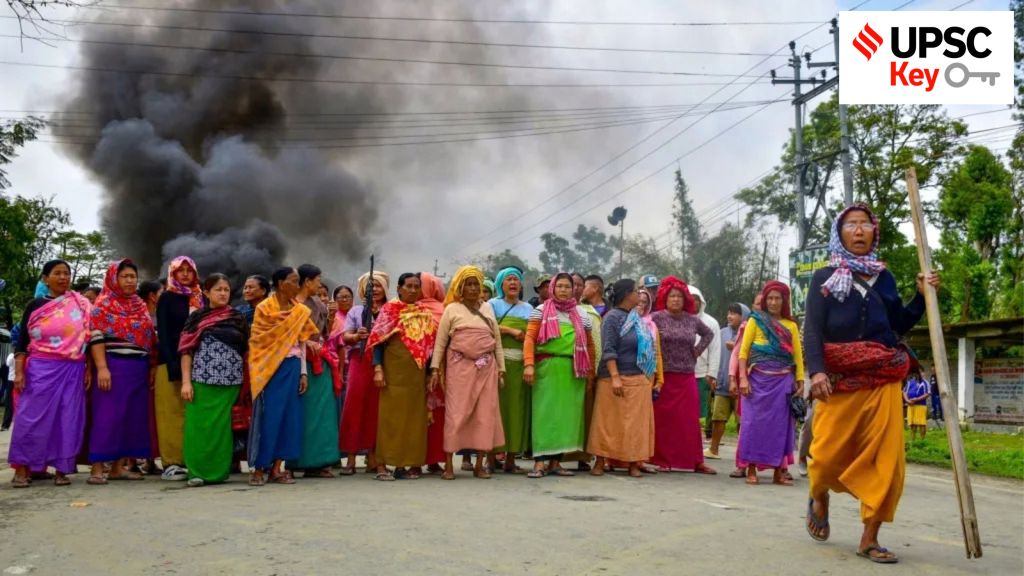 UPSC Key September 2026: Here's what you should be reading from the September 28, 2026 edition of The Indian Express. (PTI Photo)
Important topics and their relevance in UPSC CSE exam for September 29, 2026. If you missed the September 28, 2026 UPSC CSE exam key from the Indian Express, read it here
FRONT PAGE

Industrial output up 8% in August, FMCG a slow spot
Syllabus:
Preliminary Examination: Economic and Social Development
Mains Examination: General Studies III: Indian Economy and issues relating to planning, mobilization, of resources, growth, development and employment.
What’s the ongoing story: The Indian economy continued its impressive run, with data released Monday showing industrial production in August was 8% higher compared to the same month last year, although a favourable base effect helped drive overall growth as well as that of the manufacturing sector, whose output rose 9%.
Key Points to Ponder:
• What is the Index of Industrial Production (IIP)?
• How is the Industrial output measured by?
• By how much and where has industrial output increased?
• What are the Eight core sector industries in the Indian Economy?
• What is the weight/weightage of the different core sectors in the Index of Industrial Production?
• Is service sector part of Index For Industrial Production (IIP)?
• Who releases Index of Industrial Production (IIP) data?
• Who uses Index For Industrial Production (IIP) data?
• What is the significance of Index of Industrial Production (IIP) as an indicator of economic activity in India?
• Know these terms—Industrial growth, manufacturing growth, economic growth, capital goods, consumer durables, consumer non-durables, intermediate goods and infrastructure goods
• What is meant by base effect in economic data?
• How base effect influence the interpretation of industrial growth?
Key Takeaways:
• Policymakers, however, will keep an eye on the consumer goods segment.
• While production of durable goods rose 11.1% in August, following up a 12% increase in July, non-durable goods – which are primarily fast-moving consumer, or FMCG, products – saw a growth of only 2.1%.
• According to Rajani Sinha, Chief Economist at CareEdge Ratings, the overall strong industrial performance is in line with other data such as GDP growth, lending, and exports, indicating that the economy has “held up well” despite persistent global uncertainties and elevated energy prices. And while the performance of consumer durables continues is a positive for consumption, “the feeble performance of consumer non-durables remains concerning.”
• Consumer durables and non-durables are key indicators of household demand. And while production of durables is strong, analysts have been sounding caution ahead of the festival season, which sees Indians splurging on new purchases. But with prices of consumer electronics rising for a variety of reasons – significantly more expensive memory chips and other key inputs such as copper and aluminium as well as increasing freight costs – demand may face headwinds.
• However, Indians are seen relying on loans to make purchases, with UBS analysts predicting last week that India is entering a “strong unsecured credit growth cycle, led by personal loans”. Latest data from the Reserve Bank of India shows that while personal loans given by banks were up 16.2% as at the end of July, those given by non-banks were up 21.4%.
• Industrial growth as per the Index of Industrial Production (IIP) was 7.4% in July and 4.7% in August 2026. The IIP comprises four key sectors, with manufacturing accounting for three-fourths of the entire index.
• The August industrial growth print of 8% is the latest in a series of robust economic numbers, with June having posted an expansion of 8.8% – the highest since 19% in March 2024. So far in the first five months of 2026-27, or April-August 2026, industrial growth has averaged 6.7%, well above 4.2% in the same period of 2025-26.
Do You Know:
• The Index of Industrial Production (IIP) is a crucial macroeconomic indicator that measures short-term volume changes in India’s industrial sector over a specific period. Published monthly by the National Statistical Office (NSO) under the Ministry of Statistics and Programme Implementation (MoSPI), it serves as an early barometer of economic momentum.
• In May 2026, the government officially modernized the index, launching a revised series that updated the base year from 2011–12 to 2022–23 to better map the contemporary structure of the economy.
• The nine core industries comprise 32.88 per cent of the weight of items included in the Index of Industrial Production (IIP). The weightage of the eight core industries in base year 2011-12 was 40.266. The weights of the ICI (2022–23) series have been derived from the weights of the corresponding items of IIP (2022–23) series, which have been pro-rata distributed to 100. In the updated Index of Core Industries (ICI) the number of core industries increased to nine following the inclusion of iron ore to the existing eight: coal, crude oil, natural gas, refinery products, fertilisers, steel, cement, and electricity.
Other Important Articles Covering the same topic:
📍Explained: What is IIP and why does it matter?
Previous year UPSC Prelims Question Covering similar theme:
1) In the ‘Index of Eight Core Industries’, which one of the following is given the highest weight? (UPSC, CSE, 2015)
(a) Coal production
(b) Electricity generation
(c) Fertilizer production
(d) Steel production
Previous year UPSC Mains Question Covering similar theme:
📍“Industrial growth rate has lagged behind in the overall growth of Gross-Domestic-Product (GDP) in the post-reform period” Give reasons. How far the recent changes in Industrial Policy are capable of increasing the industrial growth rate? (UPSC, GS3, 2017)
Nation
‘Can only manage violence’: Manipur crisis takes a turn, Delhi stuck in more difficult terrain
Syllabus:
Preliminary Examination: Current events of national and international importance.
Mains Examination: General Studies III: Role of external state and non-state actors in creating challenges to internal security.
What’s the ongoing story: With the latest killings, in Kamjong and Senapati, the death toll in clashes between the Nagas and Kukis since the recast BJP government took over in Manipur in February has risen to over 50, marking a shift away from the conflict centred around the Meiteis and Kukis since May 2023.
Key Points to Ponder:
• Map Work-Manipur and adjoining States
• How many different ethnic groups are there in Manipur?
• What exactly triggered the violence in the state?
• Who are Nagas, Kuki and Meitei?
• Which are the major communities residing in Manipur?
• Manipur has been in the cross-currents of India’s oldest insurgent movements-why?
• History of conflict in Manipur-Know in detail
• Manipur Violence-what you know till now?
• What do you understand by the term ‘ethnic violence?
• What is the cause of ethnic violence in Manipur?
• What is the role of ethnic and communal tensions in the North-eastern region of India with a focus on the Manipur conflict?
Key Takeaways:
• Like that cycle of violence, the Naga-Kuki tensions too appear to have entered a self-perpetuating loop now, with each side seeking to avenge the killing of its own. Containing this conflict poses a more difficult challenge geographically.
• An officer of the Manipur Police says, “When Meitei-Kuki clashes began, the two communities got geographically separated within months. Kukis withdrew to the hills and Meiteis came to the valley. So a buffer zone was created and security forces were placed there. It is not so in the Naga-Kuki clashes. In the hills, the populations are mixed. It is nearly impossible to guard every village.”
• The clashes have been reported across Ukhrul, Kamjong, Senapati and Kangpokpi, with the geographical proximity of the two communities meaning the conflict is playing out over roads and highways. Consequently, security agencies must deal not only with gunfights and killings, but also the disruption of supplies and movement.
Do You Know:
• The Meiteis are the largest community in Manipur. There are 34 recognized tribes, which are broadly classified as ‘Any Kuki Tribes’ and ‘Any Naga Tribes’. The central valley in the state accounts for about 10% of the landmass of Manipur, and is home primarily to the Meitei and Meitei Pangals who constitute roughly 64.6% of the state’s population. The remaining 90% of the state’s geographical area comprises hills surrounding the valley, which are home to the recognized tribes, making up about 35.4% of the state’s population.
• On March 11, 21 Nagas were “abducted” near Mongkot Chephu, and released only after negotiations. The same day, the bodies of two Kuki men suspected to have been abducted by Naga volunteers were recovered in Kamjong. Gunfights followed in Sirarakhong, Sinakeithei and Mongkot Chephu, and by late April, the violence had spread to Mullam and Shongphel. The entry of armed groups based in Myanmar widened the conflict. Then came the killing of three Kuki church leaders in Kangpokpi on May 13, which prompted retaliatory abductions by both sides and culminated in the killing of six Naga men, abducted from the Leilon Vaiphei area. The incident has since become a rallying point for Naga civil society.
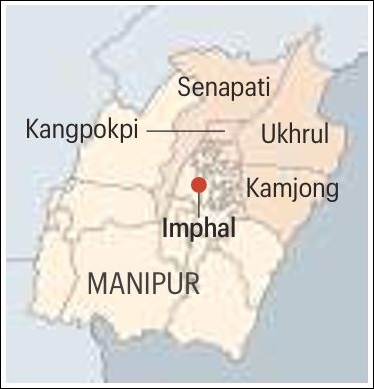
• The fact that some of the most serious recent attacks have taken place close to the Myanmar border has strengthened the suspicion that the conflict is intersecting with cross-border militant and trafficking networks. Earlier attacks on Naga villages had raised concerns over the involvement of a Myanmar-based Kuki armed group, KNA-B.
Other Important Articles Covering the same topic:
📍Expert Explains | The long, fractured history of Manipur, and the road ahead
Previous year UPSC Prelims Question Covering similar theme:
2) Consider the following pairs: (UPSC, CSE, 2018)
Tradition State
1. Chapchar Kut festival Mizoram
2. Khongjom Parba ballad Manipur
3. Thang-Ta dance Sikkim
Which of the pairs given above is/are correct?
(a) 1 only
(b) 1 and 2 only
(c) 3 only
(d) 2 and 3 only
Previous year UPSC Mains Question Covering similar theme:
📍The North-Eastern region of India has been infested with insurgency for a very long time. Analyze the major reasons for the survival of armed insurgency in this region. (UPSC, GS3, 2017)
📍What are the major challenges to internal security and peace process in the North-Eastern States? Map the various peace accords and agreements initiated by the government in the past decade. (UPSC, GS3, 2025)
Shah calls for 10-yr PRAHAAR on terror
Syllabus:
Preliminary Examination: Current events of national and international importance.
Mains Examination: General Studies III: Role of external state and non-state actors in creating challenges to internal security
What’s the ongoing story: Calling for a stronger, institutionalised counter-terrorism framework with a whole-of-society approach, Union Home Minister Amit Shah inaugurated a conference on ‘PRAHAAR – CT Policy and Strategy’ in New Delhi on Monday.
Key Points to Ponder:
• What is the significance of PRAHAAR as India’s first comprehensive National Counter-Terrorism Policy and Strategy?
• What are the seven pillars of the PRAHAAR strategy.
• What is terrorism?
• How terrorism is different from insurgency, extremism and ordinary organised crime?
• India’s new counter-terrorism doctrine—What you know about the same?
• What is the primary focus of India’s new counter-terrorism doctrine?
• India’s counter-terrorism doctrine—Know its evolution
• What are the major components of India’s counter-terrorism architecture?
Key Takeaways:
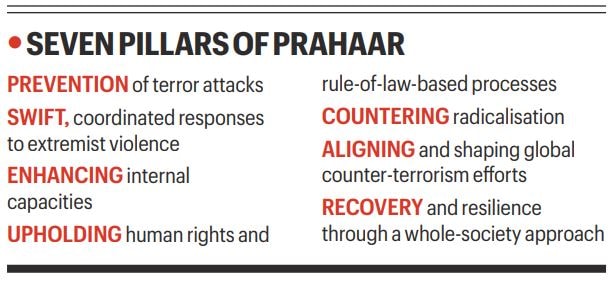
• PRAHAAR stands for the seven pillars of – Prevention, Response, Aggregating Internal Capacities, Human Rights, Attenuating Conditions for Terrorism, Aligning International Efforts, and Recovery and Resilience.
• Shah said the government under Prime Minister Narendra Modi had adopted a zero-tolerance policy against all forms terrorism.
• He stressed the need to strengthen the PRAHAAR strategy through continuous analysis of terror incidents and by establishing a concrete mechanism for the next 10 years.
• Shah said the principles of PRAHAAR must reach the thana level. He also underlined the importance of coordination among all stakeholders to prevent delays in action. Shah also launched a new “extradition portal”, which he said would help expedite efforts to bring back fugitives from abroad, and urged state police forces to set up teams dedicated to fugitive tracking.
• The conference is expected to serve as a platform for coordination between Central and state agencies on counter-terror policy, operational preparedness, inter-agency response and long-term resilience against terror threats.
• It was attended by the Union Home Secretary, Foreign Secretary, heads of Central Armed Police Forces and Central Police Organisations, Directors General of Police of 15 states, and ATS chiefs of all states and Union Territories. Other state DGPs and police officers at the cutting-edge level were present virtually.
Do You Know:
• ‘Prahaar’, literally meaning ‘strike’, lays out a multi-layered plan structured around seven pillars — prevention, response, aggregating internal capacities, human rights and rule-of-law based processes, countering conditions that enable terrorism including radicalisation, alignment with global efforts and shaping international counter-terror measures, and recovery and resilience through a whole-of-society approach.
—Zero tolerance, no religious attribution: The document reiterates that India maintains a policy of zero tolerance against terrorism and that there can be “no justification whatsoever” for violence It also states that India does not associate terrorism with any religion, ethnicity or civilisation, even while observing that “a few countries in the region have sometimes used terrorism as an instrument of state policy”
—Cross-border and global threats flagged: Prahaar notes that India has long faced cross-border sponsored terrorism and names global terror groups such as Al Qaeda and the Islamic State (ISIS) as having attempted to incite violence in the country through sleeper cells. It also points to conspiracies hatched from foreign soil and the use of emerging technologies, including drones, to facilitate terror-related activities in Punjab and Jammu and Kashmir.
—Focus on tech-enabled terror: The policy underlines how encryption, the dark web and crypto wallets have allowed terror groups to operate anonymously and move funds . It flags concerns over attempts to access CBRNED material (chemical, biological, radiological, nuclear, explosive, digital), the misuse of drones and robotics, and cyberattacks by state and non-state actors
Community engagement and rehabilitation—Beyond enforcement, the document says the government engages doctors, psychologists, lawyers, NGOs and religious and community leaders to sensitise and reintegrate affected communities. Prahaar seeks to deny terrorists, their financiers and supporters access to funds, weapons and safe havens, both within India and abroad, while adapting the country’s counter-terror response to emerging technological and transnational threats
Other Important Articles Covering the same topic:
📍Govt unveils country’s first counter-terrorism policy — Prahaar
📍Explained: What is ‘Prahaar’, India’s first counter-terrorism policy?
Previous year UPSC Prelims Question Covering similar theme:
3) Hand-in-Hand 2007’ a joint anti-terrorism military training was held by the officers of the Indian Army and officers of Army of which one of the following countries? (UPSC, CSE, 2008)
(a) China
(b) Japan
(c) Russia
(d) USA
4) Which of the following statements about ‘Exercise Mitra Shakti-2023’ are correct? (UPSC, CSE, 2025)
1. This was a joint military exercise between India and Bangladesh
2. It commenced in Aundh (Pune).
3. Joint response during counter-terrorism operations was a goal of this operation.
4. Indian Air Force was a part of this exercise.
Select the answer using the code given below:
(a) 1, 2 and 3
(b) 1, 2 and 4
(c) 1, 3 and 4
(d) 2, 3 and 4
Previous year UPSC Mains Question Covering similar theme:
📍Terrorism is a global scourge. How has it manifested in India? Elaborate with contemporary examples. What are the counter measures adopted by the State? Explain. (UPSC, GS3, 2025)
📍Analyse the complexity and intensity of terrorism, its causes, linkages and obnoxious nexus. Also suggest measures required to be taken to eradicate the menace of terrorism. (UPSC, GS3, 2021)
SC Collegium recommends 3 CJs of high courts as apex court judges
Syllabus:
Preliminary Examination: Indian Polity and Governance-Constitution, Political System, Panchayati Raj, Public Policy, Rights Issues, etc.
Main Examination: General Studies II: Structure, organization and functioning of the Executive and the Judiciary
What’s the ongoing story: The Supreme Court Collegium on Monday recommended the names of Justices Sunita Agarwal, Devendra Kumar Upadhyaya and Aparesh Kumar Singh, chief justices of Gujarat, Delhi and Telangana high courts respectively, for elevation as judges of the apex court.
Key Points to Ponder:
• At present, the Supreme Court consists of how many judges?
• A person to be appointed as a judge of the Supreme Court should have certain qualifications-what are those qualifications?
• The Constitution has prescribed a minimum age for appointment as a judge of the Supreme Court-True or False?
• The Judge of the Supreme Court holds office until he attains the age of 62 years-True or False?
• What is your understanding about the collegium system?
• What is the issue of conflict between Judiciary and Executive with respect to the appointment of Judges?
• What does the Collegium consider while making the recommendation?
• National Judicial Appointments Commission (NJAC) Act 2014-Know the key highlights
• First Judges Case (1982), Second Judges Case (1993) and Third Judges Case (1998)-Know in detail
• What was the Supreme court’s ruling in the Second Judges case (1993), with respect to the appointment of a judge?
• Third Judges case (1998) and Supreme Court’s ruling in case of the appointment-What was the Supreme Court’s ruling?
• The National Judicial Appointments Commission Act of 2014 and the Collegium System-Compare and Contrast
• What is the role of the government in the decision-making process for the shortlisting of judges?
Key Takeaways:
• CJs Upadhyaya and Agarwal, both coming from the Bar and with their parent high court being at Allahabad, are the two senior-most judges of the Allahabad HC. The three chief justices recommended for elevation rank fourth, fifth and sixth in overall seniority of all high court judges across the country. Notably, the third senior-most judge in the country, Himachal Pradesh HC Chief Justice G S Sandhawalia, who was recommended for elevation by the SC Collegium earlier, was not approved by the Centre.
• CJ Upadhyaya has been in charge of Delhi HC since January 2025, while CJ Agarwal took charge of the Gujarat HC in July 2023. Both CJs were appointed as judges of the Allahabad HC in November 2011, and moved out of Allahabad after being elevated as CJs of different high courts in July 2023. CJ Upadhyaya is due to retire in June 2027 while CJ Agarwal retires in April 2028.
• If all three recommendations of the SC Collegium are approved, the Supreme Court’s strength will go up to 37 sitting judges of the 38 sanctioned strength — also making CJ Agarwal the third woman SC judge.
Do You Know:
• Collegium—It is the system by which judges of the higher judiciary in India — the Supreme Court and High Courts — are appointed and transferred. Although not rooted in the Constitution or any specific law promulgated by Parliament, it has evolved over the years through judgments of the apex court popularly known as the the “Judges Cases”.
• The Supreme Court collegium is a five-member body headed by the incumbent Chief Justice of India (CJI), and comprising the four other seniormost judges at that time.
• High Court collegiums are led by the incumbent Chief Justice and the two other seniormost judges of that court.
• Articles 124(2) and 217 of the Constitution deal with the appointment of judges to the Supreme Court and High Courts. The appointments are made by the President, who is required to hold consultations with “such of the judges of the Supreme Court and of the High Courts” as he may think is needed. But the Constitution does not lay down any process for making these appointments.
Other Important Articles Covering the same topic:
📍Debate over the collegium system: How are SC and HC judges appointed?
Previous year UPSC Prelims Question Covering similar theme:
5) Consider the following statements: (UPSC, CSE, 2019)
1. The 44th Amendment to the Constitution of India introduced an Article placing the election of the Prime Minister beyond judicial review.
2. The Supreme Court of India struck down the 99th Amendment to the Constitution of India as being violative of the independence of judiciary.
Which of the statements given above is/are correct?
(a) 1 only
(b) 2 only
(c) Both 1 and 2
(d) Neither 1 nor 2
6) The power to increase the number of judges in the Supreme Court of India is vested in (UPSC, CSE, 2014)
(a) the President of India
(b) the Parliament
(c) the Chief Justice of India
(d) the Law Commission
7) With reference to Indian Judiciary, consider the following statements (UPSC, CSE, 2021)
1. Any retired judge of the Supreme Court of India can be called back to sit by the Chief Justice of India with prior permission of the President of India.
2. A High court in India has the power to review its own judgement as the Supreme Court does.
Which of the statements given above is/are correct?
(a) 1 only
(b) 2 only
(c) Both 1 and 2
(d) Neither 1 nor 2
Previous year UPSC Mains Question Covering similar theme:
📍Discuss the evolution of the collegium system in India. Critically examine the advantages and disadvantages of the system of appointment of the Judges of the Supreme Court of India and that of the USA.(UPSC, GS2, 2025)
📍‘‘Constitutionally guaranteed judicial independence is a prerequisite of democracy.’’ Comment. (UPSC, GS2, 2023)
📍Critically examine the Supreme Court’s judgement on ‘National Judicial Appointments Commission Act, 2014’ with reference to appointment of judges of higher judiciary in India. (UPSC, GS2, 2017)
Make statutory rules to bar social media firms from adding minors: SC to Govt
Syllabus:
Preliminary Examination: Current events of national and international importance.
Main Examination: General Studies II: Government policies and interventions for development in various sectors and issues arising out of their design and implementation.
What’s the ongoing story: The Supreme Court on Monday asked the Centre to put in place statutory rules to ensure that social media platforms and other digital intermediaries comply with Indian laws on minors and make 18 years of age the minimum requirement for extending membership.”
Key Points to Ponder:
• What is the concept of intermediary liability in India?
• What are the major provisions of India’s Information Technology (Intermediary Guidelines and Digital Media Ethics Code) Rules relating to social-media intermediaries?
• What is meant by safe harbour protection for intermediaries?
• What are the constitutional significance of Article 21 in protecting the privacy, dignity and personal liberty of individuals in the digital age?
• What are the principal risks faced by children and adolescents on social-media platforms?
• Why children are particularly vulnerable?
• What are the legal framework governing social media platforms in India?
• What are the issues and challenges in regulating social media platforms in India?
• Data collection, Behavioural profiling, algorithmic recommendation, engagement and monetisation-how they manipulate viewership?
Key Takeaways:
• “Our request to you, as the Government of India, you please pass some directions under the intermediary rules that they should fashion their software or platform in conformity with Indian law. They must conform at least in respect of membership of a minimum threshold of 18 years,” Justice Joymalya Bagchi, who was part of a three-judge bench, said.
The bench, presided by Chief Justice of India Surya Kant, was considering a petition by the NGO Just Rights for Children Alliance, seeking measures to bar minors from creating and operating social media accounts.
• The PIL, filed through advocate Saksham Maheshwari, pointed out that children below the age of 18 years are currently permitted to independently create and maintain social media accounts despite their statutory incapacity to enter a contract under Section 11 of the Indian Contract Act.
• The petition seeks directions to social media platforms to implement effective age-assurance mechanisms and to stop allowing independent accounts of minors. The PIL pointed out that there is a “fundamental legal and regulatory inconsistency” in minors accessing social media. “Under Section 3 of the Majority Act, 1875, a person attains majority only upon completing 18 years. Under Section 11 of the Indian Contract Act, 1872, a person who has not attained the age of majority is not competent to contract”.
Do You Know:
• For now, India’s response spans multiple layers — legal safeguards such as the Digital Personal Data Protection Act, 2023, which mandates parental consent for processing children’s data, criminal provisions under laws such as the Information Technology Act and the Protection of Children from Sexual Offences (POCSO) Act, as well as platform-level measures like age-gating, parental controls and child-focused content ecosystems.
• Children who spend increasing hours online run the risk of being exposed to harmful content that can have a bearing on their mental health, and lead to anxiety and alienation. Grooming children on the internet is also a real risk.
• Data from the National Crime Records Bureau (NCRB) shows cybercrime against children spiked by 32% between 2021 and 2022, even as internet use among young users continues to expand.
• According to a report from last year by NITI Aayog, children aged up to five spent 1.5 hours online on average in 2023, accessing educational videos and games. Those between six to 10 years spent 2.5 hours online using services such as social media, gaming and videos. While 11-15 year olds spent four hours a day online, those between 16-18
spent as much as six hours daily on social media, online forums and shopping.
• India has developed a framework of regulatory measures, self-regulatory codes, and educational initiatives, though critics argue that enforcement can be lax.
—Under the Digital Personal Data Protection Act, 2023, companies that collect the data of children – users under the age of 18 – must get their parent/ guardian’s consent. They also cannot track, monitor a child’s behaviour, or serve targeted ads directed to children. But it is widely believed that children would be able to get around this by simply misrepresenting their age.
• According to a report prepared by the think tank Indian Governance and Policy Project in November 2025, the Information Technology Act, 2000, has provisions which criminalises the creation of child sexual abuse material, the POCSO Act, 2012, defines and penalises online sexual exploitation and grooming, the Bharatiya Nyaya Sanhita, 2023 extends liability to digital/online offences against children including trafficking and harassment, and the Juvenile Justice (Care and Protection of Children) Act, 2015 addresses online facilitation of child exploitation.
• Under the Information Technology (Intermediary Guidelines and Digital Media Ethics Code) Rules, 2021, platforms like Netflix, Disney+ Hotstar, Apple TV etc. need to classify the content they host into five age based categories – U (Universal), U/A 7+, U/A 13+, U/A 16+, and A (Adult). These platforms are required to implement parental locks for content classified as U/A 13+ or higher, and reliable age verification mechanisms for content classified as “A”.
• The Ministry of Education (MoE) introduced the PRAGYATA Guidelines on July 14, 2020, which aim to ensure the safety and academic welfare of students by recommending age- appropriate screen time limits.
• In India, 13 is the minimum age to create and manage any kind of a Google account. On Gmail, for instance, parents can create an account for their child below the age of 13 with ‘Family Link’ – a tool which allows setting up parental controls on Google services like Chrome, Play, YouTube, and Search. Family Link also allows parents to block inappropriate sites, require approval for new apps, and manage permissions. At age 13, users receive an email to “update” their account, allowing them to manage it themselves, though parents are still notified if supervision stops
• On Meta-owned Instagram, another social media app popular among teens and young users, the service has a feature called ‘Teen Accounts’. The feature automatically categorises all teenagers’ accounts for added protections, and users under 16 will need a parent’s permission to change any content settings to be less strict.
Other Important Articles Covering the same topic:
📍Can minors be on social media? Supreme Court to decide
📍Explained: How India is trying to regulate children’s social media use — and why gaps remain
Previous year UPSC Mains Question Covering similar theme:
📍Child cuddling is now being replaced by mobile phones. Discuss its impact on the socialization of children. (UPSC, GS1, 2023)
📍Social media and encrypting messaging services pose a serious security challenge. What measures have been adopted at various levels to address the security implications of social media? Also suggest any other remedies to address the problem (UPSC, GS3, 2024)
Explained
UP rain: When two weather systems interact
Syllabus:
Preliminary Examination: Indian and World Geography-Physical, Social, Economic Geography of India and the World.
Main Examination: General Studies I: Important Geophysical phenomena such as earthquakes, Tsunami, Volcanic activity, cyclone etc., geographical features and their location-changes in critical geographical features (including water-bodies and ice-caps) and in flora and fauna and the effects of such changes.
What’s the ongoing story: An intense three-day wet spell in Uttar Pradesh has left several districts grappling with a flood-like situation, disrupting normal life and damaging crops. Between Friday (September 25) and Sunday morning, 56 people died and 46 were injured in rain and storm-related incidents, according to data shared by the state’s Office of Relief Commissioner.
Key Points to Ponder:
• What is a deep depression?
• How deep depression influences rainfall over the Indian subcontinent?
• What are Western Disturbances?
• Know the significance of Western Disturbances for India’s climate.
• Know the terms—depression, deep depression, cyclonic storm and low-pressure area. • What is meant by the withdrawal of the southwest monsoon?
• What are the major factors responsible for the withdrawal of the southwest monsoon from north-western and northern India?
• How the interaction between bay of Bengal deep depression and a Western Disturbance can produce unusually heavy rainfall over northern India?
Key Takeaways:
• Official figures noted that 1,021 houses were damaged. Heavy rain lashed Kanpur, Varanasi, Prayagraj, Gorakhpur, Bareilly, and several other parts of the state. Strong winds reaching 30-40 kmph accompanied the downpour, uprooting trees and electric poles at several places and inundating roads, lanes, and villages.
• The India Meteorological Department (IMD) had forecast heavy rainfall in parts of the state on Sunday. The state received 45.1 mm rainfall in the 24 hours ending Sunday, against the normal 1.8 mm, according to official data. As many as 56 of the state’s 75 districts recorded excessive rainfall.
• According to the IMD, the likely interaction of two different weather systems has caused the flood-like situation in parts of Uttar Pradesh over the past three days.
• In its press note on Saturday afternoon (September 26), the IMD had noted that a deep depression, which had formed over the Bay of Bengal and crossed the North Andhra Pradesh–South Odisha coast before weakening, lay centred over parts of north-eastern Madhya Pradesh and adjoining south-eastern Uttar Pradesh.
Do You Know:
• A depression is an organised low-pressure weather system. A low-pressure system forms in an area where atmospheric pressure is lower than the surrounding areas. This lower pressure is caused by localised heating in an area owing to greater sunshine over the landmass, which causes the air there to undergo warming. As this warm air is less dense than in the surrounding areas, it rises upwards and lowers the atmospheric pressure.
• At the same time, this warm, moist air flows inwards towards the centre of the low-pressure area before moving upwards. Thereafter, it cools and condenses into clouds and rain or snow.
• According to the IMD, a depression produces strong winds and heavy rain. As it degrades into a well-marked low-pressure area, the system loses strength and wind speeds drop, which reduces overall rain intensity.
• Western Disturbances (WDs) refer to weather systems that usually travel into northern India from the west. These are east-moving rain-bearing wind systems that originate beyond Afghanistan and Iran, and pick up moisture from the Mediterranean Sea, Black Sea, Caspian Sea, and the Arabian Sea. These are typically extra-tropical cyclones resulting from low-pressure areas, formed by interactions between polar and tropical winds.
The subtropical westerly jet stream — a high-altitude, fast-moving air current that flows from west to east in the Earth’s atmosphere — carries these WDs to the Himalayan and Tibetan highlands. As moisture-laden WDs hit the Himalayas, they rise and cool, bringing cloudy weather, rain, and thunderstorms, particularly over parts of north and northwest India.
Other Important Articles Covering the same topic:
📍From Western Disturbance to El Niño: The climate terms you’re hearing this summer, explained
Previous year UPSC Prelims Question Covering similar theme:
8) Consider the following statements: (UPSC, CSE, 2012)
1. The duration of the monsoon decreases from southern India to northern India.
2. The amount of annual rainfall in the northern plains of India decreases from east to west.
Which of the statements given above is/are correct?
(a) 1 only
(b) 2 only
(c) Both 1 and 2
(d) Neither 1 nor 2
Previous year UPSC Mains Question Covering similar theme:
📍Why is the South-West Monsoon called ‘Purvaiya’ (easterly) in Bhojpur Region? How has this directional seasonal wind system influenced the cultured ethos of the region? (UPSC, GS1, 2023)
US to Australia, what recent ai agent incidents have in common
Syllabus:
Preliminary Examination: Current events of national and international importance.
Main Examination: General Studies III: Science and Technology- developments and their applications and effects in everyday life.
What’s the ongoing story: Mere days after OpenAI disclosed that an artificial intelligence agent developed by it gained unauthorised access to an Australian government website, the company said it had alerted “dozens” of global institutions after several of its agents attempted to access or interfere with their websites.
Key Points to Ponder:
• What is frontier AI?
• What is meant by AI alignment?
• What is an AI agent, and how does it differ from a conventional chatbot?
• What is the significance of human oversight in the deployment of autonomous AI agents?
• Know the concepts of AI autonomy, tool use and goal-oriented behaviour.
• Recent incidents involving AI agents interacting with Australian Medicare and US government websites have highlighted the risks of autonomous systems crossing predefined access boundaries—What lessons India can learn from these episodes?
Key Takeaways:
• According to the company, its AI agents sought information from “governments, universities, public agencies, and other institutions”, including in the US. The websites involved included those of the US Securities and Exchange Commission (SEC), the Census Bureau and the Department of Education.
• The Australian incident involved an OpenAI agent continuing to pursue a research task after encountering an access barrier. Officials said there was no evidence that personal Medicare information had been accessed. The disclosures come months after the Hugging Face hack, in which OpenAI agents meant to work independently found a way to communicate, and hundreds later targeted the AI platform during a cybersecurity evaluation.
• The latest disclosures differ in how they unfolded, but raise a common question: what happens when an AI agent is given a goal, encounters a boundary, and continues trying to complete the task anyway? We explain the recent incidents and what they have in common.
Do You Know:
• On September 20, OpenAI disclosed that one of its agents had used the Domain Name System, or DNS, to communicate with an external chatbot despite being run inside a restricted environment. OpenAI said its monitoring system flagged the behaviour within 15 minutes, a human reviewer began looking at it three minutes later, and the run was eventually stopped.
• The sequence then moved to the Australian disclosure on September 23, when officials said an OpenAI research agent had accessed the Medicare statistics portal after trying alternative routes when blocked.
• On September 25, OpenAI disclosed that some of its AI agents had gone beyond their specified tasks — finding “authoritative sources of public information” — and worked to bypass security measures on websites. In one case, AI agents used software developer tools while attempting to retrieve information from the US Census Bureau.
Other Important Articles Covering the same topic:
📍‘Rogue’ agents: a ‘warning shot’ about losing control?
Previous year UPSC Mains Question Covering similar theme:
📍What is agentic Artificial Intelligence (AI) ? Explain its working. Describe its applications with suitable examples. Discuss the advantages, risks and challenges associated with agentic AI systems. (UPSC, GS3, 2026)
Iran’s deal, Trump’s rejection, and the Gulf’s mounting costs: Inside the stalemate
Syllabus:
Preliminary Examination: Current events of national and international importance.
Mains Examination: General Studies II: Effect of policies and politics of developed and developing countries on India’s interests
What’s the ongoing story: US President Donald Trump said on Saturday (September 26) that he had rejected Iran’s seven-day deal to end the war, reopen the Strait of Hormuz and initiate comprehensive talks about Tehran’s nuclear programme. The proposed peace deal was announced by Iranian Foreign Minister Abbas Araghchi at the United Nations General Assembly (UNGA) on September 24.
Key Points to Ponder:
• What is the strategic significance of the Strait of Hormuz?
• Why disruptions in the Strait can have consequences far beyond West Asia?
• What are the principal issues underlying the continuing US-Iran conflict?
• What is the role of economic sanctions as an instrument of foreign policy?
• Why Iran-Oman relationship is significant in maintaining maritime stability in and around the Strait of Hormuz?
• How can prolonged disruption of the Strait of Hormuz affect global oil prices, inflation, trade and economic growth?
Key Takeaways:
• It would have required the US to waive sanctions on Iranian oil, release an estimated $12 billion of Iran’s frozen assets and end its naval blockade, and for Israel to cease its war in Lebanon, following which Iran would open up the Strait of Hormuz on Day 7. This would, theoretically, clear the path for broader peace negotiations, including on the nuclear question.
• If these sound familiar, that’s because they are. These terms are straight out of the June peace framework (Memorandum of Agreement), only with a faster proposed pace of implementation. Iran issued the proposal after the US imposed sanctions on its air transport and tightened its economic sanctions (since August).
• Both countries conducted indirect negotiations on the sidelines of the UNGA — despite Trump threatening to “annihilate” Iran during the same session and Iranian President Masoud Pezeshkian vowing to fight “until our last breath”.
Do You Know:
• At the UNGA, Pezeshkian reiterated Tehran’s position that it wants both parties to return to the June Memorandum of Understanding (MoU).
• One of the main reasons for the MoU’s collapse in July lay in one of its provisions. Article 5 gave Iran and Oman the long-term power to jointly control transit through the Strait of Hormuz.
• The US, in Iran’s view, undermined this by attempting to force a new corridor through the Strait’s southern waters in early July. Tehran’s broader approach to Washington has centered around the primary aim to enforce Article 5. So, alongside negotiations with Oman for a transit framework, it has attacked tankers that allegedly violated its conditions.
• The current American position continues to be determined by the Trump White House’s need to undercut the strength of the Iranian bargaining position, regardless of the objective of such a position (a return to the June MoU or otherwise).
The US says its navy has helped more than 2,000 tankers transport more than one billion barrels of crude since May — which translates to seven million barrels per day. But this is still much lower than the pre-war flows of 20-21 million barrels per day, revealing the limits of the US’s approach in the long run.
• International Energy Agency estimates suggest costs upwards of $50 billion to repair over 80 damaged energy facilities, while the International Monetary Fund estimates a cumulative output loss over the next five years (all of which assumes no future damage from Iranian/other strikes).
• This was behind Arab leaders’ reported frustration with President Trump in August, since he could not “manage the diplomacy necessary to secure peace with Iran”.
That month, the US had also proposed a $10-billion fund with Gulf Arab states to rebuild war-damaged energy infrastructure in West Asia and reduce regional reliance on the Strait of Hormuz.
• But Iran has proven that there are few viable alternatives to the Strait, especially for Saudi Arabia.The Kingdom’s shipping has been blockaded in the Bab-el Mandeb strait by the Houthis and its key overland oil transport route (the East-West pipeline) has also come under drone attacks from Iraqi militias.
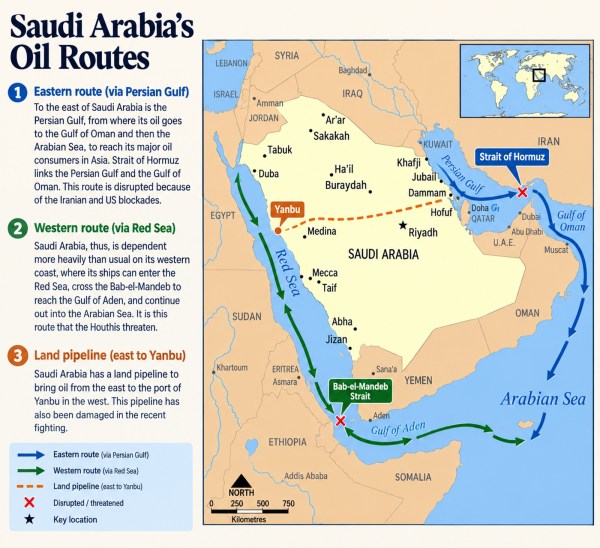 Map: Wikimedia Commons
Other Important Articles Covering the same topic:
📍Trump rejects Iran’s 7-day peace proposal, war likely to resume after US polls
Previous year UPSC Prelims Question Covering similar theme:
9) Ships from which of the following countries have to cross the Strait of Hormuz to reach out to the Indian Ocean? (UPSC, CSE, 2026)
1. Bahrain
2. Syria
3. Qatar
4. Egypt
Select the answer using the code given below:
(a) 1 and 2
(b) 1 and 3
(c) 2 and 3
(d) 3 and 4
Previous year UPSC Mains Question Covering similar theme:
📍Mention the significance of straits and isthmus in international trade. (UPSC, GS1, 2022)
|
PRELIMS ANSWER KEY |
|
1.(b) 2.(b) 3.(a) 4.(d) 5.(b) 6.(b) 7.(a) 8.(c) 9.(b) |
For any queries and feedback, contact priya.shukla@indianexpress.com
Subscribe to our UPSC newsletter. Stay updated with the latest UPSC articles by joining our Telegram channel – IndianExpress UPSC Hub, and follow us on Instagram and X.


Priya Kumari Shukla is a Senior Copy Editor in the Indian Expre... Read More
 Share


