


© IE Online Media Services Pvt Ltd
Tags:


🚨 Attention: UPSC Key is now all 7 Days a Week!🚨
Important topics and their relevance in UPSC CSE exam for June 6th, 2024. If you missed the June 5th, 2024 UPSC CSE exam key from the Indian Express, read it here.

🚨 The Indian Express UPSC Essentials brings to you the May edition of its monthly magazine. Click Here to read. Share your views and suggestions in the comment box or at manas.srivastava@indianexpress.com🚨
UPSC Syllabus:
Preliminary Examination: General issues on Environmental Ecology, Biodiversity and Climate Change
Mains Examination: GS-III: Environment
What’s the ongoing story- Now the generations-old craft is increasingly under threat as some experts say rising temperatures brought by climate change disrupt the growth of bees, the availability of their food, and even pollination of plants.

— What is the impact of climate change?
— What is the recent report on rising global temperature?
— How global warming is increasing the average temperature of the globe?
Key takeaways:
— For generations, the Gurung community in Taap, about 175 km (110 miles) west of the capital, Kathmandu, and other villages in the nearby districts of Lamjung and Kaski, have scoured the steep Himalayan cliffs for honey.
— The honeycomb extract, also known as ‘mad honey’, for some intoxicating qualities that can cause hallucinations, sells for 2,000 Nepali rupees ($1.5) a litre, but the villagers rule out overharvesting as a reason for falling collections.
— Some experts blame climate change, driven by a global rise in temperatures, as a major factor in the decline, but other contributors are deforestation, diversion of water from streams and rivers for hydroelectric dams, and use of pesticides.
— Temperatures in the Himalayas, home to the planet’s tallest peaks, range higher than an average global increase of 1.2 degrees Celsius (2.2 degrees Fahrenheit) above pre-industrial levels, United Nations data and independent research show.
— Global studies show that a temperature rise of even one degree affects the growth of bees, the availability of their food, and cross-pollination of plants, said Suruchi Bhadwal of India’s Energy and Resources Institute (TERI).
— Research showed climate change was disrupting the food chains for bees and the flowering of plants, affecting populations of both across the world, added Bhadwal, the head of earth science and climate change at the institute.
For Your Information:
— The last decade has seen bee populations declining twice as fast, coupled with the rise of the Colony Collapse Disorder – a phenomenon whose cause is being attributed to certain chemicals in fertilizers interfering with the bees internal navigation system. Each of these have contributed to a drastic decline in global bee populations.
— As the world’s second-largest producer of fruits and vegetables, bees are vital for the nation’s economic performance as well. A study by a team from the University of Kolkata, assessed the effect of pollination on five different crop productions and found that the annual loss can be estimated to be $726 million – thus the effects of a loss in bees would also lead to a shortfall in agricultural produce as well.
Points to Ponder:
— What are the global initiatives for tackling climate change?
— What is the Paris Agreement?
— What initiatives have been made by the Indian government to mitigate climate change?
Post Read Question:
Colony collapse disorder is associated with which of the following organisms?
(a) Dragonflies
(b) Honeybees
(c) Butterflies
(d) Wasps
Other Important Articles Covering the same topic:
Truth bee told: Why the threat of climate change is a warning we can’t buzz away
UPSC Syllabus:
Preliminary Examination: Science and Technology
Mains Examination: GS-III: Science and Technology
What’s the ongoing story- Indian-origin astronaut Sunita Williams flew to space for the third time on Wednesday along with a colleague, scripting history as the first members aboard Boeing’s Starliner spacecraft on a 25-hour flight to the International Space Station.
Prerequisites:
— What is the International Space Station (ISS)?
— What is the importance of ISS?
Key takeaways:
— “This crew flight test represents the beginning of a new era of space exploration as we watch astronauts Wilmore and Williams put Boeing’s Starliner through its paces on the way to the International Space Station,” said Boeing Defense, Space & Security President and CEO Ted Colbert.
— Williams also made history as the first woman to embark on such a mission. And it won’t be her first entry in the history books.
— In 2012, during a prior trip to the International Space Station, Williams became the first person to finish a triathlon in space, during which she simulated swimming using a weight-lifting machine and ran on a treadmill while strapped in by a harness so she wouldn’t float away.
For Your Information:
— The mission has been delayed for several years because of setbacks in the spacecraft’s development.
— If it is successful, it will become the second private firm able to provide crew transport to and from the ISS, alongside Elon Musk’s SpaceX.
— SpaceX and Boeing developed their respective vehicles under NASA’s Commercial Crew Programme, a partnership with private industry contractors. From the outset, the space agency aimed to have both companies operating at once.
— The Crew Dragon and Starliner spacecraft would each serve as a backup to the other, giving astronauts the option to keep flying, even if technical issues or other setbacks grounded one spacecraft.
Points to Ponder:
— What is India’s Space Policy 2023?
— What are the opportunities and challenges with private sector participation in space missions?
— What are the initiatives taken by the government to promote the privatisation of the space sector?
Post Read Question:
What is India’s plan to have its own space station and how will it benefit our space programme? (UPSC CSE 2019)
Other Important Articles Covering the same topic:
Indian-origin astronaut Sunita Williams set to fly into space for a third time next month
UPSC Syllabus:
Preliminary Examination: Current events of national and international importance.
Mains Examination: GS- II: Effect of policies and politics of developed and developing countries on India’s interests, Indian diaspora.
What’s the ongoing story- Deep divisions will limit progress at reconciliation talks between Palestinian factions Hamas and Fatah this month, conversations with five sources in the groups indicate, but the meetings highlight that the Islamist group is likely to retain influence after Israel’s war in Gaza.
Prerequisites:
— What is Hamas?
— Know in brief about the ongoing Israel-Hamas war.
— What is Fatah party of Palestinian?
Key takeaways:
— The talks between Hamas and the Fatah party of Palestinian President Mahmoud Abbas will be held in China in mid-June, according to officials from both sides. They follow two recent rounds of reconciliation talks, one in China and one in Russia. China’s foreign ministry declined to comment.
— The next meeting will be held amid attempts by international mediators to reach a ceasefire deal for Gaza, with one of the key sticking points being the “day-after” plan – how the enclave will be governed.
— Considered a terrorist organisation by many Western nations, Hamas was shunned long before its Oct. 7 attacks killed 1,200 people in Israel, with more than 250 hostages taken, triggering the war in Gaza.
— Hamas, which ruled Gaza before the war, recognises it cannot be part of any internationally recognised new government of the Palestinian territories when fighting in the enclave eventually ends, said the source.
— Nonetheless, it wants Fatah to agree to a new technocratic administration for the West Bank and Gaza as part of a wider political deal, the source and senior Hamas official Basim Naim said.
For Your Information:
— Hamas is the largest Palestinian militant Islamist group and one of the two major political parties in the region. Hamas as a whole, or in some cases its military wing, is designated a terrorist group by Israel, the United States, the European Union, the United Kingdom, and other countries.
Points to Ponder:
— What is the conflict between Hamas and Fatah?
— What is India’s stand on the Israel-Hamas Conflict?
— What is India’s diplomatic attitude towards Palestine?
— Map Work-Israel, Palestine, Gaza Strip and other places in news.
Post Read Question:
The Mediterranean Sea is a border of which of the following countries? (UPSC CSE 2017)
1. Jordan
2. Iraq
3. Lebanon
4. Syria
Select the correct answer using the code given below:
(a) 1, 2 and 3 only
(b) 2 and 3 only
(c) 3 and 4 only
(d) 1, 3 and 4 only
Other Important Articles Covering the same topic:
Which countries recognie Hamas as a Terrorist Organisation?
Hamas: Its conflict with Fatah
UPSC Syllabus:
Preliminary Examination: Indian Polity and Governance
Mains Examination: GS-II:Indian Polity and Governance
What’s the ongoing story- Telugu Desam Party (TDP) president N Chandrababu Naidu emerged as a key player in national politics on Wednesday (June 5), after his party won 16 seats in the Lok Sabha election. TDP is in alliance with the Jana Sena Party and the BJP in Andhra Pradesh. Naidu’s support is critical for the BJP, which has only 240 seats in Lok Sabha. In return, Naidu is likely to extract several promises and assurances, the most important of which will be the status of a Special Category State for Andhra Pradesh.
Prerequisites:
— What is a Special Category Status?
— Which states presently have SCS?
— What is the criteria for SCS designation?
Key takeaways:
— In 1969, the Fifth Finance Commission of India introduced the mechanism of SCS to assist certain states in their development and fast-tracking growth if they faced historical economic or geographical disadvantages. Factors such as difficult and hilly terrain, low population density and/ or a sizable tribal population, strategic location along borders, economic and infrastructural backwardness, and non-viable nature of state finances were typically considered to accord SCS.
— The system was scrapped on the recommendation of the 14th Finance Commission, which suggested that the resource gap of the states should be filled by increasing the devolution of tax to 42% from the existing 32%.
— SCS would mean higher grants-in-aid to the state government from the Centre.
— SCS states enjoy special industrial incentives such as Income-tax exemptions, custom duty waivers, reduced excise duty, corporate tax exemption for a certain period, concessions and exemptions relating to GST, and lower state and central taxes.
Points to Ponder:
— What does The 14th Finance Commission say about the Special Category status?
— Which states are demanding the Special Category Status?
— What are the Benefits of SCS?
— What are the concerns related to SCS?
Post Read Question:
What is the significance of the special category status given to states? What are the concerns associated with it?
Other Important Articles Covering the same topic:
What is special category status?
UPSC Syllabus:
Preliminary Examination: Polity
Mains Examination: GS-II: Polity and Governance
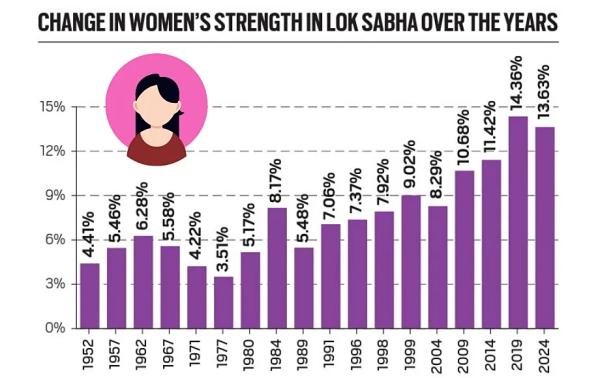
What’s the ongoing story- Over the years, Lok Sabha’s gender composition has shown a general trend towards increasing women’s representation. But progress has been slow and not linear.
Prerequisites:
— What is the status of women’s representation in the Parliament?
— What is the composition of the Lok Sabha?
— What is the significance of increased women’s representation in the parliament?
Key takeaways:
— India has elected 74 women MPs to Lok Sabha this year, four fewer than in 2019 and 52 more than in India’s first elections in 1952. These 74 women make just 13.63% of the elected strength of the Lower House, much less than the 33% that will be reserved for women after the next delimitation exercise.
— In 1952, women made up just 4.41% of the strength of the Lower House. This number increased to more than 6% in the election held a decade later, but again dipped to below 4% in 1971.
— Since then, there has been a slow, but steady rise in women’s representation (with a few exceptions), which crossed the 10% mark in 2009, and peaked in 2019 at 14.36%. India still lags behind several countries — 46% of MPs in South Africa, 35% in the UK, and 29% in the US, are women.
— Of the 74 women MPs elected, 43 are first time MPs, and one (Misa Bharti of the RJD) is a first time Lok Sabha MP. This is higher than the overall percentage of newcomers in the House (59% vs 52%).
— Women MPs have only 0.76 Lok Sabha terms of experience (one term is generally 5 years long).
— Women MPs, with an average age of 50 years, are also younger. The overall age of the House is 56. They are as educated as their male counterparts, with 78% completing undergraduation.
— Out of the total 8,360 candidates, who stood in the 2024 Lok Sabha elections, just around 10% were women. This number too has increased over time — it stood at 3% in 1957. This is the first time that women candidates’ proportion touched 10%.
Points to Ponder:
— What are the reasons for low women representation in the Lok Sabha?
— Why do women’s MPs have low Lok Sabha terms of experience?
— What initiatives have been taken been by the government to increase women participation in the Parliament?
Post Read Question:
Consider the following statements:
1. The Constitution (106th Amendment) Act, 2023 reserves one-third of all seats for women in Lok Sabha and State legislative assemblies.
2. It has inserted Article 239-AA in the constitution of India.
Which of the statements given above is/are correct?
(a) 1 only
(b) 2 only
(c) Both 1 and 2
(d) Neither 1 nor 2
Other Important Articles Covering the same topic:
Women’s reservation Bill gets President’s assent, becomes law
UPSC Syllabus:
Preliminary Examination: Indian Polity and Governance – Constitution, Political System
Mains Examination: GS-II: Governance, Constitution, Polity
What’s the ongoing story- Elections, however, are not just about victory and defeat. They are equally, if not more importantly, tests of the process, and its checks and balances, the system’s ability to ensure fair play.
Prerequisites:
— What is the role of the Election Commission?
— What is the role of the Enforcement Directorate (ED)?
— What is the Model Code of Conduct (MCC)?
— Who are star campaigners?
Key takeaways:
— For India’s poll monitor, the Election Commission (EC), that task is both delicate and difficult: Making adherence to due procedures non-negotiable in a diverse and intensely competitive field, where passions often run high.
— On Tuesday, when it declared the results of the General Elections the EC could justifiably claim to have lived up to its own high standards. “Parinaam mein hi pramaan hai (the result is the proof)”, said the CEC.
For Your Information:
— According to Chief Election Commissioner Rajiv Kumar, India created a world record with 64.2 crore voters, including 31.2 crore women, participating in the Lok Sabha elections this year. It is 1.5 times the voters of all G7 countries. A total of 1.5 crore polling and security personnel were involved in holding the elections
Points to Ponder:
— What are the constitutional provisions related to the Election Commission of India (ECI)?
— What is the composition of the Election Commission?
— What were the concerns related to the ECI?
— What needs to be done to strengthen the ECI?
Post Read Question:
Consider the following statements: (UPSC CSE 2017)
1. The Election Commission of India is a five-member body.
2. The Union Ministry of Home Affairs decides the election schedule for the conduct of both general elections and bye-elections.
3. Election Commission resolves the disputes relating to splits/mergers of recognised political parties.
Which of the statements given above is/are correct?
(a) 1 and 2 only
(b) 2 only
(c) 2 and 3 only
(d) 3 only
Other Important Articles Covering the same topic:
UPSC Syllabus:
Preliminary Examination: Indian economy
Mains Examination: GS-III: Indian Economy and issues relating to planning, mobilization, of resources, growth, development and employment.
What’s the ongoing story- India’s service sector growth eased to a five-month low in May amid fierce competition, price pressures and a severe heatwave, even as new orders from international markets expanded.
Prerequisites:
— What is the contribution of the service sector to India’s GDP?
— What is the Purchasing Managers Index?
— How does the Purchasing Managers Index work?
For Your Information:
— The PMI is an indicator of the economic trends in the manufacturing and service sectors. The indicator is compiled and released monthly.
— It is a survey-based measure that asks respondents about changes in their perceptions of important business factors over the past month.
Points to Ponder:
— Why Purchasing Managers Index is important?
— How does the Purchasing Managers Index affect economic decisions?
Post Read Question:
Consider the following statements: (UPSC CSE 2020)
1. The weightage of food in Consumer Price Index (CPI) is higher than that in Wholesale Price Index (WPI).
2. The WPI does not capture changes in the prices of services, which CPI does.
3. The Reserve Bank of India has now adopted WPI as its key measure of inflation and to decide on changing the key policy rates.
Which of the statements given above is/are correct?
(a) 1 and 2 only
(b) 2 only
(c) 3 only
(d) 1, 2 and 3
“A Life Spent in Making Mistakes Is Not Only More Honorable But More Useful Than a Life Spent Doing Nothing.”
– George Bernard Shaw
(Thought Process: This quote has been taken from Shaw’s play “The Doctor’s Dilemma” which was first staged in London in 1906. Is embracing your mistakes an integral part of the human experience? Why is the method of trial and error considered so important? Shouldn’t mistakes be viewed not as failures but as part of the learning process? Does making no mistakes indicate inaction in life, showing missed opportunities and unfulfilled potential? If you don’t take risks, how will you learn? How can this quote be implemented in your life?)
Subscribe to our UPSC newsletter and stay updated with the news cues from the past week.
The UPSC articles of Indian Express is now on Telegram. Join our Telegram channel- Indian Express UPSC Hub and stay updated with the latest Updates.
https://www.youtube.com/watch?v=wsnxUastCeM?si=ck2m_hnrRrUvVCvy&w=560&h=315


