
UPSC Key: Casteist Slurs, Iraq Invasion and Rising Sea Level
Why Green Energy Corridor Scheme, is relevant to the UPSC exam? What is the significance of topics such as Madden-Julian Oscillation, Montevideo Convention and economic nationalism on both the preliminary and main exams? You can learn more by reading the Indian Express UPSC Key for October 1, 2026.
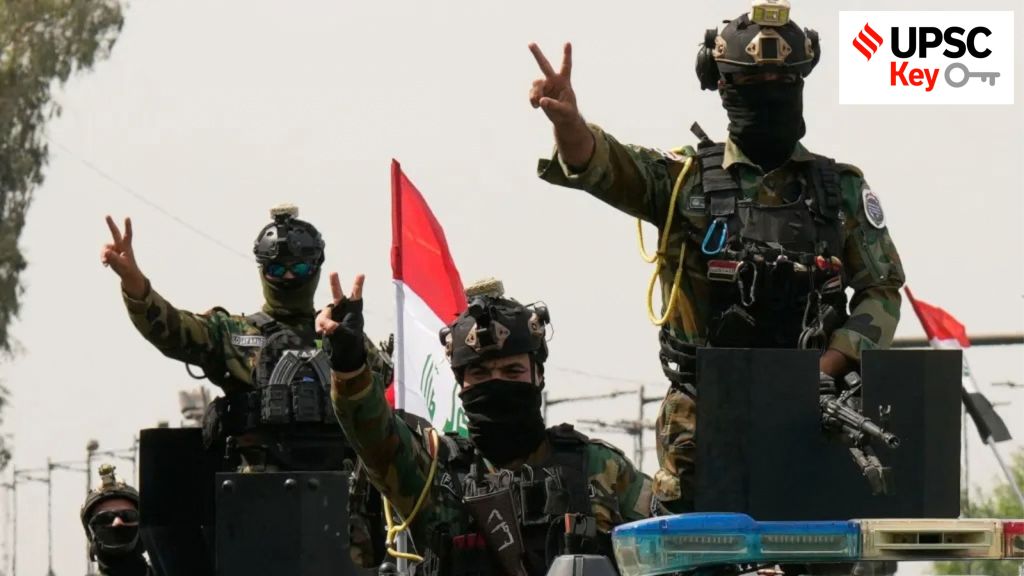 UPSC Key October, 2026: Here's what you should be reading from the October 1, 2026 edition of the Indian Express.
Important topics and their relevance in UPSC CSE exam for October 1, 2026. If you missed the September 30, 2026 UPSC CSE exam key from the Indian Express, read it here
Front Page

Modi, Trump review trade, defence ties
Syllabus:
Preliminary Examination: Current events of national and international importance.
Mains Examination: General Studies II: Bilateral, regional and global groupings and agreements involving India and/or affecting India’s interests
What’s the ongoing story: Prime Minister Narendra Modi spoke to US President Donald Trump on Wednesday, in their first phone conversation since the American President signed the law that has granted powers to impose 100 per cent tariffs to India, China and other countries for importing Russian energy.
Key Points to Ponder:
• What are the key components of the India-US Comprehensive Global Strategic Partnership?
• What is the significance of the India-US Comprehensive Global Strategic Partnership?
• How strategic autonomy is different from neutrality and non-alignment?
• What are tariffs?
• How tariffs is used not only as trade instruments but also as instruments of foreign policy?
• What are the major dimensions of India’s energy security?
• Why is Russian oil strategically important for India?
• What are the factors that determine India’s choice of crude-oil suppliers?
• What are the key highlights from the Lindsey O. Graham Sanctioning Russia and Iran Act of 2026?
• What are economic sanctions?
• What has been India’s immediate response?
• What options India have?
Key Takeaways:
• This is Modi’s first conversation with Trump since April when the two leaders had spoken after the agreement on a fragile ceasefire between US and Iran over the war in West Asia.
“Had a productive conversation with President Trump. We reviewed our bilateral cooperation in trade, defence, energy, critical technologies and other areas. We agreed to maintain close engagement to take our Comprehensive Global Strategic Partnership forward,” Modi said, after the conversation. “We also exchanged views on regional and international issues, including ongoing efforts to advance global peace and security,” he said.
• According to PMO statement, the two leaders reviewed progress in bilateral cooperation across trade, defence, energy, critical technologies and other areas of mutual interest.
• “They reaffirmed their commitment to advancing the India-US Comprehensive Global Strategic Partnership and agreed to maintain close engagement to deepen cooperation for the benefit of the people of both countries,” it said, adding that the leaders also exchanged views on regional and international developments and discussed ongoing efforts to promote global peace and security.
• “Both leaders agreed to remain in touch,” it said. Modi is expected to travel to the US for the G20 leaders’ summit in December this year. But, before that US Secretary of State Marco Rubio is expected to travel to India in the third week of October.
Do You Know:
• The US President Donald Trump signed into law the ‘Lindsey O. Graham Sanctioning Russia and Iran Act of 2026’, that gives him the authority to slap tariffs of up to 100% on countries, including India and China, that are buying Russian oil and gas.
• For India, the development is significant. The country depends on imports to meet over 88% of its crude oil needs, and Russia currently accounts for nearly half of these imports. It remains to be seen how the Trump administration implements the legislation’s provisions, given the prevailing energy market crisis amid the West Asia conflict, which has now expanded to Bab el-Mandeb from the Strait of Hormuz.
• The legislation allows imposing tariffs of up to 100% on top five buyers of Russian oil and natural gas, against the blanket proposal of a 500% tariff on buyers of Russian energy in the original bill that was floated last year. While this reduction in proposed tariffs appears meaningful on paper, the cap is still too high for India, which is also working to finalise a trade deal with the US.
Other Important Articles Covering the same topic:
📍Trump signs Russia sanction bill into law giving him power to impose 100% tariffs on India
Previous year UPSC Mains Question Covering similar theme:
📍‘What introduces friction into the ties between India and the United States is that Washington is still unable to find for India a position in its global strategy, which would satisfy India’s National self-esteem and ambitions’. Explain with suitable examples. (UPSC CSE 2019)
Politics
Eye on transmission bottlenecks, Cabinet clears green energy plan
Syllabus:
Preliminary Examination: Economic and Social Development
Main Examination: General Studies III: Infrastructure: Energy, Ports, Roads, Airports, Railways etc.
What’s the ongoing story: The Union Cabinet on Wednesday approved the Green Energy Corridor Phase-III (GEC-III) scheme, aimed at enabling the evacuation of up to 135 gigawatts (GW) of renewable energy across states.
Key Points to Ponder:
• What is the green energy corridor?
• The Green Energy Corridor Phase-III (GEC-III) scheme—What are the key takeaways?
• What is an intra-state transmission system (In-STS)?
• How the Green Energy Corridor Scheme supports renewable energy projects?
• What are the major issues and challenges in India’s power sector?
• How much power is lost in transmission in India?
• What is Central Financial Assistance?
• What is the role of Battery Energy Storage Systems (BESS) in the electricity sector?
Key Takeaways:
• With a total outlay of Rs 1,86,405 crore, the scheme is targeted for completion by FY33. This scheme is aimed at tackling a festering problem in India’s power sector — even as the peak power demand has been surging to record highs, the grid operators have been forced to curtail electricity generated by solar power sources due to transmission bottlenecks.
• Along with the development of the intra-state transmission system (InSTS), the scheme, for the first time under the Green Energy Corridor programme, includes a dedicated battery energy storage component, with provisions for deploying 50 GWh of Battery Energy Storage Systems (BESS) at renewable energy developer/generator sites or other locations of importance to the grid.
• According to the government, the storage capacity is intended to address intermittency, transmission congestion and peak-hour curtailment, while helping meet demand during non-solar hours.
• Of the total outlay, Rs 1,36,378 crore has been earmarked for developing intra-state transmission systems, while Rs 50,000 crore has been allocated for 50 GWh of BESS. The scheme will involve total Central Financial Support of Rs 54,082 crore.
• “The Central Financial Assistance (CFA) will help in offsetting the Intra-State transmission charges and thus keep the power costs down. Thus, the government support will ultimately benefit the end users — the citizens of India,” the government said in a statement.
• “All Greenfield projects under the InSTS component will be implemented through Tariff Based Competitive Bidding (TBCB) mode, while brownfield upgradation and network strengthening works will be executed under Cost Plus Basis (CPB). The State Transmission Utilities will be the overall implementing agency, and Transmission Service Providers (TSPs) will participate under TBCB on a Build-Own-Operate-Maintain (BOOM) model,” the government added.
• “The Central Financial Assistance (CFA) will help in offsetting the Intra-State transmission charges and thus keep the power costs down. Thus, the government support will ultimately benefit the end users — the citizens of India,” the government said in a statement.
Do You Know:
• The inclusion of the battery component in the scheme comes as the country’s rapidly expanding renewable energy sector is grappling with a major challenge of transmission constraints.
• Close to 21 GW, about 9% of the installed renewable energy capacity, is transferred from plants through temporary grid connections while awaiting dedicated transmission infrastructure. Of this, around 12 GW faces restrictions on evacuation of electricity during periods of peak solar generation, exposing developers to revenue losses and raising concerns over the financial viability of several projects.
• During FY26, around 6,900 gigawatt-hour (GWh) of clean electricity faced restrictions due to a mismatch between the rapid pace of renewable energy deployment and commissioning of associated transmission infrastructure, latest government data shows.
During April-June, when the peak power demand touched a record high of 270 GW, the grid operators had to curtail 8,133 GWh of electricity generated by solar power sources due to transmission bottlenecks and to maintain grid security, Ministry of New and Renewable Energy (MNRE) had informed the Parliament in July.
• Notably, the Ministry of New and Renewable Energy (MNRE) is implementing the Green Energy Corridor (GEC) in two phases to augment transmission lines and transformation capacity through intra-state transmission (InSTS) and inter-state transmission (ISTS) networks. However, a parliamentary panel has previously flagged delays in the scheme’s implementation.
• According to government data, under GEC Phase-I, being implemented across eight states — Andhra Pradesh, Gujarat, Himachal Pradesh, Karnataka, Madhya Pradesh, Maharashtra, Rajasthan, and Tamil Nadu — 9,130 circuit kilometres (ckm) of transmission lines had been constructed as of June 30 against the target of 9,461 ckm.
• Under GEC Phase-II, which is being implemented in seven states — Gujarat, Himachal Pradesh, Karnataka, Kerala, Rajasthan, Tamil Nadu and Uttar Pradesh — the target is to add 7,863 ckm of transmission lines and 24,388 MVA of substation capacity. According to the government’s data submitted to Parliament, of the 95 packages under the scheme, 93 had been tendered and 85 awarded as of June 30. A total of 1,124 ckm of transmission lines had been charged and 6,860 MVA of substation capacity commissioned till June 30.
As per the report of the parliamentary panel, issues related to compensation for Right of Way (RoW) have emerged as the major cause for delay in laying of transmission lines.
Other Important Articles Covering the same topic:
📍How transmission bottlenecks are threatening India’s renewable energy projects
Previous year UPSC Prelims Question Covering similar theme:
1) Which one of the following is a purpose of ‘UDAY’, a scheme of the Government? (UPSC, CSE, 2016)
(a) Providing technical and financial assistance to start-up entrepreneurs in the field of renewable sources of energy
(b) Providing electricity to every household iv the country by 2018
(c) Replacing the coal-based power plants with natural gas, nuclear, solar, wind and tidal power plants over a period of time.
(d) Providing for financial turnaround and revival of power distribution companies
Previous year UPSC Mains Question Covering similar theme:
📍Write a note on India’s green energy corridor to alleviate the problem of conventional energy. (UPSC, GS3, 2013)
Nation
Monsoon ends with 13% rain deficit, driest year in a decade
Syllabus:
Preliminary Examination: Indian and World Geography
Mains Examination: General Studies I: Important Geophysical phenomena such as earthquakes, Tsunami, Volcanic activity, cyclone etc., geographical features and their location-changes in critical geographical features (including water-bodies and ice-caps) and in flora and fauna and the effects of such changes.
What’s the ongoing story: The monsoon season ended on Wednesday with a 13 per cent deficit in overall rainfall, the largest in more than a decade. India Meteorological Department (IMD) said rainfall over the country as a whole during the four-month monsoon season was 87 per cent of long-period average, or LPA.
Key Points to Ponder:
• What is a normal monsoon?
• What is above normal monsoon and below normal monsoon?
• How is Indian monsoon predicted?
• How IMD defines rainfall as ‘normal’, ‘above normal’, ‘excess’ and ‘deficit’ in overall rainfall?
• What is Long Period Average (LPA) rainfall?
• How El Niño influences the Indian monsoon?
• What is the Madden-Julian Oscillation (MJO)
• What are the main drivers of Indian monsoon?
• How Arabian Sea branch and Bay of Bengal branch are associated with Indian monsoon?
• What is difference between Arabian Sea branch and Bay of Bengal branch?
• What is the difference between the southwest monsoon and the Northeast Monsoon?
• Why is the Indian economy particularly vulnerable to variations in the southwest monsoon despite the expansion of irrigation and modern agricultural technology?
Key Takeaways:
• In quantitative terms, India received 759.4 mm of rainfall against the LPA of 868.6 mm. LPA is the average rainfall received in the monsoon season over the 50-year period between 1971 and 2020.
• The 13 per cent deficit makes this monsoon the driest in 11 years, the fourth driest in this century, and the 13th driest since 1901.
• The last time seasonal rainfall fell below 90 per cent of LPA was in 2015, which was also affected by a strong El Nino in the equatorial Pacific Ocean. El Nino, which refers to an abnormal warming of surface waters in the equatorial Pacific Ocean, is known to suppress rainfall over India. The opposite phase, La Nina, when the surface waters are cooler than normal, generally favours good rainfall. This year, the developing El Nino is expected to turn into the strongest ever.
• In the last ten years, there have been only two occasions when the monsoon rain has dropped below normal (96 to 104 per cent of LPA). In 2017, India had received 95 per cent rain while the following year it was 91 per cent.
• The impact of El Nino was expected to be stronger in the second half of the monsoon season. However, many areas of the country, except southern peninsular India, continued to receive normal to above normal rainfall.
• The rainfall during June – September is also influenced by the Madden Julian Oscillation (MJO) and local low pressure systems. After June, there were several low pressure systems that developed in the Bay of Bengal and their subsequent landward movement maintained the rainfall momentum over many parts of central Indian regions.
Do You Know:
• El Nino—Any discussion on Indian monsoon these days invariably has references to the El Nino phenomenon. It is almost as if the fate of the Indian monsoon depends on the abnormalities in sea surface temperatures in far-away Pacific Ocean.
—El Nino, as is commonly known, refers to an abnormal warming of surface waters in equatorial Pacific Ocean. It is known to suppress monsoon rainfall. The opposite phase, La Nina, which is the abnormal cooling of sea surface waters in the same region, is known to aid rainfall over India. There is a third, neutral phase, as well in which the sea surface temperatures remain roughly in line with long-term averages. Together, these three phases in the Pacific Ocean are referred to as El Nino Southern Oscillation, or ENSO.
—El Nino phenomenon was first noticed by the scientists in the 1920s, though local populations in Peru and Ecuador were aware of the periodic warming much earlier. The La Nina phenomenon, on the other hand, was discovered only in the 1980s.
—Though ENSO is mostly discussed in terms of temperature abnormalities of sea surface waters, it is important to understand that it is not just an ocean system. ENSO actually is an interaction of ocean and atmospheric conditions. In fact, the ‘southern oscillation’ part in the term ENSO refers to a specific atmospheric condition that is a measure of the difference in sea-level air pressure over western and eastern side of the Pacific Ocean. Another atmospheric condition that plays a key role in ENSO is the strength and direction of winds.
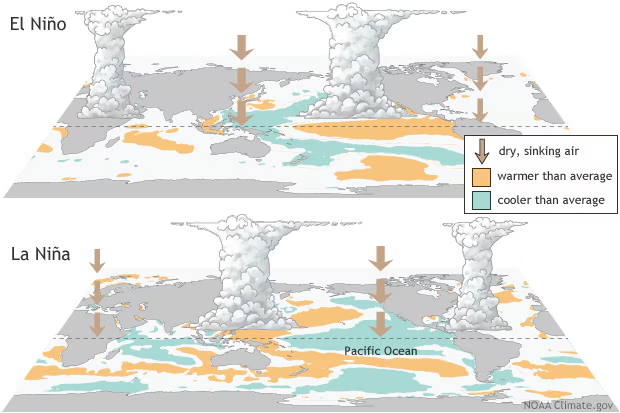 A schematic diagram showing water and wind movements during El Nino and La Nina phases. (Image Credit: NOAA, US)
—The ocean part of the ENSO is measured by what is known as the Oceanic Nino Index or ONI. The atmospheric part is monitored through Southern Oscillation Index, or SOI.
• Madden Julian Oscillation (MJO)— The MJO is a moving system of winds, cloud, and pressure that brings rain as it circles around the equator. The phenomenon takes its name from the two scientists who identified it in 1971 — Roland Madden and Paul Julian, who then worked at the National Centre for Atmospheric Research in Boulder, Colorado. The system typically travels eastward at a speed of 4-8 metres per second. It goes around the globe in 30-60 days on average, but can sometimes take 90 days.
—As it moves, strong MJO activity often splits the planet into two parts — one in which the MJO is in active phase and brings rainfall, and the other in which it suppresses rainfall. In the active phase, MJO results in higher-than-average rainfall for that time of the year, while in the suppressed phase, the area receives less than average rainfall.
Other Important Articles Covering the same topic:
📍How El Niño development during May-June is likely to affect India
Previous year UPSC Prelims Question Covering similar theme:
2) La Nina is suspected to have caused recent floods in Australia. How is La Nina different from EI Nino? (UPSC, CSE, 2011)
1. La Nina is characterized by un¬usually cold ocean temperature in equatorial Indian ocean whereas EI Nino is characterized by unusually warm ocean temperature in the equatorial pacific ocean.
2. EI Nino has adverse effect on south¬west monsoon of India, but La Nina has no effect on monsoon climate.
Which of the statements given above is/are correct?
(a) 1 only
(b) 2 only
(c) Both 1 and 2
(d) Neither 1 nor 2
3) With reference to ‘Indian Ocean Dipole (IOD)’ sometimes mentioned in the news while forecasting Indian monsoon, which of the following statements is/are correct? (UPSC, CSE, 2017)
1. IOD phenomenon is characterised by a difference in sea surface temperature between tropical Western Indian Ocean and tropical Eastern Pacific Ocean.
2. An IOD phenomenon can influence an EI Nino’s impact on the monsoon.
Select the correct answer using the code given below:
(a) 1 only
(b) 2 only
(c) Both 1 and 2
(d) Neither 1 nor 2
Previous year UPSC Mains Question Covering similar theme:
📍What characteristics can be assigned to monsoon climate that succeeds in feeding more than 50 percent of the world population residing in Monsoon Asia? (UPSC, GS1, 2017)
Explained
Rising sea level threat to India’s eroding coastline
Syllabus:
Preliminary Examination: General issues on Environmental ecology, Bio-diversity and Climate Change
Main Examination: General Studies III: Conservation, environmental pollution and degradation, environmental impact assessment.
What’s the ongoing story: On 24 September, the UN General Assembly adopted its first ever declaration on rising sea levels, which pose an existential threat to populations around the world.
Key Points to Ponder:
• Why is the sea level rising?
• How fast are sea levels rising?
• What exactly the World Meteorological Organization’s (WMO) State of the Global Climate 2025 report said about rising sea level?
• What is the 1933 Montevideo Convention?
• Can a country lose territory without losing statehood?
• What does India gain from a promise for small islands?
• Is India’s own coast ready?
• Who does the declaration leave out?
• What should India do before the UN meets again?
Key Takeaways:
• The rise in sea levels has been “accelerating” (to quote the declaration) for some time now. The rate of global rise more than doubled from 2.1 mm a year in 1993-2002 to 4.7 mm a year in 2015-2024, according to the World Meteorological Organization. In 2024 alone the sea rose 6 mm, the largest annual increase on record.
• Much of what is coming is locked in. Even on the lowest-emissions path, global sea level will rise about 38 cm by 2100 above its level of the early 2000s, according to ‘Surging Seas in a Warming World’, a 2024 technical brief from the UN Secretary-General’s Climate Action Team.
• If emissions keep climbing, the brief puts the figure at about 77 cm. The brief says the sea will keep rising for centuries to millennia even if the world reaches “net zero”.
• Amid these scenarios, the declaration focuses on the loss of territory faced by vulnerable countries — such as the island nations of Tuvalu and Kiribati in the Pacific, as well as the Maldives. Importantly, it also asks nations to build sea-level rise projections into the planning and design of their coastal infrastructure — which is where India has work to do.
Do You Know:
• Under the 1933 Montevideo Convention, a State is defined using four main criteria: a permanent population, a
defined territory, a government and the capacity to enter into relations with other states.
• But if rising sea levels swallow a State’s “defined territory”, or render it uninhabitable for a “permanent population”, does it still remain a state? This is the question the UN declaration attempts to settle. Indeed, it affirms that a country stays a country when the sea takes its land.
• The declaration mentions a “presumption in favour of continued statehood”, so such a country keeps its sovereignty, its rights and its seat at the UN. Crucially, such a country would also keep its nautical boundaries — which are calculated from the coast — even when the coastline retreats. These include the sovereign waters of the ‘territorial sea’ that extends 12 nautical miles (around 22.2 km) from the coast and the larger ‘exclusive economic zone’ of up to about 370 km from the coast in which a country has exclusive rights over natural resources.
• The declaration calls adaptation and mitigation action “essential”, but leaves the negotiation of emission cuts to the UN climate convention and the Paris Agreement.
For people who lose their homes, the declaration asks countries to respect their human rights and to “encourage strengthened international cooperation to assist persons affected”. It also supports voluntary choices for communities and “mobility with dignity”.
One example of this is already underway. By December 2025, more than a third of Tuvalu’s 11,000-strong population had applied for climate visas to migrate to Australia under a bilateral treaty.
• India has its own stake in the text. A 2023-24 remeasurement counts 1,298 offshore islands and islets and a coastline of 11,098 km. Lakshadweep and the Andaman and Nicobar Islands carry India’s boundaries at sea far into the Arabian Sea and the Bay of Bengal. So, a pledge to keep those nautical boundaries fixed, as mentioned above, protects India’s waters as well as the Pacific’s.
• The government’s National Centre for Coastal Research tracked the whole mainland shoreline between 1990 and 2016 and found that about a third of it was eroding. Nationally, the losses and gains are roughly balanced, with 234 sq km lost to erosion and 231 sq km gained elsewhere. The losses, however, are concentrated: the assessment finds nearly 400 km of coast retreating by more than 5 metres a year, and another 225 km by 3 to 5 metres. West Bengal alone has more than 170 km in the fastest category, about a third of its coast.
• The Survey of India has mapped a better line, a hazard line, that takes in sea level rise and shoreline change, and it has been shared with the coastal states. The 2019 rules use it as “a tool for disaster management plan” and for land-use planning, while the no-build strip is still measured from today’s tide. The declaration India supported recognises the need to build sea-level projections into the planning of coastal infrastructure.
Other Important Articles Covering the same topic:
📍Sea level rise: Can a country retain its statehood even if it loses its territory?
Previous year UPSC Mains Question Covering similar theme:
📍How are climate change and the sea level rise affecting the very existence of many island nations ? Discuss with examples. (UPSC, GS1, 2025)
📍The Intergovernmental Panel on Climate Change (IPCC) has predicted a global sea level rise of about one metre by AD 2100. What would be its impact in India and the other countries in the Indian Ocean region? (UPSC, GS3, 2023)
‘Public view’: why HC said SC/ST act covers online slurs
Syllabus:
Preliminary Examination: Economic and Social Development
Main Examination: General Studies I: Salient features of Indian Society
What’s the ongoing story: The Calcutta High Court held that casteist slurs on social media can attract provisions of the SC/ST (Prevention of Atrocities) Act, 1989, observing that “public view” under the law is not confined to physical spaces.
Key Points to Ponder:
• What is a Casteist?
• What is meant by the expression “public view”?
• What are the constitutional provisions relating to the protection of Scheduled Castes and Scheduled Tribes from discrimination and exploitation?
• What is caste-based discrimination?
• What is the significance of Article 17 of the Constitution in the eradication of untouchability and caste-based exclusion?
• What are the circumstances under which an insult or humiliation based on caste may attract provisions of the SC/ST (Prevention of Atrocities) Act, 1989?
• How has the expansion of social media and digital communication changed the nature and reach of caste-based discrimination?
Key Takeaways:
• The ruling comes weeks after the Supreme Court reiterated that not every caste-related remark amounts to an offence under the Act and that courts must closely examine whether its statutory requirements are satisfied.
Do You Know:
• Sections 3(1)(r) and 3(1)(s) of the SC/ST Act criminalise intentionally insulting, intimidating or abusing a member of a Scheduled Caste or Scheduled Tribe by caste name “in any place within public view.”
• To establish these offences, three elements are required: the accused should not be a member of an SC or ST community, the act must be intended to humiliate the victim on their caste, and the incident must occur in a place “within public view”. Digital cases turn on the third requirement.
• The SC in Hitesh Verma v. State of Uttarakhand (2020) held that “public view” means a place where members of the public can witness or hear the alleged utterance. “If the alleged offence takes place within the four corners of the wall where members of the public are not present, then it cannot be said that it has taken place at a place within public view,” it said.
• Last month, in Ramkrishna Chauhan v. State of Uttar Pradesh, Justices Vikram Nath and Sandeep Mehta quashed proceedings under both clauses against a school manager. The bench held that the requirement “depends upon whether the alleged utterance was made in circumstances in which members of the public could witness or hear it”. It said “the mere fact that the occurrence took place within the premises of a school does not, by itself, satisfy this requirement.”
Other Important Articles Covering the same topic:
📍No offence under SC/ST Act if caste abuse not in ‘public view’: Supreme Court
Previous year UPSC Prelims Question Covering similar theme:
4) Consider the following statements about the provisions pertaining to the Scheduled Castes and the Scheduled Tribes in India: (UPSC, CSE, 2026)
1. Provisions regarding the administration of the Tribal Areas in the States of Assam, Meghalaya, Tripura and Mizoram are given in the Fifth Schedule of the Constitution of India.
2. Some tribes of India are entitled to exemption from paying Income Tax on certain incomes.
3. The Constitution of India provides for reservation of seats in Panchayats for women belonging to the Scheduled Castes and the Scheduled Tribes.
Which one of the following conclusions based on the above statements is correct?
(a) There are two correct statements, that include statement 2.
(b) There are two correct statements, that are statements 1 and 3.
(c) There is only one correct statement.
(d) All three statements are correct.
Previous year UPSC Mains Question Covering similar theme:
📍Is caste disappearing in urban India? Illustrate your answer with examples. (UPSC, GS1, 2026)
📍“Caste system is assuming new identities and associational forms. Hence caste system cannot be eradicated in India.” Comment. (UPSC, GS1, 2018)
📍What are the two major legal initiatives by the State since Independence addressing discrimination against Scheduled Tribes (STs)? (UPSC, GS1, 2017)
US Treasury yields at 25-yr high: What are bond yields, what happens when they rise
Syllabus:
Preliminary Examination: Current events of national and international importance.
Main Examination: General Studies II: Effect of policies and politics of developed and developing countries on India’s interests, Indian diaspora.
What’s the ongoing story: The yield on the 30-year US Treasury bond hit the highest level in around 25 years on Tuesday. This instrument is an IOU (I-owe-you) document used by the US government to borrow money from the market.
Key Points to Ponder:
• What are government bonds and bond yields?
• What is a coupon rate in a government bond?
• Why do bond yields generally rise when investors expect higher inflation?
• What is meant by real return and nominal return on a financial investment?
• What is a sovereign bond?
• Why are US Treasury securities generally regarded as a benchmark for global financial markets?
• What are the major factors that can cause government bond yields to rise?
Key Takeaways:
• The yield denotes the return on investment that a lender can expect when loaning the money to the government for a particular length of time. So a 30-year bond refers to a loan the government repays over that same period. Governments borrow money for all kinds of durations, ranging from a few days to several years.
• When a government borrows it stipulates an exact amount — called the coupon — that it will pay at the end of each year to the bondholder (or lender). But, government bonds, especially those issued by the US government, are heavily traded in the secondary market, and it is in this trade that yields start shifting.
• Imagine the US government floating a one-year bond of $100 with a coupon of $10. In other words, the lender will get $110 at the end of the year. The rate of return is 10%. But suppose that soon after launching the bond, the US starts a war that spikes inflation — as it has done this year. Inflation basically means your money is worth less and less with the passage of time. As inflation starts to go up, it threatens to eat away or reduce the real value of that $10 the lender was supposed to get at the end of the year. In such a case, the lender will try to sell the bond in the secondary market before inflation completely ruins the returns, and use their money to invest in other places which pay a better return.
Do You Know:
• Rising yields on US bonds have two broad implications.
—One, it signals higher borrowing costs for the US government. In other words, if yields on existing bonds are rising, the US government will have to match them when it goes to the market to borrow again. Like any other government, the US government, too, routinely goes to the market to borrow money — either to meet some new expenditure or to pay back old debt that is maturing.
—Two, higher yields for the US government also signal higher borrowing costs for every other government and business, including higher interest rates on home loans.
Other Important Articles Covering the same topic:
📍After US Fed and others, will RBI also raise interest rates in Oct?
Previous year UPSC Prelims Question Covering similar theme:
5) Consider the following statements: (UPSC, CSE, 2024)
Statement-I: If the United States of America (USA) were to default on its debt, holders of US Treasury Bonds will not be able to exercise their claims to receive payment.
Statement-II: The USA Government debt is not backed by any hard assets, but only by the faith of the Government.
Which one of the following is correct in respect of the above statements?
(a) Both Statement-1 and Statement-II are correct and Statement-II explains Statement-I
(b) Both Statement-I and Statement-II are correct, but Statement-II does not explain Statement-I
(c) Statement-I is correct, but Statement-II is incorrect
(d) Statement-I is incorrect, but Statement-II is correct
6) Indian Government Bond Yields are influenced by which of the following? (UPSC, CSE, 2021)
1. Actions of the United States Federal Reserve
2. Actions of the Reserve Bank of India
3. Inflation and short-term interest rates
Select the correct answer using the code given below.
(a) 1 and 2 only
(b) 2 only
(c) 3 only
(d) 1, 2 and 3
Economy
‘Economic nationalism, corruption are barriers to investment in India’
Syllabus:
Preliminary Examination: Current events of national and international importance.
Main Examination: General Studies II: Bilateral, regional and global groupings and agreements involving India and/or affecting India’s interests.
What’s the ongoing story: A new US Department of State report on the investment climate in India has said that India welcomes foreign direct investment (FDI), but US investors are encountering an environment balancing openness with “economic nationalism” and the risk of corruption in the regulatory system, which is posing a barrier to FDI.
Key Points to Ponder:
• What exactly new US Department of State report on the investment climate in India said?
• What is Foreign Direct Investment (FDI)?
• How Foreign Direct Investment (FDI) is different from Foreign Portfolio Investment (FPI)?
• What are the major factors that determine a country’s attractiveness as an FDI destination?
• What is meant by ease of doing business?
• How ease of doing business attracts domestic and foreign investment?
• What is economic nationalism?
• Compare and Contrast—automatic route and government route for FDI in India.
• How does regulatory uncertainty influence foreign investment decisions?
Key Takeaways:
• Amid ongoing negotiations for a trade deal with Commerce Minister Piyush Goyal in the US and bilateral trade talks with his US counterpart during the ongoing G20 Trade Ministers’ meeting, the report pitched for a level-playing field for investment in India. Reiterating its long-standing concerns, the State Department report said India maintains laws and practices that treat foreign and domestic investment differently.
• “While India permits 100% FDI in most sectors without prior approval, India requires foreign investors — including wholly owned subsidiaries incorporated in India, paying Indian taxes, and maintaining an Indian workforce — to request governmental approval to invest in multi-brand retail trading, private banking, pharmaceuticals, defence, print and digital media and satellites,” the report said.
• It said that US businesses report actual corruption and the anticipation of potential corruption — particularly in regulatory systems — as barriers to FDI, adding that US direct investment stock in India reached $58.54 billion in 2024, a 3.37% decline from 2023.
• Weak investment has been a major worry for Indian policymakers. Data showed that India saw a jump in net foreign direct investment (FDI) inflows in July. Data released late Friday by the Reserve Bank of India (RBI) showed that net FDI soared to an over five-year high of $7.35 billion. This is the highest monthly inflow since May 2021’s $8.80 billion.
• The Foreign Exchange Management Act (FEMA) restricts concurrent FDI and foreign portfolio investment (FPI) investments, creating a redundant and uniquely burdensome restriction that blocks independent funds within the same investment group from participating in initial public offerings (IPOs) if any affiliated fund holds pre-IPO FDI stakes — a safeguard rendered unnecessary by the existing 10% FPI cap and unmatched by any other major jurisdiction, the report said.
Do You Know:
• According to Investopedia, Foreign direct investment (FDI) refers to an ownership stake in a foreign company or project made by an investor, company, or government from another country. FDI is generally used to describe a business decision to acquire a substantial stake in a foreign business or to buy it outright to expand operations to a new region.
• Foreign portfolio investment (FPI) involves buying assets, such as stocks and bonds, in another country without taking control of the businesses that issue them.
Other Important Articles Covering the same topic:
📍Ease of doing business needs ease of justice
Previous year UPSC Prelims Question Covering similar theme:
7) Which one of the following is not a sub-index of the World Bank’s ‘Ease of Doing Business Index’? (UPSC, CSE, 2019)
(a) Maintenance of law and order
(b) Paying taxes
(c) Registering property
(d) Dealing with construction permits
The World
Iran: Received reply to latest proposal; US pulls out of Iraq
Syllabus:
Preliminary Examination: Current events of national and international importance.
Main Examination: General Studies II: Effect of policies and politics of developed and developing countries on India’s interests.
What’s the ongoing story: The United States has ended its military mission in Iraq, with the Pentagon saying on Wednesday, September 30 2026, that all American troops have left, 23 years after the invasion of 2003 that removed Saddam Hussein, according to Reuters.
Key Points to Ponder:
• Why did the Iraq invasion happen?
• What happened after the invasion of Iraq began?
• How did the Iraq invasion change the world?
• Why the US is leaving now?
• US troops are out—Who fills the security gap in Iraq?
• Why is the Kurdistan Region of Iraq, particularly Erbil, strategically significant in the security architecture of West Asia?
• Why can the withdrawal of foreign troops create a security vacuum even when the host country’s own security forces formally assume responsibility?
Key Takeaways:
• The last troops left an air base in Erbil, in the semi-autonomous Kurdish region in northern Iraq, under a deal between Baghdad and Washington. Pentagon spokesperson Sean Parnell told the Associated Press (AP) the troops and equipment made an “orderly departure”. He called it the end of a 12-year campaign against the Islamic State group (IS), and said the US will still give Iraq “targeted training and intelligence support”.
• Iran and the armed groups it backs in Iraq hailed the exit as a win. Many Iraqis are less sure. Reuters reported fears of a security gap that could let Iran-backed Shi’ite militias grow stronger and allow IS to regroup. The AP said those fears are strongest in the Kurdish region.
• The pullout comes while the US is at war with Iran. The two news agencies note that Iran-backed militias in Iraq have fired on US troops and that the US has hit militia bases since the war began.
• Reuters said the pullout was agreed in 2024 under then-President Joe Biden and carried out by the Donald Trump administration. The AP said Washington and Baghdad agreed then to wind the mission down because IS had been cut back to scattered sleeper cells.
• US troops had already left bases in most parts of Iraq last year. Only a few hundred stayed, in the Kurdish north, the AP said.
Do You Know:
• US-led forces invaded in 2003 and removed Saddam Hussein. Reuters said the years that followed brought upheaval and chaos.
• American troops first left at the end of 2011. They returned in 2014, less than three years later, after IS took about a third of the country. The AP said Iraqi authorities invited a smaller US-led mission to fight the group. In Mosul, Iraq’s second-largest city, Reuters said soldiers took off their uniforms and ran when IS captured it that year.
• IS lost its self-declared caliphate in 2017. Since then, Reuters said, US troops have given Iraqi forces intelligence on the group’s movements, along with air surveillance and reconnaissance.
• The war carried a heavy price. More than 4,500 US troops died in Iraq, Reuters said, about twice the number lost in Afghanistan. The Iraq Body Count project says more than 200,000 Iraqi civilians were killed.
Other Important Articles Covering the same topic:
📍20 years after US-led invasion of Iraq: Why it happened and how it changed the world
|
PRELIMS ANSWER KEY |
| 1.(d) 2.(d) 3.(b) 4.(a) 5.(a) 6.(d) 7.(a) |
For any queries and feedback, contact priya.shukla@indianexpress.com
Subscribe to our UPSC newsletter. Stay updated with the latest UPSC articles by joining our Telegram channel – IndianExpress UPSC Hub, and follow us on Instagram and X.


Priya Kumari Shukla is a Senior Copy Editor in the Indian Expre... Read More
 Share


