
UPSC Key: BRICS New Delhi Declaration, India-China ties, and East-West oil pipeline
How is the BRICS New Delhi Declaration relevant to the UPSC exam? What significance do topics such as India-UAE ties, the carbon border tax, and the East-West oil pipeline hold for both the preliminary and main examinations? You can learn more by reading the Indian Express UPSC Key for September 13, 2026.
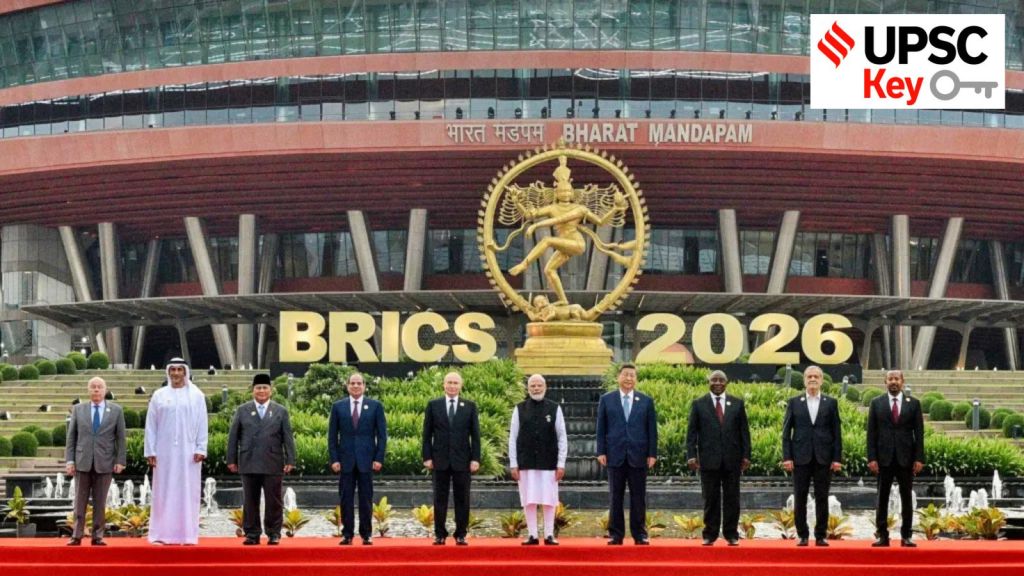 The New Delhi Declaration was adopted during the 18th BRICS Summit on Saturday. Know more about it in our UPSC Key (MEA via PTI Photo)
Important topics and their relevance in UPSC CSE exam for September 13, 2026. If you missed the September 12, 2026 UPSC CSE exam key from the Indian Express, read it here.
BRICS SUMMIT
Behind the BRICS agreement: No Ukraine, Iran-UAE balance, swipe at (US) tariffs, flagging Gaza
Syllabus:

Preliminary Examination: Current events of national and international importance.
Mains Examination: General Studies-II: Bilateral, Regional and Global Groupings and Agreements involving India and/or affecting India’s interests.
What’s the ongoing story: The 45-page BRICS declaration achieved a consensus through careful diplomatic calibration nuancing the most divisive issues and creating space for each of the participants to walk away with their stated goals acknowledged — and their triggers avoided.
Key Points to Ponder:
— Know about the BRICS in detail.
(Thought Process: Know about the evolution of BRICS, founding members, present member countries, structure and objective.)
— How does BRICS differ from other groupings like the G7, G20 and SCO?
— What are the key highlights of 18th BRICS Summit?
— What is a troika?
— What is the significance of BRICS for India?
— What are the major challenges facing BRICS as an expanding multilateral grouping?
— Map work: Locate the BRICS member countries on map.
Key Takeaways:
— As many as 140 paragraphs of the document dwelt at length on trade, health, AI and tourism, making the document cooperative rather than confrontational.In many cases, it echoed the 2025 Rio declaration — be it the war in Gaza, Pahalgam terror attack or UNSC reforms.
— The declaration avoided any mention of the “T” that matters the most — Trump — but it used the other two Ts, trade and tariff. These found repeated mentions in the declaration. While all participants have been at the receiving end of US tariffs, two important members of the grouping – Russia and Iran – have repeatedly faced the pressure of US economic sanctions.
— In this context, para 22 of the declaration says the members condemn “unilateral coercive measures,” “unilateral economic sanctions and secondary sanctions” — which is standard BRICS shorthand for Western sanctions regimes. Para 27 talks about Latin America and the Caribbean as a zone of peace, mentions “tightening of unilateral blockade measures” on Cuba, which is again an unnamed but pointed reference to the US embargo.
— There is also emphasis on “proliferation of trade-restrictive actions… indiscriminate rising of tariffs” — an oblique nod to Trump-era tariff policy. The declaration also opposed “carbon border adjustment mechanisms”, aiming at US/EU trade-climate measures.
— On Ukraine, there was no mention at all in the Delhi 2026 declaration. With Russia at the high table as India’s long-time partner, any mention of Ukraine has been avoided. No paragraph in the 45-page declaration mentions Ukraine, Russia’s invasion, or related sanctions by name.
— In the section on UN Security Council reform, the declaration states: “Recalling the 2022 Beijing and 2023 Johannesburg-II Leaders’ Declarations, China and Russia, as permanent members of the UN Security Council, reiterate their support to the aspirations of Brazil and India to play a greater role in the UN, including its Security Council..”
— Para 20, which talks about trade diplomacy, acknowledges China for “expanding its zero-tariff treatment to cover 53 African countries with which it has diplomatic ties”, also casting China as a benefactor to the Global South at a moment when the region reels under the impact of unilateral tariffs and sanctions.
— Other than the Iran-UAE consensus, the declaration, in Para 20, mentions strong support for “Iran’s bid for accession to the WTO, along with Ethiopia’s”. The Delhi 2026 declaration cites UNSC Resolution 2803, which opposes forced displacement of Palestinians.
From the Front Page: Six months into war, Iran and UAE find consensus in BRICS joint declaration
— As the six-month-long West Asia war flares up with US and Iran exchanging strikes, India achieved the much-anticipated – and the much-fraught — consensus at the BRICS summit between UAE and Iran after hectic negotiations paving the way for the joint declaration adopted Saturday.
— In paragraph 28 of the joint declaration, the BRICS leaders said, “We express deep concern over the continued escalation of tensions in Middle East/West Asia and, recalling our respective national positions, call for exercising maximum restraint, as well as avoiding actions that could further aggravate the situation.”
— The declaration acknowledged the sensibilities of both sides by flagging territorial sovereignty and the need to secure civilians and infrastructure.
From the Front Page: Pyramid of privilege must give way to partnership platform: PM
— Underlining the “coming of age” of BRICS in its 20th year, Prime Minister Narendra Modi said Saturday that the grouping has carved a distinct identity for itself on the global stage and its members “respect each other’s perspectives and move forward through consensus”. He said they strive to progress “not by opposing anyone, but by taking everyone along”.
— The Prime Minister said the Global South must become a “rule-shaper” and the existing “pyramid of privilege” structure in global governance must give way to a “platform of partnership”.
— To keep track of the initiatives, the Prime Minister proposed a mechanism. “The BRICS chairship rotates annually, but this should not halt our institutional momentum. I propose a ‘BRICS Continuity and Implementation Mechanism.’ This would enable the follow-up of all initiatives and outcomes through the Troika (the troika refers to a framework comprising past, current and incoming chairs of the grouping).
— Notably, the next summit will be hosted by China which has resisted India’s moves for a permanent seat at the UN Security Council.
— “I propose that we collectively formulate 10 proposals for global governance reform, aiming to shape them into a ‘BRICS Reform Roadmap’ by the next summit,” Prime Minister said. In crafting this roadmap, Modi said, “We must focus on three key aspects: Representation, Responsiveness, and Rule-making.”
From the BRICS Summit Page- BRICS condemns Pahalgam attack, calls for action on terror safe havens
— The BRICS grouping on Saturday once again condemned the April 2025 Pahalgam terror attack that killed 26 people, with China joining the other members in a declaration that called for “zero tolerance” towards terrorism, action against terrorist safe havens and accountability for those involved in terror activities.
— The reaffirmation, in the New Delhi Declaration adopted at the 18th BRICS Summit, is significant as it comes more than a year after the attack and amid continuing tensions between India and Pakistan over cross-border terrorism. It is also the second consecutive BRICS summit declaration to specifically name the Pahalgam attack, after the Rio de Janeiro declaration of July 2025.
From the BRICS Summit Page- Amid wars in sea lanes, PM proposes seafarers’ emergency support network
— At the BRICS Leaders’ Summit on Saturday, Prime Minister Narendra Modi proposed establishing a ‘Seafarers’ Emergency Support Network’ to provide timely assistance and ensure the safety of personnel working at sea.
— The safety of Indian seafarers has emerged as a recurring focus of New Delhi’s recent engagements. He proposed that the support network should provide distress alerts, medical aid, family communication and evacuation support for seafarers.
— India has been advocating for the safety of seafarers because it supplies a massive share of the global maritime workforce and relies heavily on secure sea lanes for international trade. In fact, India provides over 12% of all trained seafarers around the world, with thousands of Indian families depending on those working aboard commercial vessels.
From the BRICS Summit Page- Four agricultural initiatives announced, aimed at climate resilience, productivity
— The BRICS nations on Saturday announced four new agriculture initiatives, including the establishment of Agroecology and Regenerative Agriculture for Climate Resilience and Productivity and Digital Agriculture.
— The leaders also agreed to the establishment of a collaborative, non-binding, and farmer-centric BRICS AGRIN (Agro-Inputs, Genetic Resources, and Information Network), while welcoming the launch of a Global Forum on Farmers’ Rights in Seed Systems.
From the BRICS Summit Page- NIMHANS to be nodal body for BRICS Centres of Excellence
— The New Delhi Declaration adopted during the ongoing 18th BRICS Summit agrees to support the establishment of a network of training hubs and centres of excellence (CoEs) for mental health, with Bengaluru-based National Institute of Mental Health and Neuro Sciences (NIMHANS) being the coordinating centre.
From the BRICS Summit Page- With China on board, BRICS calls for boosting transport
— BRICS nations, in a joint statement issued Saturday, reaffirmed their commitment to enhance transport potential, including in civil aviation, while also respecting the “sovereignty and territorial integrity” of all member states.
— India, China, Russia, and Brazil are among the top five countries in the world with the largest railway and road networks.
From the Politics Page: BRICS education agenda: Childhood care, courses on par with market demand
— The BRICS nations have called for cooperation in Early Childhood Care and Education (ECCE) and Foundational Literacy and Numeracy (FLN), according to the New Delhi Declaration adopted at the 18th BRICS Summit on Saturday.
— They also welcomed the outcomes of the 13th BRICS Education Minister’s meeting in Bhubaneshwar last month. The Declaration also highlighted another priority sector — the BRICS Technical and Vocational Education and Training (TVET) Cooperation Alliance (BRICS-TCA).
From the Politics Page: Members laud progress in expanding remote-sensing satellite constellation
— The New Delhi Declaration adopted during the ongoing 18th BRICS Summit acknowledges the significant progress in finalising the amendment to the BRICS Remote Sensing Satellite Constellation (RSSC) Agreement for including new space agencies.
— The RSSC is a virtual network of existing observation satellites of the BRICS countries, including India’s Resourcesat 2 and 2A, China’s Gaofen-6 and Ziyuan III 02, and Russia’s Kanopus-V type.
— The Summit also drafted the Terms of Reference for the BRICS Space Council. There was also an emphasis on debris mitigation and long-term sustainability.
From the Economy Page- BRICS seeks ‘mutually reinforcing policy levers’ to boost intra-bloc trade
— With an eye on ensuring resilient global value chains, the BRICS countries will look at “mutually reinforcing policy levers” to boost trade within the grouping, the New Delhi Declaration, issued on Saturday, said.
— The statement comes a month after the meeting of BRICS trade ministers in August in Jaipur made note of the same, detailing that the levers would include backward and forward global value chain linkages, regional integration, economic diversification beyond primary commodities, investment in physical and digital infrastructure, regulatory frameworks, and upgrading workforce skills.
From the Front Page: No fire & brimstone: Delhi pushes back against making BRICS a geopolitical bloc
— C. Raja Mohan writes- “Underlying the wordy 140-paragraph declaration of the Delhi BRICS Summit is India’s careful steering of the 20-year forum, amid deepening great-power conflict involving its own members, economic uncertainty, accentuated by wars in Europe and the Middle East.”
— “Delhi’s diplomatic success lies in keeping BRICS “boring”, if you will, amid the rhetorical excess about radical global change that often accompanies its summits.”
— “The declaration reaffirms the political diversity of the forum and dispels the notion of an ideological crusade against the West — one that some supporters of BRICS desire and many of its critics assume is already under way.”
—“It contains familiar criticism of unilateral sanctions, tariffs and protectionism, as well as strong language on Gaza and other humanitarian crises. But it does not turn BRICS into a collective political front against the United States or the West.”
— “Its principal achievement is to underline a simpler proposition: A more fragmented world requires more, not less, practical cooperation among major nations. The emphasis is on reforming the international order, not demolishing it.”
— “The Delhi Summit’s emphasis on resilience, innovation, cooperation and sustainability moves the focus towards supply chains, health, food security, climate adaptation, digital systems, small enterprises and development finance. This does not make BRICS a transformative economic institution. But it makes the forum more useful than an ideological platform devoted to denouncing American dominance.”
— “The Delhi declaration steers clear of a common BRICS currency. It supports the more modest objective of making cross-border payments faster, cheaper and more reliable.”
— “The New Delhi Declaration’s extraordinary breadth is a measure of the grouping’s ambition, but also of its institutional weakness. It ranges across global governance, wars, terrorism, health, agriculture, energy, trade, finance, climate, technology, culture, education and sport. The result often reads like a catalogue of global problems rather than a sharp political document.”
Do You Know:
— As per BRICS 2026 website, BRICS brings together eleven major emerging markets and developing countries of the world: Brazil, China, Egypt, Ethiopia, India, Indonesia, Iran, Russia, Saudi Arabia, South Africa and the United Arab Emirates.
— It serves as a useful platform for consultation and cooperation on contemporary issues having global as well as regional significance, and issues of global political and economic governance.
— BRICS began as BRIC, Brazil, Russia, India and China, in 2006, following a Goldman Sachs projection identifying these economies as future engines of global growth. It evolved from a foreign ministers’ dialogue into a leaders’ forum, with its first summit held in Yekaterinburg, Russia, in 2009.
— South Africa joined in 2010, and the grouping expanded dramatically in 2024 with the addition of Egypt, Ethiopia, Iran, Saudi Arabia and the UAE. Indonesia became the 11th full member in January 2025.
Other Important Articles Covering the same topic:
📍BRICS condemns unilateral tariffs, backs WTO reforms
📍Main takeaways from the BRICS declaration: Tariffs, terrorism, West Asia war, and more
Previous year UPSC Prelims Question Covering similar theme:
(1) Consider the following statements with regard to BRICS: (UPSC CSE, 2025)
1. 16th BRICS Summit was held under the Chairship of Russia in Kazan.
2. Indonesia has become a full member of BRICS.
3. The theme of the 16th BRICS Summit was Strengthening Multiculturalism for Just Global Development and Security.
Which of the statements given above is/are correct?
(a) 1 and 2
(b) 2 and 3
(c) 1 and 3
(d) 1 only
Strong India-UAE ties key to stability: PM meets Crown Prince of Abu Dhabi
Syllabus:
Preliminary Examination: Current events of national and international importance.
Mains Examination: General Studies-II: Bilateral, regional and global groupings and agreements involving India and/or affecting India’s interests.
What’s the ongoing story: A day after holding an extensive bilateral meeting with visiting Iranian President Masoud Pezeshkian, Prime Minister Narendra Modi on Saturday held a meeting with Abu Dhabi Crown Prince Sheikh Khaled bin Mohamed bin Zayed Al Nahyan, calling “a strong India-UAE” a symbol of peace and stability at a time of uncertainty in West Asia.
Key Points to Ponder:
— What is the status of the India-United Arab Emirates (UAE) relationship?
— What are the areas of cooperation between both countries?
— What is the significance of the UAE for India?
— What are the factors that contributed to bilateral relations acquiring a more strategic dimension between India and the UAE?
— What are the key sectors where India and the UAE have worked closely to strengthen the bilateral ties?
— What is the significance of the India-UAE Comprehensive Economic Partnership Agreement (CEPA)?
— How do West Asian conflicts reshape India’s Gulf strategy?
— Map work: Locate UAE and other Gulf countries on the map.
Key Takeaways:
— Modi and the visiting UAE Crown Prince discussed the overall situation in West Asia and ways to take the India-UAE strategic partnership forward. “Discussed taking our strategic partnership forward across defence, AI, space, critical minerals, energy, food security and connectivity,” Modi said in a social media post after the meeting, just hours ahead of the summit kick-off. “At a time of uncertainty in West Asia, a strong India-UAE is a symbol of stability, prosperity and peace,” he added.
— As per the Ministry of External Affairs, during their talks on Saturday, Prime Minister Modi appreciated the UAE’s active and constructive participation in BRICS under India’s Chairship.
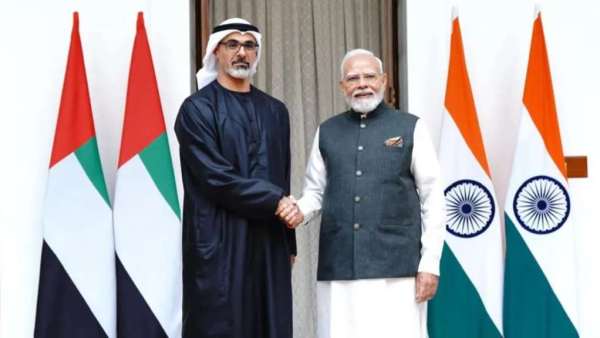 PM Narendra Modi and Abu Dhabi Crown Prince Sheikh Khaled bin Mohamed bin Zayed Al Nahyan discussed the West Asia situation and ways to take forward the India-UAE strategic partnership. (Photo: X/@meaindia)
— Adding that the leaders acknowledged the progress achieved in bilateral relations in a wide range of sectors, the MEA said that the two leaders “positively noted the announcement by UAE’s International Holding Company to invest in the development of a $ 11.5 billion integrated greenfield aluminium project in Odisha, India’s largest integrated aluminium investment”. The project is expected to position Odisha as a global aluminium manufacturing hub.
— They also discussed opportunities to enhance cooperation between the two countries in strategic and emerging areas, including defence, space, nuclear energy, technology and innovation.
Do You Know:
— India and the UAE established diplomatic relations in 1972. While the UAE opened its Embassy in India in 1972, the Indian Embassy in UAE was opened in 1973.
— India and the UAE enjoy strong cooperation at the United Nations. Both countries are also currently part of several plurilateral platforms such as BRICS, I2U2 (India-Israel-UAE- USA) and UFI (UAE-France-India) Trilateral, etc. UAE was invited as a Guest Country to the G- 20 Summit held under India’s Presidency.
— The traditionally strong bilateral relations enjoyed by India-UAE gained a new momentum when the PM Narendra Modi visited UAE in 2015, the first PM of India in 34 years which marked the beginning of a new Comprehensive and Strategic partnership between the two countries.
— In recent years, bilateral relations between India and UAE have acquired a more strategic dimension, especially as the two countries have begun developing closer cooperation mechanisms to address the impact of evolving developments in West Asia.
Other Important Articles Covering the same topic:
📍Why defence, security dimensions become increasingly central to India-UAE ties
📍Energy to defence, India, UAE deepen ties; PM calls for opening of Hormuz
Previous year UPSC Mains Question Covering similar theme:
The question of India’s Energy Security constitutes the most important part of India’s economic progress. Analyse India’s energy policy cooperation with West Asian countries. (UPSC CSE 2017)
‘Fossil fuels will still play an important role’: Declaration opposes carbon border tax
Syllabus:
Preliminary Examination: Current events of national and international importance.
Mains Examination: General Studies-II: Bilateral, regional and global groupings and agreements involving India and/or affecting India’s interests.
What’s the ongoing story: Amid disruptions to global supply chains and energy security due to the West Asia conflict, the New Delhi Declaration adopted at the 18th BRICS Summit unequivocally acknowledged that fossil fuels will still play an important role in the world’s energy mix, particularly for developing economies, and opposed European Union’s carbon border tax.
Key Points to Ponder:
— What are fossil fuels and why are they still important for developing countries?
— What is Carbon Border Adjustment Mechanism (CBAM)?
— What are India’s concerns regarding CBAM?
— Why has BRICS opposed the European Union’s CBAM?
— What is the principle of Common but Differentiated Responsibilities (CBDR)?
— How can developing countries balance climate goals with energy security?
Key Takeaways:
— The declaration reaffirmed the commitment of BRICS to tackle climate change and called upon all countries to uphold their existing commitment to the Paris climate agreement, including its provisions related to climate mitigation, adaptation, loss and damage and the principles of equity.
— However, it underscored the importance of nationally determined just transitions — which refers to shift to cleaner fuels for producing electricity and in energy use. It called upon developed countries to provide additional, adequate, predictable and accessible financial resources along with technological transfer to developing countries for climate adaptation to tackle impacts of climate change.
— The declaration framed energy security as a crucial foundation for social and economic development, national security and the welfare of all nations.
— BRICS member countries China, India, Indonesia and Russia are among the top five largest coal consumers with the US being the only non-BRICS bloc country. They have also made rapid strides in the expansion of renewable energy, but coal continues to remain one of the largest sources for electricity production and energy use.
— On the EU’s carbon border adjustment mechanism, which imposes an import levy on carbon-intensive goods, the declaration said that it opposed “unilateral, punitive, discriminatory and protectionist measures that are not in line with international law”. “…Such measures undermine efforts by countries, specifically developing countries, aimed at addressing the adverse impacts of climate change, increasing adaptive capacity and resilience.”
From the Economy Page- Need inclusive energy transition, fossil fuels will keep playing key role: BRICS
— BRICS countries have called for “just, orderly, equitable and inclusive” energy transitions while stressing the need to reduce greenhouse gas emissions in line with global climate goals.
— In its declaration, issued on Saturday in New Delhi, the countries also stressed the principle of “technological neutrality” and “common but differentiated responsibilities and respective capabilities” in pursuing energy transitions, while recognising that countries’ pathways would need to take into account their respective national circumstances, needs and priorities.
— They recognised that a wide range of energy sources and technologies including but not limited to renewable energy, bioenergy, fossil fuels, nuclear energy, hydropower, hydrogen, low carbon technologies, energy storage technologies, would play an important role in achieving the Sustainable Development Goals (SDGs) and energy security.
Do You Know:
— CBAM is an import duty that is imposed by Europe on goods produced in other countries by processes that lead to greater carbon emissions than domestic European manufacturers are allowed to emit.
— The ostensible purpose is to check “carbon leakage”, but this has the effect of making items like steel or cement manufactured in countries like India more expensive, and thus less competitive, in European markets.
Other Important Articles Covering the same topic:
📍Knowledge Nugget: What is Carbon Tax and why is it important for UPSC exam?
📍What is the European Union’s CBAM, and why has BRICS condemned and rejected it?
Previous year UPSC Prelims Question Covering similar theme:
(2) Consider the following statements: (UPSC CSE 2023)
Statement-I: Carbon markets are likely to be one of the most widespread tools in the fight against climate change.
Statement-II: Carbon markets transfer resources from the private sector to the State.
Which one of the following is correct in respect of the above statements?
(a) Both Statement-I and Statement-II are correct and Statement-II is the correct explanation for Statement-I
(b) Both Statement-I and Statement-II are correct and Statement-II is not the correct explanation for Statement-I
(c) Statement-I is correct but Statement-II is incorrect
(d) Statement-I is incorrect but Statement-II is correct
FRONT
Modi and Xi hold talks: ‘Partners not rivals, committed to resolution of boundary question’
Syllabus:
Preliminary Examination: Current events of international importance.
Mains Examination: General Studies-II, III: Bilateral, regional and global groupings and agreements involving India and/or affecting India’s interests, Indian economy.
What’s the ongoing story: Two years after their meeting in Russia’s Kazan led to the disengagement of troops along the Line of Actual Control in eastern Ladakh after a tense military standoff that began 2020, Prime Minister Narendra Modi and Chinese President Xi Jinping said Saturday that “differences should not become disputes” and committed themselves to “a fair, reasonable, and mutually acceptable resolution of the boundary question”.
Key Points to Ponder:
— What is the history of India-China relations?
— What are the areas of cooperation and conflict between India and China?
— India-China Border Dispute: Know the background and recent development.
— What is the Special Representatives (SR) mechanism in India-China border talks?
— What is India’s biggest economic vulnerability vis-à-vis China?
— How does the China-Pakistan strategic partnership influence India’s China policy?
— What measures can help rebuild strategic trust between India and China?
— Can BRICS serve as a platform for India-China cooperation despite their bilateral strategic competition?
— Map Work: Line of Actual Control, McMahon Line, Chang Chenmo river, Gogra-Hot Springs, Kongka Pass, Galwan Valley, Depsang Plains, and Charding Nala region.
Key Takeaways:
— Holding bilateral talks in New Delhi on the sidelines of the BRICS Summit – it was their first meeting in India in seven years amid efforts to restore relations that plummeted after the Chinese incursions six years ago – Modi and Xi said “both countries should take a strategic and long term perspective of their ties”.
— During the meeting, the Prime Minister, according to a statement from the Ministry of External Affairs, highlighted that “both sides must be guided by three mutuals: mutual respect, mutual sensitivity and mutual interest”.These “three mutuals” have been part of Delhi’s redlines over the last five years..
— The Chinese statement said Xi made “four observations on promoting the steady and sustained development of China-India relations”.
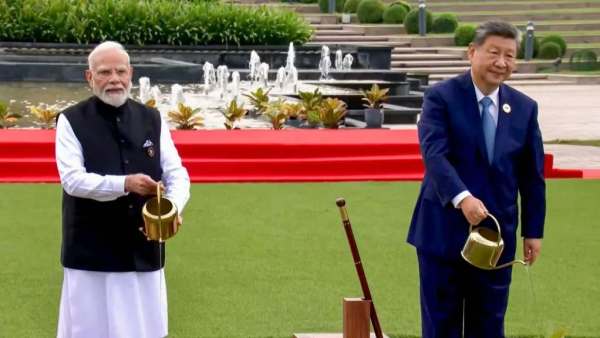 Prime Minister Narendra Modi with Chinese President Xi Jinping during a joint tree plantation initiative amid the ongoing 18th BRICS Summit, at the Bharat Mandapam, in New Delhi. (@NarendraModi/YT via PTI Photo)
— “First, calibrate the direction with an objective and rational strategic perception. China and India are partners rather than rivals, and development opportunities rather than threats to each other. ”
— “Second, help each other succeed in the spirit of win-win cooperation. Both sides should focus on development as the greatest common denominator, and strengthen friendly exchanges and mutually beneficial cooperation.”
— “Third, remove irritants with the political wisdom of mutual respect and mutual understanding. The two sides should stay committed to advancing bilateral relations and resolving the boundary question,” the statement said on the border issue.
— “Fourth, contribute to a better world with open and inclusive multilateral coordination. The two sides should support each other’s BRICS chairship, strengthen coordination in the United Nations, the Shanghai Cooperation Organization, and the G20, work together to address global challenges, and unequivocally uphold international fairness and justice,” it said.
— Xi’s participation in the BRICS summit is an important signal to India – he had skipped the G20 summit at the Bharat Mandapam in New Delhi three years ago amid strained ties.
— Following the disengagement of troops along the LAC in eastern Ladakh in November 2024, the two countries have taken incremental steps to stabilise ties. But pressing issues remain, including visa denials and restrictions on Indian businesses, challenges in the sharing of trans-boundary river data, and the active collusion of China and Pakistan during the India-Pakistan hostilities that followed Operation Sindoor in May 2025.
From the Economy Page- Challenges that China’s heft poses for India
— Prime Minister Narendra Modi and Chinese President Xi Jinping highlighted the need to address structural trade imbalance between the two countries during their bilateral meeting on Saturday.
— The ties between the two countries had thinned after the Galwan Valley military clash in June 2020. But, of late, there have been signs of a thaw—resumption of direct flights, reopening of border trade via NATHU LA after six years, and, most importantly, easing of restrictions on foreign direct investments (FDI) from land-bordering countries.
— Unpredictable American trade policies and two ongoing wars that have rattled the oil and bond markets seem to have nudged India and China to ease tensions.
— With current trade within BRICS heavily centred around China, MSMEs have a deep dependency on Chinese capital goods and technical expertise. However, manufacturers said that there is significant opportunity in the BRICS for exports.
— While Indian MSMEs are seeking better technical cooperation with China and easier access to input items from the country, there is also a simultaneous challenge of a trade deficit with the neighbouring country.
— While Indian manufacturers are increasingly scouting for opportunity, the biggest challenge is competing with Chinese goods abroad and China’s overreliance on exports rather than consumption for economic growth.
Other Important Articles Covering the same topic:
📍Making progress on normal ties after border peace: India, China
📍Thaw in China chill: Direct flights, Mansarovar Yatra, easing of visas
Previous year UPSC Prelims Question Covering similar theme:
(3) “Belt and Road Initiative” is sometimes mentioned in the news in the context of the affairs of : (UPSC CSE 2016)
(a) African Union
(b) Brazil
(c) European Union
(d) China
Previous year UPSC Mains Question Covering similar theme:
The China-Pakistan Economic Corridor (CPEC) is viewed as a cardinal subset of China’s larger ‘One Belt One Road’ initiative. Give a brief description of CPEC and enumerate reasons why India has distanced itself from the same. (UPSC CSE 2018)
‘China is using its economic relations and positive trade surplus as tools to develop potential military power status in Asia’, In the light of this statement, discuss its impact on India as her neighbour. (UPSC CSE 2017)
ECONOMY
Saudi Arabia shuts East-West oil pipeline after attacks: Why it matters for India
Syllabus:
Preliminary Examination: Current events of national and international importance.
Mains Examination: General Studies-I, II: Salient features of World’s Physical Geography; Effect of Policies and Politics of Developed and Developing Countries on India’s Interests, Indian Diaspora.
What’s the ongoing story: Saudi Arabia has temporarily shut its East-West oil pipeline after multiple attacks on the crucial network on Thursday, raising fresh concerns over global oil supplies already strained by disruption in the Strait of Hormuz. The pipeline, also called Petroline, is one of the most important Hormuz-bypass routes for exporting Saudi Arabian crude.
Key Points to Ponder:
— What is the importance of the East-West pipeline?
— How has the disruption in the Strait of Hormuz affected global oil supplies?
— Read about the Houthis.
— What role do the Houthis play in the broader Iranian “axis” against Israel and other regional adversaries?
— What is the strategic importance of the Bab el-Mandeb Strait?
— Know about Mayun Island. What is its strategic significance?
— How is India vulnerable to global oil supply disruptions?
— What can be the impact of the shutdown of the East-West oil pipeline on India?
— Map work: Locate Saudi Arabia’s East-West oil pipeline, Mayun Island, Red sea, Bab el-Mandeb, Saudi Arabia, Persian Gulf , Strait of Hormuz.
Key Takeaways:
— This came even as Yemen’s Houthi rebels seized the strategically vital Mayun Island located at the entrance to the Red Sea — developments that mark a dangerous new front in the wider war with Iran. Both Saudi Arabia and Iraq have said that the attack originated in Iraq, where Iranian-backed militias operate.
— Saudi authorities described the shutdown as a precautionary measure. The timing of the suspension of the pipeline’s operations is critical. Apart from attacks on the pipeline system itself, Iran-backed Houthi forces have tightened their grip around the Bab el-Mandeb and Red Sea shipping route, which could further reduce oil flows, particularly from the world’s largest exporter, Saudi Arabia. Riyadh has relied upon for its oil exports amid the effective halt in shipping from the Persian Gulf.
— The development is also likely to push up oil prices, which are at their highest levels in over three months. For energy-import-dependent India, too, there will be ramifications affecting supplies, and more importantly, prices.
— The East-West Pipeline runs roughly 1,200 km across Saudi Arabia, from the Abqaiq oil processing centre in the kingdom’s oil-rich east to the Red Sea port of Yanbu in the west. From Yanbu, oil tankers usually sail east to Asia through the Bab el-Mandeb, while those headed west go through the Suez Canal.
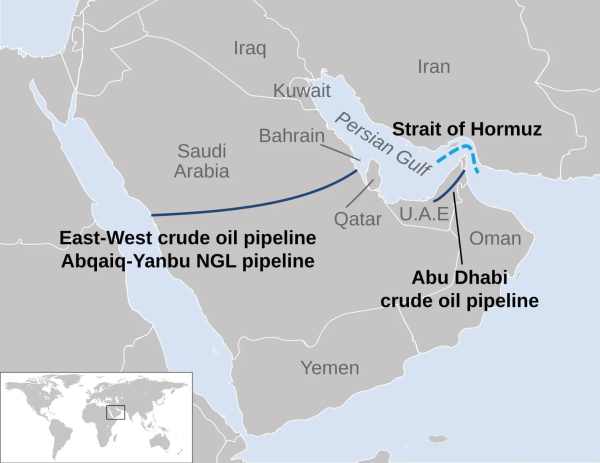 The East-West pipeline. (U.S. Energy Information Administration)
— Operated by Saudi Aramco, the pipeline allows Saudi Arabia to move crude oil overland from its main producing region to the Red Sea, rather than shipping it from terminals on the Persian Gulf through the Strait of Hormuz. In fact, the pipeline was built partly to hedge against risks arising from disruptions in oil flows through Hormuz.
— The duration of the shutdown will be critical in the prevailing circumstances. If Saudi Arabia is able to restore the pipeline quickly, the market impact could remain largely psychological and short-lived. Tankers can be redirected, inventories can be drawn down, and Saudi Arabia can use its other export infrastructure. But if the shutdown lasts weeks, the consequences become much more serious.
— Saudi Arabia had traditionally been among the top sources of crude oil for India. While supplies from Riyadh have fallen notably amid the Hormuz crisis, Saudi oil still accounted for 7-8% of India’s total oil imports over the past couple of months. And a vast majority of these came from the Yanbu export facility.
— The first impact of the Petroline’s shutdown for India would be on supplies, and Indian refiners will have to find replacement volumes. While that can be managed, given India’s highly diversified crude import slate, higher prices for those alternative barrels will be the bigger headache.
— Energy imports are a major component of India’s overall imports, and any meaningful increase has ramifications for the country’s trade balance, current account, inflation, and the rupee’s exchange rate, among others.
— India is the world’s third-largest consumer of crude oil and depends on imports to meet over 88% of its requirements. Put simply, an oil shock can be considered an external tax on the Indian economy.
Do You Know:
— The Strait of Hormuz is the narrow waterway between Iran and Oman that accounted for a fifth of global oil flows before the West Asia war started over six months ago. It is the main outlet from the Persian Gulf. Saudi Arabia, Iraq, Kuwait, Qatar and the UAE have traditionally depended heavily on it to reach global markets, particularly top oil importers China and India.
Other Important Articles Covering the same topic:
📍Saudi Arabia shut down East-West pipeline as Houthis tighten grip on Red Sea shipping
UPSC Prelims Practice Question Covering similar theme:
(4) With reference to the East–West oil pipeline, consider the following statements:
1. It is an oil pipeline that runs entirely within Saudi Arabia.
2. It runs from Abqaiq to Yanbu on the Red Sea coast.
Which of the statements given above is/are correct?
(a) 1 only
(b) 2 only
(c) Both 1 and 2
(d) Neither 1 nor 2
ALSO IN NEWS
In backdrop of handshake, a cultural keynote—Rameswaram temple
— The 12th-century Ramanathaswamy Temple in Rameswaram, Tamil Nadu, served as the visual backdrop and cultural centerpiece when Prime Minister Narendra Modi welcomed world leaders at Bharat Mandapam for the 18th BRICS Leaders’ Summit in New Delhi on Saturday, highlighting India’s civilisational history to the Global South.
— The temple in Rameswaram is dedicated to Lord Shiva, and is counted among the 12 sacred Jyotirlingas in the Hindu belief system. Its outer corridor — which was displayed in the image at Bharat Mandapam — is the longest among all temples in India, featuring over 1,200 intricately carved stone pillars.
— According to a Tamil Nadu government website, the Ramanathaswamy Temple was under the care of a monk up to the 10th century. In the 12th century, Parakiramabaghu, the King of Ceylon, built the sanctum sanctorum of the temple. Three hundred years later, Ramanathapuram King Udayan Sethupathi and a Vaisya from Nagoore built its western tower and compound walls.
— Subsequently, between 1897 and 1904, the 126-foot-high nine-tiered East Rajagopuram was completed by the family of Nattukkottai. According to Hindu mythology, Lord Ram consecrated the shivalingam here after returning from Lanka.
Tagore scholar, eminent writer dies in England at 86
— Indian-born writer of diasporic literature Ketaki Kushari Dyson, who played a significant role in bringing Rabindranath Sagar’s work to a wider audience through English translations and research, has died in England, a close family friend said. She was 86.
— Her scholarly works included research on Nobel laureate Tagore, particularly his paintings. She has made a significant contribution to translating Tagore’s works into English. The most significant of her scholarly works was ‘Rabindranath O. Victoria Ocampo-r Sandhane,’ about Tagore’s association with Argentine writer Victoria Ocampo. Her body of work includes several poems, plays, and novels like ‘Nari, Nagari’ and ‘Jal PhunreAgun.’
PRELIMS ANSWER KEY
1.(a) 2.(b) 3.(d) 4.(c)
🚨 Click Here to read the UPSC Essentials magazine for August 2026. Subscribe to our UPSC newsletter. Stay updated with the latest UPSC articles by joining our Telegram channel – IndianExpress UPSC Hub, and follow us on Instagram and X.


Roshni Yadav is a Deputy Copy Editor with The Indian Express. At The Indian Express, she writes for ... Read More
 Share


