
UPSC KEY: 18th BRICS Summit, India-EU Trade Deal and Perim Island
Why is knowing about the 18th BRICS summit being held in India relevant to the UPSC exam? What significance do topics such as the Bab el-Mandeb Strait, India-EU deal and US Federal Reserve hold for both the preliminary and main examinations? You can learn more by reading the Indian Express UPSC Key for September 12, 2026.
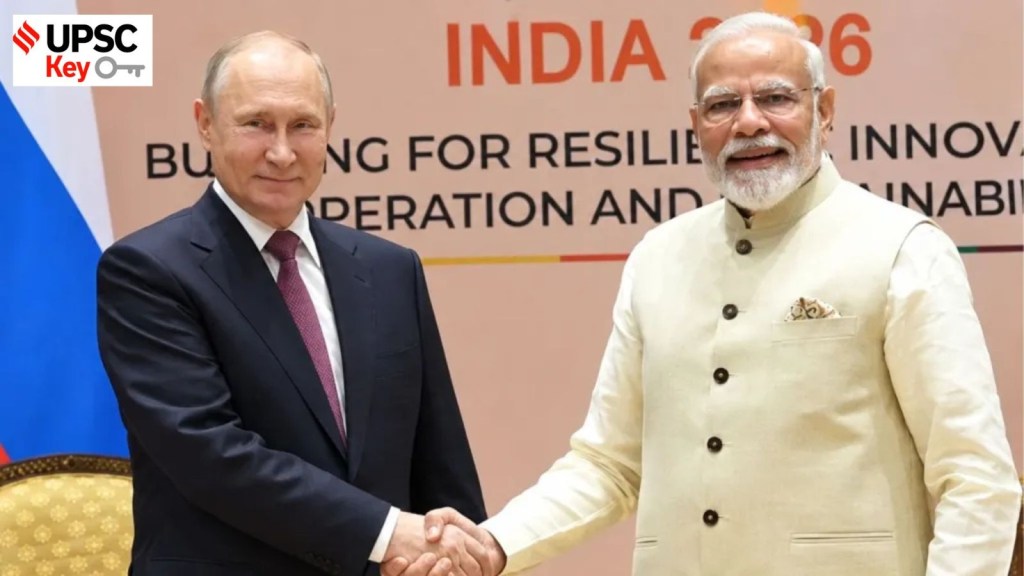 Russian President Vladimir Putin and Prime Minister Narendra Modi during their bilateral meet. (ANI Photo/ Image enhanced using AI)
Important topics and their relevance in UPSC CSE exam for September 12, 2026. If you missed the September 11, 2026 UPSC CSE exam key from the Indian Express, read it here.
FRONT
Modi, Putin set BRICS stage: ‘Deep shifts’, new engines of growth, energy security
Syllabus:
Preliminary Examination: Current events of national and international importance.

Mains Examination: General Studies II: Bilateral, Regional and Global Groupings and Agreements involving India and/or affecting India’s interests.
What’s the ongoing story: In remarks directed both at the West, opposed to his war in Ukraine, and countries with which Russia continues to do business despite crippling Western sanctions, Russian President Vladimir Putin said Friday that “the world is undergoing structural, deep, profound shifts” in which “new engines of growth” are replacing “the so-called old leaders”.
Key Points to Ponder:
— What are the objectives, institutional structure and decision-making mechanisms of BRICS?
— Trace the evolution of BRICS. Identify its founding members and subsequent members.
— Locate the BRICS member countries and read about their political structure, economy and society. .
— What is the significance of BRICS for India’s foreign policy and strategic autonomy?
— How does BRICS differ from other groupings like the G7, G20 and SCO?
— What are the major challenges facing BRICS as an expanding multilateral grouping?
— What is the significance of the Arctic Transport Corridor and the International North-South Transport Corridor (INSTC) for India?
— Locate the Strait of Hormuz on the map. Why is it important for global energy security?
— What is the significance of freedom of navigation under the United Nations Convention on the Law of the Sea (UNCLOS)?
— What are the objectives of promoting trade in local currencies among BRICS countries?
— Understand India’s Unified Payments Interface (UPI) and its potential for internationalisation.
— What are the opportunities and challenges associated with reducing dependence on the US dollar in international trade?
— Examine the significance of diversified supply chains for India’s economic resilience.
Key Takeaways:
— Addressing the BRICS business forum in New Delhi ahead of the summit Saturday, Putin said Russia and its “partners” are “ready to contribute to world energy and food security” and “building reliable logistics routes such as the Arctic Transport Corridor and the North-South Transport Corridor”.
— His remarks on energy and food security and “reliable logistics routes” are a reminder that the crisis in West Asia, where the US continues to exchange strikes with Iran, a BRICS member country, has not been resolved.
— The partial closure of the strategic Strait of Hormuz has disrupted supply chains, impacted economies and sent fuel prices soaring.
— Prime Minister Narendra Modi, who held a bilateral meeting with the Russian leader, told the BRICS business forum: “Global trade can only progress if sea lanes are secure, supply routes remain open and seafarers are safe. India is a staunch supporter of freedom of navigation and the safety of seafarers.”
Also from the FRONT page: Grouping looks at pragmatic cross border payment mechanism, local currency trade
— Ahead of the BRICS Leaders’ Summit, member countries have called for “pragmatic” and “efficient” cross-border payment mechanisms, including promotion of local currencies for trade and investments. Separately, Commerce Minister Piyush Goyal urged the bloc to link payment systems and trade in each other’s currencies.
— Addressing the opening session of the BRICS Business Forum on Friday, Goyal spoke about India’s Unified Payments Interface (UPI). “I would urge the BRICS member countries and partner countries to link our payment systems, trade in each other’s local currencies, make digital trade global and build together for the future emerging technologies,” he said.
— Noting that there is “immense potential to deepen cooperation”, he said trade among partners should be deep and resilient with diversified supply chains, adding that it should not be an impediment to growth and the well-being of each member state.
Do You Know:
— As per BRICS 2026 website, BRICS brings together eleven major emerging markets and developing countries of the world: Brazil, China, Egypt, Ethiopia, India, Indonesia, Iran, Russia, Saudi Arabia, South Africa and the United Arab Emirates.
— It serves as a useful platform for consultation and cooperation on contemporary issues having global as well as regional significance, and issues of global political and economic governance.
— BRICS began as BRIC, Brazil, Russia, India and China, in 2006, following a Goldman Sachs projection identifying these economies as future engines of global growth. It evolved from a foreign ministers’ dialogue into a leaders’ forum, with its first summit held in Yekaterinburg, Russia, in 2009.
— South Africa joined in 2010, and the grouping expanded dramatically in 2024 with the addition of Egypt, Ethiopia, Iran, Saudi Arabia and the UAE. Indonesia became the 11th full member in January 2025.
Other Important Articles Covering the same topic:
📍PM Modi met Putin, will meet Xi as India walks BRICS tightrope
📍With India as host, here are better goals for BRICS than ‘confronting the West’
Previous year UPSC Prelims Question Covering similar theme:
(1) With reference to a grouping of countries known as BRICS, consider the following statements: (UPSC CSE, 2014)
1. The First Summit of BRICS was held in Rio de Janeiro in 2009.
2. South Africa was the last to join the BRICS grouping.
Which of the statements given above is/are correct?
(a) 1 only
(b) 2 only
(c) Both 1 and 2
(d) Neither 1 nor 2
Raja Mohan writes— Brazil to Iran: why you can’t put all of BRICS in the anti-West block
Syllabus:
Mains Examination: General Studies II: Bilateral, Regional and Global Groupings and Agreements involving India and/or affecting India’s interests.
What’s the ongoing story: As it presides over the BRICS summit in Delhi Saturday, India’s challenge is two-fold: to convey the forum’s shared objective of democratizing the international system and to dispel the widespread impression that it seeks to overthrow the US-led order.
Key Points to Ponder:
— Understand the concept of the Global South and its significance in contemporary international relations.
— Examine the changing economic weight of BRICS and the G7 in the global economy.
— How do the political orientations and foreign policy priorities of BRICS members differ in their approach towards the West?
— Examine the differences between India, Brazil, Russia, China and Iran in their approaches to the existing international order.
— What is the significance of BRICS for India’s engagement with the Global South?
— Examine the opportunities and challenges associated with BRICS expansion, particularly in the context of China’s growing influence within the grouping.
— Understand the structure, functions and voting mechanisms of the International Monetary Fund (IMF) and the World Bank.
— What is the significance of the New Development Bank (NDB) and the Contingent Reserve Arrangement (CRA)?
— Examine the implications of Western trade restrictions, industrial subsidies and carbon-related trade measures for India’s exports and economic interests.
Key Takeaways:
— The forum’s champions and detractors alike view it through an anti-Western lens. Its supporters celebrate BRICS as a vehicle for resisting Western dominance; its critics warn that it is becoming a counter-bloc led by China and Russia. Both readings are simplistic.
— The BRICS members differ over whether their national aim is accommodation with the West, autonomy from it, parity within it, or direct confrontation.
— Within BRICS, India and Brazil share a strong instinct against turning the grouping into an anti-West alliance. India and Brazil do not want to undermine an international system in which they seek a larger role, more trade, access to technology and investment, and greater diplomatic standing.
— The political orientation of BRICS towards the West is best understood as a spectrum of approaches. Iran is closest to an anti-Western pole, its state ideology and recent history making resistance to US power central to foreign policy.
— At the other end are countries with deep economic, security and institutional ties with the West, even while pursuing greater autonomy.
From EDITORIAL page: India can change what BRICS stand for— more choices, not more blocs
— It is an extraordinary conclave of global leaders. As the BRICS Summit opens today at Bharat Mandapam,the leaders will represent almost half of the world’s population, 40 per cent of global GDP and over a quarter of global trade.
— The proceedings may be even more exceptional, almost audacious. Narendra Modi will host, amongst others, Russia’s Vladimir Putin, South Africa’s Cyril Ramaphosa, Iran’s Masoud Pezeshkian, Indonesia’s Prabowo Subianto, China’s Xi Jinping and the UN Secretary General. Almost miraculous, in these Manichean times.
— It will be tempting to judge it, though, as a one-off summit: Can a communique survive the night? Can wars be papered over in a paragraph? And if Xi shows up smiling, is that a thaw? None of these is the real test.
— Anyone who has attended the drafting of a summit line in this town knows how it goes. It starts with the communique and ends with the communique, and whatever gets done.
Do You Know:
— In 2000, Brazil, Russia, India and China together accounted for roughly 23% of global GDP on a purchasing power parity (PPP) basis, while the G7 held nearly 52%.
— By 2024, the positions had reversed: the expanded 11-member BRICS accounted for approximately 36.8% of global GDP (PPP), while the G7’s share fell below 29%.
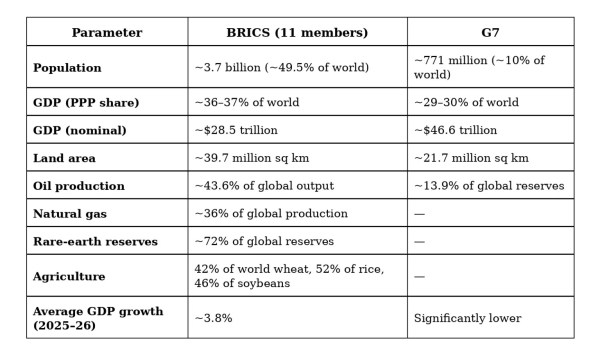 As can be seen from the table, BRICS is ahead of the G7 on almost all the parameters.
— BRICS now represents roughly a quarter of global trade, with intra-BRICS merchandise trade reaching $1.17 trillion in 2024, a nearly 13-fold increase from $84 billion in two decades.
— The grouping holds an estimated $5.2 trillion in combined foreign reserves and accounts for 78.2% of global mineral coal production. On growth, BRICS nations are projected to average 3.8% in 2025 and 3.7% in 2026, more than three times the G7 average.
— Yet the per-capita GDP tells a different story: the G7 averages around $53,000, while BRICS averages roughly $8,200. The bloc’s aggregate weight is driven by population and resource scale, not by individual prosperity.
Other Important Articles Covering the same topic:
📍Modi-Xi meet at BRICS: As India seeks trade cooperation, how China’s dominance poses a challenge
Previous year UPSC Prelims Question Covering similar theme:
(2) Consider the following statements with regard to BRICS: (UPSC CSE, 2025)
1. 16th BRICS Summit was held under the Chairship of Russia in Kazan.
2. Indonesia has become a full member of BRICS.
3. The theme of the 16th BRICS Summit was Strengthening Multiculturalism for Just Global Development and Security.
Which of the statements given above is/are correct?
(a) 1 and 2
(b) 2 and 3
(c) 1 and 3
(d) 1 only
India and EU close to sealing the trade deal, await node from top councils in Brussels
Syllabus:
Mains Examination: General Studies II: Bilateral, Regional and Global Groupings and Agreements involving India and/or affecting India’s interests.
What’s the ongoing story: THE European Commission on Friday forwarded its proposal for the conclusion of a Free Trade Agreement (FTA) between the European Union and India to the European Council (EC), a clear indication the deal could be officially signed soon.
Key Points to Ponder:
— Locate the 27 member countries of the European Union (EU).
— Distinguish EU members from European countries that are not members.
— Understand the evolution and objectives of the European Union.
— Understand the key features of a Free Trade Agreement (FTA).
— How does an FTA differ from a customs union?
— Examine the principal provisions of the India–EU FTA. What changes are proposed in market access, tariffs, and investment rules?
— Understand the significance of the EU as a trade and investment partner for India. Which sectors could gain from closer economic ties?
—Examine the possible effects of the FTA on Indian industries, consumers and employment.
Key Takeaways:
— “If authorised by the Council, this will be the largest trade agreement ever concluded by both the EU and India. Once adopted and entered into force, the agreement will improve market access, reduce tariffs, tackle unnecessary trade barriers, as well as provide predictable rules for trade and investment between the EU and India,” the European Union said in a statement.
— “With its proposals, the Commission is seeking the Council’s approval to sign the agreements, which will then require the European Parliament’s consent, before conclusion and entry into force. Authorities in India are in parallel going through their own internal ratification procedures,” the statement said.
— “The EU and India already trade over Euro 180 billion (1 Euro equals US $1.16) worth of goods and services per year, supporting close to 800,000 EU jobs. This deal will eliminate or reduce tariffs on 96% of EU goods exports to India,” as per the statement.
— “Overall, the tariff reductions will save around Euro 4 billion per year in duties on European products. It will make it easier for European companies to access the Indian market and compete on a more level playing field, while it will ensure consumers can benefit from increased choices and more competitive prices,” the statement said.
Do You Know:
— The European Union is a group of 27 countries in Europe. The European Council defines the general political direction and priorities of the European Union.
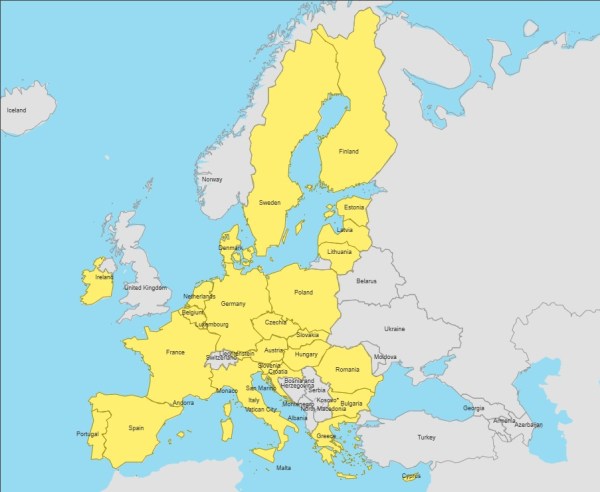 Member countries of the European Union. (Image: Official website of the EU)
— While the European Commission, the EU’s main executive body, proposes the FTA legislation, the members of the European Council, comprising heads of state or government of the 27 EU member states, the European Council President and the President of the European Commission, take the final decision.
— The relationship between India and the EU is based on shared values and principles such as democracy, rule of law, rules based international order and multilateralism.
— The ties are multifaceted and cover a broad spectrum of topics including trade, investment, climate change, science and technology, digital, connectivity and agriculture.
Other Important Articles Covering the same topic:
📍UPSC Issue at a Glance | India and EU seal the deal: Trade, Mobility, Security—and major takeaways
📍Best of Both Sides | Forget BRICS. India’s future is as global partner of Europe, the US
Previous year UPSC Prelims Question Covering similar theme:
(3) Which of the following countries are members of the European Union ? (UPSC CSE, 2026)
1. Belarus
2. Poland
3. Germany
4. Switzerland
Select the answer using the code given below :
(a) 1, 2 and 4
(b) 1 and 4 only
(c) 2 and 3
(d) 2 and 4 only
EXPLAINED
India’s BRICS balancing Act
Syllabus:
Mains Examination: General Studies II: Bilateral, Regional and Global Groupings and Agreements involving India and/or affecting India’s interests.
What’s the ongoing story: The leaders of 11 BRICS countries have arrived in India for the 18th edition of the summit to discuss ways to boost the growth prospects of the Global South. But the most consequential engagement at the summit from India’s perspective could be the bilateral talks between Prime Minister Narendra Modi and Chinese President Xi Jinping.
Key Points to Ponder:
— Locate BRICS member countries on a map and examine the grouping’s geographic and economic diversity.
— Examine how BRICS’ expansion affects its cohesion, decision-making and ability to represent the Global South.
— Examine BRICS’ original rationale and its current role in global economic governance.
— Assess the implications of China’s growing economic weight within BRICS.
— Understand the implications of India’s trade deficit with China.
— Compare India and China’s economic trajectories since the emergence of the BRIC grouping. Which structural factors have shaped their different growth paths?
— Compare India and China’s trade relations with BRICS members. What opportunities exist for Indian exporters and MSMEs?
Key Takeaways:
— There have been signs of a thaw in ties — resumption of direct flights, reopening of border trade via Nathu La Pass after six years and, most importantly, easing of restrictions on foreign direct investments (FDI) from land-bordering countries.
— But unpredictable American trade policies and two ongoing wars that have rattled the oil and bond markets seem to have nudged India and China to ease tensions.
— As negotiations between India and the US for a deal remain on, India has been seeking an edge in Section 301 rates over its competitors, including China.
— The demand for differential tariffs may have begun taking shape as the US in July this year imposed a 10% forced labour tariff on India, which was better than the 12.5% tariffs imposed on China, Russia and Brazil among others. China had earlier warned countries of consequences if they struck deals at its expense.
Also from Explained page— China and the rest: Group’s ever-widening economic gap
— Over the weekend (September 12 and 13), India will host the 18th BRICS Summit in New Delhi. BRICS is an informal grouping of 11 major emerging markets and developing countries: Brazil, China, Egypt, Ethiopia, India, Indonesia, Iran, Russia, Saudi Arabia, South Africa and the United Arab Emirates.
— However, it started out as BRIC — referring to the four countries that initially came together, namely Brazil, Russia, India, and China — on the sidelines of the United Nations General Assembly in New York in 2006. In 2010, South Africa joined the grouping, and it was renamed BRICS.
— The idea was to provide a platform for the concerns of emerging economies of the time and counter the overwhelming domination of the industrialised and developed economies (read: the G7) in international institutions.
— This is the 20th year since the grouping began, but curiously enough, there is now a dragon in the room: China. Key economic data shows just how much China dwarfs the rest of the BRICS members.
Do You Know:
— Even in 2006, China was the largest economy among the five countries after which the grouping is named but China’s overall GDP was less than the GDP of the other four members.
— However, such was the pace of increase in China’s economic growth that by the time the inaugural summit meeting happened in 2009, China had overtaken the combined economic size of BRIS (BRICS minus China). Since then, the gap has continued to increase each year. As of 2026, China’s GDP alone is more than double that of the other four combined.
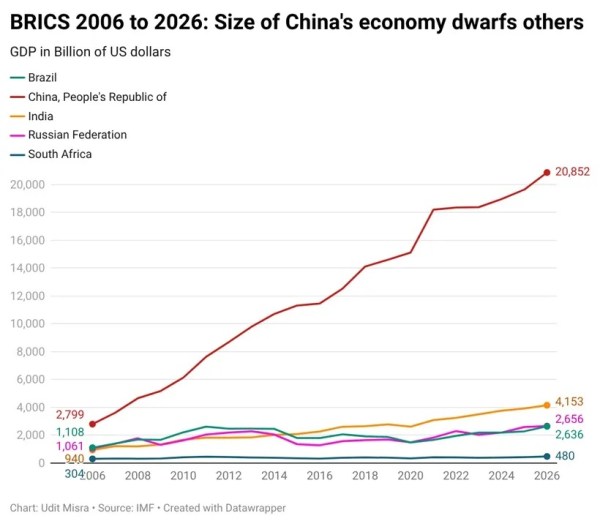
— Between 2006 and 2015, India did better than the others and overtook them to become the second-biggest economy within BRICS. However, China’s rise dwarfs all the rest.
Other Important Articles Covering the same topic:
📍BRICS summit: What trajectory of China-India ties means for the grouping
UPSC CSE Prelims Practice Question Covering similar theme:
(4) With reference to the BRICS, consider the following statements:
1. The theme of the 18th BRICS summit is “Building for Resilience, Innovation, Cooperation and Sustainability.”
2. BRICS currently has 11 official members, including Indonesia and Belarus.
3. The BRICS Presidency rotates annually among its member countries.
4. The BRICS partner-country category has been introduced at the 18th BRICS summit.
Which of the statements given above are correct?
(a) 1 and 3 only
(b) 1, 2 and 4 only
(c) 1, 3 and 4 only
(d) 1, 2, 3 and 4
What the recent trajectory of India-China ties means for the Summit
Syllabus:
Mains Examination: General Studies II: Bilateral, Regional and Global Groupings and Agreements involving India and/or affecting India’s interests.
What’s the ongoing story: Chinese President Xi Jinping landed in India on Saturday for the third time since he assumed the country’s presidency — and the first time after a gap of seven years.
Key Points to Ponder:
— Trace the evolution of India–China relations since 1949.
— Locate the Line of Actual Control (LAC), the disputed sectors, and the major flashpoints.
— Distinguish the Line of Actual Control from the Line of Control, the international boundary and the McMahon Line.
— Examine the purpose, achievements and limitations of the India–China border agreements and confidence-building mechanisms.
— Trace the diplomatic and military-level process that led to disengagement in eastern Ladakh in 2024. What issues remain unresolved?
— Examine how India’s partnerships with the US, Japan, Australia and Russia shape its strategic choices vis-à-vis China.
— Compare the two economies sector-wise.
— Examine the differences between India’s and China’s growth models.
— Examine the drivers of China’s industrial overcapacity.
Key Takeaways:
— The ostensible reason for his visit is participation in the BRICS leaders’ summit over the weekend, but the conditions arising from the 2020 border standoff that marked a low point in relations make the trip significant from a bilateral perspective. The fault line in the relationship, alongside a turbulent global scenario, will heavily influence the summit.
— With Goldman Sachs analysts calling India, China, Brazil and Russia the “emerging economies” in the world in 2001, “BRIC” as a grouping was born in the immediate aftermath of the 9/11 attacks.
— Twenty-five years later, their trajectory has been quite varied. China has surged ahead to become the second-largest economy after the US; India has grown at a modest rate but has been outpaced by Beijing by a mile, Russia has faced challenges due to wars of its own making, and Brazil has floundered amid frequent regime changes and scandals. South Africa, a later entrant to the grouping, has also not lived up to expectations.
— Apart from its economic rise, China has also grown militarily, with big-power ambitions to dethrone the US. These aspirations are visible in its increasingly aggressive and assertive stance in its neighbourhood, in its actions in the South China Sea, the Indo-Pacific, and the borders it shares with India.
Do You Know:
— After the 1962 war and the 1967 border clashes in Sikkim, major border standoffs include those in 2013 (Depsang, Ladakh), 2014 (Chumar, Ladakh), Doklam (2017) and since 2020 in eastern Ladakh, which is still ongoing with the deployment of about 50,000 Indian troops along the Line of Actual Control (LAC).
— The June 2020 clashes led to the killing of 20 Indian defence personnel, including a Colonel-rank officer, and at least four Chinese defence personnel.
— Years of diplomatic and military-level talks led to a disengagement of troops in 2024, and incremental steps have since been taken to stabilise the relationship.
— These include resumption of direct flights, easing visa restrictions, restarting the Kailash Mansarovar Yatra and relaxing restrictions on Chinese investments.
Other Important Articles Covering the same topic:
📍PM Modi met Putin, will meet Xi as India walks BRICS tightrope
📍With India as host, here are better goals for BRICS than ‘confronting the West’
Previous year UPSC Prelims Question Covering similar theme:
(5) Consider the following statements: (UPSC CSE, 2023)
1. India has more arable area than China.
2. The proportion of irrigated area is more in India as compared to China.
3. The average productivity per hectare in Indian agriculture is higher than that in China.
How many of the above statements are correct?
(a) Only one
(b) Only two
(c) All three
(d) None
ECONOMY
Trump’s unusual threat to the US federal reserve and why it matters to India?
Syllabus:
Mains Examination: General Studies II: Effect of Policies and Politics of Developed and Developing Countries on India’s interests.
What’s the ongoing story: After months of threatening allies and rivals alike with tariffs to coerce them into signing lopsided trade deals, US President Donald Trump seemingly went a step further late last week and warned the Federal Reserve (Fed) to cut interest rates, or else the US would stop trading with countries with which it has a trade deficit.
Key Points to Ponder:
— Understand the role and mandate of the US Federal Reserve (Fed).
— Distinguish monetary policy from fiscal policy.
— Examine the institutional independence of a central bank.
— Distinguish the policy interest rate from government bond yields.
— What factors influence the yield on a long-term US Treasury bond.
— Examine how a change in the Fed’s interest rates can affect capital flows into and out of India.
— Understand how changes in the US Federal Reserve’s policy rate can influence the RBI’s monetary-policy decisions.
— Know the difference between a trade deficit and a fiscal deficit.
— Examine the significance of the US dollar in the global financial system.
Key Takeaways:
— While Trump’s threat to the Fed has raised eyebrows among policy circles globally, this is not the first time that Trump has suggested extreme measures to influence the Fed to lower interest rates.
— During his first term too, Trump routinely pushed for lower interest rates and in September 2019 went on to suggest that the Fed should get the interest rates down to “zero or less” so that the US can start to “refinance its debt”.
— Trump’s warnings have gotten more and more aggressive amid growing worry over the US debt and trade deficit. The latest data showed that US debt has crossed a record $40 trillion and the trade deficit also widened despite a slew of tariffs on trade partners.
— High debt numbers are increasingly making investors nervous amid rising oil prices due to the US-Iran war and are pushing US 10-year bond yield (a benchmark for global borrowing costs) towards 5%.
— International think tanks estimated that the US government will spend little over $1 trillion this fiscal year paying interest on the debt, which is equivalent to its national defence spending.
Do You Know:
— Around 40% of India’s crude oil imports, 60% of its LNG imports, and a whopping 90% of its LPG imports regularly came from West Asia through the Strait of Hormuz.
— The country’s dependence on imports stands at over 88% for oil, 60% for LPG, and about 50% for natural gas. This means that the Strait of Hormuz effectively saw the movement of around 54% of India’s LPG consumption.
Other Important Articles Covering the same topic:
📍How US share in India’s LPG imports surged to over 50% in 6 months
📍US Fed signals rate hikes this year: What this means for Indian markets
📍A US court has ruled against Trump’s new 10% tariffs. Why this may not be good news
Previous year UPSC Prelims Question Covering similar theme:
(6) Consider the following statements: (UPSC, CSE 2022)
1. Tight monetary policy of US Federal Reserve could lead to capital flight.
2. Capital flight may increase cost of firms with existing External Commercial Borrowings (ECBs).
3. Devaluation of domestic currency decreases the currency risk associated with ECBs.
Which of the statements given above are correct?
(a) 1 and 3
(b) 1 and 2 only
(c) 2 and 3 only
(d)1, 2 and 3
WORLD
Houthis seize key Red sea island, tighten grip on key shipping route
Syllabus:
Preliminary Examination: Current events of national and international importance.
Mains Examination: General Studies I and II: Salient features of World’s Physical Geography; Effect of Policies and Politics of Developed and Developing Countries on India’s Interests, Indian Diaspora.
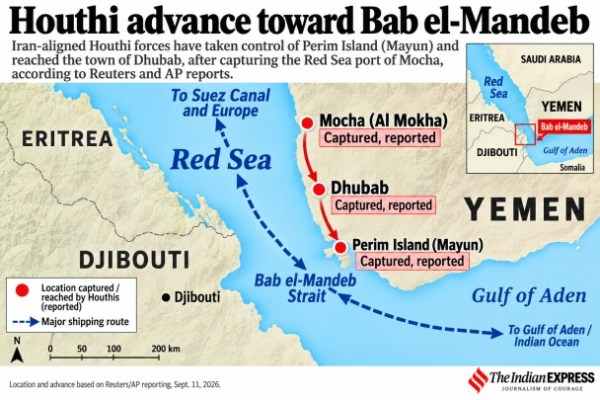
What’s the ongoing story: Iran-aligned Houthi forces have reached and taken control of Perim Island, also known as Mayun, in the Bab el-Mandeb Strait, in a major territorial advance that could put further pressure on one of the world’s most important shipping routes and Saudi Arabia’s alternative oil-export corridor, news agency Reuters reported.
Key Points to Ponder:
— Locate Yemen, Saudi Arabia, Djibouti and Eritrea on the map. Identify the major water bodies and choke points close to them.
— Locate the Bab el-Mandeb Strait and Perim Island on the map. What is their strategic significance?
— Examine the significance of major maritime chokepoints connecting the Indian Ocean with Europe and the Mediterranean Sea.
— Understand the historical background of the Yemen conflict. Identify the stakeholders.
Locate Saudi Arabia’s East-West oil pipeline and understand its significance as an alternative route for oil exports.
— Read about the Makkah Joint Defence Agreement. What are its objectives and implications for regional security?
— Discuss the significance of the United Nations Convention on the Law of the Sea (UNCLOS).
— Examine the implications of the Yemen conflict for the security architecture of West Asia and the interests of external powers.
Key Takeaways:
— Houthis have also reached the Yemeni town of Dhubab , which sits directly on the Bab el-Mandeb Strait across from the island of Perim, two Yemeni government sources told Reuters on Friday.
— Reuters also cited four Yemeni government sources on Friday confirming that the Houthis had reached the strategically located island after government forces withdrew.
— Two Saudi-backed Yemeni government sources had earlier said Houthi forces also captured the mainland coastal town of Dhubab, which faces Perim across the Bab el-Mandeb. The Mayun island is a small volcanic outcrop which lies about 3.5 km off Yemen’s western coast.
— Perim’s location gives the Houthis a potentially significant position overlooking the Bab el-Mandeb Strait, which connects the Red Sea with the Gulf of Aden. The waterway has become particularly important as the conflict around the Strait of Hormuz has disrupted another major route for global energy shipments.
Do You Know:
— Bab el-Mandeb, which translates to “Gate of Tears” in Arabic, is a narrow waterway and a major global chokepoint that connects the Red Sea to the Gulf of Aden. It sits between Yemen on one side and Djibouti and Eritrea, in the Horn of Africa, on the other.
— At its narrowest point, the Strait is just 29 km wide, with just two channels for inbound and outbound traffic. The strait is located at the mouth of the Red Sea, which leads to the Suez Canal — the gateway to Europe.
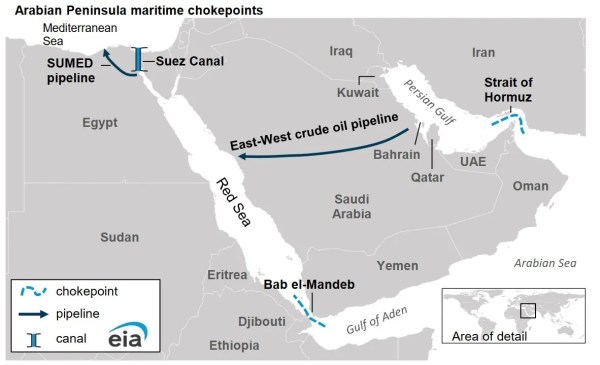
— The Strait is one of the world’s most important shipping and energy passages. Around 12% of global trade usually passes through it. In 2024 alone, about 4.1 billion barrels of oil and petroleum products passed through the Strait, roughly 5% of the global total, Al Jazeera reported.
Other Important Articles Covering the same topic:
📍Pakistan warns Houthi attacks on Saudi Arabia could activate Mecca defence pact: What it means
📍Saudi Arabia shut down East-West pipeline as Houthis tighten grip on Red Sea shipping
Previous year UPSC Prelims Question Covering similar theme:
(7) Ships from which of the following countries have to cross the Strait of Hormuz to reach out to the Indian Ocean? (UPSC CSE, 2026)
1. Bahrain
2. Syria
3. Qatar
4. Egypt
Select the answer using the code given below:
(a) 1 and 2
(b) 1 and 3
(c) 2 and 3
(d) 3 and 4
ALSO IN NEWS
FM’s, central bank chiefs flag unilateral tariffs
— Flagging “serious concerns” about the unilateral imposition of tariffs and non-tariff measures, BRICS finance ministers and central bank governors (FMCBG) in a joint statement said that such measures distort trade and are inconsistent with World Trade Organisation (WTO) rules.
— Highlighting the growing share of emerging markets and developing economies (EMDEs) in global output and growth, the BRICS FMCBG also called for a merit-based, inclusive and transparent selection process that would increase regional diversity and representation of EMDEs in the leadership of the International Monetary Fund (IMF) and the World Bank.
— Noting that the global economy is facing significant headwinds, the FMCBG said risks to the global economic outlook remain elevated, reflecting persistent geopolitical tensions, trade fragmentation and protectionism, policy uncertainty, fiscal and inflationary pressures, growing debt and financial vulnerabilities.
AI a double-edged sword, can influence elections also: FM Sitaraman
— Finance Minister Nirmala Sitharaman on Friday termed artificial intelligence (AI) a double-edged sword, flagging the risks posed by emerging technologies such as agentic AI, tokenisation and quantum computing. AI also has the potential to influence electoral outcomes in some cases, she said.
— “The model that I’m referring to, I’m not naming it, is fully capable of influencing the opinion on the ground without people even sensing that they are being influenced. To the extent that me, being a minister, being in politics, I’m clearly seeing it capable of influencing elections,” Sitharaman said at the Global Fintech Fest here.
— Her comments came in the wake of reports that a researcher who had worked at both Anthropic and OpenAI had raised concerns about major AI companies focusing more on competing with rivals than developing the technology responsibly.
PRELIMS ANSWER KEY
1.(d) 2.(a) 3.(c) 4.(a) 5.(a) 6.(b) 7.(b)
🚨 Click Here to read the UPSC Essentials magazine for August 2026. Share your views and suggestions in the comment box or at raveena.baneta@indianexpress.com🚨
Subscribe to our UPSC newsletter. Stay updated with the latest UPSC articles by joining our Telegram channel – IndianExpress UPSC Hub, and follow us on Instagram and X.


Raveena Baneta is a consultant with the UPSC section of The Indian Express where she writes on Ethic... Read More
 Share


