
Why panchayats cannot remain at the margins of climate planning
As climate change is reshaping everyday life across rural India, can uniform, national or state-level responses address the specific vulnerabilities of different communities or local ecosystems? How can panchayat-level climate actions complement the top-down planning? See infographics for quick key insights.
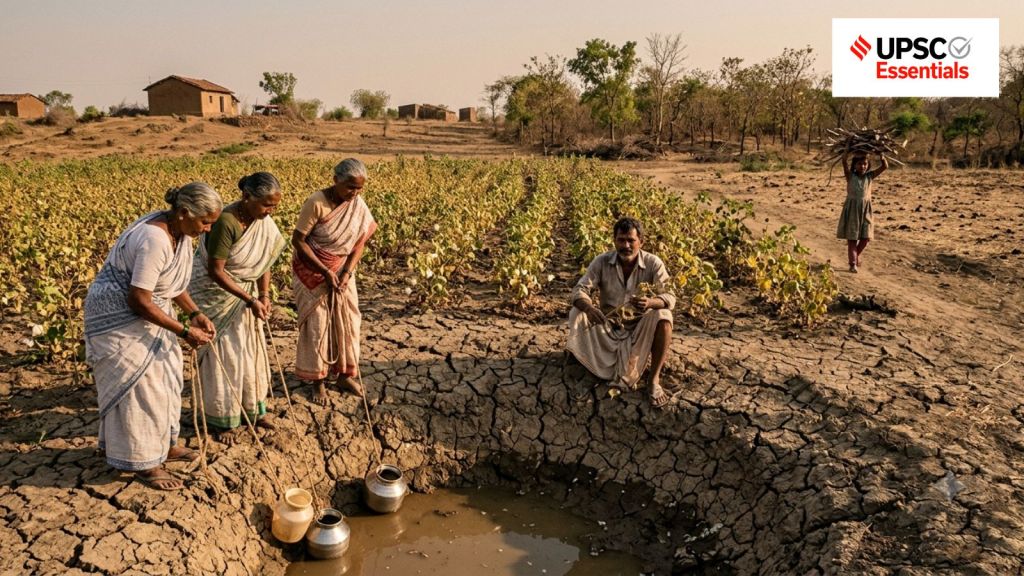 In rural areas, impacts are experienced through agriculture, water availability, and natural-resource dependence. (Image generated using AI)
— Renuka
Climate change is increasingly becoming a question of governance as much as environmental protection. While climate policies are largely formulated at international, national and state levels, the consequences of climate variability are experienced most directly by specific communities and local ecosystems.

The effects and risks associated with climate change are not uniform across urban and rural areas. In cities, the effect of climate change is amplified by urbanisation, land-use change, infrastructure, and population density. In rural areas, impacts are experienced through agriculture, water availability, and natural-resource dependence. Moreover, climate change threats can differ from one village to another, depending on geography, natural resources, livelihoods and socio-economic conditions.
Given these differences, uniform, national or state-level responses to climate change may not be adequate to address specific vulnerabilities of different communities or local ecosystems. This underlines the need for decentralising climate planning and developing adaptation and mitigation measures at the Gram Panchayat level.
As the constitutionally recognised institution of local government, the Gram Panchayat occupies a critical position in this context. Recent initiatives in states such as Uttar Pradesh and Karnataka have brought this question into sharper focus, and provide an opportunity to examine the broader case for decentralising climate planning in India.
Can Villages Govern the Climate Crisis?
What is panchayat-level climate action plan?
A panchayat-level climate plan provides a framework for a gram panchayat to identify the climate-related risks in its area and incorporate appropriate responses into its development planning. Rather than treating climate action as a separate set of environmental projects, it involves examining how climate change may affect the local community and incorporating appropriate responses into development priorities.
Adaptation measures at the panchayat-level action plan may include crop diversification, climate-resilient agricultural practices, soil conservation, rainwater harvesting, groundwater recharge, and restoration of local water bodies. Mitigation measures may include afforestation, renewable energy, energy efficiency, improved waste management, and reducing dependence on fossil fuels.
The Bela Gram Panchayat in Maharashtra has undertaken several such measures, including planting more than 90,000 trees, installing solar panels in houses and panchayat offices, and introducing waste segregation. These measures led it to become India’s first net-zero panchayat.
Climate action rooted in local realities
The starting point for such a plan would be a local assessment of climate risk and vulnerabilities. This may involve examining rainfall patterns, water availability, agricultural practices, natural resources, and socio-economic conditions of the community.
For example, a panchayat facing recurrent drought may prioritise groundwater recharge, water conservation and crop diversification, while one grappling with flooding may focus on drainage, restoration of water bodies, and protection of vulnerable infrastructure.
Notably, panchayat-level climate action does not necessarily require a separate planning structure. Climate priorities can be incorporated into the existing Gram Panchayat Development Plan (GPDP). This would allow panchayats to use existing schemes and financial resources, while ensuring that development decisions are also responsive to changing climatic conditions.
Constitutional basis for local climate governance
The role of Gram Panchayats in climate governance can be understood within India’s broader framework of decentralised local government. The 73rd Constitutional Amendment gave constitutional status to panchayats and inserted Part IX of the Constitution, which recognised them as institutions of local self-government.
Article 243G enables State legislatures to devolve powers and responsibilities to panchayats for the preparation of plans for economic development and social justice and for implementing related schemes, including matters listed under the eleventh schedule.
The Eleventh Schedule is particularly relevant to climate action, including agriculture, land improvement and soil conservation, minor irrigation, water management and watershed development, social and farm forestry, minor forest produce, drinking water, fuel and fodder, rural electrification, non-conventional energy, health and sanitation, and maintenance of community assets.
These subjects overlap considerably with the areas in which climate adaptation and resilience measures need to be undertaken. Thus, panchayat-level climate planning does not necessarily require an entirely new institutional mandate. It can build upon functions already associated with rural local governance.
Panchayats, PESA, and natural-resource management
This framework is further strengthened in Scheduled Areas through the Panchayats (Extension to the Scheduled Areas) Act, 1996 (PESA). PESA requires panchayat legislation in Scheduled Areas to respect customary law and traditional management practices relating to community resources and gives the Gram Sabha an important role in protecting community resources and approving local development plans. It also provides for community participation in matters concerning land, minerals and minor forest produce.
Together, the constitutional framework and PESA provide a basis for understanding panchayats not merely as implementing agencies, but as institutions through which local communities can participate in decisions concerning development and natural-resource management, both central to effective climate adaptation and mitigation.
Climate policy and local implementation framework
India’s climate policy has largely been organised through a top-down national-state framework. The National Action Plan on Climate Change (NAPCC), launched in 2008, comprised eight national missions covering solar energy, energy efficiency, sustainable habitat, water, sustainable agriculture, forests, the Himalayan ecosystem and Strategic knowledge for climate change.
The State Action Plans on Climate Change (SAPCCs) were intended to translate this national framework into state-specific strategies by accounting for differences in ecosystems, geography and socio-economic conditions. However, this architecture does not mean that climate action remains confined to national and state institutions.
Many programmes through which climate adaptation is actually undertaken operate at the local level. Measures relating to water conservation, watershed development, irrigation, sustainable agriculture and natural-resource management are implemented through schemes such as the Mahatma Gandhi National Rural Employment Guarantee, now the Viksit Bharat-Guarantee for Rozgar and Ajeevika Mission (Gramin), the Pradhan Mantri Krishi Sinchayee Yojana (PMKSY), and the National Mission for Sustainable Agriculture.
The NAPCC recognised the need for implementation and capacity at different levels of government and emphasised the protection of vulnerable sections. But it did not establish a specific framework for panchayat-level climate action planning. Panchayat-level climate action is essentially about making existing local development planning climate-responsive, while allowing each panchayat to determine its priorities according to its own environmental and socio-economic conditions.
The plan and activities can then be implemented through convergence with existing Central and State schemes, panchayat funds and, where appropriate, other sources such as CSR or private finance. This approach ensures that climate action is not treated as a standalone effort but rather woven into all aspects of sectoral planning. Uttar Pradesh provides an emerging example of this approach. The State developed a Climate Smart Gram Panchayat Action Plan (CSGPAP) and Standard Operating Plan (SOP) for preparing such plans.
Challenges and way forward
The effectiveness of Panchayat-level climate action ultimately depends on whether local governments have the capacity and resources to move from planning to implementation. The first is institutional capacity. Gram Panchayats may lack the technical expertise required to assess climate risks, interpret climate data, prepare vulnerability assessments and design appropriate adaptation measures. This requires sustained training and technical support from district administrations, line departments, academic and other specialised institutions.
A second challenge is access to localised data. Effective planning requires information on rainfall, temperature, groundwater, agricultural patterns, natural resources and vulnerable communities at a sufficiently granular level. Panchayats therefore need accessible climate and environmental data that can be combined with community knowledge and local observations.
Finance is another constraint. Climate action should not depend entirely on creating new funds. Greater convergence of existing schemes, GPDP resources and panchayat funds can support climate-related interventions, while other sources, such as corporate social responsibility (CSR), may supplement public financing where appropriate.
Finally, community participation and accountability are essential. Climate plans should emerge through Gram Sabha discussions and local participation rather than being prepared only as administrative documents. Clear targets, indicators and periodic reviews can help assess whether planned measures are actually reducing vulnerability.
The way forward is therefore not necessarily to create a parallel institutional structure, but to strengthen the funds, functions, functionaries, data and technical capacity already available to panchayats. This would enable Gram Panchayats to move from being implementing agencies for individual schemes to becoming meaningful institutions of local climate governance.
Post read questions
1. Why does India need to move from a predominantly top-down approach to a more decentralised approach to climate governance? Examine the potential role of Gram Panchayats.
2. The effectiveness of climate adaptation depends heavily on the extent to which local vulnerabilities are reflected in development planning. Discuss with reference to Panchayati Raj Institutions.
3. Examine the constitutional and institutional basis for assigning a greater role to Panchayats in climate governance in India.
4. How can the provisions of the 73rd Constitutional Amendment and PESA be leveraged to strengthen community participation in local climate action?
5. Climate planning at the Gram Panchayat level can transform Panchayats from implementing agencies into institutions of local climate governance. Discuss.
(Dr. Renuka holds a PhD in environmental law from Himachal Pradesh National Law University, Shimla.)
Share your thoughts and ideas on UPSC Special articles with ashiya.parveen@indianexpress.com.
Click Here to read the UPSC Essentials magazine for August 2026. Subscribe to our UPSC newsletter and stay updated with the news cues from the past week.
Stay updated with the latest UPSC articles by joining our Telegram channel – IndianExpress UPSC Hub, and follow us on Instagram and X.

 Share


