
UPSC Weekly Current Affairs Quiz (August 30 – September 05): 10 key questions with detailed answers for Prelims 2027
Test your UPSC Prelims 2027 preparation with this weekly current affairs quiz, featuring key topics like Bishkek Declaration, different types of orbits, Nancy Grace Roman Space Telescope, India's three-stage nuclear power programme, and more, with MCQs and detailed explanations.
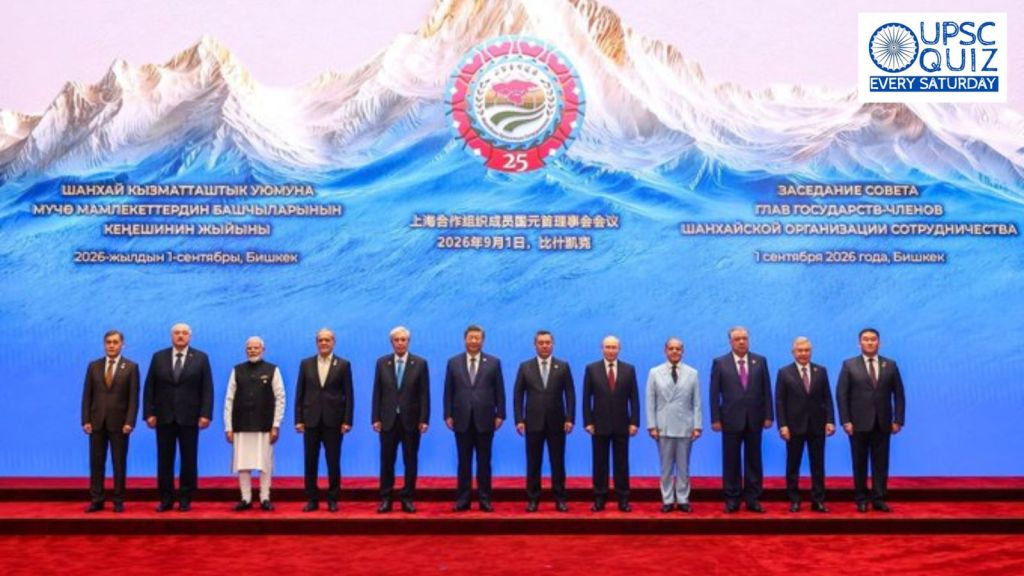 Test your UPSC Prelims 2027 preparation. Attempt a question on the Bishkek Declaration in today's quiz. ( Photo: ANI via X/@narendramodi)
As UPSC CSE Prelims 2027 is still ahead, building a strong foundation alongside regular current affairs preparation is essential. UPSC Weekly Quiz is a current affairs–based quiz on relevant topics from the past week, curated for aspirants of competitive examinations. Attempt the weekly quiz every Saturday and review the detailed answers with explanations to strengthen conceptual clarity and exam readiness.
🚨 Click Here to read the UPSC Essentials magazine for August 2026. Share your views and suggestions in the comment box or at manas.srivastava@indianexpress.com🚨

QUESTION 1
Consider the following statements:
1. The single deflation method works well when prices of inputs and outputs are changing at different rates.
2. In double deflation, the value of inputs should be adjusted by output inflation and outputs by input inflation.
Which of the statements given above is/are correct?
(a) 1 only
(b) 2 only
(c) Both 1 and 2
(d) Neither 1 nor 2
Why this question for UPSC Prelims 2027?
This question is particularly relevant because double deflation has become an important part of India’s revised National Accounts methodology, with the updated GDP series incorporating separate deflation of output and intermediate consumption for relevant manufacturing industries.
Explanation
— Revisions to past GDP numbers, especially quarterly ones, happen all the time. This is because quarterly numbers are compiled using what is called a “benchmark-indicator approach”. In this method, movement in quarterly GDP estimates is guided by changes to relevant high-frequency indicators such as crop production, cement production, finished steel consumption and commercial vehicle sales.
— Annual GDP estimates, meanwhile, are based on actual output and numbers. As more and more ‘actual’ data becomes available for a particular quarter — say from companies’ financial results and the statistics ministry’s surveys — the quarterly estimates are revised.
— On February 27 this year, MoSPI unveiled a new series of GDP data after changing the “base year” from 2011-12 to 2022-23. Every economy undergoes regular base year revisions to incorporate new data sources, improve methodology and capture data more accurately. While rebasing, the ministry overhauled its methods of calculating the GDP, including how it removes the effect of inflation from “nominal” GDP to arrive at the “real” GDP.
— GDP is calculated by summing together the value created — or Gross Value Added (GVA) — by each sector, adding indirect taxes collected by the government, and subtracting subsidies given.
— This GVA is the difference between the value of what a sector produces (output) and the raw materials (inputs) it uses. This is the “nominal” GVA, or GVA in current prices.
— The trouble begins while calculating “real” GVA.
— The single deflation method works fine when prices of inputs and outputs are changing at the same rate; when they don’t, there’s a problem. Hence, statement 1 is not correct.
— Ideally, the value of inputs should be adjusted by input inflation and outputs by output inflation. This is called double deflation and ensures that the real GVA is accurate. Hence, statement 2 is not correct.
Therefore, option (d) is the correct answer.
QUESTION 2
With reference to the ‘Bishkek Declaration’, consider the following statements:
1. The declaration has been adopted by the member countries in the BRICS grouping.
2. The declaration aims to combat terrorism, including cross-border movement of terrorists.
Which of the statements given above is/are correct?
(a) 1 only
(b) 2 only
(c) Both 1 and 2
(d) Neither 1 nor 2
Why this question for UPSC Prelims 2027?
This question is relevant as it connects current international developments with static concepts related to regional organisations and India’s foreign policy. It helps in understanding the functioning, objectives and areas of cooperation of major regional groupings.
Explanation
— The recently concluded Shanghai Cooperation Organisation (SCO) summit hosted by Kyrgyzstan saw the adoption of the “Bishkek Declaration” which called upon the international community to combat terrorism, including cross-border movement of terrorists. The declaration also saw member states condemn the “military strikes” on Iranian territory. Hence, statement 2 is correct.
— The ‘Bishkek Declaration’ adopted by India, Pakistan, Iran, Russia, China and the Central Asian countries in the SCO grouping. The declaration is important since India has always maintained that Pakistan is responsible for cross-border terrorism in the country. Hence, statement 1 is not correct.
— On terrorism, the joint declaration adopted at the end of the SCO leaders’ summit in the Kyrgyz’ capital, Bishkek, stated: “Member States, reaffirming their firm commitment to combating terrorism, separatism and extremism, emphasise the inadmissibility of attempts to exploit terrorist, separatist, and extremist groups for selfish purposes. They recognize the leading role of sovereign states and their competent authorities in countering terrorist and extremist threats.”
Therefore, option (b) is the correct answer.
QUESTION 3
With reference to the different types of orbits, consider the following statements:
1. The Low Earth Orbit (LEO) houses global navigation satellite systems.
2. The Medium Earth Orbit (MEO) has Earth observation satellites.
3. The Geosynchronous Orbit (GSO) has communications, meteorological and related applications.
How many of the statements given above are correct?
(a) Only one
(b) Only two
(c) All three
(d) None
Why this question for UPSC Prelims 2027?
This question is relevant because satellite orbits and their applications are a recurring Science & Technology theme, linking basic space concepts with India’s satellite programmes such as NavIC, INSAT/GSAT and Earth Observation satellites.
Explanation
— The European Space Agency (ESA) defines “orbit” as the curved path that an object in space follows around another object owing to gravity. In the case of satellites, the curved path they follow is around the Earth.
— Scientists broadly categorise Earth’s orbits into three primary altitude classes. Each serves a different purpose.
— Low Earth Orbit, or LEO, is the zone immediately surrounding our planet. It is typically defined as the region between 160 km and 2,000 km above Earth’s surface. The proximity to Earth reduces signal latency. This is why this orbital slice is densely populated by communications and observation satellites, as well as satellite constellations and mega-constellations (large groups of up to thousands of satellites working together). The International Space Station is also located in this zone. Hence, statement 1 is not correct.
— MEO extends from 2,000 km up to 35,786km — just below the geosynchronous orbit. Like LEO, satellites are not confined to following a specific path around the Earth. It houses global navigation satellite systems such as Galileo (a constellation of 30 satellites) and provides a balance between low signal latency and a large coverage area. Hence, statement 2 is not correct.
— Satellites considered to be placed in geosynchronous orbit (GSO) are positioned upwards of roughly 35,786 km. They fly over the Earth’s equator moving from West to East and exactly match the Earth’s rotation. This means that its position relative to Earth appears stationary. The GSO hosts communications, broadcasting, and meteorological/weather monitoring satellites. Hence, statement 3 is correct.
Therefore, option (a) is the correct answer.
QUESTION 4
With reference to the glacial lakes, consider the following pairs:
1. Shako Chho Lake – Arunachal Pradesh
2. Gurudongmar Lake – Sikkim
3. Satopanth Tal – Himachal Pradesh
How many of the pairs given above are correctly matched?
(a) Only one pair
(b) Only two pairs
(c) All three pairs
(d) None of the above pairs
Why this question for UPSC Prelims 2027?
This question is relevant because glacial lakes and Glacial Lake Outburst Floods (GLOFs) have emerged as an important Himalayan environmental and disaster-management issue. Recent assessments in Sikkim have identified several high-risk glacial lakes and highlighted the need for monitoring, early-warning systems and mitigation measures.
Explanation
— A total of 40 high-risk glacial lakes have been identified in Sikkim, including 16 at the highest-risk Category A level, amid growing concern over glacial lake outburst flood (GLOF) risk in the Himalayas. The state is building a mitigation plan monitoring and possible flood measures, with Shako Chho lake flagged as the most vulnerable lake of all.
— Glacial lakes form when glaciers melt and water accumulates in depressions around them. If these lakes suddenly burst due to excess water, landslides or earthquakes, they can send large amounts of water, mud and debris downstream.
— Sikkim has already experienced the destructive potential of such an event. A GLOF in October 2023 killed at least 60 people, damaged infrastructure across Mangan, Gangtok, Pakyong and Namchi districts and destroyed the Chungthang dam, PTI reported
— The state government has identified Shako Chho Lake as the most vulnerable to a GLOF. A detailed project report for mitigation measures at the lake has been submitted to the National Disaster Management Authority, while a preliminary project report has been sent to the Jal Shakti Ministry.
Glacial lakes and their location:
Shako Chho Lake – Sikkim
Gurudongmar Lake – Sikkim
Satopanth Tal – Uttarakhand
Therefore, option (a) is the correct answer.
QUESTION 5
Consider the following:
He was born to a Brahmin family in Tiruttani, a temple town north-west of Madras City. He graduated from Madras Christian College in 1907 and completed his M.A. in Philosophy there in 1909. He was invited to occupy the George V Chair of Philosophy at the University of Calcutta, where his career gained further prominence. Between 1948 and 1949, Radhakrishnan also served as chairman of the University Education Commission. Between 1949 and 1952, he served as Ambassador to Moscow. Later, he also served as Vice-President of India for two terms.
The above-mentioned statement refers to:
(a) C. Rajagopalachari
(b) P. Subbarayan
(c) M. S. Srinivasa Sastri
(d) Sarvepalli Radhakrishnan
Why this question for UPSC Prelims 2027?
This question is relevant because it connects Indian history, education, philosophy and important personalities, areas that fall within UPSC Prelims’ broad coverage of Indian history and culture. Such personality-based questions can also link education, philosophy, diplomacy and post-Independence institutional development.
Explanation
— Among the significant events during Sarvepalli Radhakrishnan’s presidency was the decision to observe September 5 as Teachers’ Day. Academic and philosopher P. Nagaraja Rao writes in his 1994 publication, Dr. S. Radhakrishnan, that the National Federation of Teachers made the request and that “Nehru was responsible for it.” Official accounts, however, record that Radhakrishnan himself expressed a wish that his 75th birthday be observed as Teachers’ Day rather than celebrated as a personal occasion.
— Radhakrishnan was born to a Brahmin family in Tiruttani, a temple town north-west of Madras City. He received his early education there until the age of eight, before moving to Vellore. He graduated from Madras Christian College in 1907 and completed his M.A. in Philosophy there in 1909.
— His teaching career began at Madras Presidency College in 1909. After teacher training at Saidapet, he returned to the college in 1911, where he taught philosophy and psychology before moving to the University of Mysore in 1918.
— In his 1989 work, Radhakrishnan, a Biography, Sarvepalli Gopal also details Radhakrishnan’s growing interest in Swami Vivekananda and V.D. Savarkar.
— He was soon invited to occupy the George V Chair of Philosophy at the University of Calcutta, where his career gained further prominence. “He wrote his two volumes of Indian Philosophy and visited America and England for his lectures,” Rao writes. His growing reputation earned him a knighthood, and he was later appointed Spalding Professor at Oxford.
— Between 1948 and 1949, Radhakrishnan also served as chairman of the University Education Commission.
— Between 1949 and 1952, he served as Ambassador to Moscow, succeeding Pandit Nehru’s sister, Vijaya Lakshmi Pandit. He was comfortable in Moscow and sought to strengthen friendly relations between India and the Soviet Union.
— His next major political assignment was as Vice-President of India, a post he held for two terms, from 1952 to 1962. “It is here in Delhi that he developed the friendship with Nehru. Nehru took to Radhakrishnan very kindly and was appreciative of his talent and ability,” notes Rao.
Therefore, option (d) is the correct answer.
QUESTION 6
Consider the following statements about Article 142:
1. It allows the Supreme Court to pass a decree or order as it is necessary for doing complete justice in any cause or matter pending before it.
2. The article defines “complete justice” or specifies when it may be used.
3. The origins of this provision can be traced back to the Government of India Act, 1909.
How many of the statements given above are correct?
(a) Only one
(b) Only two
(c) All three
(d) None
Why this question for UPSC Prelims 2027?
This question is relevant because Article 142 has again come into focus following its recent invocation by the Supreme Court, making it an important intersection of current affairs and Indian Polity.
Explanation
— A bench led by Chief Justice of India Surya Kant and Justices Joymalya Bagchi and V Mohana closed the cases after the Centre said that it had “consciously decided“ not to pursue them, and ordered compensation, within three months, for families of students who died by suicide over the leak of the NEET-UG 2026 exam.
— Article 142 lets the Supreme Court pass such “decree or order as it is necessary for doing complete justice in any cause or matter pending before it”. Unlike most Constitutional provisions, it does not define “complete justice” or specify when it may be used. Hence, statement 1 is correct and statement 2 is not correct.
— The origins of this provision can be traced back to Section 210 of the Government of India Act, 1935, and beyond that, to the colonial-era practice of deciding disputes on “justice, equity and good conscience” where written law was silent. In the Draft Constitution, it appeared as Article 118 and was adopted by the Constituent Assembly on May 27, 1949, without a debate. Two amendments to it were moved and then withdrawn. Hence, statement 3 is not correct.
Therefore, option (a) is the correct answer.
QUESTION 7
Recently, NASA launched the Nancy Grace Roman Space Telescope. It will provide:
(a) high-resolution measurements of Earth’s atmosphere and ocean circulation to monitor climate change.
(b) detailed observations of the Sun’s corona and solar wind to study space weather.
(c) insights about dark matter, dark energy and exoplanets.
(d) direct observations of black holes by detecting gravitational waves generated by their mergers.
Why this question for UPSC Prelims 2027?
This question is relevant because the Nancy Grace Roman Space Telescope is a major contemporary space-science mission, making it suitable for the Space Technology and Astronomy portion of the Prelims syllabus. UPSC may test awareness of recent space missions, their scientific objectives, observational techniques and the distinction between different space telescopes and their applications.
Explanation
— NASA launched a powerful, next-generation space telescope that can search for clues for some of the universe’s deepest mysteries, including mysterious phenomena such as dark matter and dark energy.
— The telescope, launched on a SpaceX rocket, is named after the late Nancy Grace Roman — known as the “mother of Hubble” owing to her role in the creation of the Hubble Space Telescope, which has been operating since 1990.
— In terms of scientific capabilities, the Nancy Grace Roman Space Telescope lies between the Hubble Space Telescope and the James Webb Telescope. It will be able to scan vast swathes of the cosmos and may provide new insights about dark matter, dark energy and exoplanets.
Therefore, option (c) is the correct answer.
QUESTION 8
With reference to India’s three-stage nuclear power programme, consider the following statements:
1. The first stage is based on a pressurised heavy water reactor (PHWR) using natural uranium as fuel.
2. The plutonium is used in the second stage, comprising fast breeder reactors (FBRs).
3. In the third stage, the thorium (Th-232) will be converted into U-233, which would be fuel for the advanced reactors.
Which one of the following conclusions based on the above statements is correct?
(a) All three statements are correct.
(b) There are two correct statements, that include statement 1.
(c) There is only one correct statement.
(d) There is no correct statement.
Why this question for UPSC Prelims 2027?
This question is highly relevant because India’s three-stage nuclear power programme has gained renewed significance with the Prototype Fast Breeder Reactor (PFBR) attaining first criticality in April 2026, marking India’s entry into the second stage of the programme.
Explanation
— One of India’s top nuclear scientists, Anil Kakodkar, has advocated introducing thorium-based fuel into the country’s indigenous pressurised heavy water reactor (PHWR) fleet alongside the ongoing three-stage nuclear programme, arguing that this could accelerate the utilisation of India’s abundant thorium reserves and help the country become self-reliant in nuclear fuel.
— The commercial acceptability of indigenous PHWRs and plans to deploy around half of India’s targeted 100 gigawatts-electric (GWe) of nuclear capacity through the technology create an opportunity to introduce thorium at an earlier stage.
— India is following a three-stage nuclear power programme aimed at achieving long-term fuel self-reliance. The first stage is based on PHWRs using natural uranium as fuel. The plutonium generated in the spent fuel from these reactors is then used in the second stage, comprising fast breeder reactors (FBRs). Hence, statements 1 and 2 are correct.
— FBRs initially use plutonium plus depleted uranium to obtain Uranium-233 (U-233) from the Thorium-232 (Th-232), which is used as a blanket in such reactors.
— In the third stage, it is Th-232 that will get converted into U-233, which would be fuel for the advanced reactors. Hence, statement 3 is correct.
— FBRs represent a crucial intermediate step between the first and third stages of India’s nuclear programme, enabling the country to utilise its abundant thorium resources and move towards greater self-reliance in nuclear fuel.
— In April, India’s first indigenous fast breeder reactor at Kalpakkam attained criticality, meaning the reactor fuel can now sustain a fission chain reaction. This marks a major milestone in the country’s civil nuclear programme as it is a step further towards the second stage.
Therefore, option (a) is the correct answer.
QUESTION 9
The United Nations General Assembly has adopted a resolution promoting the use of the Equal Earth projection in place of which traditional world map projection?
(a) 18th-century Gall-Peters projection of the world
(b) 16th-century Mercator map of the world
(c) Robinson projection of the world
(d) Winkel Tripel projection of the world
Why this question for UPSC Prelims 2027?
This question is relevant because it relates a current international development to the static Geography topic of map projections and cartography. The issue introduces ideas like area, shape, distance, and direction distortion into contemporary discourse.
Explanation
— At the UN general assembly session, 164 countries (including India) voted to adopt the 2018 Equal Earth design — with the US voting against the resolution, and six countries abstaining. While UN resolutions are not binding, the vote may result in an update of classroom curriculums and technology.
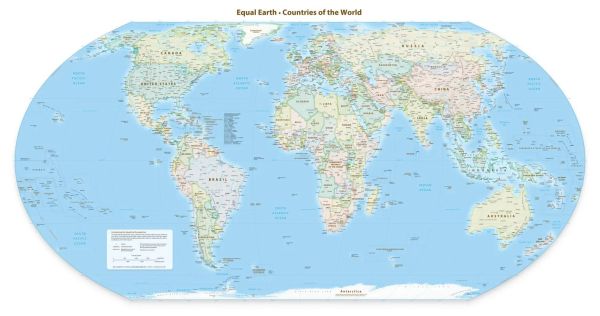 The Equal Earth map. Wikimedia Commons
— The 2018 Equal Earth design, which was developed by an international team of cartographers, also comes with its own limitations. But its supporters say it will help reverse perceptions of Africa and “decolonise” global curriculums, The Guardian reported.
— Gerardus Mercator (1512-94), a mathematician and engraver, created the map in 1569 to help sailors navigate their way around the globe. The map’s first version was a set of 18 sheets, which formed a wall-size mosaic 48 inches high by 80 inches wide (Rhumb Lines and Map Wars: A Social History of the Mercator Projection, Mark Monmonier, 2004).
— Mercator projected the Earth’s surface as if unwrapped from a cylinder around the globe. It had a grid pattern with longitudes (or meridians) and latitudes (or parallels) at 90-degree angles. The lines of longitude were evenly spaced, but the distance between the lines of latitude increased away from the equator, which was placed at the centre of the map. This allowed a straight line between any two points on the map to be the correct direction for sailors to follow using their compasses.
— The Mercator map revolutionised travel and became the standard world map for atlases and wall maps by the 19th century. “Wall-map publishers readily embraced the Mercator map’s rectangular format… [and] schoolbooks and classroom atlases also promoted the Mercator worldview,” wrote Monmonier.
Therefore, option (b) is the correct answer.
QUESTION 10
With reference to the Saptakoteshwar temple, consider the following statements:
1. The site of Saptakoteshwar temple is located on Goa’s Divar Island.
2. The site of the Saptakoteshwar temple existed during the Kadamba dynasty.
3. The temple was destroyed during the Bahmani rule, and it was subsequently rebuilt in the Vijayanagar kingdom.
Which one of the following conclusions based on the above statements is correct?
(a) All three statements are correct.
(b) There are two correct statements, that include statement 1.
(c) There is only one correct statement.
(d) There is no correct statement.
Why this question for UPSC Prelims 2027?
For Prelims, it is useful for testing knowledge of temple architecture, regional dynasties, historical sites, and the interaction of different political powers in medieval India. It also illustrates how archaeological discoveries can revive or strengthen historical narratives, making it a good current-affairs-to-static linkage.
Explanation
— Ancient relics dating between the 14th and 16th centuries, indicating the existence of an ancient temple complex and a corridor, have been found during restoration work at the old site of Saptakoteshwar temple in Goa’s Divar island, Chief Minister Pramod Sawant said.
— The archaeological discoveries include a ‘Kirtimukh’ motif, which is traditionally carved above temple doorways, and a carved capital of a temple pillar. “Relics and remains dating between the 14th and 16th centuries have been found along the old pathway between Koti Tirth and Madhavachi Talli, indicating the existence of an ancient temple complex and sacred corridor,” he wrote.
— According to historical records, the site of Saptakoteshwar temple at Naroa in Divar existed during the Kadamba dynasty (10th to 14th century). The rock cut tank of the temple was called ‘Koti-Tirth’. Hence, statements 1 and 2 are correct.
— The temple was destroyed during the Bahmani rule and it was subsequently rebuilt in 1391 by a minister in the Vijayanagar kingdom. The Portuguese destroyed the temple in the 16th century. The deity’s idol was shifted across the river to Bicholim, where Maratha warrior king Chhatrapati Shivaji Maharaj established a new temple in 1668. Hence, statement 3 is correct.
Therefore, option (a) is the correct answer.
Previous Weekly Quiz
UPSC Weekly Current Affairs Quiz (August 23 – August 29)
UPSC Weekly Current Affairs Quiz (August 16 – August 22)
UPSC Weekly Current Affairs Quiz (August 09 – August 15)
UPSC Weekly Current Affairs Quiz (August 02 – August 08)
UPSC Weekly Current Affairs Quiz (July 26 – August 01)
UPSC Weekly Current Affairs Quiz (July 19 – July 25)
UPSC Weekly Current Affairs Quiz (July 12 – July 18)
Subscribe to our UPSC newsletter and stay updated with the news cues from the past week.
Stay updated with the latest UPSC articles by joining our Telegram channel – IndianExpress UPSC Hub, and follow us on Instagram and X.

 Share


