
UPSC Weekly Current Affairs Quiz (September 13 – September 19): 10 key questions with detailed answers for Prelims 2027
Test your UPSC Prelims 2027 preparation with this weekly current affairs quiz, featuring key topics like Consumer Protection (E-Commerce) Rules, 2020, ‘OneTag’ service, Operation Polo, Cinematograph Rules, BRICS Payment Task Force, and more, with MCQs and detailed explanations.
 Test your UPSC Prelims 2027 preparation. Attempt a question on the amendments to the Consumer Protection (E-Commerce) Rules, 2020 in today's quiz. (AI-generated Image)
As UPSC CSE Prelims 2027 is still ahead, building a strong foundation alongside regular current affairs preparation is essential. UPSC Weekly Quiz is a current affairs–based quiz on relevant topics from the past week, curated for aspirants of competitive examinations. Attempt the weekly quiz every Saturday and review the detailed answers with explanations to strengthen conceptual clarity and exam readiness.
🚨As we mark the 3rd anniversary of the UPSC Essentials magazine, we thank our readers for being part of this journey. Your trust, feedback and continued support have shaped the magazine and encouraged us to keep improving with every edition. Click Here to read the UPSC Essentials magazine for September 2026. Share your views and suggestions in the comment box or write to us at manas.srivastava@indianexpress.com.🚨

QUESTION 1
Which of the following is/are the amendments to the Consumer Protection (E-Commerce) Rules, 2020?
1. Whenever a price reduction is announced, platforms must display both the reduced price and the prior price.
2. Prohibition of e-commerce entities from manipulating search results in a way that misleads users or adversely affects the relevance of results to their search query.
3. It is mandatory for the e-commerce entities to conduct a self-audit every year and prominently display a certificate of compliance.
Select the correct answer using the codes given below:
(a) 1 and 2 only
(b) 1 only
(c) 2 and 3 only
(d) 1, 2 and 3
Why this question for UPSC Prelims 2027?
The question tests awareness of recent changes in the Consumer Protection (E-Commerce) Rules, 2020 and regulation of online marketplaces. It is relevant for understanding the regulatory framework governing India’s rapidly expanding e-commerce sector.
Explanation
— The Department of Consumer Affairs has amended the Consumer Protection (E-Commerce) Rules, 2020 to strengthen “consumer protection while facilitating a transparent and balanced regulatory framework for the e-commerce sector”, according to a release by the Press Information Bureau (PIB). The new rules will come into force on January 1, 2027.
— The amended rules say that whenever a price reduction is announced, platforms must display both the reduced price and the “prior price”. The PIB release specifies that the prior price will mean the “lowest price at which the product or service was offered during the 30 days preceding the announcement.” Hence, statement 1 is correct.
— The amended rules prohibit e-commerce entities from manipulating search results in a way that misleads users or adversely affects the relevance of results to their search query. Hence, statement 2 is correct.
— In practical terms, consumers should be able to distinguish between a product appearing because it is a relevant search result and one appearing because a seller or brand has paid for its placement. The change addresses a familiar problem in online shopping: advertising that can look like an ordinary recommendation or search result.
— E-commerce entities will have to comply with the Guidelines for Prevention and Regulation of Dark Patterns, 2023, conduct a self-audit every year and prominently display a certificate of compliance. Hence, statement 3 is correct.
— Every e-commerce entity will have to provide a complainant with a copy of the complaint as recorded by its grievance officer. This is meant to give consumers a clearer record of what exactly they complained about and what the platform has formally recorded.
— Every e-commerce entity will have to become a partner in the convergence process of the National Consumer Helpline (NCH). The government says this will integrate online platforms more closely with the national consumer grievance-redressal mechanism.
— The rules say marketplace e-commerce entities cannot collect bundled fees for services unrelated to the e-commerce platform, except under the specified provision for loyalty or membership programmes.
— Marketplace e-commerce entities will not be allowed to use consumer information for specified purposes without the consumer’s “express and affirmative consent”, according to the PIB.
Therefore, option (d) is the correct answer.
QUESTION 2
Which of the following statements is/are not correct about Uranium?
1. Uranium found in nature consists largely of three isotopes — U-235, U-237 and U-238.
2. U-235 does not contribute directly to releasing energy in the form of heat.
3. Energy production in nuclear reactors comes from the fusion of U-238 atoms.
Select the correct answer using the codes given below:
(a) 2 only
(b) 3 only
(c) 1 and 2 only
(d) 1, 2 and 3
Why this question for UPSC Prelims 2027?
The question links nuclear energy with atomic structure, radioactivity and energy generation. It is relevant for UPSC Prelims through the intersection of Science and Technology and India’s nuclear-energy programme.
Explanation
— The law’s double standards are evident. It aims to squeeze Russia’s energy revenues over the Ukraine war, yet it carves out US imports of low-enriched uranium (LEU) from Russia, a material crucial to America’s nuclear power industry. The Bill spells it out: “…shall not apply with respect to imports into the United States of low-enriched uranium.”
— Uranium found in nature consists largely of two isotopes — U-235 and U-238. Natural uranium contains 0.7% of the U-235 isotope, while the remaining 99.3% is mostly the U-238 isotope, which does not contribute directly to the fission process. Hence, statements 1 and 2 are not correct.
— Energy production in nuclear reactors comes from the “fission”, or splitting, of U-235 atoms, which releases energy in the form of heat. Since natural uranium contains only 0.7% U-235, LWRs require uranium to be “enriched” — which means raising the concentration of U-235 relative to U-238 to sustain a fission chain reaction. Hence, statement 3 is not correct.
Therefore, option (d) is the correct answer.
QUESTION 3
Which of the following countries/organisations is/are an associate member of the European Union (EU)?
1. Canada
2. Brazil
3. New Zealand
4. BRICS
5. ASEAN
Select the correct answer using the codes given below:
(a) 1 and 2 only
(b) 1, 3, and 5 only
(c) 2, 4 and 5 only
(d) None of the above
Why this question for UPSC Prelims 2027?
The question tests understanding of the European Union’s membership structure and external partnerships. It helps distinguish between EU membership, partnership arrangements and other forms of association.
Explanation
— On Wednesday (September 16), European Commission president Ursula von der Leyen told Canadian Prime Minister Mark Carney that she was open to Canada becoming the EU’s first “associate member”. This came after Carney, on Sunday, said Canada was seeking a “unique alliance” with the European grouping. Any final decision, however, rests with EU member states. On Thursday, Carney said he welcomes the EU’s ambition for his country to become an “associate member”.
— The EU is not just an economic but also a political grouping of 27 countries that have ceded sovereignty in certain issues to remain part of it. Nine others are official candidates for a full membership of the bloc — a process that normally takes years.
— Two things complicate Canada’s case: First, it’s obviously not in Europe; and second, the term “associate member” does not exist within the EU as of now.
— And getting all member states to agree on anything has been historically difficult. In fact, EU members have already pushed back against a proposal for “associate member” status for Ukraine floated by German Chancellor Friedrich Merz earlier this year.
Therefore, option (d) is the correct answer.
QUESTION 4
With reference to the Black carbon, consider the following statements:
1. It is a component of fine particulate air pollution (PM 2.5).
2. Black carbon can last for decades in the atmosphere.
3. It warms the atmosphere because it is very effective at absorbing light.
4. In South Asia, the majority of black carbon is produced from vehicles plying on the road.
How many of the statements given above are correct?
(a) Only one
(b) Only two
(c) Only three
(d) All four
Why this question for UPSC Prelims 2027?
The question tests understanding of black carbon as a short-lived climate pollutant and its role in air pollution and climate change. It is relevant for understanding air-pollution sources and climate impacts in South Asia, a recurring UPSC theme.
Explanation
— The report, ‘A resilient Himalaya: protecting a region at risk and securing future prosperity’, was compiled by the global consultancy Systemiq, in partnership with Integrated Mountain Initiative, and supported by the International Centre for Integrated Mountain Development (ICIMOD), Nepal, and GB Pant National Institute of Himalayan Environment, Uttarakhand.
— The report identifies black carbon — soot produced by incomplete combustion — as a polluter that is causing damage and which India can control faster.
— “Recent modelling attributes about one-third of glacier mass loss in the Himalayas to South Asian black carbon. Industry, primarily brick kilns, contributes 32-42% of South Asian anthropogenic deposition across the region. Cutting kiln emissions therefore tackles local air pollution and glacier melt through the same plume,” the report states. Hence, statement 4 is not correct.
— Black carbon, sometimes known as soot, is a component of fine particulate air pollution (PM2.5). It is created from incomplete combustion of wood, trash, and fossil fuels, which also produces carbon dioxide (CO2), carbon monoxide, and volatile organic compounds. Hence, statement 1 is correct.
— Because of its high light absorption capacity, black carbon heats the atmosphere. It accelerates warming of the air and surfaces in the areas where it is concentrated, causing changes in weather patterns and ecosystem cycles. Hence, statement 3 is correct.
— Black carbon remains in the atmosphere for only a few days or weeks, but it has a large direct and indirect impact on the climate, snow and ice, agriculture, and human health. Hence, statement 2 is not correct.
Therefore, option (b) is the correct answer.
QUESTION 5
With reference to the Himalayan Monal, consider the following statements:
1. It is the state bird of Uttarakhand.
2. It is a ground-dwelling bird.
3. The Himalayan Monal is exclusively herbivorous.
4. The Himalayan Monal is listed as Vulnerable on the IUCN Red List.
How many of the statements given above are correct?
(a) Only one
(b) Only two
(c) Only three
(d) All four
Why this question for UPSC Prelims 2027?
The question links species-based current affairs with biodiversity conservation and IUCN status. It is relevant for understanding Himalayan fauna, protected species and Indian biodiversity, recurring themes in UPSC Prelims.
Explanation
— The Himalayan monal, the state bird of Uttarakhand, is a striking landfowl found across the Himalayan mountains, including in Jammu and Kashmir, Himachal Pradesh, Uttarakhand and Sikkim. While the ground-dwelling bird is not endangered, two studies carried out by researchers at Hemvathi Bahuguna Garhwal University (HBGU) have flagged key threats to it. Hence, statement 1 is correct.
— For the noise study, the researchers compared two areas within the Kedarnath Musk Deer Sanctuary — the Madmaheshwar Valley, which has relatively little human activity, and Chopta Valley, which has roads, tourists, pilgrims and other visitors. They recorded hundreds of monal calls and compared them. The striking finding was that monals in the noisier area used higher-frequency calls.
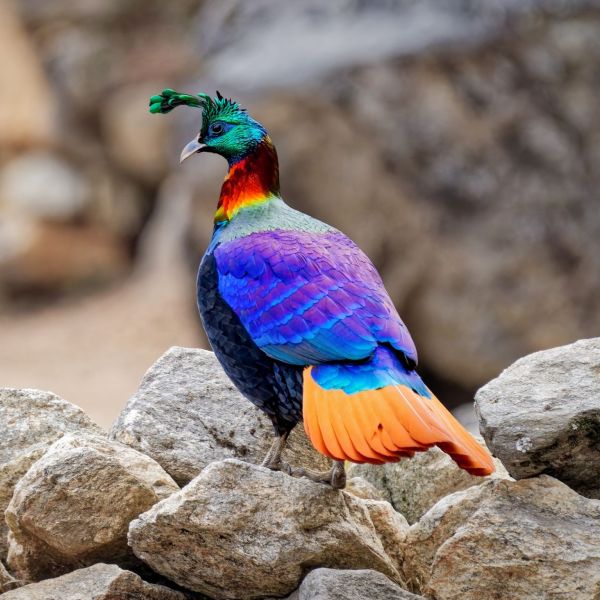 The bird is found across the Himalayan mountains. (Wikimedia Commons)
— For the monal, calls are important for communication, including reproduction and social behaviour. The researchers worry that increasing human noise could make such communication more difficult.
— The Himalayan Monal is a ground-dwelling bird, often seen digging through leaf litter or soft soil with its powerful beak in search of roots, tubers, seeds, insects, and grubs. Hence, statement 2 is correct and statement 3 is not correct.
— The Himalayan Monal is listed as Least Concerned on the IUCN Red List. Hence, statement 4 is not correct.
Therefore, option (b) is the correct answer.
QUESTION 6
With reference to the BRICS Payment Task Force (BPTF), consider the following statements:
1. It is a collaborative grouping of central bank experts from BRICS nations.
2. The BPTF aims to make cross-border payments among BRICS countries faster and cheaper.
Which of the statements given above is/are correct?
(a) 1 only
(b) 2 only
(c) Both 1 and 2
(d) Neither 1 nor 2
Why this question for UPSC Prelims 2027?
The question links current affairs with international financial cooperation, digital payments and payment-system interoperability. It is relevant for understanding BRICS initiatives and evolving global financial architecture, an important area of UPSC Prelims.
Explanation
— The BRICS grouping adopted the New Delhi Declaration, laying out common positions on issues ranging from trade and terrorism to artificial intelligence and institutional reform.
— While speculation about a unified BRICS currency has been rife for years, the declaration steered clear of the subject.
— Instead, BRICS continued to focus on a more incremental goal: making it easier for members to promote trade settlements and investments in their own currencies to achieve faster, cheaper and safer cross-border payments. The declaration acknowledged discussions on promoting the use of BRICS local currencies while respecting national priorities and recognising that there is “no one-size-fits-all approach”.
— The declaration says that the BRICS Payment Task Force, a collaborative grouping of central bank experts from BRICS nations, has been studying how their payment and messaging systems could work more easily with one another. The stated aim is to make cross-border payments among BRICS countries faster, cheaper, more accessible and safer. Hence, statements 1 and 2 are correct.
— The declaration encouraged the New Development Bank to further expand local-currency financing, diversify its funding sources and mobilise resources for development and infrastructure projects.
Therefore, option (c) is the correct answer.
QUESTION 7
With reference to the Geneva Conventions, consider the following statements:
1. The Geneva Conventions are primarily applicable in cases involving international armed conflict.
2. The Geneva Conventions were signed in the aftermath of the Second World War.
3. The conventions include the Protection of Civilian Persons in Time of War, but do not include the Treatment of Prisoners of War.
Which of the statements given above are correct?
(a) 1 and 2 only
(b) 2 and 3 only
(c) 1 and 3 only
(d) 1, 2 and 3
Why this question for UPSC Prelims 2027?
The question tests understanding of the Geneva Conventions and their role in international humanitarian law. It is relevant to international relations, humanitarian law and contemporary armed conflicts, which have significant UPSC relevance.
Explanation
— In its report, the UN mission said it examined whether actions during the war “violated IHL (International Humanitarian Law) pursuant to the 1949 Geneva Conventions and customary international law.”
— The Geneva Conventions are primarily applicable in cases involving international armed conflict. They also state that the Red Cross can offer its services during conflicts. Hence, statement 1 is correct.
— The Geneva Convention of 1949 was signed in the aftermath of the Second World War (1939-45) and has been ratified by 196 countries. It includes four separate conventions, such as those on the Treatment of Prisoners of War, and the Protection of Civilian Persons in Time of War. Hence, statement 2 is correct and statement 3 is not correct.
Therefore, option (a) is the correct answer.
QUESTION 8
Recently, the National Highways Authority of India (NHAI) has made the ‘OneTag’ service operational. The ‘OneTag’ service:
(a) allows highway users to use a single FASTag for multiple vehicles registered in their name.
(b) allows highway users to link multiple FASTags issued by different banks to a single vehicle.
(c) allows highway users to change their issuer bank without replacing the FASTag sticker on their vehicle.
(d) allows highway users to transfer the balance of an existing FASTag to a new vehicle without closing the FASTag account.
Why this question for UPSC Prelims 2027?
The question tests awareness of recent NHAI initiatives and FASTag-based electronic toll collection and also links current affairs with digital infrastructure, transport technology and ease of doing business.
Explanation
— The National Highways Authority of India (NHAI) has made ‘OneTag’, a FASTag portability service, operational on the Rajmargyatra app. The new service allows highway users to change their issuer bank without replacing the FASTag sticker on their vehicle.
— Users earlier had to purchase a new FASTag to change their issuer bank and remove the existing tag from their vehicle. The new system will work along the lines of mobile number portability, where users need not change their SIM card to switch to another telecom service provider.
— Highway users who want to change the bank linked to their FASTag have to first log in to the Rajmargyatra app and check their eligibility by entering their registration number. The user will then receive a six-digit mobile verification code from the current issuer bank.
— After this, the user must select a new issuer, complete customer verification and wallet onboarding with the new issuer to complete the portability process. Upon successful portability, the FASTag ID linked to the vehicle registration number will remain unchanged. The user can continue with the existing tag and use the new bank account to pay at toll plazas.
— According to NHAI, a user can port to a new bank only after six months. “After portability is completed, previous issuer will close the existing FASTag wallet and refund the available balance, post applicable adjustments. Also, interoperable FASTag has a cooling period of 6 months before it can be ported again,” said the NHAI in a statement.
Therefore, option (c) is the correct answer.
QUESTION 9
The ‘Operation Polo’ is associated with:
(a) The integration of Junagadh into the Indian Union
(b) The accession of Hyderabad to the Indian Union
(c) The merger of Travancore with the Indian Union
(d) The integration of Goa into the Indian Union
Why this question for UPSC Prelims 2027?
The question tests knowledge of post-Independence political integration and the integration of princely states into the Indian Union. It is relevant for understanding post-Independence consolidation of India, a key theme under UPSC History.
Explanation
— September 17 marks the anniversary of the accession of Hyderabad to independent India. This day in 1948 brought to a close a year-long saga that threatened to make the rich Deccan province a “cancer in the belly of India”, in the words of Sardar Vallabhbhai Patel.
— Founded in 1713, Hyderabad in 1947 was a very large province, comprising present-day Telangana and parts of Karnataka and Maharashtra. Its ruler, Mir Usman Ali or Nizam Asaf Jah VII, was then among the richest men on the planet.
— Sardar Patel moved patiently with Hyderabad. In November 1947, India and Hyderabad signed a stand-still agreement, which meant ties between India and the state would continue as they had under the British. Meanwhile, negotiations continued.
— Eventually, on September 13, 1948, the Indian Army was sent to Hyderabad under Operation Polo. In three days, the Nizam’s forces surrendered. On the night of September 17, the Nizam made a public address on the radio, banning the razakars. Six days later, he made another address, in which Guha quotes him as saying that Razvi and his men had taken “possession of the state through Hitlerite methods while he had been “anxious to come to an honourable settlement with India”.
— For India, the accession of Hyderabad was not just a huge problem solved, but also a triumph of the secularism the Indian state stood for. Indian Muslims had backed the government fully, and the picture Jinnah had painted had not even come close to materialising. Sardar Patel shared this view.
Therefore, option (b) is the correct answer.
QUESTION 10
Which of the following are the new categories for marking content suitable for children under the Cinematograph Rules?
1. UA 7+
2. UA 10+
3. UA 13+
4. UA 16+
Select the correct answer using the codes given below:
(a) 1 and 2 only
(b) 2 and 3 only
(c) 1, 3 and 4
(d) 2, 3 and 4
Why this question for UPSC Prelims 2027?
The question tests awareness of recent changes in India’s film certification framework and the Cinematograph Rules. It links current affairs with the role and functioning of the Central Board of Film Certification (CBFC).
Explanation
— The Ministry of Information and Broadcasting (I&B) has notified new film certification guidelines for the Central Board of Film Certification (CBFC) earlier this week. These revised guidelines retain all the aspects of its detailed 1991 version, save for the addition of two new points.
— One calls for a disclaimer or statutory warning in scenes depicting or involving the use, consumption or trafficking of narcotic drugs or other psychotropic substances. These scenes must now carry the warning ‘Illicit Narcotics Destroy Health and Guarantees Imprisonment, Say No to Drugs.’
— The other point pertains to the specification of new-age markers in line with the three new categories under the UA (Unrestricted Public Exhibition With Parental Guidance) certification, as notified in the Cinematograph Rules, 2024
— The latest guidelines state that if the Board thinks that it is necessary to caution the parents or the child’s guardian to consider as to whether their wards may be allowed to see such a film, the same shall be certified for unrestricted public exhibition with an endorsement to that effect.
— The three categories are UA 7+, UA 13+, and UA 16+ — to mark content suitable for children in the age group of seven, 13 and 16, respectively.
Therefore, option (c) is the correct answer.
Previous Weekly Quiz
UPSC Weekly Current Affairs Quiz (September 06 – September 12)
UPSC Weekly Current Affairs Quiz (August 30 – September 05)
UPSC Weekly Current Affairs Quiz (August 23 – August 29)
UPSC Weekly Current Affairs Quiz (August 16 – August 22)
UPSC Weekly Current Affairs Quiz (August 09 – August 15)
UPSC Weekly Current Affairs Quiz (August 02 – August 08)
Subscribe to our UPSC newsletter and stay updated with the news cues from the past week.
Stay updated with the latest UPSC articles by joining our Telegram channel – IndianExpress UPSC Hub, and follow us on Instagram and X.

 Share


